


Environmental background of the Xishantou microlithic site in Heilongjiang
Received date: 2024-05-07
Accepted date: 2024-07-05
Online published: 2025-08-07
Northeast China is of great importance in the development and diffusion of microblade technology. Reconstructing the vegetation ecology of Northeast China during the emergence of microblade technology is crucial for understanding the origins of microblade technology and ancient human beings’ adaptations to the environment.
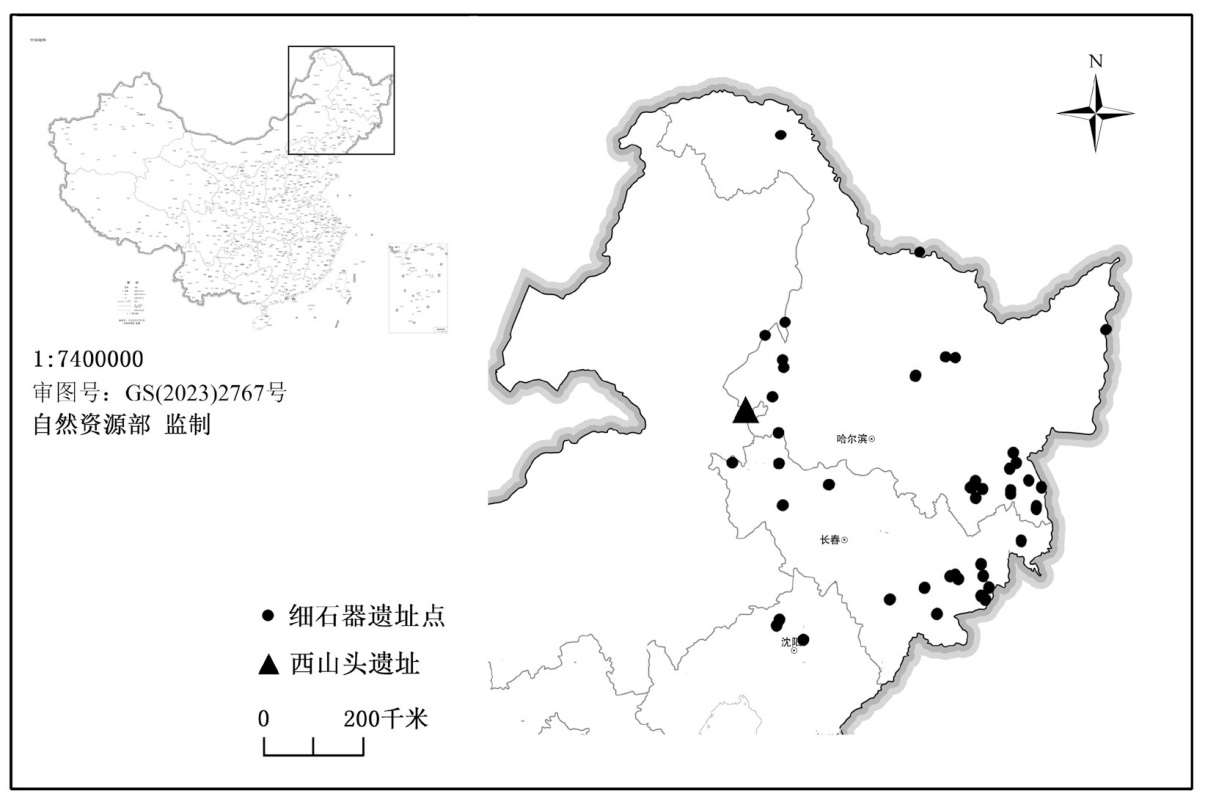
This study focuses on the sedimentary profile of the Xishantou site. The site is located in Xishantou Village, Xingshan Township, Longjiang County, Heilongjiang Province, on the secondary terrace of the left bank of Chaor River. Excavations at the site uncovered fire-using features, lithic products and animal fossils. The lithics are located below a loess-type subclay layer and above a yellow fine silt and gravel layer in the Songnen Plain, and its stratigraphy belongs to Guxiangtun Formation of the Late Pleistocene in northeastern China. The main types of lithics are cores, blades and implements. The dense distribution of lithics with a certain spatial regularity in the excavated area suggests that this may have been a lithic workshop site.
AMS 14C results show that the major cultural layers of microblade technology at the Xishantou site are dated to around 27.8 kaBP cal, which corresponds to the GI-3 interglacial section of the late Marine Oxygen Isotope Stage 3 (MIS 3). By using the pollen analysis method, an attempt is made to reconstruct vegetation types from the late MIS 3 through the early Last Glacial Maximum (LGM) at the site. A total of 24 samples were collected for pollen analysis from the Xishantou site profile, and 31 pollen types were identified, with an overwhelming majority of herb pollen.
The vegetation and climatic characteristics of the cultural layer where the microblade technology emerged are also analyzed in combination with climate proxies and principal component analysis. The pollen analysis results show that the ancient human living environment was mainly the meadow-steppe type dominated by Poaceae and Asteraceae, with a relatively temperate and moist climate. Pollen results from the overlying loess-type subclay of the cultural layer show that the climate gradually shifted to a relatively cooler and drier climate and the vegetation changed to a typical steppe dominated by Artemisia and Asteraceae, indicating that this stage may have entered the LGM. Changes in the abundance of fungal spores indicate the presence of herbivorous mammals around the site.
These findings offer valuable scientific insights into the environmental context of ancient human existence during the emergence of microblade technology, shedding light on the ecological mechanisms behind the transition from blade technology to microblade technology.
BAI Guangyi , ZHAO Keliang , LI Youqian , LIU Wei , YANG Shixia , WANG Jian , LI Xiaoqiang . Environmental background of the Xishantou microlithic site in Heilongjiang[J]. Acta Anthropologica Sinica, 2025 , 44(04) : 606 -617 . DOI: 10.16359/j.1000-3193/AAS.2025.0004
| [1] | 贾兰坡, 盖培, 尤玉桂. 山西峙峪旧石器时代遗址发掘报告[J]. 考古学报, 1972, 1: 39-58+135-136 |
| [2] | 陈胜前. 细石叶工艺的起源:一个理论与生态的视角[J]. 考古学研究, 2008, 244-264 |
| [3] | Zhang M. Rethinking microblade technology research in northeastern Asia[J]. Journal of Paleolithic Archaeology, 2021, 4(3): 17 |
| [4] | 仪明洁. 细石器研究中几个关键概念的厘定[J]. 考古与文物, 2014, 5: 37-41 |
| [5] | 李锋. “殊途同归”:关于细石叶类遗存的探讨[J]. 史前考古, 2024, 1(1): 53-67 |
| [6] | 陈胜前, 叶灿阳. 细石叶工艺起源研究的理论反思[J]. 人类学学报, 2019, 38(4): 547-562 |
| [7] | 王幼平. 华北细石器技术的出现与发展[J]. 人类学学报, 2018, 37(4): 565-576 |
| [8] | 朱之勇. 华北地区细石叶组合演变与生态适应研究[J]. 考古学报, 2023, 4: 435-458 |
| [9] | Kuzmin YV, Orlova LA. Radiocarbon chronology of the Siberian Paleolithic[J]. Journal of world Prehistory, 1998, 12: 1-53 |
| [10] | Goebel T. The “microblade adaptation” and recolonization of Siberia during the Late Upper Pleistocene[J]. Archeological Papers of the American Anthropological Association, 2002, 12(1): 117-131 |
| [11] | Song YH, Cohen DJ, Shi JM, et al. Environmental reconstruction and dating of Shizitan 29, Shanxi Province: An early microblade site in north China[J]. Journal of Archaeological Science, 2017, 79: 19-35 |
| [12] | 宋艳花, 石金鸣. 山西吉县柿子滩遗址S29地点发掘简报[J]. 考古, 2017, 2: 35-51+2 |
| [13] | Zhang JF, Wang XQ, Qiu WL, et al. The paleolithic site of Longwangchan in the middle Yellow River, China: chronology, paleoenvironment and implications[J]. Journal of Archaeological Science, 2011, 38(7): 1537-1550 |
| [14] | 胡松梅, 杨苗苗, 王小庆, 等. 陕西宜川龙王辿旧石器遗址动物化石研究[J]. 华夏考古, 2017, 4: 36-47 |
| [15] | 王幼平, 汪松枝. MIS 3阶段嵩山东麓旧石器发现与问题[J]. 人类学学报, 2014, 33(3): 304-314 |
| [16] | 李泽涛, 李冰, 李月丛, 等. 泥河湾盆地油房剖面旧石器时代中期到晚期文化过渡的环境背景[J]. 第四纪研究, 2017, 37(3): 463-473 |
| [17] | Guan Y, Wang XM, Wang FG, et al. Microblade remains from the Xishahe site, North China and their implications for the origin of microblade technology in Northeast Asia[J]. Quaternary International, 2020, 535: 38-47 |
| [18] | 关莹, 李有骞, 邢松, 等. 黑龙江省甘南县旧石器地点发现的新材料[J]. 人类学学报, 2021, 40(2): 281-291 |
| [19] | 赵超. 中国东北北部地区30ka以来植被演替及其气候环境响应[D]. 博士研究生毕业论文, 北京: 中国科学院大学, 2015 |
| [20] | 刘孝艳, 詹涛, 刘恋, 等. 黑龙江五大连池火山口湖沉积物有机残体粒度记录的早全新世千百年尺度夏季风降水演化[J]. 地质学报, 2017, 91(12): 2854-2866 |
| [21] | 汪佩芳, 夏玉梅. 松嫩平原晚更新世以来古植被演替的初步研究[J]. 植物研究, 1988, 1: 87-96 |
| [22] | Mingram J, Stebich M, Schettler G, et al. Millennial-scale East Asian monsoon variability of the last glacial deduced from annually laminated sediments from Lake Sihailongwan, NE China[J]. Quaternary Science Reviews, 2018, 201: 57-76 |
| [23] | 夏玉梅, 汪佩芳. 松嫩平原晚第三纪—更新世孢粉组合及古植被与古气候的研究[J]. 地理学报, 1987, 2: 165-178 |
| [24] | 刘玉英, 张淑芹, 刘嘉麒, 等. 东北二龙湾玛珥湖晚更新世晚期植被与环境变化的孢粉记录[J]. 微体古生物学报, 2008, 3: 274-280 |
| [25] | 李小强. 赵超. 周新郢. 末次盛冰期以来中国东北地区特征时期植被格局[J]. 中国科学(D辑):地球科学, 2019, 49(8): 1213-1230 |
| [26] | Yue JP, Yang SX, Li YQ, et al. Human adaptations during MIS 2: Evidence from microblade industries of Northeast China[J]. Palaeogeography, Palaeoclimatology, Palaeoecology, 2021, 567: 110286 |
| [27] | 李有骞. 嫩江流域细石器遗存的年代框架与发展序列[J]. 考古与文物, 2021, 5: 61-70 |
| [28] | 刘伟, 李有骞, 杨石霞. 黑龙江龙江县西山头旧石器时代遗址试掘简报[J]. 考古, 2019, 11: 3-13 |
| [29] | 李小强, 尚雪, 周新郢, 等. 黄土花粉分析的筛析:重液综合法[J]. 干旱区地理, 2006, 663-667 |
| [30] | 唐领余, 毛礼米, 舒军武, 等. 中国第四纪孢粉图鉴[M]. 北京: 科学出版社, 2016 |
| [31] | 王伏雄, 钱南芬, 张玉龙, 等. 中国植物花粉形态(第二版)[M]. 北京: 科学出版社, 1995 |
| [32] | Wei HC, Duan RL, Xu QH, et al. Fungal spore indicators of vegetation and highland pastoralism in modern topsoil and dung, eastern Tibetan Plateau[J]. Catena, 2021, 202: 105231 |
| [33] | 李小强, 周新郢, 尚雪, 等. 黄土炭屑分级统计方法及其在火演化研究中的意义[J]. 湖泊科学, 2006, 5: 540-544 |
| [34] | Zhao Y, Liu HY, Li FR, et al. Application and limitations of the Artemisia/Chenopodiaceae pollen ratio in arid and semi-arid China[J]. The Holocene, 2012, 22(12): 1385-1392 |
| [35] | 崔巧玉, 赵艳, 秦锋, 等. 中国东北表土花粉组合特征及其在古气候重建中的意义[J]. 中国科学(D辑):地球科学, 2020, 50(1): 134-148 |
| [36] | Ejarque A, Miras Y, Riera S. Pollen and non-pollen palynomorph indicators of vegetation and highland grazing activities obtained from modern surface and dung datasets in the eastern Pyrenees[J]. Review of Palaeobotany and Palynology, 2011, 167(1-2): 123-139 |
| [37] | 宋扬, 郝青振, 葛俊逸, 等. 黄土高原表土磁化率与气候要素的定量关系研究[J]. 第四纪研究, 2012, 32(4): 679-689 |
| [38] | 杨青, 李小强, 周新郢. 末次盛冰期以来沙漠-黄土过渡带植被演替及其对气候变化的响应[J]. 人类学学报, 2016, 35(3): 469-481 |
| [39] | Ter Braak CJ, Verdonschot PF. Canonical correspondence analysis and related multivariate methods in aquatic ecology[J]. Aquatic sciences, 1995, 57: 255-289 |
| [40] | 孙湘君, 王琫瑜, 宋长青. 中国北方部分科属花粉-气候响应面分析[J]. 中国科学(D辑):地球科学, 1996, 5: 431-436 |
| [41] | 中国科学院中国植物志编辑委员会. 中国植物志·第76卷第2册菊科[M]. 北京: 科学出版社, 1990 |
| [42] | Rasmussen SO, Bigler M, Blockley SP, et al. A stratigraphic framework for abrupt climatic changes during the Last Glacial period based on three synchronized Greenland ice-core records: refining and extending the INTIMATE event stratigraphy[J]. Quaternary science reviews, 2014, 106: 14-28 |
| [43] | Dansgaard W, Johnsen SJ, Clausen HB, et al. Evidence for general instability of past climate from a 250-kyr ice-core record[J]. Nature, 1993, 364(6434): 218-220 |
| [44] | 周以良. 中国东北植被地理[M]. 北京: 科学出版社, 1997 |
| [45] | Tian F, Wang Y, Chi ZQ, et al. Late Quaternary vegetation and climate reconstruction based on pollen data from southeastern Inner Mongolia, China[J]. Review of Palaeobotany and Palynology, 2017, 242: 33-42 |
/
| 〈 |
|
〉 |