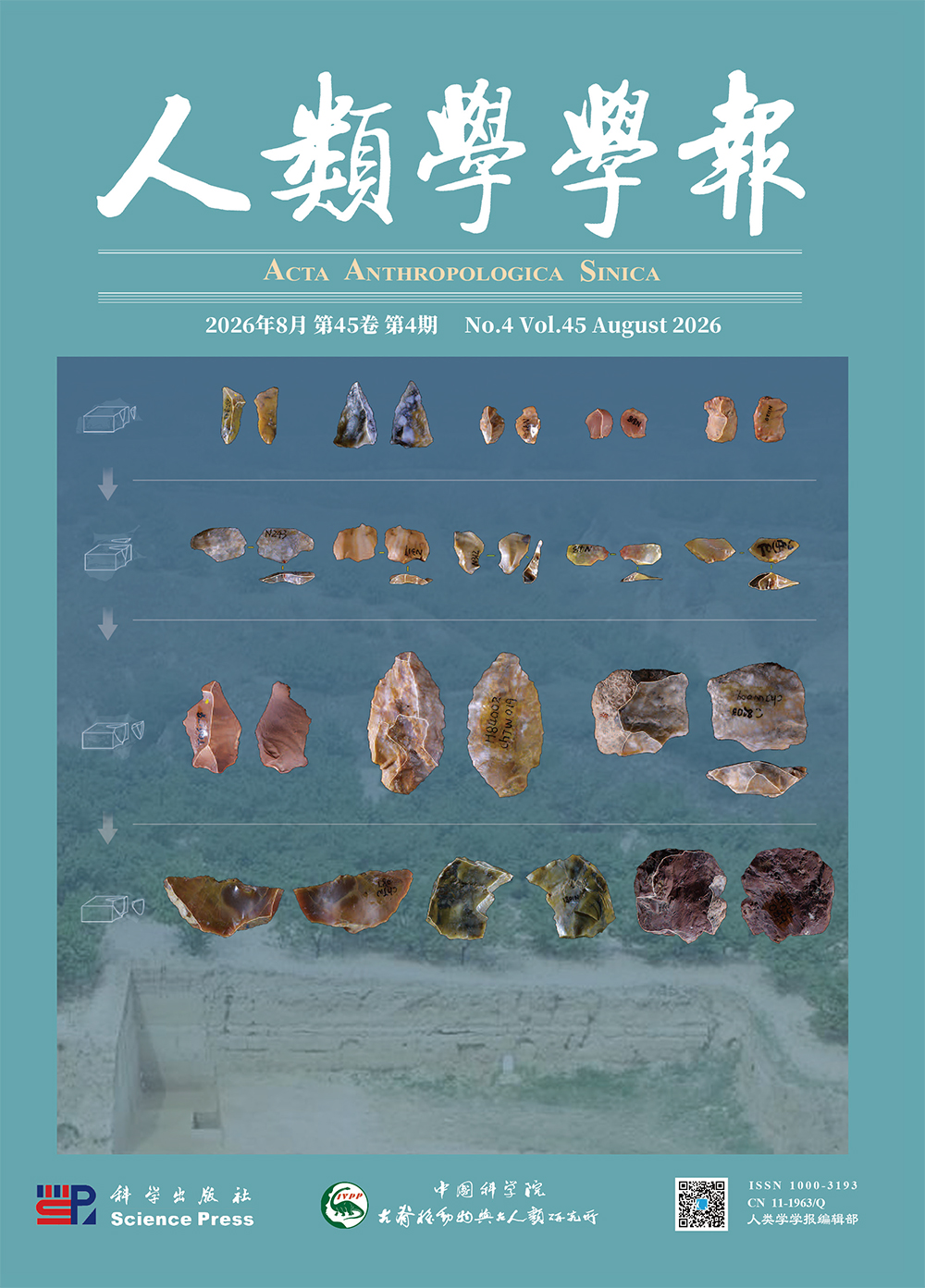
In recent years, new archaeological discoveries in Southwest China have gradually revealed the adaptability of ancient humans to diverse environments and their cultural complexity during the Middle and Late Pleistocene in East Asia. In particular, the newly discovered Quina-type lithic artefacts in northwestern Yunnan Province have provided new evidence for understanding the cultural connotations of the Middle Palaeolithic in East Asia. Among them, the technological features of Quina-type scrapers with unidirectional multi-tiered retouch are particularly striking. On the other hand, it is noteworthy that some cobble tools bearing characteristics of the Hoabinhian technocomplex previously reported in southwestern Yunnan, as well as those steep-edged cobble tools found in the Lingnan region (i.e., south to the Five-Ranges) and Mainland Southeast Asia, also exhibited multi-tiered stepped flake scars on a nearly vertical flaking surface. Despite their very different morphologies and their production concepts, the two types of products share a technological strategy of unidirectional multi-tiered retouch on the margin(s) of a blank, resulting in steep-edged lithic artefacts. Therefore, this article aims to review the archaeological finds of steep-edged lithic artefacts from Southwest China and the Lingnan region, and try to explore the development of both types of steep-edged lithic artefacts in this vast area, the adaptation of ancient hominins to diverse environments, and possible cultural diffusion among them.
This article focuses on two types of steep-edged lithic artefacts. The first type is on thick flake blanks. Taking the ventral surface of a thick flake as a striking platform, after continuous unidirectional flaking on the margin(s), multi-tiered retouch would normally be seen on the dorsal surface with edge angle(s) gradually increasing. Those flake scars usually end in the shape of a step or a hinge, wherein earlier flake scars tend to be large and wide while later ones tend to be small and short. Recently in western and eastern Yunnan Province, there found some Quina-like scrapers and semilunar-shaped stone tools respectively, bearing features of multi-tiered retouch scars and nearly steep edge angles. They are representatives for the first type of steep-edged lithic artefacts. Such type of scrapers is currently only found in Southwest China. For example, the Longtan open-air site and Tianhuadong cave site in Heqing, northwestern Yunnan, around 60-50 ka BP, are thought to have yielded lithic artefacts of the Quina system, wherein scrapers clearly show the technological features of unidirectional multi-tiered retouch. The Dahe cave site in Fuyuan, eastern Yunnan, around 50~30 ka BP, also found multi-tiered stepped flake scars on dorsal surface of thick flake blanks.
The second type is on shaping cobbles. Taking a relatively flat surface of a cobble as a striking platform, after continuous unidirectional flaking on one side or around the periphery of a cobble, multi-tiered retouch would also be seen on a vertical flaking surface with nearly steep edge angle(s). Similarly, those flake scars end in the shape of a step. The end choppers and side choppers found in the limestone cave sites in the Lingnan region from the 1950s to 1960s are representatives for the second type of steep-edged lithic artefacts. Such type of steep-edged cobble tools is widely distributed in a vast area covering Southwest China, the Lingnan region, as well as Mainland Southeast Asia.
In fact, some researchers used to collect chopping tools with steep edge angles from river terraces in the western Hunan mountainous areas, wherein deposits are presumed to be around the late Middle Pleistocene-early Late Pleistocene. In the western part of the Yunnan-Guizhou Plateau, some core-axes were found in the Xiaodong rockshelter site in Cangyuan, exhibiting quite steep edge angles after shaping around the entire margin of a cobble, claimed to be as early as 43.5 cal ka BP. Thereafter steep-edged cobble tools became quite popular in Southwest China until Terminal Pleistocene, such as the Laohudong (Tiger Cave) site in Baoshan and the Maomaodong (Kitty Cave) site in Xingyi, Guizhou. While in the Lingnan region and Mainland Southeast Asia, steep-edged cobble tools seemed to occur during the MIS 2, such as the Qingtang and Niulandong cave sites in Yingde, Guangdong Province; Bailiandong and Fengyan cave sites in Liuzhou, Guangxi; the Dieu rockshelter site in northern Vietnam, and even reaching far east to the Taiwan Island. Till the Early Holocene, they were more widely distributed, involving the Hainan Island and western Thailand. It could be assumed that steep-edged cobble tools were widely distributed from southern China to Mainland Southeast Asia during the late Late Pleistocene, and that the preference for multi-tiered retouch on shaping cobbles may have gradually spread from north to south, and eastwards to the Taiwan Island.
The two types of steep-edged lithic artefacts differ greatly in both production concept and morphology, but the late Late Pleistocene lithic industries in the Southwest China-Lingnan region seem to share a technological preference for invasive multi-tiered retouch on lithic blanks. So far, it is difficult to associate all those lithic industries with certain populations, despite fossil and genetic evidence suggesting that a variety of population groups should have inhabited in this vast area during the late Middle Pleistocene-Late Pleistocene. This vast area covers a wide range of topographic and climatic environment, and the interrelationships with lithic industries or population groups remain to be explored.
It has been suggested that the European Quina system was a technological strategy developed by Neanderthals in response to specific environmental circumstances or economic needs. If the variability of Quina lithic industries in the Europe-Near East region is a manifestation of the adaptability of Neanderthals in responding flexibly to their surrounding environment, then the existence of regional variations in similar technological lithic assemblages is equally understandable in China. Prehistoric archaeologists have also pointed out that modern humans in different regions have creatively exploited diverse resources in their regions as their cognitive abilities improved and they adapted to new environments, thus demonstrating their unique behaviours and cultural modernity to varying degrees.
Regardless of complex relationships among ancient hominin populations, the late Late Pleistocene lithic industries from Southwest China to the Lingnan region produced different types but relatively standardised forms of stone tools based on different kinds of raw materials, resources, and tasks. Such technological practices reflect a high level of creativity in the adaptation of ancient humans to different environments and their subsistence strategies during the Middle-Late Pleistocene in southern China. The technological preference for multi-tiered retouch on different types of blanks may be related to the adaptation of Middle-Late Pleistocene hominins to different environments and the exploitation strategy of diversified resources in southern China.