


Craniofacial reconstruction and morphological characteristics of Hualongdong No.6 hominid skull
Received date: 2025-02-10
Revised date: 2025-04-14
Online published: 2025-10-13
The Hualongdong (HLD) site is situated in Wangcun Village, Yaodu Town, Dongzhi County, Anhui Province, China, on the southern slope of Meiyuan Hill. The site is characterized by a collapsed cave comprising carbonate-cemented cavern breccia, unconsolidated clay and gravel. It was discovered in late 1988. Following several excavation campaigns between 2006 and 2024, approximately 20 human individuals, more than 400 artificial stone tools, numerous bone fragments with signs of manual cutting and chopping, and over 80 species of animal fossils have been uncovered. These findings date back to between 331,000 and 275,000 years ago.
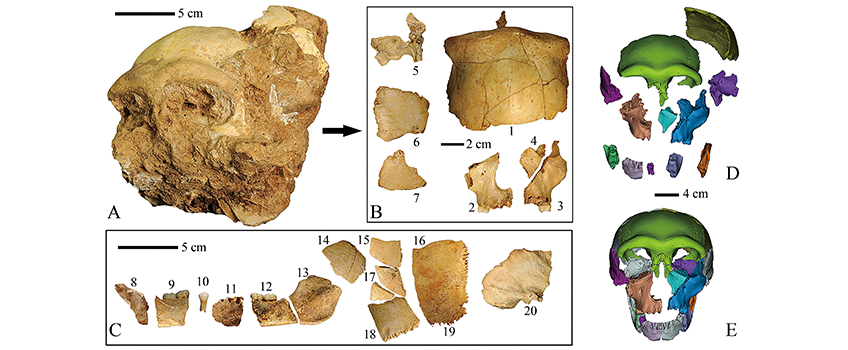
In this paper, we carried out facial restoration on the HLD No.6 skull fossil unearthed at this site. The HLD 6 hominid skull was found in 2015. When unearthed, the skull was broken into 20 fragments of different sizes, among which 7 were wrapped in a large cementing material, and the other 13 dispersed around the large cementing material. According to the bone thickness, bone sutures, cross-sections, the middle cerebral artery and the occlusal state of the teeth, a three-dimensional model of the HLD skull was 3D virtual restored. After reconstruction, it preserves almost entire face, most of the mandibular and a largely cranium.
To show the pre-life appearance of HLD hominid, according to the relationship between facial bones and soft tissues, a manual method was adopted to reconstruct the outer surface of the skull with muscle, skin, and facial features using plasticized materials (silly putty and plaster) on the 3D virtual reconstruction of the 3D printed skull model. After craniofacial reconstruction, the HLD hominid showed more modern human features with a flat glabella, a backward forehead, a flat face, and the appearance of a chin, however, it still retained some archaic features such as a developed brow ridge, a low cranial height. The HLD human fossils exhibit a mix of physical characteristics transitional between Homo erectus and modern humans. The cranium displays more primitive traits, the facial structure resembles that of modern humans, and the mandible shows early signs of modern human chin. Compared with the "pre-Homo sapiens" Jebel Irhoud found in Morocco, Africa, dated to the same age, the two show similar transitional physical features from archaic to Homo sapiens. The HLD hominin fossils provide crucial evidence of the diversity of late Middle Pleistocene human evolution in East Asia, indicating that modern forms related to Homo sapiens emerged in this region around 300,000 years ago.
JIN Zetian , WU Xiujie , DENG Guodong , LIU Wu . Craniofacial reconstruction and morphological characteristics of Hualongdong No.6 hominid skull[J]. Acta Anthropologica Sinica, 2025 , 44(05) : 754 -764 . DOI: 10.16359/j.1000-3193/AAS.2025.0063
| [1] | 【苏】格拉西莫夫 MM. 从头骨复原面貌的原理[M]. 译者:吴新智,孙廷魁,王钟明,等. 北京: 科学出版社, 1958, 1-242 |
| [2] | Wilkinson C. Computerized forensic facial reconstruction[J]. Forensic Science Medicine Patholology, 2005, 1(3): 173-177 |
| [3] | Lee WJ, Yoon AY, Mi KS, et al. The archaeological contribution of forensic craniofacial reconstruction to a portrait drawing of a Korean historical figure[J]. Journal of Archaeological Science, 2014, 49: 228-236 |
| [4] | 税午阳, 吴秀杰. 奇和洞古人类头骨面貌的三维虚拟复原[J]. 科学通报, 2018, 63: 745-754 |
| [5] | Shui WY, Wu XJ, Zhou MQ. A computerized facial approximation method for Homo sapiens based on facial soft tissue thickness depths and geometric morphometrics[J]. Journal of Anatomy, 2023, 243: 796-812 |
| [6] | Lee WJ, Wilkinson C, Hwang HS. An accuracy assessment of forensic computerized facial reconstruction employing cone-beam computed tomography from live subjects[J]. Journal of Forensic Science, 2012, 57(2): 318-327 |
| [7] | 吴汝康, 吴新智, 王存义. 中国猿人女性头象的复原[J]. 古脊椎动物与古人类, 1959, 1(3): 147-150 |
| [8] | 朱泓, 周慧, 林雪川. 老山汉墓女性墓主人的种族类、DNA分析和颅像复原[J]. 文物, 2004, 2: 21-27 |
| [9] | Weidenreich F. The skull of Sinanthropus pekinensis: a comparative on a primitive hominid skull[M]. Palaeontologia Sinica Series D, 1943, 10: 1-484 |
| [10] | Dong Y, Huang L, Feng Z, et al. Influence of sex and body mass index on facial soft tissue thickness measurements of the northern Chinese adult population[J]. Forensic science international, 2012, 222(1-3): 396, e1-e7 |
| [11] | Shui WY, Zhou MQ, Deng QQ, et al. Densely Calculated Facial Soft Tissue Thickness for Craniofacial Reconstruction in Chinese Adults[J]. Forensic science international, 2016, 266(573): 573, e1-e12 |
| [12] | 吴新智, 赵忠义. 马坝人头象的复原[A]. 见:广东省博物馆,曲江县博物馆(编). 纪念马坝人化石发现三十周年文集[C]. 北京: 文物出版社, 1988, 43-44 |
| [13] | 吴新智. 谈我国几个化石人的复原像[J]. 化石, 1981, 4: 8-9 |
| [14] | 张建军. 谈我国古人类化石面貌复原像[J]. 大自然, 2011, 3: 24-26 |
| [15] | 税午阳, 邓擎琼, 吴秀杰, 等. 颅面复原技术在体质人类学中的应用概述[J]. 人类学学报, 2021, 40(4): 706-720 |
| [16] | Wu XJ, Pei SW, Cai YJ, et al. Archaic human remains from Hualongdong, China, and Middle Pleistocene human continuity and variation[J]. Proceedings of the National Academy of Sciences the United States of America, 2019, 116: 9820-9824 |
| [17] | Wu XJ, Pei SW, Cai YJ, et al. Morphological description and evolutionary significance of 300 ka hominin facial bones from Hualongdong, China[J]. Journal of Human Evolution, 2021, 161, 102052. |
| [18] | 吴汝康, 吴新智, 张振标. 人体测量方法[M]. 北京: 科学出版社,1984 |
| [19] | 税午阳, 周明全, 纪元, 等. 面部软组织厚度测量及其在面貌复原中的应用[J]. 人类学学报, 2013, 32(3): 345-353 |
| [20] | 陈廷瑜, 余家树, 钟山, 等. 中国土家族人群头面部软组织厚度的测量[J]. 中国法医学杂志, 2005, 20(4): 213-215 |
| [21] | 吴秀杰, 刘武, 张全超, 等. 中国北方全新世人群头面部形态特征的微观演化[J]. 科学通报, 2007, 52(2): 192-198 |
| [22] | Wu XJ, Pei SW, Cai YJ, et al. Morphological and morphometric analyses of a late Middle Pleistocene hominin mandible from Hualongdong, China[J]. Journal of Human Evolution, 2023, 182, 103411. |
| [23] | 刘武, 邢松, 吴秀杰. 中更新世晚期以来中国古人类化石形态特征的多样性[J]. 中国科学, 2016, 46(7): 906-917 |
| [24] | 税午阳, 张亚盟, 吴秀杰, 等. 山顶洞101 号男性头骨的三维颅面复原[J]. 人类学学报, 2020, 39(4): 659-670 |
| [25] | Phillips VM, Smuts NA. Facial reconstruction: utilization of computerized tomography to measure facial tissue thickness in a mixed racial population[J]. Forensic science international, 1996, 83(1): 51-59 |
| [26] | 刘武, 吴秀杰, 邢松. 现代人的出现与扩散:中国的化石证据[J]. 人类学学报, 2016, 35(1): 1-11 |
| [27] | Armitage S, Jasim S, Marks A, et al. The southern route "Out of Africa": evidence for an early expansion of modern humans into Arabia[J]. Science, 2011, 331: 453-456 |
| [28] | Hublin JJ, Ben-Ncer A, Bailey S, et al. New fossils from Jebel Irhoud, Morocco and the pan-African origin of Homo sapiens[J]. Nature, 2017, 546: 289-292 |
| [29] | Trinkaus E. Early modern humans[J]. Annual Review of Anthropology, 2005, 34: 207-230 |
/
| 〈 |
|
〉 |