


Fossil carnivora from the Hualongdong Site Loc.1 and their chronological and paleoenvironmental implications
Received date: 2025-03-07
Revised date: 2025-06-03
Online published: 2025-10-13
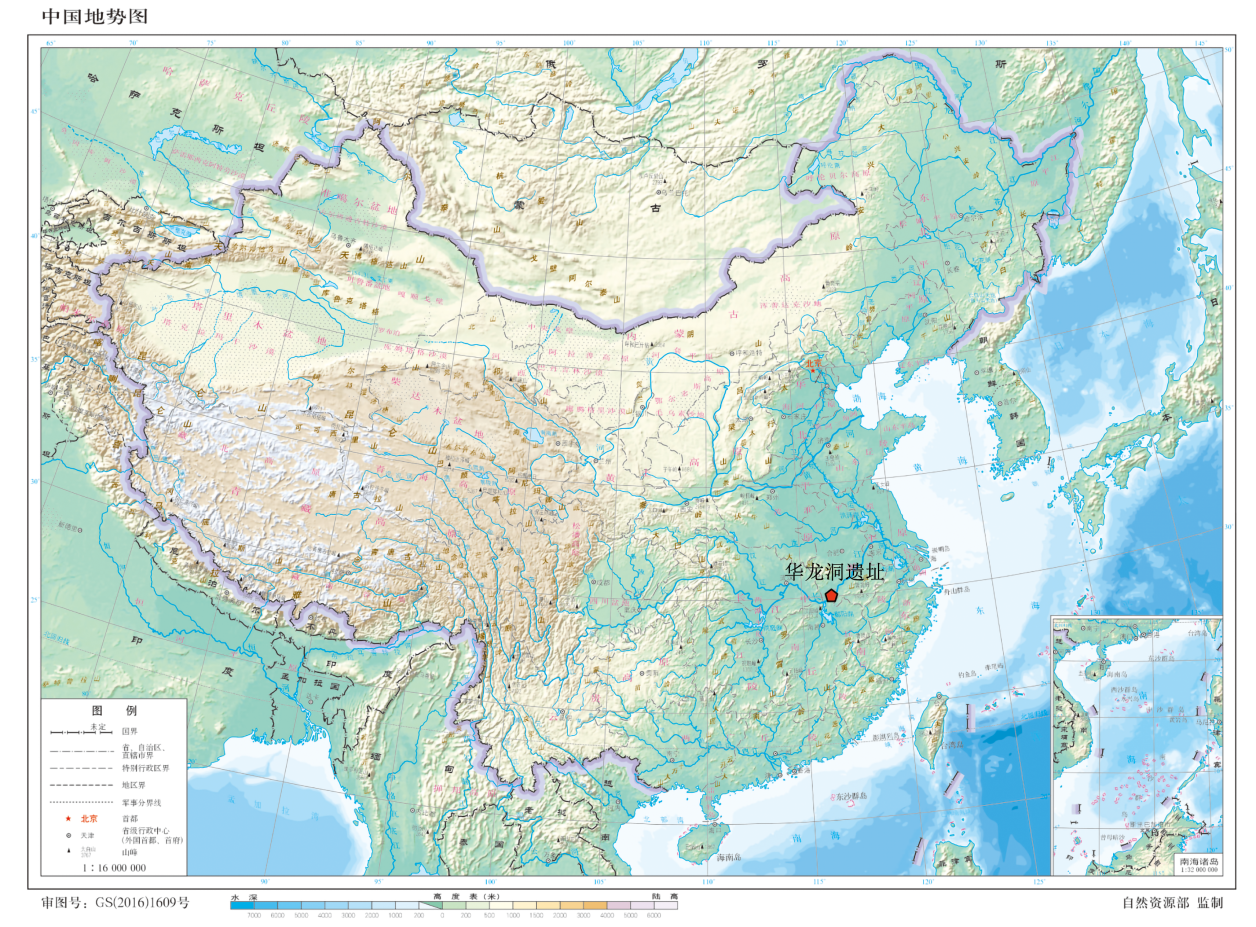
The Hualongdong Hominid Site is an important locality for ancient human fossils in the middle and lower reaches of the Yangtze River in China, where several well-preserved ancient human fossils and many mammal fossils have been discovered. This paper systematically studies the Carnivora fossils excavated from Hualong Cave from 2014 to 2024, including 8 families, 14 genera, and 17 species, including Cuon alpinus, Ursus thibetanus, Ursus arctos, Ailuropoda melanoleuca baconi, Arctonyx cf. collaris, Catopuma teilhardi, Prionailurus kurteni, Prionailurus sp., Panthera tigris, Panthera pardus, Neofelis nebulosa, Prionodon hualongensis sp. nov., Pachycrocuta brevirostris sinensis, Crocuta ultima, Viverra zibetha, Paguma larvata, Urva urva. Felidae are the most diverse family, with six species coexisted, ranging from about 1kg P. kurteni to around 200 kg P. tigris. Ursidae are also diversified, with three species, and two of them, U. thibetanus and A. m. baconi are the two abundant carnivore species in the fauna. Among these species, the newly identified species of linsang (Prionodon hualongensis) is the first fossil species discovered from the genus Prionodon, characteristic by having large body size, robust dentition and mandible, wide m1 protocone and m1 talonid, indicating a diet comprising more hard tissue. The presence of the abundant spotted hyena, indicating that the site is older than Zhoukoudian Loc.1 (very rare and only present in the upmost layer). On the other hand, the morphology of the brown bear and the golden cat is similar to those from the Zhoukoudian Loc.1, and the morphology of the dhole (relatively distinct m1 entoconid) and the hog-nosed badger (relatively large m1 paraconid) appears slightly more primitive than that of modern population. The archaic element giant hyena Pachycrocuta is still present in the locality, and there are also several extinct species, including the Hualong linsang and the Kurten's leopard cat. In summary, the composition and evolutionary level of carnivore guild from the Hualongdong site supports a late Middle Pleistocene age, which aligns with the results of previous dating. The Hualongdong carnivore guild mainly composes of species typical of woodland areas (no specific temperature preference), such as the dhole and the Asian black bear, followed by typical southern China components like the giant panda and the clouded leopard. However, there are also typical North China components, notably the brown bear, indicating a mosaic habitat primarily dominated by forests.
Key words: Late Middle Pleistocene; Anhui; southern China; ancient human; mammal fossil
JIANGZUO Qigao , LIU Boxuan , LIU Sitong , HE Letian , TONG Haowen . Fossil carnivora from the Hualongdong Site Loc.1 and their chronological and paleoenvironmental implications[J]. Acta Anthropologica Sinica, 2025 , 44(05) : 836 -849 . DOI: 10.16359/j.1000-3193/AAS.2025.0064
| [1] | 陈胜前, 罗虎. 安徽东至县华龙洞旧石器时代遗址发掘简报[J]. 考古, 2012, 7-13 |
| [2] | 宫希成, 郑龙亭, 邢松, 等. 安徽东至华龙洞出土的人类化石[J]. 人类学学报, 2014, 33: 427-436 |
| [3] | Wu XJ, Pei SW, Cai YJ, et al. Archaic human remains from Hualongdong, China, and Middle Pleistocene human continuity and variation[J]. Proceedings of the National Academy of Sciences, 2019, 116: 9820-9824 |
| [4] | Wu X, Pei S, Cai Y, et al. Morphological description and evolutionary significance of 300 ka hominin facial bones from Hualongdong, China[J]. Journal of Human Evolution, 2021, 161: 103052 |
| [5] | Wu X, Pei S, Cai Y, et al. Morphological and morphometric analyses of a late Middle Pleistocene hominin mandible from Hualongdong, China[J]. Journal of Human Evolution, 2023, 182: 103411 |
| [6] | 董哲, 裴树文, 盛锦朝, 等. 安徽东至华龙洞古人类遗址2014-2016年出土的石制品[J]. 第四纪研究, 2017, 37: 778-788 |
| [7] | 裴树文, 蔡演军, 董哲, 等. 安徽东至华龙洞遗址洞穴演化与古人类活动[J]. 人类学学报, 2022, 41: 593-607 |
| [8] | 同号文, 吴秀杰, 董哲, 等. 安徽东至华龙洞古人类遗址哺乳动物化石的初步研究[J]. 人类学学报, 2018, 37: 284-305 |
| [9] | 江左其杲, 张贝, 邓里, 等.江西萍乡杨家湾2号洞的食肉目:兼论华南第四纪晚期有关食肉类牙齿鉴定[A].见:董为(主编). 第十六届中国古脊椎动物学学术年会论文集[C]. 北京: 海洋出版社, 2018, 119-146 |
| [10] | 江左其杲, 丛浩亮, 马睿, 等.中国南方中-晚更新世的马来熊化石[A].见:董为(主编). 第十四届中国古脊椎动物学学术年会论文集[C]. 北京: 海洋出版社, 2014, 119-134 |
| [11] | Pei WC. On the Carnivora from locality 1 of Choukoutien[M]. Palaeontologia Sinica, Ser. C, 1934, 8: 1-166 |
| [12] | Pei WZ. The Upper Cave fauna of Choukutien[J]. Palaeontologia Sinica, Ser. C, 1940, 10: 1-100 |
| [13] | Teilhard de Chardin P. Fossil mammals from Locality 9 of Choukoutien[M]. Palaeontologia Sinica, Ser. C, 1936, 1-61 |
| [14] | Teilhard de Chardin P, Pei WZ. The Fossil Mammals from Locality 13 of Choukoutien[M]. Beijing: Geological Survery of China, 1941, 1-106 |
| [15] | 祁国琴, 何传坤. 台湾第四纪澎湖海沟动物群及古地理环境[J]. 第四纪研究, 1999, 19: 185-185 |
| [16] | Hu H, Tong H, Shao Q, et al. New remains of Ailuropoda melanoleuca baconi from Yanjinggou, China: Throwing light on the evolution of giant pandas during the Pleistocene[J]. Journal of Mammalian Evolution, 2022, 1-18 |
| [17] | Jiangzuo QG, Huang Z, Yu C, et al. Dental shape evolution of the giant panda (Ailuropoda, Ursidae) during the Quaternary[J]. Historical Biology, 2024, 10.1080/08912963.2024.23244461-7 |
| [18] | Jin C, Ciochon RL, Dong W, et al. The first skull of the earliest giant panda[J]. Proc Natl Acad Sci USA, 2007, 104: 10932-7 |
| [19] | Kurtén B. A note on the systematic and evolutionary relationships of Felis teilhardi Pei[J]. Vertebrata PalAsiatica, 1957, 1: 123-128 |
| [20] | Jiangzuo QG, Werdelin L, Zhang K, et al. Prionailurus kurteni (Felidae, Carnivora), a new species of small felid from the late Middle Pleistocene fossil hominin locality of Hualongdong, southern China[J]. Annales Zoologici Fennici, 2024, 61: 335-342 |
| [21] | Jiangzuo QG, Liu JY. First record of the Eurasian jaguar in southern Asia and a review of dental differences between pantherine cats[J]. Journal of Quaternary Science, 2020, 35: 817-830 |
| [22] | 高耀亭. 中国动物志-哺乳纲·第八卷·食肉目[M]. 北京: 科学出版社, 1987, 1-377 |
| [23] | Flynn JJ, Finarelli JA, Zehr S, et al. Molecular phylogeny of the carnivora (mammalia): assessing the impact of increased sampling on resolving enigmatic relationships[J]. Systematic Biology, 2005, 54: 317-37 |
| [24] | Hunt RJ. Basicranial anatomy of the living linsangs Prionodon and Poiana (Mammalia, Carnivora, Viverridae), with comments on the early evolution of aeluroid carnivorans[J]. American Museum novitates, 2001, 3330: 1-24 |
| [25] | 张兆群, 冯小波.第五章·哺乳动物·食肉目[A].见:郑绍华(主编).建始人遗址[C]. 北京: 科学出版社, 2004, 185-219 |
| [26] | Liu J, Liu J, Zhang H, et al. The giant short-faced hyena Pachycrocuta brevirostris (Mammalia, Carnivora, Hyaenidae) from Northeast Asia: A reinterpretation of subspecies differentiation and intercontinental dispersal[J]. Quaternary International, 2021, 577: 29-51 |
| [27] | 刘金毅. 中国鬣狗Pachycrocuta sinensis的研究综述—与现生两属Hyaena和Crocuta的系统发育关系浅析[J]. 见:邓涛,王原(主编). 第八届中国古脊椎动物学学术年会论文集[C]. 北京: 海洋出版社, 2001, 149-157 |
| [28] | Jiangzuo QG, Wang Y, Wang F, et al. A new species of Urva (Herpestidae, Carnivora) from late Upper Pleistocene deposits of East Fissure-Fillings, Fanchang, Anhui Province of Eastern China[J]. Journal of Vertebrate Paleontology, 2025, DOI: 10.1080/02724634.2025.2453603e2453603 |
| [29] | 金昌柱, 刘金毅. 安徽繁昌人字洞—早期人类活动遗址[M]. 北京: 科学出版社, 2009, 1-439 |
| [30] | 辽宁省博物馆, 本溪市博物馆. 庙后山--辽宁省本溪市旧石器文化遗址[M]. 北京: 文物出版社, 1986, 1-102+8 |
| [31] | 刘金毅. 记北京妙峰山晚更新世哺乳动物化石兼论最后斑鬣狗的迁移与绝灭[J]. 龙骨坡史前文化志, 1999, 1: 128-140 |
| [32] | Baryshnikov G. Late Pleistocene hyena Crocuta ultima ussurica (Mammalia, Carnivora, Hyaenidae) from the Paleolithic site in Geographical Society Cave in the Russian Far East[J]. Proceedings of Zoological Institute RAS, 2014, 318: 197-225 |
| [33] | 刘金毅, Wagner, 陈平富, 等. 河北秦皇岛斑鬣狗巢穴(灵仙洞)及斑鬣狗的集群死亡与埋藏[J]. 第四纪研究, 2015, 35: 607-621 |
| [34] | 郑龙亭, 黄万波. 和县人遗址[M]. 北京: 中华书局, 2001, 1-126 |
| [35] | 张贝, 邹松林, 陈曦, 等. 江西萍乡杨家湾2号洞哺乳动物化石及其时代探讨[J]. 第四纪研究, 2017, 37: 155-165 |
| [36] | 邹松林, 陈曦, 张贝, 等. 江西萍乡上栗县晚更新世哺乳动物化石发现[J]. 人类学学报, 2016, 35(1)109-120 |
| [37] | Sunquist M, Sunquist F. Wild cats of the world[M]. Chicago: University of Chicago press, 2002, 1-452 |
/
| 〈 |
|
〉 |