


Evolution of Cenozoic geomorphology in the Yuanmou hominin site area
Received date: 2025-03-26
Accepted date: 2025-06-10
Online published: 2025-12-15
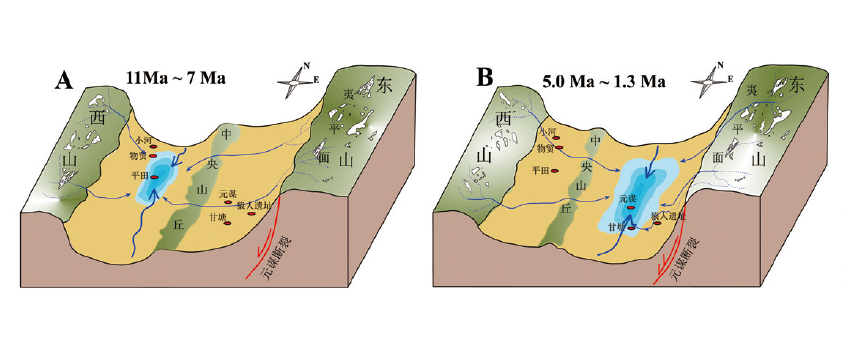
The study on the formation and evolution of geomorphology and the surface erosion of paleo-drainage of the Yuanmou paleolithic site and its surrounding region can well reveal the coupling relationship between tectonic uplift, climate, ecological environment and ancient human activities on the southeastern margin of the Tibetan Plateau. The geomorphologic formation and evolution and the surface erosion of its internal paleo-drainage around the Yuanmou paleolithic site, have profoundly influenced by the multiple tectonic uplifts and paleo-drainage reorganization on the southeastern Tibetan Plateau (SETP) since the Eocene. The ancient bedrock of the paleo-planation surface and the Cenozoic strata above the river terraces have formed a surface weathering crust under long-term physical and chemical processes, becoming an important ecological barrier for the distinctive regional ecological environment, Agricultural and livestock production, and ancient human activities. Based on magnetostratigraphic chronology, tectonic events, and lithofacies changes, our study systematically elucidated the development, formation, and breakup processes of the geomorphology from the paleo-planation surface, the paleo-drainage and the river terraces. The research results indicate that the Yuanmou paleolithic site and its surrounding region have undergone significant tectonic events and paleo-drainage reorganization events in different periods since the Cenozoic, such as during the late Oligocene to early Miocene, early Late-Miocene, early Pliocene, late Early-Pleistocene, middle Pleistocene, late Pleistocene and Holocene, and ultimately formed to its present configuration. In addition, the formation process of the Yuanmou Paleolithic Site is highly related to the formation of the third paleo-planation surface and the development of river terraces, reflecting the close association between ancient human activities and tectonic movements, paleo-drainage changes, and their controlled geomorphic evolution patterns. This work would provide significant geological evidence for exploring the impact mechanisms of geomorphic processes and ecological environment changes on the survival activities of Yuanmou Man and other ancient humans, and also offer essential proof for future archaeological work on ancient humans and Paleolithic artifacts in the Yuanmou Paleolithic Site and its surrounding region.
ZHANG Weilin , YAN Maodu , ZAN Jinbo , MIAO Yunfa , SONG Xiangsuo , ZHANG Tao , XU Zunbo , Cairangdaoji , RUAN Qijun , LI Hao . Evolution of Cenozoic geomorphology in the Yuanmou hominin site area[J]. Acta Anthropologica Sinica, 2025 , 44(06) : 952 -966 . DOI: 10.16359/j.1000-3193/AAS.2025.0098
| [1] | Antonelli A, Kissling WD, Flantua SGA, et al. Geological and climatic influences on mountain biodiversity[J]. Nature Geoscience, 2018, 11(10): 718-725 |
| [2] | Huang S, Meijers MJM, Eyres A, et al. Unravelling the history of biodiversity in mountain ranges through integrating geology and biogeography[J]. Journal of Biogeography, 2019, 46(8): 1777-1791 |
| [3] | Valdes P, Scotese C, Lunt D. Deep ocean temperatures through time[J]. Climate of the Past, 2021, 17: 1483-1506 |
| [4] | Salles T, Husson L, Lorcery M, et al. Landscape dynamics and the Phanerozoic diversification of the biosphere[J]. Nature, 2023, 624: 115-121 |
| [5] | Wang E, Burchfiel BC, Royden LH, et al. Late Cenozoic Xianshuihe-Xiaojiang, Red River, and Dali fault systems of Southwestern Sichuan and Central Yunnan. China[J]. Geological Society of America Bulletin, 1998, 327: 1-108 |
| [6] | Li SH, Deng CL, Yao HT, et al. Magnetostratigraphy of the Dali Basin in Yunnan and implications for late Neogene rotation of the southeast margin of the Tibetan Plateau[J]. Journal of Geophysical Research: Solid Earth, 2013, 118: 791-807 |
| [7] | Zhang WL, Yan MD, Fang XM, et al. High-resolution paleomagnetic constraint on the oldest hominoid- fossil bearing sequence in the Xiaolongtan Basin, southeast margin of the Tibetan Plateau and its geologic implications[J]. Global and Planetary Change, 2019, 182: 103001 |
| [8] | Xie SP, Sun BN, Wu JY, et al. Palaeoclimatic Estimates for the Late Pliocene Based on Leaf Physiognomy from Western Yunnan, China[J]. Turkish Journal of Earth Sciences, 2012, 12: 251-261 |
| [9] | Ji XP, Jablonski NG, Su DF, et al. Juvenile hominoid cranium from the terminal Miocene of Yunnan, China[J]. Chinese Science Bulletin, 2013, 58(31): 3771-3779 |
| [10] | Li YJ, Oskolski AA, Jacques FMB, et al. New middle Miocene fossil wood of Wataria (malvaceae) from southwest China[J]. IAWA Journal, 2015, 36(3): 345-357 |
| [11] | Tapponnier P, Xu ZQ, Roger F, et al. Oblique stepwise rise and growths of the Tibet Plateau[J]. Science, 2001, 294: 1671-1677 |
| [12] | Leloup PH, Tapponnier P, Lacassin R, et al. Discussion on the role of the Red River shear zone, Yunnan and Vietnam, in the continental extrusion[J]. Journal of the Geological Society, 2007, 164(6): 1253-1260 |
| [13] | Tapponnier P, Peltzer G, Ledain AY, et al. Propagating Extrusion Tectonics in Asia - New Insights from Simple Experiments with Plasticine[J]. Geology, 1982, 10(12): 611-616 |
| [14] | Zhang HP, Oskin ME, Liu ZJ, et al. Pulsed exhumation of interior eastern Tibet: Implications for relief generation mechanisms and the origin of high-elevation planation surfaces[J]. Earth and Planetary Science Letters, 2016, 449: 176-185 |
| [15] | Zhu CY, Wang GC, Leloup PH, et al. Role of the Early Miocene Jinhe-Qinghe Thrust Belt in the building of the Southeastern Tibetan Plateau topography[J]. Tectonophysics, 2021, 811: 228871 |
| [16] | Wang Y, Zhang B, Schoenbohm LM, et al. Late Cenozoic tectonic evolution of the Ailao Shan-Red River fault (SE Tibet): Implications for kinematic change during plateau growth[J]. Tectonics, 2016, 35(8): 1969-1988 |
| [17] | 许志琴, 王勤, 李忠海, 等. 印度-亚洲碰撞:从挤压到走滑的构造转换[J]. 地质学报, 2016, 90(1): 1-23 |
| [18] | Clark MK, House MA, Royden LH, et al. Late Cenozoic uplift of southeastern Tibet[J]. Geology, 2005, 33: 525-528 |
| [19] | Kirby E, Whipple KX. Expression of active tectonics in erosional landscapes[J]. Journal of Structural Geology, 2012, 44: 54-75 |
| [20] | 张会平, 杨农, 张岳桥, 等. 岷江水系流域地貌特征及其构造指示意义[J]. 第四纪研究, 2006, 1: 126-135 |
| [21] | 王洋, 王岳军, 张培震, 等. 青藏高原东南缘断裂体系新生代构造演化[J]. 中国科学:地球科学, 2022, 52(5): 777-802 |
| [22] | 吴锡浩. 青藏高原东南部地貌边界与金沙江水系发育[J]. 山地学报, 1989, 7(2): 75-84 |
| [23] | 刘静, 曾令森, 丁林, 等. 青藏高原东南缘构造地貌、活动构造和下地壳流动假说[J]. 地质科学, 2009, 44(4): 1227-1255 |
| [24] | Kirby E, Reiners PW, Krol MA, et al. Late Cenozoic evolution of the eastern margin of the Tibetan Plateau: Inferences from 40Ar/39Ar and (U‐Th)/He thermochronology[J]. Tectonics, 2002, 21(1): TC1001. |
| [25] | Wang E, Kirby E, Furlong KP, et al. Two‐phase growth of high topography in eastern Tibet during the Cenozoic[J]. Nature Geoscience, 2012, 5(9): 640-645 |
| [26] | Leloup PH, Lacassin R, Tapponnier P, et al. The Ailao Shan-Red River shear zone (Yunnan, China), Tertiary transform boundary of Indochina[J]. Tectonophysics, 1995, 251: 3-84 |
| [27] | Clark MK, Royden LH. Topographic ooze: Building the eastern margin of Tibet by lower crustal flow[J]. Geology, 2000, 28(8): 703-706 |
| [28] | Huang YJ, Zong HR, Zhang ST, et al. Higher palaeoelevation in the Baoshan Basin: Implications for landscape evolution at the southeastern margin of the Tibetan Plateau[J]. Journal of Palaeogeography, 2024, 13(3): 563-580 |
| [29] | Brookfield MB. The evolution of the great river systems of southern Asia during the Cenozoic India-Asia collision: Rivers draining southwards[J]. Geomorphology, 1998, 22(3): 258-312 |
| [30] | Clark MK, Schoenbohm LM, Royden LH, et al. Surface uplift, tectonics, and erosion of eastern Tibet from large-scale drainage patterns[J]. Tectonics, 2004, 23(1): TC1006 |
| [31] | Clift PD, Blusztajn J, Duc NA. Large-scale drainage capture and surface uplift in eastern Tibet SW China before 24 Ma inferred from sediments of the Hanoi Basin, Vietnam[J]. Geophysical Research Letters, 2006, 33: L19403 |
| [32] | Yan Y, Carter A, Huang CY, et al. Constraints on Cenozoic regional drainage evolution of SW China from the provenance of the Jianchuan Basin[J]. Geochemistry Geophysics Geosystems, 2012, 13: Q03001 |
| [33] | Zheng HB, Clift PD, Wang P, et al. Pre-Miocene birth of the Yangtze River[J]. Proceedings of the National Academy of Sciences of USA, 2013, 110(19): 7556-7561 |
| [34] | Zhao M, Shao L, Liang JS, et al. No Red River capture since the late Oligocene: Geochemical evidence from the northwestern South China Sea[J]. Deep Sea Research Part II: Topical Studies in Oceanography, 2015, 122: 185-194 |
| [35] | Chen Y, Yan MD, Fang XM, et al. Detrital zircon U-Pb geochronological and sedimentological study of the Simao Basin, Yunnan: Implications for the Early Cenozoic evolution of the Red River[J]. Earth and Planetary Science Letters, 2017, 476: 22-33 |
| [36] | Zhao XD, Zhang HP, Hetzel R, et al. Existence of a continental-scale river system in eastern Tibet during the late Cretaceous-early Palaeogene[J]. Nature Communications, 2021, 12: 7231 |
| [37] | 张叶春, 李吉均, 朱俊杰, 等. 晚新生代元谋盆地演化与河谷发育研究[J]. 兰州大学学报:自然科学版, 1999, 35(1): 199-205 |
| [38] | Liu FL, Gao HS, Pan BT, et al. Quantitative analysis of planation surfaces of the upper Yangtze River in the Sichuan-Yunnan Region, Southwest China[J]. Frontiers of Earth Science, 2019, 13(1): 55-74 |
| [39] | Schoenbohm LM, Burchfiel BC, Chen LZ, et al. Miocene to present activity along the Red River fault, China, in the context of continental extrusion, upper-crustal rotation, and lower-crustal flow[J]. Geological Society of America Bulletin, 2006, 118(5-6): 672-688 |
| [40] | Zhu RX, Potts R, Pan YX, et al. Paleomagnetism of the Yuanmou Basin near the southeastern margin of the Tibetan Plateau and its constraints on late Neogene sedimentation and tectonic rotation[J]. Earth and Planetary Science Letters, 2008, 272(1): 97-104 |
| [41] | 宗冠福, 潘悦容, 姜础, 等. 元谋盆地含古猿化石地层初步划分[J]. 人类学学报, 1991, 10(2): 155-166 |
| [42] | 宗冠福. 元谋盆地的新第三纪地层[J]. 地层学杂志, 1996, 20(2): 138-145 |
| [43] | 张云翔, 邱占祥, 郑良, 等. 云南元谋小河盆地含古猿化石地层的沉积特点与对比[J]. 沉积学报, 2001, 19(1): 85-89 |
| [44] | 岳乐平, 张云翔, 祁国琴, 等. 云南元谋盆地含古猿化石层古地磁年龄及古生物意义[J]. 中国科学(D辑), 2003, 33(11): 1069-1075 |
| [45] | 董为, 刘建辉, 潘悦容. 云南元谋晚中新世真角鹿化石一新种及其古环境探讨[J]. 科学通报, 2003, 48(3): 271-278 |
| [46] | Zhu RX, Liu QS, Yao HT, et al., Magnetostratigraphic dating of hominoid-bearing sediments at Zhupeng, Yuanmou Basin, southwestern China[J]. Earth and Planetary Science Letters, 2005, 236: 559-568 |
| [47] | 钱方. 关于元谋人的地质时代问题——与刘东生等同志商榷[J]. 人类学学报, 1965, 4(4): 324-332 |
| [48] | 胡承志. 云南元谋发现的猿人牙齿化石[J]. 地质学报, 1973, 1: 65-71 |
| [49] | 李普, 钱方, 马醒华, 等. 用古地磁方法对元谋人化石年代的初步研究[J]. 中国科学, 1976, 6: 579-591 |
| [50] | 浦庆余, 钱方. 对元谋人化石层-元谋组的研究[J]. 地质学报, 1977, 1: 89-99 |
| [51] | 梁其中, 江能人, 孙荣. 元谋盆地晚新生代地层的磁性地层学研究[J]. 云南地质, 1988, 3(7): 46-57 |
| [52] | 江能人, 孙荣, 梁其中. 云南元谋盆地晚新生代地层和古生物[J]. 云南地质, 1989, (增刊): 1-107 |
| [53] | 钱方, 周国兴. 元谋第四纪地质与古人类[M]. 北京: 科学出版社, 1991 |
| [54] | 张宗祜, 刘平贵, 钱方, 等. 元谋盆地晚新生代地质研究的新进展[J]. 海洋地质与第四纪地质, 1994, 14(2): 1-17 |
| [55] | 程国良, 李素玲, 林金录. “元谋人”的年代和松山早期事件的商榷[J]. 地质科学, 1997, 1: 34-43 |
| [56] | 刘东生, 丁梦林. 关于元谋人化石地质时代的讨论[J]. 人类学学报, 1983, 2(1): 40-48 |
| [57] | 尤玉柱, 刘后一, 潘悦容. 云南元谋、班果盆地晚新生代地层与脊椎动物化石.见:中国地质科学院地层古生物论文集编委会.地层古生物论文集(第七辑)[C]. 北京: 地质出版社, 1978 |
| [58] | Zhu RX, Potts R, Pan YX, et al. Early evidence of the genus Homo in East Asia[J]. Journal of Human Evolution, 2008, 55: 1075-1085 |
| [59] | Hyodo M, Nakaya H, Urabe A, et al. Paleomagnetic dates of hominid remains from Yuanmou, China, and other Asian sites[J]. Journal of Human Evolution, 2002, 43: 27-41 |
| [60] | 刘泽纯, 李庆辰. 关于元谋盆地的沉积特征与地层划分[J]. 海洋地质与第四纪地质, 1988, 8(4): 65-75 |
| [61] | 高星. “元谋人”的年龄及相关的年代问题讨论[J]. 人类学学报, 2015, 34(4): 442-450 |
| [62] | Zhang WL, Fang XM, Zhang T, et al. Eocene Rotation of the Northeastern Central Tibetan Plateau Indicating Stepwise Compressions and Eastward Extrusions[J]. Geophysical Research Letters, 2020, 47(17): 1-14 |
| [63] | Li SH, van Hinsbergen DJJ, Najman Y, et al. Does pulsed Tibetan deformation correlate with Indian plate motion changes?[J]. Earth and Planetary Science Letters, 2020, 536: 116144 |
| [64] | Su T, Spicer RA, Li SH, et al. Uplift, climate and biotic changes at the Eocene-Oligocene transition in south-eastern Tibet[J]. National Science Review, 2018, 6(3): 495-504 |
| [65] | He SL, Ding L, Xiong ZY, et al. A distinctive Eocene Asian monsoon and modern biodiversity resulted from the rise of eastern Tibet[J]. Science Bulletin, 2022, 67: 2245-2258 |
| [66] | Ni XJ, Li Q, Deng T, et al. New Yuomys rodents from southeastern Qinghai-Tibet Plateau indicate low elevation during the Middle Eocene[J]. Frontiers of Earth Science, 2023, 10: 1018675 |
| [67] | Bai B. Reappraisal of some perissodacyl fossils from the Middle Eocene of the Lijiang Basin, Yunnan, China with a revision of tapiroid Diplolophodon[J]. Vertebrata PalAsiatica, 2023, 61(1): 26-42 |
| [68] | Gourbet L, Leloupa PH, Paquette JL, et al. Reappraisal of the Jianchuan Cenozoic basin stratigraphy and its implica tions on the SE Tibetan plateau evolution[J]. Tectonophysics, 2017, (700-701): 162-179 |
| [69] | Fang XM, Yan MD, Zhang WL, et al. Paleogeography control of Indian monsoon intensification and expansion at 41 Ma[J]. Science Bulletin, 2021, 66: 2320-2328 |
| [70] | Zheng H, Clift PD, He MY, et al. Formation of the First Bend in the late Eocene gave birth to the modern Yangtze River, China[J]. Geology, 2020, 49: 35-39 |
| [71] | Cao K, Leloup PH, Wang GC, et al. Thrusting, exhumation, and basin fill on the western margin of the South China block during the India-Asia collision[J]. Geological Society of America Bulletin, 2021, 133(1-2): 74-90 |
| [72] | Linnemann U, Su T, Kunzmann L, et al. New U-Pb dates show a Paleogene origin for the modern Asian biodiversity hot spots[J]. Geology, 2018, 46(1): 3-6 |
| [73] | Li SH, Su T, Spicer RA, et al. Oligocene deformation of the Chuandian terrane in the SE margin of the Tibetan Plateau related to the extrusion of Indochina[J]. Tectonics, 2020, 39: e2019TC005974 |
| [74] | Ni X, Li Q, Li L, et al. Oligocene primates from China reveal divergence between African and Asian primate evolution[J]. Science, 2016, 352: 673-677 |
| [75] | Tian YM, Spicer RA, Huang J, et al. New early oligocene zircon U-Pb dates for the ‘Miocene’ Wenshan Basin, Yunnan, China: Biodiversity and paleoenvironment[J]. Earth and Planetary Science Letters, 2021, 565: 116929 |
| [76] | Socquet A, Pubellier M. Cenozoic deformation in western Yunnan (China-myanmar border)[J]. Journal of Asian Earth Sciences, 2005, 24(4): 495-515 |
| [77] | Tanaka K, Mu CL, Sato K, et al. Tectonic deformation around the eastern Himalayan syntaxis: constraints from the Cretaceous paleomagnetic data of the Shan-Thai Block[J]. Geophysical Journal International, 2008, 175: 713-728 |
| [78] | Wang JH, Yin A, Harrison TM, et al. A tectonic model for Cenozoic igneous activities in the eastern Indo-Asian collision zone[J]. Earth and Planetary Science Letters, 2001, 188(1-2): 123-133 |
| [79] | Spurlin MS, Yin A, Horton BK, et al. Structural evolution of the Yushu-Nangqian region and its relationship to syncollisional igneous activity, east-central Tibet[J]. Geological Society of America Bulletin, 2005, 117(9-10): 1293-1317 |
| [80] | Lu YJ, Kerrich R, Cawood PA, et al. Zircon SHRIMP U-Pb geochronology of potassic felsic intrusions in western Yunnan, SW China: constraints on the relationship of magmatism to the Jinsha suture[J]. Gondwana Research, 2012, 22(2): 737-747 |
| [81] | Xu Y, Zhu J, Hu R, et al. Heterogeneous lithospheric mantle beneath the Southeastern Tibetan plateau: Evidence from Cenozoic high-Mg potassic volcanic rocks in the Jinshajiang-Ailaoshan Cenozoic magmatic belt[J]. Journal of Asian Earth Sciences, 2019, 180: 103849 |
| [82] | Sun XL, Ding WN, Kuiper KF, et al. New early Oligocene age for the Mouding Basin, Southwestern China: Source and paleoenvironment[J]. Palaeogeography, Palaeoclimatology, Palaeoecology, 2024, 636: 111983 |
| [83] | Zhang GH Tian, YT, Li R, et al. Progressive tectonic evolution from crustal shortening to mid-lower crustal expansion in the southeast Tibetan Plateau: a synthesis of structural and thermochronological insights[J]. Earth-Science Reviews, 2022, 226: 103951 |
| [84] | Zhao LC, Wang YF, Liu CJ, et al. Climatic implications of fruit and seed assemblage from Miocene of Yunnan, southwestern China[J]. Quaternary International, 2004, 117: 81-89 |
| [85] | Jacques FMB, Guo SX, Su T, et al. Quantitative reconstruction of the Late Miocene monsoon climates of southwest China: A case study of the Lincang flora from Yunnan Province[J]. Palaeogeography, Palaeoclimatology, Palaeoecology, 2011, 304: 318-327 |
| [86] | Li SH, Deng CL, Dong W, et al. Magnetostratigraphy of the Xiaolongtan Formation bearing Lufengpithecus keiyuanensis in Yunnan, southwestern China: Constraint on the initiation time of the southern segment of the Xianshuihe-Xiaojiang fault[J]. Tectonophysics, 2015, 655: 213-226 |
| [87] | Nie JS, Ruetenik G, Gallagher K, et al. Rapid Incision of the Mekong River in the Middle Miocene Linked to Monsoonal Precipitation[J]. Nature Geoscience, 2018, 11: 944-948 |
| [88] | 郑勇, 王亚军, 孔屏. 四川攀枝花昔格达组及其下伏河流砾石的地球化学特征以及对物源的制约[J]. 地质科学, 2009, 44(3): 1036-1051 |
| [89] | 姚海涛, 邓成龙, 吕连清. 元谋盆地河湖相沉积物磁性地层学研究综述[J]. 地球物理学进展, 2005, 20(2): 518-523 |
| [90] | 张进江, 钟大赉, 周勇. 东南亚及哀牢山红河构造演化的讨论[J]. 地质论评, 1999, 45: 337-344 |
| [91] | 蒋复初, 吴锡浩, 肖华国, 等. 四川泸定昔格达组时代及其新构造意义[J]. 地质学报, 1999, 73(1): l-6 |
| [92] | 孔屏. 金沙江何时开始东流[J]. 地质科学, 2009, 44(4): 1256-1265 |
| [93] | 李朝柱, 蒋复初, 傅建利, 等. 云南元谋龙街粉砂层的形成时代研究[J]. 第四纪研究, 2011, 31(5): 933-934 |
| [94] | 黄万波, 王景文, 邱铸鼎, 等. 元谋组、龙街组及昔格达组的时代对比[A].见:中国地质科学院地层古生物论文集编委会(主编).地层古生物论文集(第七辑)[C]. 北京: 地质出版社, 1978 |
| [95] | Kong P, Granger DE, Wu FY, et al. Cosmogenic nuclide burial ages and provenance of the Xigeda paleo-lake: Implications for evolution of the Middle Yangtze River[J]. Earth and Planetary Science Letters, 2009, 278(1-2): 131-141 |
| [96] | 刘芬良, 高红山, 李宗盟, 等. 金沙江巧家-蒙姑段的阶地发育与河谷地貌演化[J]. 地理学报, 2020, 75(5): 1095-1105 |
| [97] | 黄成敏, 王成善, 何毓蓉, 等. 元谋盆地古红土的土壤发生学特征及古环境意义[J]. 土壤通报, 2004, 35(3): 251-256 |
| [98] | 杨达源, 韩志勇, 葛兆帅, 等. 金沙江石鼓-宜宾河段的贯通与深切地貌过程的研究[J]. 第四纪研究, 2008, 28(4): 564-568 |
| [99] | McPhillips D, Hoke GD, Liu ZJ, et al. Dating the incision of the Yangtze River gorge at the First Bend using three nuclide burial ages[J]. Geophysical Research Letters, 2016, 43(1): 101-110 |
| [100] | 闵隆瑞, 尹占国, 张金起. 龙街粉砂层形成时代及其古环境[J]. 第四纪研究, 1990, 4: 354-362 |
/
| 〈 |
|
〉 |