


Growth and development of Chinese adolescents and the trend of overweight
Received date: 2024-07-05
Accepted date: 2024-10-09
Online published: 2026-02-13
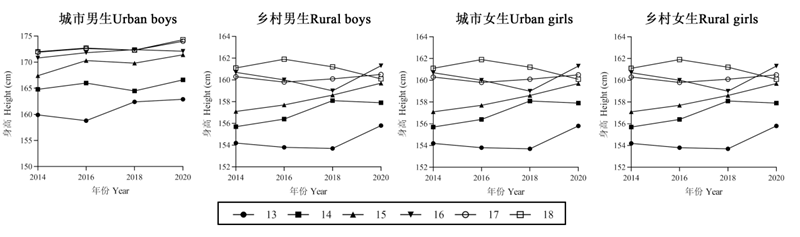
This study analyzes the growth, physical development, and changes in overweight and obesity status among Chinese adolescents from 2014 to 2020. Using data from the China Family Panel Studies (CFPS) in 2014, 2016, 2018, and 2020, we examined height, body mass, and body mass index (BMI) measurements of 10,603 adolescents aged 13-18 to assess prevalence changes across different groups. Logistic regression was utilized to explore the influencing factors of overweight and obesity in adolescents. The results showed that the height of adolescents aged 13~18 exhibited an increasing trend from 2014 to 2020. The heights of urban and rural boys aged 13 and 15, urban girls aged 15, and rural girls aged 13~15 in 2014 were all statistically significantly different from those in 2020 (P<0.05). In 2020, the body masses of urban boys and girls aged 13~18 increased by 2.8 kg and 1.6 kg respectively compared to those in 2014, and the gender differences were statistically significant (boys: t=4.329, P<0.05; girls: t=3.159, P<0.05). The body mass differences between urban boys aged 13, 14, 15, and 18, rural boys aged 13, 14, 15, and 17, urban girls aged 14 and 18, and rural girls aged 13, 14, 15, 17, and 18 in 2020 and those in 2014 were statistically significant (P<0.05). From 2014 to 2020, the overweight, obesity, overweight-obesity rates for boys increased from 6.4%, 0.7%, 7.1% to 13.3%, 3.2%, 16.5% respectively; those for girls increased from 5.0%, 0.6%, 5.6% to 7.5%, 2.3%, 9.8% respectively; those for urban adolescents increased from 6.1%, 0.4%, 6.5% to 12.2%, 4.3%, 16.5% respectively; and those for rural adolescents increased from 5.3%, 0.8%, 6.1% to 9.1%, 1.7%, 10.8% respectively. The prevalence of overweight (4.8% vs 3.1%) and overweight-obesity (5.6% vs 3.7%) of boys was significant higher than girls’ (P<0.001). Multivariate Logistic regression analysis revealed that region, gender, age, and year were influencing factors for adolescent overweight/overweight-obesity (P<0.05); region, age, and year were influencing factors for adolescent obesity(P<0.05). From 2014 to 2020, although the heights of Chinese adolescents aged 13 - 18 did not show substantial growth, the body masses of urban adolescents increased significantly, presenting a “horizontal development” phenomenon in body shape. Additionally, the overweight and obesity rates of all groups continued to rise. It is extremely urgent to focus on students’ physical health and prevent overweight and obesity.
Key words: adolescent; height; body mass; obesity; growth and development
ALIMUJIANG·Yimiti·Taerken , MA Yunfei , LI Chengyue , LI Weimin . Growth and development of Chinese adolescents and the trend of overweight[J]. Acta Anthropologica Sinica, 2026 , 45(01) : 165 -173 . DOI: 10.16359/j.1000-3193/AAS.2025.0020
| [1] | 季成叶. 现代儿童少年卫生学[M]. 北京: 人民卫生出版社, 2010 |
| [2] | 王烁, 董彦会, 王政和, 等. 1985-2014年中国7-18岁学生超重与肥胖流行趋势[J]. 中华预防医学杂志, 2017, 51(4): 300-305 |
| [3] | 张瀚月, 马璐, 孔振兴, 等.2016-2020年我国学生超重、肥胖和营养不良状况的流行趋势与防控策略[J]. 北京体育大学学报, 2023, 46(11): 118-131 |
| [4] | 王洋, 阿力木江·依米提·塔尔肯. 2000-2019年中国汉族7-18岁儿童青少年超重与肥胖变化趋势[J]. 卫生研究, 2023, 52(4): 519-527 |
| [5] | Ding S, Chen J, Dong B, et al. Association between parental socioeconomic status and offspring overweight/obesity fromthe China Family Panel Studies: a longitudinal survey[J]. BMJ Open, 2021, 11(4): e045433 |
| [6] | Ng M, Fleming T, Robinson M, et al. Global, regional, and national prevalence of overweight and obesity in children and adults during 1980-2013: a systematic analysis for the Global Burden of Disease Study 2013[J]. The lancet, 2014, 384(9945): 766-781 |
| [7] | 中华人民共和国国家卫生和计划生育委员会.学龄儿童青少年超重与肥胖筛查 WS /T 586-2018[S]. 北京: 中华人民共和国国家卫生和计划生育委员会, 2018 |
| [8] | 钟磊发, 周谷城, 范艳艳, 等. 青少年肥胖的危害、发生机制和防治概述[J]. 生物学教学, 2018, 43(8): 7-9 |
| [9] | Ding C, Fan J, Yuan F, et al. Association between physical activity, sedentary behaviors, sleep, diet, and adiposity among children and adolescents in China[J]. Obesity facts, 2022, 15(1): 26-35 |
| [10] | 程文林, 危羽豪, 胡凡春, 等. 中国2010-2016年10-15岁青少年生长发育及超重肥胖状况分析[J]. 中国公共卫生, 2021, 37(3): 520-524 |
| [11] | 吐拉洪·吾布拉吉, 古力克孜·阿布都克力木, 阿力木江·依米提·塔尔肯. 新疆喀什地区7-12岁青少年身体形态发育状况的城乡比较[J]. 当代体育科技, 2022, 12(8): 26-28 |
| [12] | 严志玲. 儿童青少年肥胖影响因素探讨[J]. 中国学校卫生, 2011, 32(10): 1278-1280 |
| [13] | Ruoff C, 段莹. 睡眠与肥胖的相互关系[J]. 世界睡眠医学杂志, 2015, 2(6): 377-379 |
| [14] | 朱秋丽, 翟向明. 中国儿童青少年2006-2015年闲暇静坐行为变化趋势[J]. 中国学校卫生, 2019, 40(6): 827-830+834 |
| [15] | 向蔓, 赵海磊, 吉伟, 等. 上海市宝山区2013-2019年儿童青少年超重肥胖流行趋势分析[J]. 中国儿童保健杂志, 2023, 31(10): 1070-1075 |
| [16] | Rodriguez A, Korzeniowska K, Szarejko K, et al. Fitness, food, and biomarkers:characterizing body composition in 19,634 early adolescents[J]. Nutrients, 2022, 4(7): 1369 |
| [17] | Wu Y, Ma G, Kang M, et al. Secular trends in growth and obesity among Chinese children and adolescents from 1985 to 2014[J]. European Journal of Pediatrics, 2018, 177(11): 1655-1664 |
| [18] | Dong B, Ma Y, Wang D, et al. Trends in overweight and obesity among children and adolescents in China from 1991 to 2015[J]. BMC Public Health, 2019, 19(1): 1589 |
| [19] | 高迪, 董彦会, 尹杨, 等. 中国2005-2014年中小学生身高体重变化趋势分析[J]. 中国学校卫生, 2018, 28(2): 252-255 |
| [20] | Armitage R. Bullying in children: impact on child health[J]. BMJ paediatrics open, 2021, 5(1): 11-20 |
| [21] | 李芳, 刘素, 李长风, 等. 武汉市青少年超重肥胖状况及对被欺凌的影响[J]. 中国学校卫生, 2020, 41(9): 1343-1345 |
| [22] | 胡霄, 李丽, 欧阳一非, 等. 2000-2018年中国十六省(自治区、直辖市)7-17岁儿童青少年超重与肥胖流行趋势[J]. 卫生研究, 2022, 51(4): 568-573 |
| [23] | 王宇, 王丹彤, 陈旭, 等. 2019年秦皇岛市城区中小学生超重肥胖流行特征及影响因素分析[J]. 中国慢性病预防与控制, 2021, 29(12): 927-930 |
| [24] | 张垚. 北京市通州区2012-2017年7-17岁儿童青少年超重肥胖流行趋势及预测研究[J]. 中国儿童保健杂志, 2020, 28(2):178-182 |
| [25] | 马福维, 韦经富, 黄秀峰, 等. 广西壮族、汉族大学生体质现状及其影响因素[J]. 人类学学报, 2024, 43(4): 638-647 |
/
| 〈 |
|
〉 |