


Excavation report on the Fenglin Loc.2 in Fusong County, Jilin Province
Received date: 2024-03-17
Accepted date: 2024-07-10
Online published: 2026-02-13
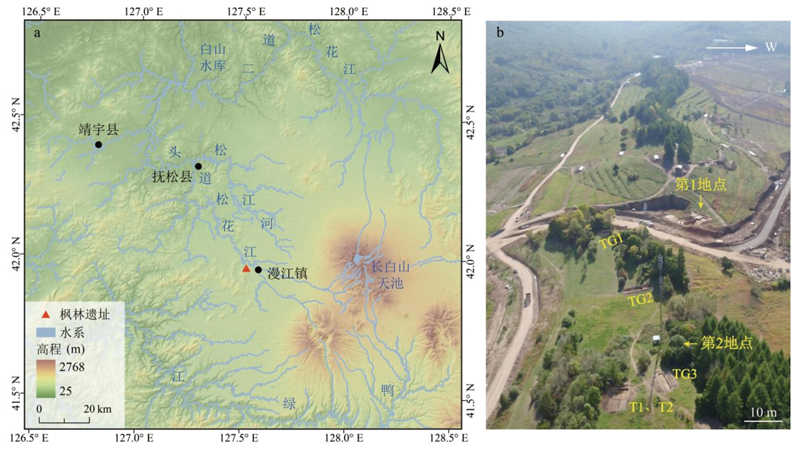
The Fenglin site (41°57′58″N, 127°31′57″E), a Late Paleolithic site, lies in Fusong County, Jilin Province, northeastern China. This open-air site is perched on a mountain ridge along the left bank of the Toudao Songhua River, at an elevation of around 900 meters above sea level. Discovered in 2014, during subsequent surveys, thousands of lithic artifacts were gathered from an approximately 30,000 m² surface area. Based on the distribution of these lithic artifacts, the Fenglin site can be partitioned into three localities: Locality(Loc.) 1, Loc.2 (Dongshanpo site), and Loc.3 (Guanjingtai site). Loc.1 features relatively thick stratigraphic deposits but has sustained substantial damage over the years due to road-widening and construction activities. Conversely, Loc.2 and Loc.3 have shallower and less-developed stratigraphic deposits, yet with relatively better preservation conditions.
In 2016, a joint team from the Institute of Archaeology of Jilin Province and the Institute of Paleontology and Paleoanthropology, Chinese Academy of Sciences, carried out a systematic 80 m² excavation at Loc.2. The aim was to obtain lithic artifacts from reliable stratigraphic sequences and conduct chronometric research. This excavation unearthed a total of 983 lithic artifacts. Employing AMS 14C and optically stimulated luminescence (OSL) dating methods, the sediments in which these artifacts were embedded were dated to at least 17 kaBP.
This article presents the outcomes of raw-material and fundamental techno-typological analyses of the lithic assemblages from Fenglin Loc.2. Given its close proximity (~43 km) to the Changbai Mountain to the west, obsidian is the predominant raw material, succeeded by tuff, chert, limestone, vein quartz, sandstone, diorite porphyrite, quartzite, and basalt. The artifact types include debitage products from blade, microblade, and flake production, along with elaborately retouched tools such as sidescrapers, endscrapers, burins, points, notches, choppers, and adzes. The blade-production technique is identified as the prismatic blade reduction method. The main methods for microblade production involve wedge-shaped, boat-shaped, burin-like, and irregular-shaped microblade cores.
Our findings fill a crucial gap in the archaeological record regarding the Last Glacial Maximum in the Changbai Mountain region and the evolution of microblade technology from its primitive to mature phases. The excavation at Fenglin Loc.2 further refines the cultural sequence of the Late Paleolithic era in the Changbai Mountain area. Moreover, it is of great significance for comprehending the adaptation strategies of ancient humans to extreme environments in high-latitude regions and the interactions among prehistoric populations in Northeast Asia.
Key words: Fenglin site; Upper Paleolithicc; blade; microblade
XU Ting , HUANG Lunyue , REN Jincheng , GE Junyi , GAO Xing . Excavation report on the Fenglin Loc.2 in Fusong County, Jilin Province[J]. Acta Anthropologica Sinica, 2026 , 45(01) : 174 -186 . DOI: 10.16359/j.1000-3193/AAS.2025.0018
| [1] | 李万博, 陈全家, 张福有. 吉林枫林旧石器遗址发现的石制品[J]. 人类学学报, 2019, 38(2): 191-199 |
| [2] | 徐廷. 吉林抚松发现枫林旧石器遗址[N]. 中国文物报,2016-10-21(08) |
| [3] | 王非, 陈文寄, 彭子成, 等. 长白山天池火山晚更新世以来的喷发活动:高精度铀系TIMS年代学制约[J]. 地球化学, 2001, 30(1): 88-94 |
| [4] | 卫奇.石制品观察格式探讨[A].见:邓涛,王原(主编).《第八届古脊椎动物学术年会文集》[C]. 北京: 海洋出版社, 2001, 209-218 |
| [5] | 田川, 徐廷, 关莹, 等. 吉林抚松枫林遗址细石核研究[J]. 人类学学报, 2019, 38(1): 19-32 |
| [6] | 崔哲慜, 侯哲, 高星. 朝鲜半岛旧石器时代晚期的有柄尖刃器[J]. 人类学学报, 2017, 36(4): 465-477 |
| [7] | Kuzmin YV, Keates SG, Shen C. Origin and spread of microblade technology in Northern Asia and North America[M]. Burnaby, BC, Simon Fraser University, Archaeology Press, 2007 |
| [8] | 陈胜前. 细石叶工艺的起源:一个理论与生态的视角[J]. 考古学研究(七). 2008, 244-264 |
| [9] | Yi MJ, Gao X, Li F, et al. Rethinking the origin of microblade technology: A chronological and ecological perspective[J]. Quaternary International, 2016, 400: 130-139 |
| [10] | Zhang M. Rethinking microblade technology research in Northeastern Asia[J]. Journal of Paleolithic Archaeology, 2021, 4(3): 1-40 |
| [11] | Kuzmin YV.Recent studies of obsidian exchange networks in prehistoric Northeast Asia[A].In: Dumond DE, Bland RL (Eds). Archaeology in Northeast Asia: On the pathway to Bering Strait[C]. Museum of Natural History, Oregon, 2006, 61-72 |
| [12] | Kato S. The use of lithic raw materials during the Upper Paleolithic in eastern China: A focus on microblade industries[J]. Quaternary International, 2017, 442: 66-77 |
| [13] | Kim JC, Chang Y. Evidence of human movements and exchange seen from curated obsidian artifacts on the Korean Peninsula[J]. Journal of Archaeological Science: Reports, 2021, 39: 103184 |
| [14] | Yue JP, Yang SX, Li YQ, et al. Human adaptations during MIS 2: Evidence from microblade industries of Northeast China[J]. Palaeogeography Palaeoclimatology Palaeoecology, 2021, 567(2): 1-14 |
/
| 〈 |
|
〉 |