


Morphological variations of circum-nasal region of the Pleistocene human skulls in China
Received date: 2023-09-18
Accepted date: 2024-05-06
Online published: 2026-02-13
When studying the Homo erectus fossils from Zhoukoudian in the 1940s, Weidenreich noticed that the lower border of the nasal aperture of Zhoukoudian hominins exhibited patterns different from those of modern populations from Europe, Australia, and Melanesia. In the 1960s, when studying the crania of Upper Cave, Wu Xinzhi proposed that the Late Pleistocene humans in China had wide nasal apertures. Even so, so far, no study of the circum-nasal region morphology of Chinese hominins has been conducted, and the morphological patterns and variabilities of the circum-nasal region in Chinese hominins remain unclear.
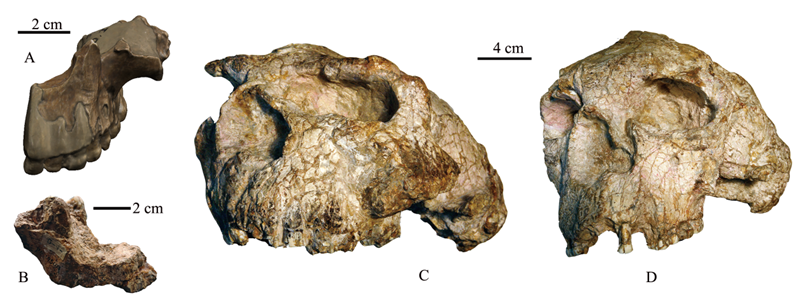
In this study, the morphological features in the circum-nasal region of 22 Chinese hominin fossils were described and compared. Our study indicates that the circum-nasal region morphology of Pleistocene humans in China exhibited marked evolutionary changes. Homo erectus, Middle Pleistocene humans, and Late Pleistocene early modern humans showed different patterns. In addition, there were intragroup variations among Chinese hominins from different chronological periods.
The nasal aperture of H. erectus exhibited some common morphological patterns: 1) a sharp lateral margin; 2) a sharp lower margin that formed a clear border dividing the naso-alveolar clivus and the nasal cavity; 3) the absence of a subnasal fossa, resulting in a flat upper portion of the naso-alveolar clivus; 4) a weak or absent anterior nasal spine.
The nasal apertures of late Middle Pleistocene hominins showed some specific patterns: 1) the nasal aperture was wide and low, with the horizontal size larger than the vertical size; 2) a sharp lateral margin; 3) a sharp lower margin forming a clear border; 4) all the specimens had a subnasal fossa that, together with the lower margin, divided the naso-alveolar clivus and the nasal cavity; 5) the anterior nasal spines were either weak or moderately developed; 6) the subnasal fossae showed different morphological patterns.
The nasal apertures of Late Pleistocene hominins also showed some common patterns: 1) the height of the nasal aperture increased; 2) the lower margin in most specimens was open, with a flat transition between the naso-alveolar clivus and the nasal cavity; 3) nearly all the specimens had a subnasal fossa, with the exception of Yahuaidong; 4) the anterior nasal spines were pronouncedly developed in most specimens; 5) the relative size of the nasal apertures seemed to be irregular; 6) the lower margins in some specimens (UC 101 and Maludong) exhibited a morphological pattern resembling that of late Middle Pleistocene hominins and different from those of other specimens from this time period.
Except for these characteristics of the nasal aperture mentioned above, compared with Holocene populations, the nasal apertures of Pleistocene hominins were lower. Both H. erectus and late Middle Pleistocene hominins had clear lower borders of the nasal aperture. The lower borders of the nasal aperture in most Late Pleistocene hominins were open, with a flat transition between the naso-alveolar clivus and the nasal cavity. The subnasal fossa seemed to appear from the late Middle Pleistocene. The anterior nasal spine also seemed to appear in the late Middle Pleistocene and became more pronounced gradually. Starting from the Late Pleistocene, the development of the anterior nasal spine showed variabilities, with the northern specimen of Upper Cave having a pronounced anterior nasal spine, and the southern specimens of Liujiang and Longlin showing weak anterior nasal spines.
Key words: hominins; skull; nasal aperture; morphological variations
LIU Wu , HE Jianing , WU Xiujie . Morphological variations of circum-nasal region of the Pleistocene human skulls in China[J]. Acta Anthropologica Sinica, 2026 , 45(01) : 18 -33 . DOI: 10.16359/j.1000-3193/AAS.2025.0001
| [1] | Weidenreich F. The Skull of Sinanthropus pekinensis: A Comparative Study of A Primitive Hominid Skull[M]. Palaeontologica Sinica N.S. D10, The Geological Survey of China, 1943, 1-484 |
| [2] | Franciscus R, Trinkaus E. Nasal morphology and the emergence of Homo erectus[J]. American Journal of Physical Anthropology, 1988, 75: 517-527 |
| [3] | McCollum MA, Grine FE, Ward SC, et al. Subnasal morphological variation in extant hominoids and fossil hominids[J]. J Hum Evol, 1993, 24: 87-111 |
| [4] | McCollum MA, Ward SC. Subnasoalveolar anatomy and hominoid phylogeny: evidence from comparative ontogeny[J]. Am J Phys Anthropol, 1997, 102: 377-405 |
| [5] | Schwartz JH, Tattersall I, Teschler-Nicola M. Architecture of the nasal complex in Neanderthals: Comparison with other hominids and phylogenetic significance[J]. The Anatomical Record, 2008, 291: 1517-1534 |
| [6] | McCollum M. Subnasal Morphological variation in fossil hominids: a reassessment based on new observations and recent developmental findings[J]. American Journal of Physical Anthropology, 2000, 112: 275-283 |
| [7] | Gower CD. A contribution to the morphology of the apertura piriformis[J]. American Journal of Physical Anthropology, 1923, 6: 26-36 |
| [8] | Tran CNH, Schroeder L. Common evolutionary patterns in the human nasal region across a worldwide sample[J]. American Journal of Physical Anthropology, 2021, 176: 422-433 |
| [9] | 刘武, 何嘉宁, 严毅, 等. 现代人群颅骨梨状孔区域形态变异[J]. 人类学学报, 2023, 42: 445-457 |
| [10] | Carey JW, Steegmann AT. Human nasal protrusion, latitude and climate[J]. American Journal of Physical Anthropology, 1981, 56: 313-319 |
| [11] | Hubbe M, Hanihara T, Harvati K. Climate signatures in the morphological differentiation of worldwide modern human populations[J]. Anatomical Record, 2009, 292: 1720-1733 |
| [12] | Noback ML, Harvati K, Spoor F. Climate-related variation of the human nasal cavity[J]. American Journal of Physical Anthropology, 2011, 145: 599-614 |
| [13] | Zaidi AA, Mattern BC, Claes P, et al. Investigating the case of human nose shape and climate adaptation[J]. PLoS Genetics, 2017, 13: e1006616 |
| [14] | Butaric LN, Klocke RP. Nasal variation in relation to highaltitude adaptations among Tibetans and Andeans[J]. American Journal of Human Biology, 2018, 30: 1-14 |
| [15] | 吴新智. 山顶洞人的种族问题[J]. 古脊椎动物与古人类, 1960, 2: 141-148 |
| [16] | 吴新智. 周口店山顶洞人化石的研究[J]. 古脊椎动物与古人类, 1961, 3: 181-203 |
| [17] | 吴汝康, 张银运, 吴新智. 南京直立人1号头骨[A]. 见:吴汝康,李星学,吴新智,等(编). 南京直立人[C]. 南京: 江苏科学技术出版社, 2002, 35-67 |
| [18] | 张银运, 刘武, 张罗. 南京直立人的鼻骨形态及其与欧洲化石人类基因交流的可能性[J]. 人类学学报, 2004, 23: 187-195 |
| [19] | 吴新智, 尚虹. 南京直立人的高鼻梁是由于对寒冷气候的适应吗[J]. 人类学学报, 2007, 26: 289-294 |
| [20] | Lumley MA de, Grimaud-Hervé D, Li TY, et al. Les cranes d’ Homo erectus du site de L; Homme de Yunxian Quyuanhekou, Quingqu, Yunxian I et Yunxian II, Province du Hubei, République Populaire de Chine[A]. In: de Lumley H, Li TY(Eds). Le site de l’homme de Yunxian Quyuanhekou, Quibgqu, Yunxian, Province du Hubei[C]. 2008 |
| [21] | Ni XJ, Ji Q, Wu WS, et al. Massive cranium from Harbin in northeastern China establishs a new Middle Pleistocene human lineage[J]. The Innovation, 2021, 2: 100130 |
| [22] | Curnoe D, Ji XP, Herries A, et al. Human remains from the Pleistocene-Holocene transition of Southwest China suggest a complex evolutionary history for East Asians[J]. PLoS ONE, 2012, 7: e31918 |
| [23] | Schwartz JH, Pantoja-Pérez A, Arsuaga JJ. The nasal region of the -417 ka Sima de los Huesos (Sierra de Atapuerca, Spain) Hominin: New terminology and implications for later human evolution[J]. The Anatomic Record, 2022, 305: 1991-2029 |
| [24] | 邵象清. 人体测量手册[M]. 上海: 上海辞书出版社, 1985, 1-492 |
| [25] | Schwartz JH. What constitutes Homo sapiens? Morphology versus received wisdom[J]. Joural of Anthropological Sciences, 2016, 94: 1-16 |
/
| 〈 |
|
〉 |