


Gigantopithecus blacki discovered in the Early-Middle Pleistocene transition phase in Yanli Cave 1, Chongzuo, Guangxi
Received date: 2025-11-03
Revised date: 2026-02-04
Online published: 2026-04-17
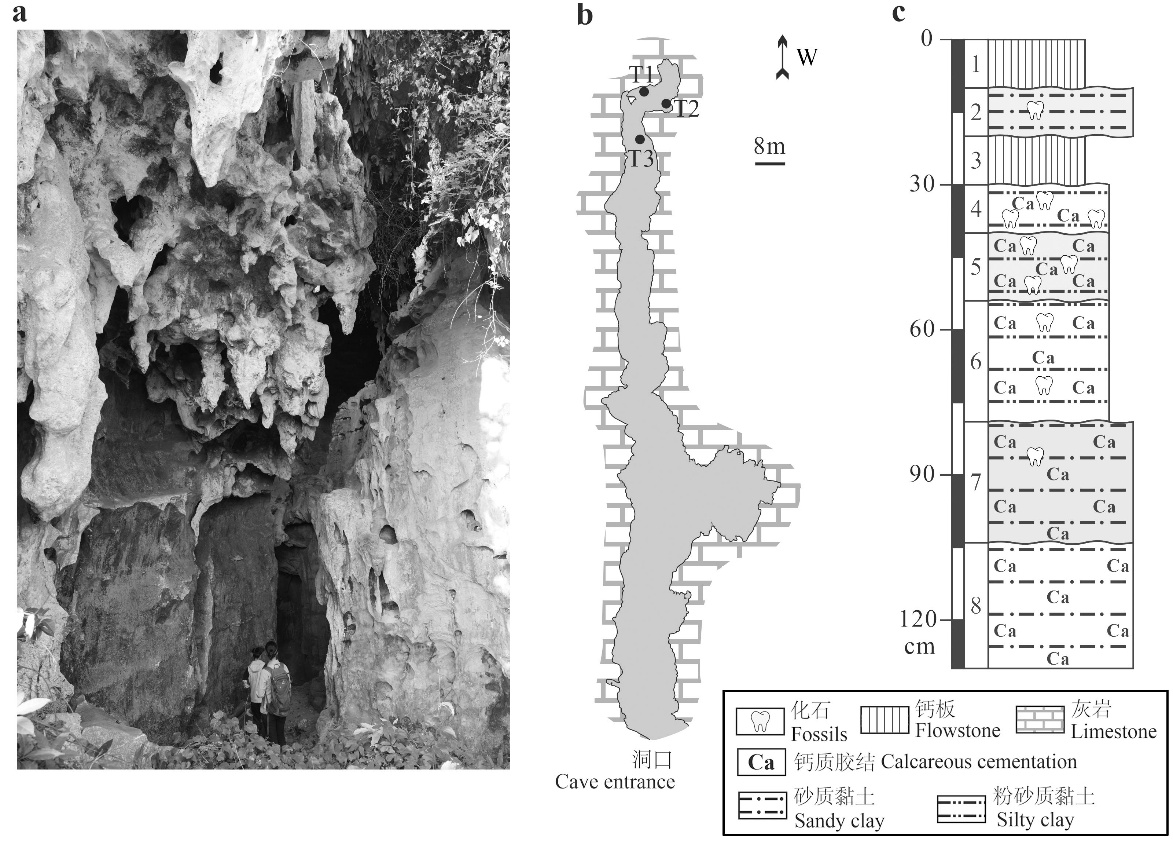
Gigantopithecus blacki is hypothesized to have been the largest primate species. Its fossil record is predominantly concentrated in the Early Pleistocene, followed by the Middle Pleistocene, while materials from the Early-Middle Pleistocene transition (EMPT, 1.2~0.7 Ma) remain relatively scarce, therefore limiting in-depth exploration of the Gigantopithecus evolutionary patterns against the backdrop of climatic shifts during the Middle Pleistocene Revolution. Systematic excavations at Yanli Cave 1 in Chongzuo, Guangxi, conducted between late 2023 and early 2024, yielded 13 dental specimens of G. blacki. The associated mammalian fossil assemblage has been identified as comprising 6 orders, 17 families, 27 genera, and 30 species. The Primates include G. blacki, Pongo weidenreichi, Hylobates sp., Macaca sp., Rhinopithecus sp., and Trachypithecus sp. The Rodentia include Hystrix kiangsenensis. The Carnivora include Cuon javanicus antiquus, Panthera tigris, Neofelis nebulosa, Catopuma temminckii, Viverra sp., Ursus thibetamus, Ailuropoda wulingshanensis, A. melanoleuca baconi, Arctonyx collaris, and Meles leucurus. The Perissodactyla include Rhinoceros sondaicus and Tapirus sinensis. The Artiodactyla consist of Sus peii, S. xiaozhu, Cervus unicolour, Elaphodus cephalophus, Muntiacus muntjak, M. reevesi, Capricornis sumatraensis, Megalovis guangxiensis, and Bos gaurus. The Proboscidea include Stegodon cf. S. orientalis and Elephas maximus. The mammalian assemblage associated with these giant ape fossils includes both late Early Pleistocene representative taxa such as A. wulingshanensis, as well as Middle Pleistocene forms like A. melanoleuca baconi. The faunal assemblage indicates a biostratigraphic age of EMPT. Comparative analysis of tooth dimensions with Gigantopithecus fossils from other localities reveals that some specimens (447, 418, 043, 653, and SG-2) from Yanli Cave 1 retain the relatively small-sized characteristic generally found in the early Early Pleistocene populations. However, other specimens (589, 326, and 715) approach the large dental size commonly found in the late Early Pleistocene populations and larger size ranges documented in the Middle Pleistocene populations. These findings are consistent with the biochronological assessment. Following the discoveries at Queque Cave and Zhanwang Cave (both located at Chongzuo, Guangxi), Yanli Cave 1 represents as a third potential EMPT Gigantopithecus locality, likely offering crucial evidence for understanding dental evolutionary patterns and adaptive strategies in response to EMPT climatic shifts.
YAO Yanyan , AI Wanting , HU Minhang , FU Qiongyao , LI Guoshan , ZHONG Jiemei , HU Pengcheng , HUANG Shengmin , TIAN Chun , LIANG Hua , LIAO Wei , WANG Wei , YI Zhixing . Gigantopithecus blacki discovered in the Early-Middle Pleistocene transition phase in Yanli Cave 1, Chongzuo, Guangxi[J]. Acta Anthropologica Sinica, 2026 , 45(02) : 199 -209 . DOI: 10.16359/j.1000-3193/AAS.2026.0010
| [1] | Von Koenigswald GHR. Eine fossile Säugetierfauna mit Simiaaus Südchina[J]. Proceedings of the Koniklijke Nederlandse Akademie van Wetenschappen Series B, 1935, 38: 872-879 |
| [2] | Zhang YQ, Harrison T. Gigantopithecus blacki: A giant ape from the Pleistocene of Asia revisited[J]. American Journal of Physical Anthropology, 2017, 162: 153-177 |
| [3] | Weidenreich F. Giant early man from Java and South China[J]. Anthropological Papers of the American Museum of Natural History, 1945, 40: 1-134 |
| [4] | Gelvin BR. Morphometric affinities of Gigantopithecus[J]. American Journal of Physical Anthropology, 1980, 53(4): 541-568 |
| [5] | 裴文中, 吴汝康. 华南新发现的巨猿牙齿化石[J]. 古生物学报, 1956, 4(4): 477-490 |
| [6] | 张立召, 赵凌霞. 巨猿牙齿釉质厚度及对食性适应与系统演化的意义[J]. 人类学学报, 2013, 32(3): 365-376 |
| [7] | Welker F, Ramos-Madrigal J, Kuhlwilm M, et al. Enamel proteome shows that Gigantopithecus was an early diverging pongine[J]. Nature, 2019, 576(7786): 262-265 |
| [8] | 张颖奇. 步氏巨猿研究九十年的回顾与展望[J]. 人类学学报, 2024, 43(6): 1006-1026 |
| [9] | Zhang YQ, Westaway KE, Haberle S, et al. The demise of the giant ape Gigantopithecus blacki[J]. Nature, 2024, 625(7995): 535-539 |
| [10] | 吴汝康. 巨猿下颌骨和牙齿化石[M]. 北京, 科学出版社, 1962, 1-94 |
| [11] | 张银运, 吴茂霖, 刘金荣. 广西武鸣新发现的巨猿牙齿化石[J]. 科学通报, 1973, 3: 130-133 |
| [12] | 赵凌霞, 同号文, 许春华, 等. 贵州毕节发现的巨猿牙齿化石及其意义[J]. 第四纪研究, 2006, 26(4): 548-554 |
| [13] | Wang W. New discoveries of Gigantopithecus blacki teeth from Chuifeng Cave in the Bubing Basin, Guangxi, South China[J]. Journal of Human Evolution, 2009, 57(3): 229-240 |
| [14] | 金昌柱, 秦大公, 潘文石, 等. 广西崇左三合大洞新发现的巨猿动物群及其性质[J]. 科学通报, 2009, 54(6): 765-773 |
| [15] | Zhang YQ, Jin CZ, Kono RT, et al. A fourth mandible and associated dental remains of Gigantopithecus blacki from the Early Pleistocene Yanliang Cave, Fusui, Guangxi, South China[J]. Historical Biology, 2016, 28(1-2): 95-104 |
| [16] | 胡海虔, 黄万波, 魏光飚, 等. 重庆武隆早更新世地层中发现巨猿化石[J]. 人类学学报, 2024, 43(5): 701-711 |
| [17] | Noerwidi S, Siswanto, Widianto H. Giant primate of Java: A new Gigantopithecus specimen from Semedo[J]. Berkala Arkeologi, 2016, 36: 141-160 |
| [18] | 许春华, 韩康信, 王令红. 鄂西巨猿化石及共生的动物群[J]. 古脊椎动物与古人类, 1974, 12(4): 293-309 |
| [19] | 黄万波, 方其仁. 巫山猿人遗址[M]. 北京: 海洋出版社, 1991, 1-230 |
| [20] | 王頠, 田丰, 莫进尤. 广西布兵盆地么会洞发现的巨猿牙齿化石[J]. 人类学学报, 2007, 26(4): 329-343 |
| [21] | Jin CZ, Wang Y, Deng CL, et al. Chronological sequence of the early Pleistocene Gigantopithecus faunas from cave sites in the Chongzuo, Zuojiang River area, South China[J]. Quaternary International, 2014, 354: 4-14 |
| [22] | 张银运, 王令红, 董兴仁, 等. 广西巴马发现的巨猿牙齿化石[J]. 古脊椎动物与古人类, 1975, 13(3): 148-153+201 |
| [23] | Zhang YQ, Jin CZ, Cai YJ, et al. New 400-320 ka Gigantopithecus blacki remains from Hejiang Cave, Chongzuo City, Guangxi, South China[J]. Quaternary International, 2014, 354: 35-45 |
| [24] | Clark PU, Archer D, Pollard D, et al. The middle Pleistocene transition: Characteristics, mechanisms, and implications for long-term changes in atmospheric pCO2[J]. Quaternary Science Reviews, 2006, 25(23-24): 3150-3184 |
| [25] | Lisiecki LE, Raymo ME. A Pliocene-Pleistocene stack of 57 globally distributed benthic δ18O records[J]. Paleoceanography, 2005, 20(1): PA1003 |
| [26] | 王婷, 孙有斌, 刘星星. 中更新世气候转型:特征、机制和展望[J]. 科学通报, 2017, 62(33): 3861-3872 |
| [27] | Ao H, Rohling EJ, Li XZ, et al. Northern hemisphere ice sheet expansion intensified Asian aridification and the winter monsoon across the mid-Pleistocene transition[J]. Communications Earth & Environment, 2023, 4(1): 36 |
| [28] | Herbert TD. The Mid-Pleistocene Climate Transition[J]. Annual Review of Earth and Planetary Sciences, 2023, 51: 389-418 |
| [29] | Zhang YY. Variability and evolutionary trends in tooth size of Gigantopithecus blacki[J]. American Journal of Physical Anthropology, 1982, 59(1): 21-32 |
| [30] | Zhang YQ, Kono RT, Wang W, et al. Evolutionary trend in dental size in Gigantopithecus blacki revisited[J]. Journal of Human Evolution, 2015, 83: 91-100 |
| [31] | Zhang YQ, Kono RT, Jin CZ, et al. Possible change in dental morphology in Gigantopithecus blacki just prior to its extinction: Evidence from the upper premolar enamel-dentine junction[J]. Journal of Human Evolution, 2014, 75: 166-171 |
| [32] | 王頠. 广西田东么会洞早更新世人猿超科化石及其在早期人类演化研究上的意义[D].博士学位毕业论文, 武汉: 中国地质大学(武汉), 2005, 1-150 |
| [33] | White TD. New fossil hominids from Laetolil, Tanzania[J]. American Journal of Physical Anthropology, 1977, 46(2): 197-229 |
| [34] | Suwa G, Kono RT, Simpson SW, et al. Paleobiological implications of the Ardipithecus ramidus dentition[J]. Science, 2009, 326(5949): 94-99 |
| [35] | 张银运. 哺乳动物[C].见:郑绍华(主编).建始人遗址[M]. 北京: 科学出版社, 2004, 67-76 |
| [36] | Mahler PE. Metric variation in the pongid dentition[D]. PhD thesis, Michigan: The University of Michigan, 1973, 1-467 |
| [37] | Swindler DR. Primate dentition: An introduction to the teeth of non-human primates[M]. New York: Cambridge University Press, 2002, 1-296 |
/
| 〈 |
|
〉 |