


Newly discovered early Late Pleistocene orangutan teeth from southern China
Received date: 2025-11-03
Revised date: 2026-02-25
Online published: 2026-04-17
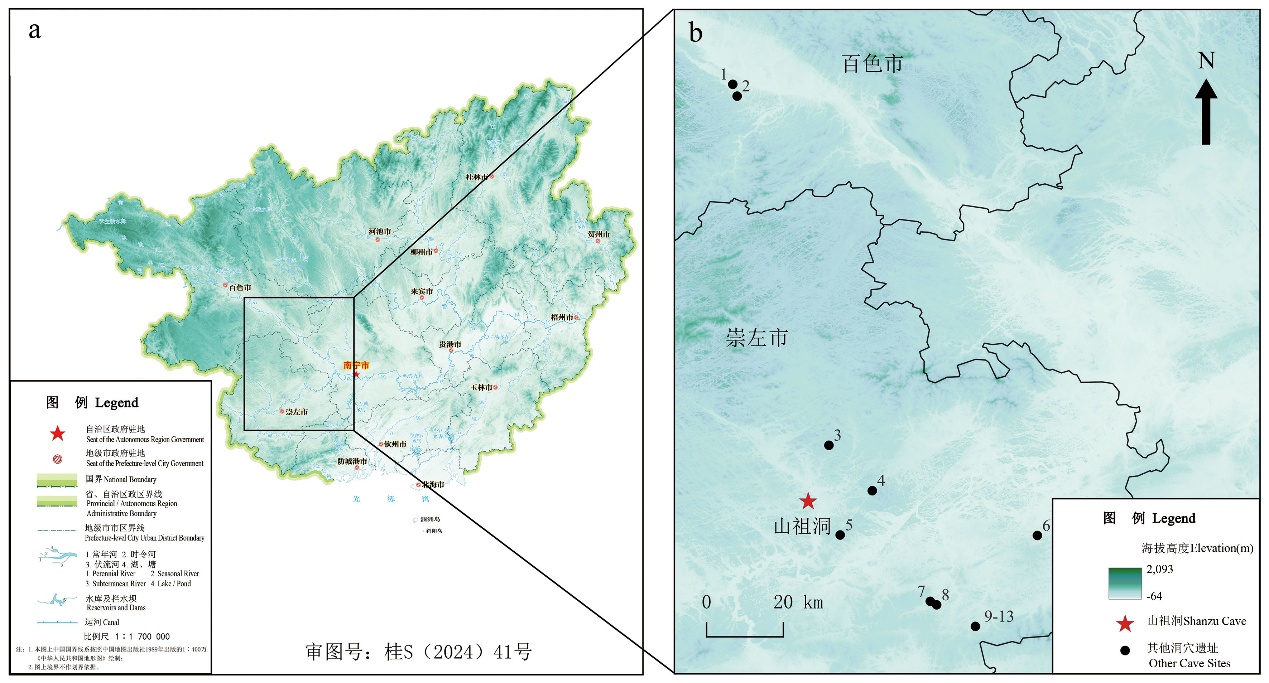
During the Pleistocene, orangutans were widely distributed across southern China. Although the fossil record of orangutans in South China spans the entire Pleistocene period, materials from the early Late Pleistocene remain insufficiently studied. Here we report on orangutan tooth fossils from the Shanzu Cave which is located in Xinhe Town, Jiangzhou District, Chongzuo City, Guangxi. The interior of the cave is relatively wide, exceeding 1 m in width, and extends approximately 30 m in length, with the overall cave structure running east-west. Approximately 20 meters from the main entrance lies a side passage. Both the main passage and the side passage retain deposits. Fossils of mammals such as Pongo, Ailuropoda melanoleuca baconi, and Sus scrofa were collected from the surface layers near the cave entrance and along the central passageway. In 2017, researchers from Natural History Museum of Guangxi and Anthropology Museum of Guangxi conducted excavations at this cave. Prior to systematic excavation, based on the preservation and distribution of sediments in the cave, researchers established excavation unit T1 at the side passage approximately 20 meters from the main entrance. After clearing disturbed surface deposits, excavation proceeded in 10-centimeter-thick horizontal layers from top to bottom, reaching a maximum depth of approximately 225 cm. The Shanzu Cave mammal fauna includes key members of the “Ailuropoda-Stegodon” Fauna (Ailuropoda melanoleuca baconi, Tapirus augustus, Elephas maximus, Stegodon orientalis). Based on the faunal composition, the Shanzu Cave mammal fauna is restricted to the Late Middle Pleistocene to Late Pleistocene. Additionally, limited uranium-series dating data has been obtained from Shanzu Cave. A geochronological sample from the T1 section of Shanzu Cave, taken 40 cm below the top of the excavation grid, yielded a radiometric age of 126.72±0.61 ka. Based on evidence from the mammal fossil assemblage and radiometric dating, the Shanzu Cave site is preliminarily dated to the Early Late Pleistocene. 179 orangutan tooth fossils excavated from the Shanzu Cave site provide new insights into the taxonomy and evolutionary history of orangutans during a critical but poorly documented period. Metric analyses reveal that the Shanzu Cave teeth are, on average, approximately 18% larger than those of extant Pongo. This size falls within the documented range of variation for P. weidenreichi. Morphologically, the maxillary molars exhibit a high frequency of a well-developed lingual cingulum, a feature consistent with the diagnosis of P. weidenreichi. In contrast, the complexity of enamel folding on the molars is comparable to that observed in extant Pongo. Furthermore, the dental metrics reinforce the hypothesis of a non-linear reduction in dental size of orangutan from the Early to the Late Pleistocene. Following a previously documented size decrease during the Middle Pleistocene, the early Late Pleistocene Shanzu Cave teeth are notably larger than those from Middle Pleistocene localities, yet distinctly smaller than the Late Pleistocene specimens from Yicun Cave in the same region. This pattern argues for a phased pattern of dental size evolution of orangutan during the Pleistocene of southern China.
Key words: Guangxi; Shanzu Cave; orangutan teeth; evolution; environmental change
XU Shilin , YANG Yuwei , LIANG Hua , YAO Yanyan , TIAN Chun , DONG Ruxun , HUANG Nannan , LIAO Wei , WANG Wei . Newly discovered early Late Pleistocene orangutan teeth from southern China[J]. Acta Anthropologica Sinica, 2026 , 45(02) : 236 -247 . DOI: 10.16359/j.1000-3193/AAS.2026.0017
| [1] | Young CC. On some fossil mammals from Yunnan[J]. Bulletin of the Geological Society of China, 1932, 11(4): 383-393 |
| [2] | Pei W. Fossil mammals from the Kwangsi caves[J]. Bulletin of the Geological Society of China, 1935, 14: 413-425 |
| [3] | Bien M, Chia L. Cave and rock-shelter deposits in Yunnan[J]. Bulletin of the Geological Society of China, 1938, 18: 325-347 |
| [4] | Hooijer DA. Prehistoric teeth of man and of the orang-utan from central Sumatra, with notes on the fossil orang-utan from Java and southern China[M]. Leiden: Zoologische Mededeelingen, 1948, 175-301 |
| [5] | Pei W. Discovery of Gigantopithecus mandibles and other material in Liucheng district of central Kwangsi in South China[J]. Vertebrata PalAsiatica, 1957, 1(2): 65-71 |
| [6] | 张玉萍. 广东肇庆更新世哺乳类化石[J]. 古脊椎动物与古人类, 1959, 1: 141-144 |
| [7] | 裴文中. 广西柳城巨猿洞及其他山洞的第四纪哺乳动物[J]. 古脊椎动物与古人类, 1962, 6: 211-218 |
| [8] | 吴新智, 越资奎, 袁振新, 等. 广西东北地区调查简报[J]. 古脊椎动物与古人类, 1962, 6: 408-414 |
| [9] | 刘昌芝. 粤北第四纪哺乳动物化石调查简报[J]. 古脊椎动物与古人类, 1962, 6: 202-203 |
| [10] | 裴文中, 袁振新, 林一朴, 等. 貴州黔西县观音洞试掘报告[J]. 古脊椎动物与古人类, 1965, 9(3): 270-279 |
| [11] | 张银运, 王令红, 董兴仁. 广西巴马发现的巨猿牙齿化石[J]. 古脊椎动物与古人类, 1975, 13: 148-153 |
| [12] | 吴茂霖, 王令红, 张银运, 等. 贵州桐梓发现的古人类化石及其文化遗物[J]. 古脊椎动物与古人类, 1975, 13: 14-23 |
| [13] | 韩德芬, 许春华, 易光远. 广西柳州笔架山第四纪哺乳动物化石[J]. 古脊椎动物与古人类, 1975, 13(4): 250-256 |
| [14] | Aigner JS. Pleistocene faunal and cultural stations in South China[J]. In: Ikawa-Smith F(Ed.). Early Palaeolithic in South and East Asia[C]. The Hague: Mouton Publishers, 1978, 129-160 |
| [15] | 陈德珍, 祁国琴. 云南西畴人类化石及共生的哺乳动物群[J]. 古脊椎动物与古人类, 1978, 16(1): 33-46 |
| [16] | 宋方义, 邱立诚, 王令红. 广东封开黄岩洞古人类文化遗址简讯[J]. 古脊椎动物与古人类, 1981, 19(1): 85-86 |
| [17] | 韩德芬. 广西大新黑洞哺乳动物化石[J]. 古脊椎动物与古人类, 1982, 20(1): 58-64 |
| [18] | 李有恒, 吴茂霖, 彭书琳, 等. 广西田东县祥周公社定模洞调查报告[J]. 人类学学报, 1985, 4(2): 127-131 |
| [19] | 顾玉珉, 王淑琴, 张文定, 等. 广西洞穴调查报告[J]. 人类学学报, 1986, 5(2): 198-199 |
| [20] | 顾玉珉, 黄万波, 宋方义, 等. 两广部分地区猩猩化石的研究[J]. 人类学学报, 1987, 6(4): 272-283 |
| [21] | 黄万波, 宋方义, 郭兴富, 等. 记广东首次发现巨羊及扬子鳄化石[J]. 古脊椎动物学报, 1988, 26(3): 227-231 |
| [22] | Ho CK, Zhou GX, Swindler DR. Dental evolution of the orang-utan in China[J]. Human Evolution, 1995, 10: 249-269 |
| [23] | 顾玉珉, 黄万波, 陈大远, 等. 广东罗定更新世灵长类化石[J]. 古脊椎动物学报, 1996, 34(3): 235-250 |
| [24] | 陈耿娇, 王頠, 莫进尤, 等. 广西田东雾云洞更新世脊椎动物群[J]. 古脊椎动物学报, 2002, 40(1): 42-51 |
| [25] | 周国兴. 华南早期褐猿的分布与演化[J]. 北京自然博物馆研究报告, 2002, 60: 71-87 |
| [26] | 赵凌霞, 同号文, 许春华, 等. 贵州毕节发现的巨猿牙齿化石及其意义[J]. 第四纪研究, 2006, 26(4): 548-554 |
| [27] | Wang W, Potts R, Yuan BY, et al. Sequence of mammalian fossils, including hominoid teeth, from the Bubing Basin caves, South China[J]. Journal of Human Evolution, 2007, 52: 370-379 |
| [28] | 赵凌霞, 王翠斌, 金昌柱, 等. 广西崇左木榄山洞古人类遗址中发现的猩猩类牙齿化石及其分类演化意义[J]. 科学通报, 2009, 54(19): 2920-2926 |
| [29] | 赵凌霞, 张忠文, 戴犁. 贵州毕节团结乡麻窝口洞发现晚更新世猩猩化石[J]. 人类学学报, 2009, 28(2): 191 |
| [30] | Harrison T, Jin C, Zhang Y, et al. Fossil Pongo from the Early Pleistocene Gigantopithecus fauna of Chongzuo, Guangxi, southern China[J]. Quaternary International, 2014, 354: 59-67 |
| [31] | Wang C, Zhao L, Jin C, et al. New discovery of Early Pleistocene orangutan fossils from Sanhe Cave in Chongzuo, Guangxi, southern China[J]. Quaternary International, 2014, 354: 68-74 |
| [32] | Yao Y, Liao W, Bae CJ, et al. New discovery of Late Pleistocene modern human teeth from Chongzuo, Guangxi, southern China[J]. Quaternary International, 2020, 563: 5-12 |
| [33] | Harrison T, Zhang Y, Yang L, et al. Evolutionary trend in dental size in fossil orangutans from the Pleistocene of Chongzuo, Guangxi, southern China[J]. Journal of Human Evolution, 2021, 161: 103090 |
| [34] | Liao W, Harrison T, Yao Y, et al. Evidence for the latest fossil Pongo in southern China[J]. Journal of Human Evolution, 2022, 170: 103233 |
| [35] | Liang H, Harrison T, Shao Q, et al. Middle Pleistocene Pongo from Ganxian Cave in southern China with implications for understanding dental size evolution in orangutans[J]. Journal of Human Evolution, 2023, 178: 103348 |
| [36] | Zhang Y, Westaway KE, Haberle S, et al. The demise of the giant ape Gigantopithecus blacki[J]. Nature, 2024, 625(7995): 535-539 |
| [37] | Liang H, Harrison T, Shao QF, et al. Evidence for the smallest fossil Pongo in southern China[J]. Journal of Human Evolution, 2024, 189: 1035507 |
| [38] | 廖卫. 中国南方猩猩化石的研究进展[J]. 人类学学报, 2024, 43(2): 199-213 |
| [39] | Harrison T. The palaeoecological context at Niah Cave, Sarawak: evidence from the primate fauna[J]. Bulletin of the Indo-Pacific Prehistory Association, 1996, 14: 90-100 |
| [40] | Harrison T. Archaeological and ecological implications of the primate fauna from prehistoric sites in Borneo[J]. Bulletin of the Indo-Pacific Prehistory Association, 2000, 20: 134-146 |
| [41] | Filoux A, Wattanapituksakul A. The Late Pleistocene Orangutan from Tham Prakai Phet: New discoveries[J]. Annales de Paleontologie, 2019, 105: 287-293 |
| [42] | Ibrahim YK, Tshen LT, Westaway KE, et al. First discovery of Pleistocene orangutan (Pongo sp.) fossils in Peninsular Malaysia: Biogeographic and paleoenvironmental implications[J]. Journal of Human Evolution, 2013, 65: 770-797 |
| [43] | Hooijer DA. The orang-utan in Niah Cave prehistory[J]. Sarawak Museum Journal, 1960, 9: 408-42 |
| [44] | Badoux D. Fossil mammals from two deposits at Punung (Java)[D]. PhD thesis, Kemink: University of Utrecht, 1959 |
/
| 〈 |
|
〉 |