


Determining gender based on the images of human barefoot footprints
Received date: 2024-05-17
Revised date: 2025-03-13
Online published: 2026-04-17
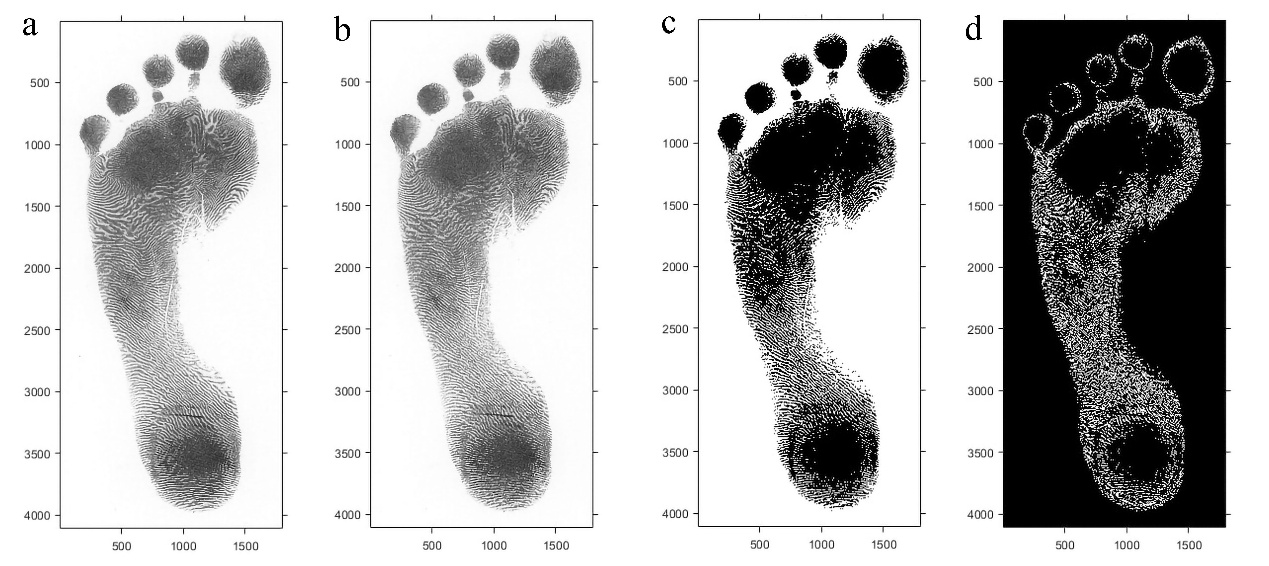
To explore the correlation between barefoot footprints and human gender, this study proposes a gender analysis model based on a Back Propagation (BP) neural network optimized by genetic algorithms. The model integrates footprint morphology, biomechanical principles, and traditional footprint analysis theories. A total of 500 barefoot footprint images from healthy subjects aged 20-30 were collected. These images underwent preprocessing using MATLAB software, including denoising, enhancement, binarization, and edge detection, followed by the extraction of 54 features encompassing grayscale distribution, geometric characteristics, and morphological parameters. Genetic algorithms were employed to select the optimal feature subset, identifying seven key discriminative features such as heel-to-ball distance (dFT6), barefoot ball width (dS1S2), and barefoot length (dOP).
The optimized BP neural network classifier achieved an average accuracy of 84.34% in gender classification, significantly outperforming traditional BP networks (70.10%), logistic regression (75.62%), and support vector machines (78.94%). The analysis revealed that features like heel-to-ball distance and barefoot ball width exhibited strong sexual dimorphism, aligning with anatomical differences between genders. For instance, males generally displayed larger heel-to-ball distances and wider ball regions compared to females. Additionally, geometric features such as the rectangularity and aspect ratio of the metatarsal-arch-heel region further contributed to classification accuracy, reflecting structural variations in footprint morphology.
Statistical significance tests (e.g., t-tests and Mann-Whitney U tests) confirmed that the selected features demonstrated significant gender-related differences (p≤0.05), with high effect sizes (Cohen’s d>0.5) for critical parameters. Notably, while some statistical features (e.g., probability density functions) lacked individual significance, their nonlinear interactions within the neural network enhanced overall model performance. This highlights the importance of feature synergy in machine learning-based classification.
The study underscores the feasibility of applying artificial neural networks to footprint analysis, particularly in forensic contexts. The genetic algorithm’s ability to optimize feature selection and network parameters improved model robustness and generalization, addressing limitations of traditional methods that rely on linear assumptions or manual feature engineering. However, challenges remain, including sample homogeneity and potential errors in ink-based footprint acquisition. Future work should expand datasets to include diverse age groups, refine feature extraction techniques (e.g., incorporating pressure distribution data), and develop integrated software tools for real-world forensic applications.
In conclusion, this research advances the automation and objectivity of footprint-based gender analysis, offering both academic insights and practical value for criminal investigations. By bridging biomechanics, computer vision, and evolutionary computation, the proposed framework demonstrates the potential of machine learning in decoding complex biological patterns embedded in human footprints.
Key words: footprint image; foot type; gender; genetic algorithms
YAO Li , LUO Zhen , GE Heng , MA Xiaoyun , LIN Zhehan . Determining gender based on the images of human barefoot footprints[J]. Acta Anthropologica Sinica, 2026 , 45(02) : 296 -309 . DOI: 10.16359/j.1000-3193/AAS.2025.0024
| [1] | 曲卫东, 沈琦祥, 杨波, 等. 足迹检验技术刍议[J]. 刑事技术, 2004, 2: 47-49 |
| [2] | 吴乐斌. 皮纹密度的初步研究[J]. 人类学学报, 1990, 2(2): 130-138 |
| [3] | 汤澄清. 利用足迹足型特征分析性别的研究[J]. 山西警官高等专科学校学报, 2009, 17(3): 78-80 |
| [4] | 刘丽, 李朋林, 赵东波, 等. 足跖区乳突花纹的类型与分布规律[J]. 中国刑警学院学报, 2020, 5: 88-92 |
| [5] | Moorthy TN, Syarani N, Pritam HMMH. Sexual dimorphism from toe prints among Malaysian Malays for person identification[J]. Journal of Krishna Institute of Medical Sciences University, 2022, 11(1): 1-12 |
| [6] | Kanchan T, Krishan K, Prusty D, Machado M. Heel-Ball index: An analysis of footprint dimensions for determination of sex[J]. Journal of Forensic Medicine, 2014, 1(1): 1-6 |
| [7] | Hemy N, Flavel A, Ishak NI, et al. Sex estimation using anthropometry of feet and footprints in a Western Australian population[J]. Forensic science international, 2013, 231(1-3): 402, e1-e6 |
| [8] | Moudgil R, Kaur R, Menezes RG, et al. Foot index: is it a tool for sex determination?[J]. Journal of Forensic and Legal Medicine, 2008, 15(4): 223-226 |
| [9] | 姬瑞军, 汤澄清, 王明月. 基于Logistic回归模型的赤足迹的性别分析[J]. 四川警察学院学报, 2017, 29(1): 62-68 |
| [10] | 邓宏明, 姚力. 费歇尔判别法在足底压力特征分析中的应用[J]. 云南警官学院学报, 2019, 4: 113-117 |
| [11] | 马振东. 利用星座图法分析足迹性别的研究[J]. 河南司法警官职业学院学报, 2023, 21(3): 75-81 |
| [12] | Hilmi O, Yasemin B, Canan D, et al. Stature and sex estimate using foot and shoe dimensions[J]. Forensic science international, 2005, 147(2-3): 181-184 |
| [13] | 王卫东. 立体足迹重压面分割与形态特征描述[D]. 硕士研究生毕业论文, 郑州: 中国人民解放军信息工程大学, 2005 |
| [14] | 高毅. 起足部位步态特征性别差异研究[J]. 警察技术, 2012, 4: 19-21 |
| [15] | Jung JW, Bien Z, Lee SW, et al. Dynamic Footprint-based Person Identification using Mat-type Pressure sensor[J]. Domestic Journal IEEE EMBC, 2003, 3(3): 2937-2940 |
| [16] | Abledu KJ, Abledu KG, Offei BE, et al. Determination of Sex from Footprint Dimensions in a Ghanaian Population[J]. PLoS ONE, 2017, 10(10): e0139891-e0139891 |
| [17] | 曹俭民, 祁麟, 张一平, 等. 融合标尺信息的足迹性别检验方法[J]. 淮阴师范学院学报:自然科学版, 2024, 23(2): 114-120 |
| [18] | Natarajan N, Cecil GMR. Computer Assisted Analysis of Footprint Geometry[J]. Journal of Forensic Identification, 2005, 55(4): 489 |
| [19] | Basu N, Bandyopadhyay SK. Crime scene reconstruction—Sex prediction from blood stained foot sole impressions[J]. Forensic science international, 2017, 278: 156-172 |
| [20] | 史力民. 足迹学[M]. 北京: 中国人民公安大学出版社, 2007 |
| [21] | 王佐林. 图像分割在文档图像处理中的应用[D]. 硕士研究生毕业论文, 济南: 山东师范大学, 2007 |
| [22] | 郭勇, 李梦超, 谢晓春, 等. 基于LVQ神经网络的图像边沿检测研究[J]. 光学技术, 2021, 47(4): 489-493 |
| [23] | 曾希君, 于博. 基于改进BP神经网络图像边缘检测的研究[J]. 微电子学与计算机, 2009, 26(8): 215-218 |
| [24] | 邱东, 李佳禧, 杨宏韬, 等. 基于信息测度和核函数极限学习机的图像边缘检测[J]. 计算机应用与软件, 2019, 36(10): 156-161 |
| [25] | 董志强. 基于内容的Flash Movies分类研究[D]. 硕士研究生毕业论文, 济南: 山东师范大学, 2012 |
| [26] | Battiti R. First- and Second-Order Methods for Learning: Between Steepest Descent and Newton's Method[J]. Neural Computation, 2014, 4(2): 141-166 |
| [27] | MacKay DJC. A Practical Bayesian Framework for Backpropagation Networks[J]. Neural Computation, 1992, 4(3): 448-472 |
| [28] | Widrow B, Lehr MA. 30 years of adaptive neural networks: perceptron, Madaline, and backpropagation[J]. Proceedings of the IEEE, 2002, 78(9): 1415-1442 |
| [29] | 姬瑞军, 王明月. 支持向量机在不同性别人群足底压力分析识别中的应用[J]. 科技资讯, 2017, 15(24): 248-249+252 |
| [30] | 史力民, 李硕, 赵悦岑. 基于深度学习的赤足迹性别自动分析研究[J]. 中国刑警学院学报, 2018, 3: 97-99 |
/
| 〈 |
|
〉 |