


Dermatoglyphic phenome of the Mongolian people in Inner Mongolia
Received date: 2025-01-26
Revised date: 2025-05-18
Online published: 2026-04-17
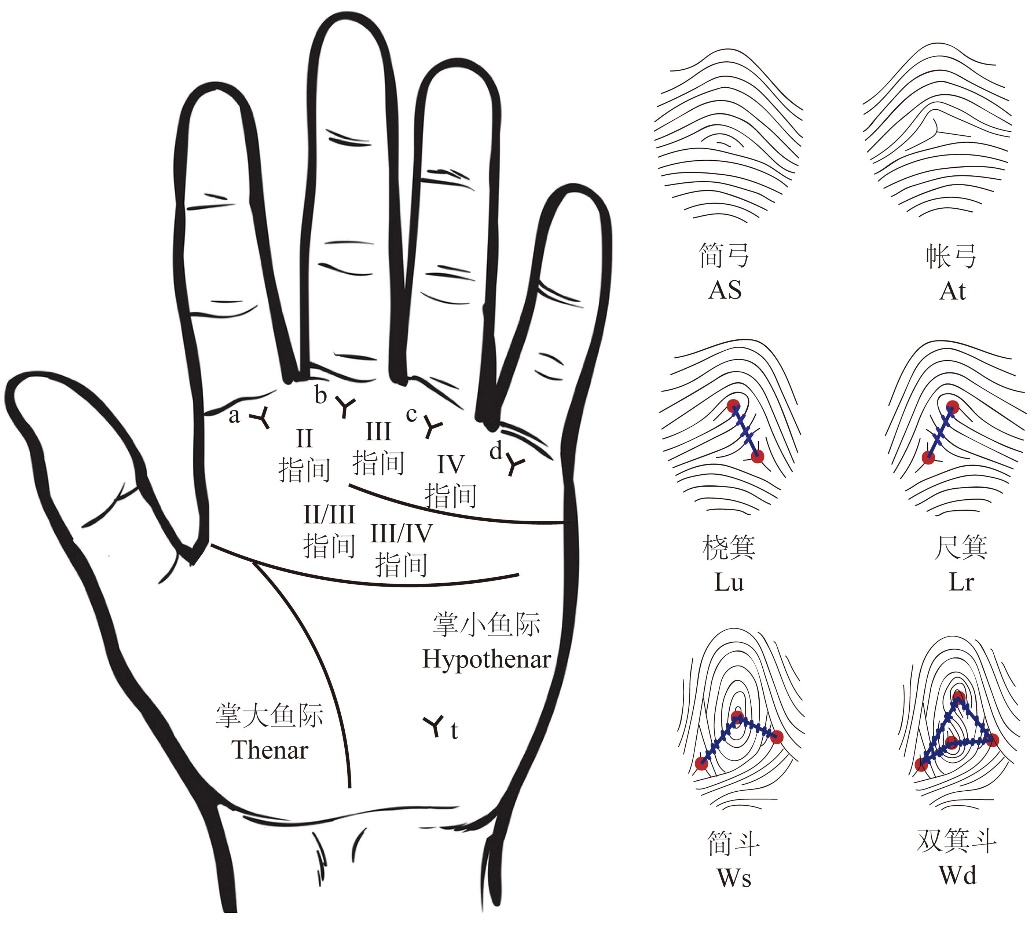
Dermatoglyphics, formed by the raised ridge patterns on the skin surface, play a crucial role in personal identification, population genetics, and disease diagnosis. This study provides the first comprehensive analysis of soleprint phenotypes in the Mongolian population. Additionally, a comprehensive analysis of dermatoglyphic patterns in this population is presented, encompassing frequency distributions and combination characteristics across genders and bilateral sides. Specifically, we examined: 1) fingerprint patterns categorized as simple arch, tented arch, radial loop, ulnar loop, simple whorl, and double whorl; 2) palmprint phenotypes including the pattern in the thenar, hypothenar, interdigital regions II, III, IV, and their transitional regions (II/III, III/IV), along with the prevalence of simian lines, triple radial base lines, cdt triradius; 3) soleprint phenotypes in interdigital regions II, III, and IV, along with patterns observed in the hallucal region, hypothenar region, and calcar region. Our analysis in Mongolian population revealed distinct dermatoglyphic pattern distributions across different fingers: double whorl exhibited higher frequency in thumbs, radial loop predominated in index fingers, ulnar loop showed increased prevalence in middle and little fingers, and simple whorl were more common in ring fingers. Bilateral symmetry was observed in homologous fingers, demonstrating a significant tendency for pattern concordance. The pentadactyl pattern combinations exhibited non-random distribution characteristics. Regarding palmprint configurations, the highest frequency of true patterns was observed in interdigital region IV. Soleprint analysis indicated a predominance of loop pattern on the hallucal region, with arch patterns showing relatively lower frequency. Through cluster analysis and principal component analysis of 39 Chinese ethnic groups with complete soleprint phenotypes, we have identified three distinct population clusters: Southern, Northern, and Central Asian groups, based on dermatoglyphic phenotypes. Intra-site phenotypic correlation analysis demonstrated significant associations between fingerprint patterns, as well as between true patterns in palmprint and soleprint interdigital regions. Cross-site analysis revealed a strong positive correlation between total fingerprint ridge count (TFRC) and palm a-b ridge count (a-b RC), suggesting that populations with higher TFRC tend to exhibit increased ridge counts in the a-b interdigital region. Furthermore, significant correlations were identified between palmar and plantar interdigital regions, with palm interdigital regions showing the highest frequency of true pattern occurrence. These interregional associations warrant further investigation as potential focal points for future research. Notably, soleprint demonstrate significant diagnostic value, contributing up to 25% of the discriminative information in specific disease identification. This study not only fills the gap in the study of Mongolian soleprints, but also provides a theoretical basis for the application of dermatoglyphics in individual identification, population discriminant, and auxiliary diagnosis of diseases.
Key words: dermatoglyphics phenomics; fingerprint; palmprint; soleprint; Mongolian
ZHEN Wentian , ZHANG Haiguo , YANG Haitao , TAN Jingze , QIAO Hui , YUAN Ziyu , ZANG Jun , YAN Mingliang , WANG Jiucun . Dermatoglyphic phenome of the Mongolian people in Inner Mongolia[J]. Acta Anthropologica Sinica, 2026 , 45(02) : 310 -321 . DOI: 10.16359/j.1000-3193/AAS.2025.0043
| [1] | 彼得·威廉斯. 格氏解剖学(第38版)[M].译者:杨林,高英茂. 沈阳: 辽宁教育出版社, 1999, 377 |
| [2] | Cummins H, Midlo C. Finger prints, palms and soles[M]. Philadelphia: New York. Dover Publications, 1961, 45-140 |
| [3] | Mavalwala J. Dermatoglyphics·An International Bibliography[M]. The Hague: Mouton, 1977 |
| [4] | Penrose LS. Finger-Prints, Palms and Chromosomes[J]. Nature, 1963, 197: 933-938 |
| [5] | Reed TE, Borgaonkar DS, Conneally PM, et al. Dermatoglyphic nomogram for the diagnosis of Down’s syndrome[J]. J Pediatr, 1970, 77(6): 1024-1032 |
| [6] | 张海国. 中国肤纹表型组的研究现状与对策[J]. 人类学学报, 2024, 43(4): 675-686 |
| [7] | 沈国文, 徐同祥. 中国指纹史[M]. 北京: 中国人民公安大学出版社, 2015, 91 |
| [8] | 刘持平, 王京. 中华指纹发明史考[M]. 北京: 群众出版社, 2018, 360 |
| [9] | 庄振西, 李印宣, 王贵琛, 等. 600名蒙古族青少年皮纹学研究[J]. 锦州医学院学报, 1984, 5(1): 19 |
| [10] | 丁明, 张海国, 黄明龙. 皮肤纹理学:24个民族皮肤纹理参数[M]. 昆明: 云南科技出版社, 2002, 218-221 |
| [11] | Li JX, Glover JD, Zhang HG, et al. Limb development genes underlie variation in human fingerprint patterns[J]. Cell, 2022, 185(1): 95-112 |
| [12] | 张海国(著). 中华民族肤纹[M]. 北京: 科学出版社, 2021 |
| [13] | 张海国(著). 肤纹学之经典和活力[M]. 北京: 知识产权出版社, 2011 |
| [14] | 张海国(著). 中华56个民族肤纹[M]. 上海: 上海交通大学出版社, 2012 |
| [15] | 张海国(著). 中国民族肤纹学[M]. 福州: 福建科技出版社, 2002, 11-267 |
| [16] | 张海国(著). 人类肤纹学[M]. 上海: 上海交通大学出版社, 2006 |
| [17] | Schaumann B, Alter M. Dermatoglyphics in medical disorders[M]. New York Heidelberg Berlin: Springer-Verlag, 1976 |
| [18] | 谭浩强. BASIC语言[M]. 北京: 科学普及出版社, 1984, 56 |
| [19] | 高惠璇. SAS-系统-SAS/STAT软件使用手册[M]. 北京: 中国统计出版社, 1997, 630 |
| [20] | 杨纪珂. 数理统计方法:在医学科学中的应用[M]. 上海: 上海科学技术出版社, 1964, 244 |
| [21] | 史秉璋, 苏炳华. 实用医学统计手册[M]. 福州: 科学技术出版社, 1987, 126 |
| [22] | 黄明龙, 王亚平, 丁明, 等. 云南蒙古族皮纹学研究[J]. 云南医药, 1985, 1: 52-55 |
| [23] | 高昌荣, 王秀雯, 王有德. 蒙古族儿童手皮纹学482例分析[J]. 内蒙古医学杂志, 1982, 2: 365-368 |
| [24] | 刘丽, 高梦婷, 于洮弘. 3500例男性手指乳突花纹类型的分布规律和对称性分析[J]. 湖南警察学院学报, 2019, 31(4): 20-26 |
| [25] | Rivaldería N, Moreno-Piedra A, Alvarez A, et al. Study of the fingerprints of a Spanish sample for the determination of the hand and finger[J]. Science & Justice, 2024, 64(2): 216-231 |
| [26] | 袁丽华. 德昂族祖先迁徙记忆探究[J]. 文化创新比较研究, 2019, 3(21): 46-48 |
| [27] | 杨勇. 明代白族分布及历史源流探析[D]. 硕士学位毕业论文, 昆明: 云南师范大学, 2013 |
| [28] | Ma X, Yang W, Gao Y, et al. Genetic Origins and Sex-Biased Admixture of the Huis[J]. Mol Biol Evol, 2021, 38(9): 3804-3819 |
| [29] | 张兴华, 张尚才, 宇克莉, 等. 山东、安徽汉族与我国19个族群体质特征的聚类分析与主成分分析[J]. 天津师范大学学报(自然科学版), 2014, 34(3): 76-80 |
| [30] | Li X, Zhang X, Yu T, et al. Whole mitochondrial genome analysis in highland Tibetans: further matrilineal genetic structure exploration[J]. Front Genet, 2023, 14: 1221388 |
| [31] | Zhang M, Yan S, Pan W, et al. Phylogenetic evidence for Sino-Tibetan origin in northern China in the Late Neolithic[J]. Nature, 2019, 569(7754): 112-115 |
| [32] | Feng Q, Lu Y, Ni X, et al. Genetic History of Xinjiang’s Uyghurs Suggests Bronze Age Multiple-Way Contacts in Eurasia[J]. Mol Biol Evol, 2017, 34(10): 2572-2582 |
| [33] | 陈尧峰, 张海国. 台湾客家汉族手肤纹学研究[J]. 解剖学报, 2007, 5: 606-609 |
| [34] | 陈尧峰, 张海国. 台湾闽南汉人肤纹学研究[J]. 人类学学报, 2007, 3: 270-276 |
| [35] | 陈尧峰, 张海国, 赖俊宏, 等. 台湾原住民噶玛兰人肤纹学研究[J]. 中国科学(C辑:生命科学), 2006, 5: 476-480 |
| [36] | 张海国, 陈尧峰, 沈建甫, 等. 台湾阿美原住民肤纹学研究[J]. 中国科学(C辑:生命科学), 2008, 3: 277-284 |
| [37] | Zhang HG, Chen YF, Ding M, et al. Dermatoglyphics from all Chinese ethnic groups reveal geographic patterning[J]. PLoS One, 2010, 5(1): e8783 |
/
| 〈 |
|
〉 |