


The 2015 excavation of the Nanjiagou Paleolithic site in Huailai Basin
Received date: 2024-09-12
Revised date: 2025-01-12
Online published: 2026-04-17
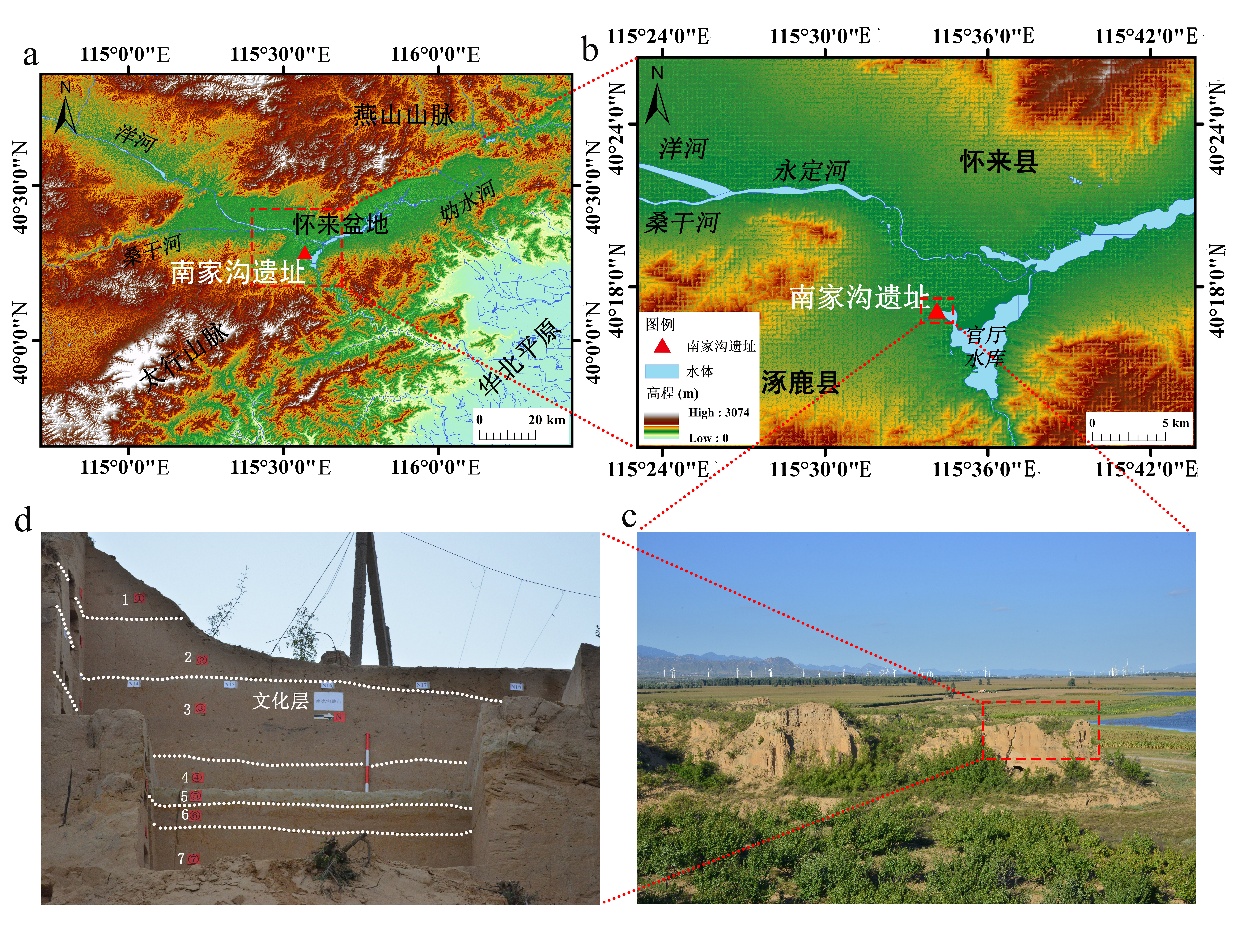
The Nanjiagou Paleolithic site, located in Huailai County of Hebei Province, is a newly discovered and excavated site in North China. The site is situated in the Xinyao Village, Sangyuan Town and buried in the front margin of the second terrace on the right bank of the Yongding River. In September 2015, a joint archaeological team conducted a small-scale test excavation at the site. The excavation exposed one cultural layer with an area of about 10 m2. An ash-heap and a total of 953 stone specimens, 355 animal fossils (including 1 ostrich eggshell and 3 ornaments), burned bones, a large amounts of lithic debris, as well as bone fragments were unearthed. The existing AMS 14C dating indicate that the age of this site is 17 ka~16 ka cal. BP, which also puts the site to the late stage of Upper Paleolithic in North China. The general features lithic assemblage include: 1) The raw materials for stone artifacts were mainly quarried from the gravel layers around the site, while a small amount of high-quality volcanic breccia may have been transported from a distance, and dolomite, siliceous limestone, and lava dominate the rock type; 2) The categories of 950 lithic assemblages include simple cores (n=4; 0.4%), microblade cores (n=50; 5.3%), simple flakes (n=604; 63.6%), microblades (n=86; 9.1%), bipolar flakes (n=3; 0.3%), retouched tools (n=61; 6.4%), chunks (n=142; 14.9%) with small in size. 3) The simple cores were made by direct hammer percussion and most flakes were produced from non-cortical platforms (96.4%) which indicating that they are mostly secondary flake products. All the microblade cores are wedge-shaped cores, with small size, and their refitted groups discovered at Nanjiagou site can reflect the technological procedure of knapping strategy. Some scholars divided wedge-shaped cores into four stages based on their production procedures and degree: prepared, flaking, suspended, and exhausted. The microblade cores and their refitted groups discovered at Nanjiagou site can reflect the technological process of these three stages. 4) The retouched tools are mostly made of chert which can be classified into scrapers, notches, endscrapers, bifacial points, adze-shaped tools, and choppers. There are also cases of using debris and gravel to produce stone tools, as well as reworking waste wedge-shaped cores into tools. Most of animal fossils are in poor condition and the fauna assemblage includes Cervus sp., Equus sp., Aves, Antilopinae, Rodentia, Carnivora and Bovidae, etc. It can be inferred that the discovery of the Nanjiagou site make great significance for improving the evolutionary sequence of lithic technology and systematically exploring the diversity of human survival behaviors during the late Upper Pleistocene in the Huailai Basin even North China.
XUE Feng , NIU Dongwei , LI Dingyuan . The 2015 excavation of the Nanjiagou Paleolithic site in Huailai Basin[J]. Acta Anthropologica Sinica, 2026 , 45(02) : 372 -386 . DOI: 10.16359/j.1000-3193/AAS.2025.0031
| [1] | 牛东伟, 薛峰, 李鼎元, 等. 怀来盆地2014年度旧石器考古调查简报[J]. 人类学学报, 2018, 37(1): 79-87 |
| [2] | 郑荣章, 计凤桔, 李建平. 延怀盆地晚更新世中晚期湖泊发育与气候变化[J]. 地震地质, 2001, 23(1): 55-62 |
| [3] | 杨景春. 怀来盆地之形成、发展、古河道演变与新构造运动的关系[J]. 中国第四纪研究, 1965, 4(2): 93-104 |
| [4] | 朱志义, 郭媛, 张小帅, 等. 河北怀来地区ZK02孔第四系地层结构特征[J]. 地质学刊, 2020, 44(3): 250-257 |
| [5] | Reimer PJ, Bard E, Bayliss A, et al. IntCal13 and Marine13 radiocarbon age calibration curves 0-50,000 years cal BP[J]. Radiocarbon, 2013, 55(4): 1869-1887 |
| [6] | 韩昕宸. 怀来盆地南家沟遗址成因及石制品拼合研究[D]. 硕士研究生毕业论文, 石家庄: 河北师范大学, 2024 |
| [7] | 卫奇. 《西侯度》石制品之浅见[J]. 人类学学报, 2000, 2: 85-96 |
| [8] | 梅惠杰. 泥河湾盆地旧、新石器时代的过渡:阳原于家沟遗址的发现与研究[D].博士研究生毕业论文,北京;北京大学, 2007 |
| [9] | Sullivan AP, Rozen KC. Debitage analysis and archaeological interpretation[J]. American Antiquity, 1985, 50(4): 755-779 |
| [10] | Toth N. The oldowan reassessed: A close look at early stone artifacts[J]. Journal of Archaeological Science, 1985, 12(2): 101-120 |
| [11] | 陈胜前. 细石叶工艺产品废弃的文化过程研究[J]. 人类学学报, 2008, 3: 210-222 |
| [12] | 冯玥, 梅惠杰, 谢飞, 王幼平. 华北北部涌别技法的技术与生产特征:以阳原马鞍山遗址拼合组为例[J]. 中国国家博物馆馆刊, 2024, 6: 33-47 |
| [13] | Cooper JR, Qiu F. Expediting and standardizing stone artifact refitting using a computerized suitability model[J]. Journal of Archaeological Science, 2006, 33(7): 987-998 |
| [14] | 朱之勇, 高星. 虎头梁遗址楔型细石核研究[J]. 人类学学报, 2006, 25(2): 129-142 |
| [15] | 谢飞. 泥河湾的科学意义[N]. 中国文物报,2012-12-05(003) |
| [16] | 郭晓明, 王法岗. 泥河湾百年科学探索述略[J]. 文物春秋, 2021, 4: 3-13 |
| [17] | 高星, 裴树文, 李锋. “泥河湾旧石器考古新进展”专辑介绍[J]. 人类学学报, 2024, 43(1): 1-2 |
| [18] | 谢飞. 品读“泥河湾”[J]. 人类学学报, 2024, 43(1): 3-4 |
| [19] | 薛峰, 肖雨妮, 冷雨亭, 等. 怀来盆地西沟湾1号旧石器地点试掘简报[J]. 人类学学报, 2019, 38(2): 212-222 |
| [20] | 薛峰. 怀来盆地西沟湾1号旧石器地点初步研究[D]. 硕士研究生毕业论文,石家庄;河北师范大学, 2019 |
| [21] | 宋艳花, 石金鸣. 尉家小堡遗址石制品的初步研究[J]. 人类学学报, 2008, 3: 200-209 |
| [22] | 李君, 石晓润, 李树云, 等. 山西大同县南坡旧石器时代遗址试掘简报[J]. 考古, 2018, 2: 3-11 |
| [23] | Guan Y, Wang XM, Wang FG, et al. Microblade Remains from the Xishahe Site, North China and Their Implications for the Origin of Microblade Technology in Northeast Asia[J]. Quaternary International, 2020, 535: 38-47 |
/
| 〈 |
|
〉 |