


Stone artifacts unearthed from Heyaozhuang site of Nihewan Basin in 2013
Received date: 2026-02-04
Accepted date: 2026-04-14
Online published: 2026-06-12
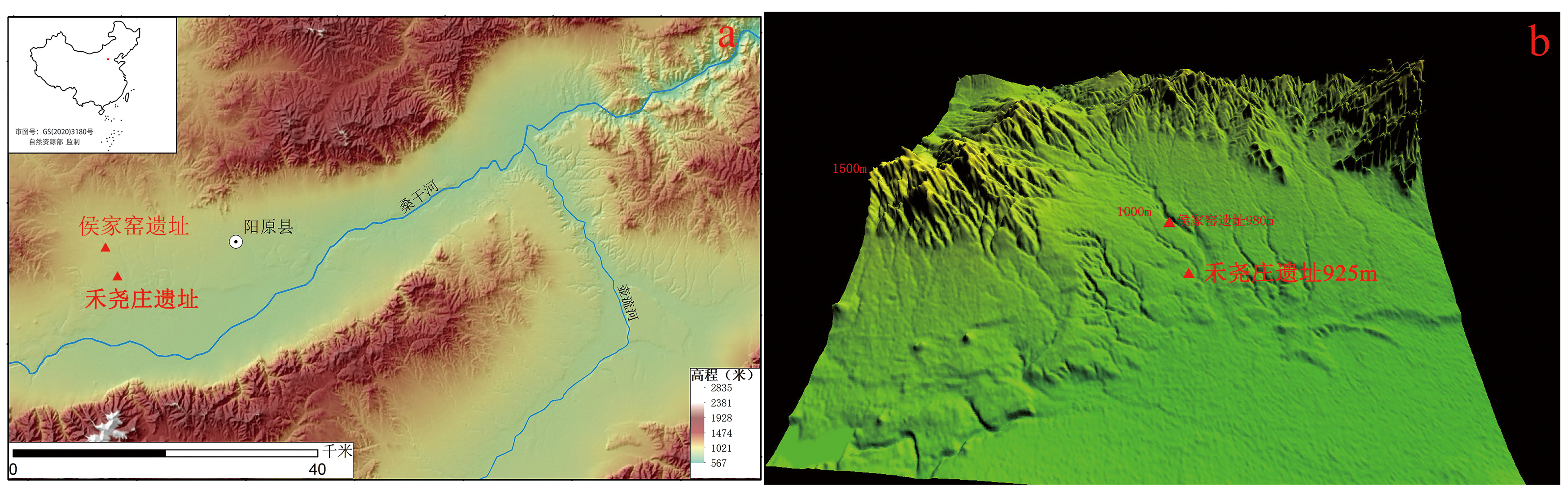
The Heyaozhuang site is located on the western edge of Nihewan Basin. In 2013, the Hebei Provincial Institute of Cultural Relics and Archaeology carried out excavations at the Heyaozhuang site, covering an area of 30 m2. A total of more than 1000 stone artifacts and animal fossils were founded at this site. The raw materials for stone artifacts are relatively abundant. Quartz is the main raw material of the stone artifacts, a certain quantity of high-quality lithic raw materials including flint and agate was recovered, indicative of local sourcing. Hammering is the main method for stripping,,with a relatively high proportion of artifacts using the bipolar percussion technique. But the presence of prismatic cores suggest some efficiency of organization in the reduction sequence, reflecting a progressive aspect of core-flake industry. The artifacts were predominantly small, followed by micro and medium ones; large ones were extremely rare, and giant ones were absent. The artifacts include gravels, hammers, stone cores, flakes, tools, fragments and chunks. There is a low proportion of tools. Scraper was the dominant tool type, along with a small number of denticulates, points, notches, borers and spheriods, which pertain to the tradition of core-flake technology in northern China. The age of Heyaozhuang site is 120~140 ka before present, which fills the gap in the Paleoanthropological cultural record of the Nihewan Basin during the transition from the late Middle Pleistocene period to the Late Pleistocene period, and further enriches and improves the cultural sequence of Paleoanthropological activities within the basin. The Heyaozhuang and Houjiayao sites are located in the same region but differ in age. Their lithic assemblages and stone tool technologies share broad similarities while displaying distinct characteristics, providing key materials for exploring the technological inheritance and development, the evolution of subsistence patterns, and the interrelationships among human groups during the Middle Paleolithic period. The Heyaozhuang site and the Houjiayao site share similar main characteristics but also exhibit some differences. Although the Heyaozhuang site is younger in age, it lacks the more advanced short-bodied end scrapers, burins, and other stone tool types found at the Houjiayao site. Meanwhile, Heyaozhuang site contains relatively abundant denticulate tools and notched scrapers that are absent at Houjiayao site. Whether these differences are attributed to the chronological sequence of the sites or to variations in human groups and subsistence strategies constitutes a highly intriguing research topic. It shares considerable similarities with the Houjiayao site, also located on the western margin of the Nihewan Basin, in terms of lithic raw material selection, stripping methods, lithic artifact dimensions, tool categories and retouching techniques. Notably, spheriods are abundant at both sites, which provides a typical case for investigating the development and evolution of lithic technology, the production and function of spheriods, and the subsistence strategies of Paleoanthropologists.
Key words: Nihewan; Heyaozhuang site; Paleolithic; core-flake industry; spheriods
LIU Heng , HOU Jiaqi , LI Manyue , DONG Liang , WANG Fagang . Stone artifacts unearthed from Heyaozhuang site of Nihewan Basin in 2013[J]. Acta Anthropologica Sinica, 2026 , 45(03) : 436 -446 . DOI: 10.16359/j.1000-3193/AAS.2026.0037
| [1] | 贾兰坡, 卫奇. 阳高许家窑旧石器时代文化遗址[J]. 考古学报, 1976, 2: 97-114 |
| [2] | 贾兰坡, 卫奇, 李超荣. 许家窑旧石器时代文化遗址1976年发掘报告[J]. 古脊椎动物与古人类, 1979, 17(4): 277-293 |
| [3] | 吴茂霖. 许家窑遗址1977年出土的人类化石[J]. 古脊椎动物与古人类, 1980, 18(3): 229-238 |
| [4] | 吴茂霖. 许家窑人颞骨研究[J]. 人类学学报, 1986, 5(3): 220-226. |
| [5] | 王法岗. 侯家窑遗址周围区域旧石器专题调查报告[J]. 文物春秋, 2018, 4: 26-38. |
| [6] | 同号文, 陈曦, 张贝, 等. 河北泥河湾及隆化新发现原始牛化石[J]. 古脊椎动物学报, 2018, 56(1): 69-92 |
| [7] | 卫奇. 石制品观察格式探讨[A].见:邓涛,王原(主编).第八届中国脊椎动物学学术年会论文集[C].北京: 海洋出版社, 2001, 209-218 |
| [8] | 张森水. 中国北方旧石器工业的区域渐进与文化交流[J]. 人类学学报, 1990, 4: 322-333 |
| [9] | 年小美, 周力平, 袁宝印. 泥河湾陆相沉积物光释光年代学研究及其对古湖泊演化的指示意义[J]. 第四纪研究, 2013, 33(3): 403-414 |
| [10] | Guo YJ, Li B, Zhang JF, et al. Luminescence ages for three‘Middle Palaeolithic’sites in the Nihewan Basin, northern China, and their archaeological and palaeoenvironmental implications[J]. Quaternary Research, 2016, 85(3): 456-470 |
| [11] | 左天文, 成洪江, 刘平, 等. 泥河湾盆地后沟旧石器遗址的磁性地层学定年[J]. 中国科学:地球科学, 2012, 42(1): 94-102 |
| [12] | 王法岗, 李锋. “许家窑人”埋藏地层与时代探讨[J]. 人类学学报, 2020, 39(2): 161-172 |
/
| 〈 |
|
〉 |