


Preliminary study on the 2018 excavation of Xinmiaozhuang Locality 2 in the Nihewan Basin
Received date: 2026-03-06
Accepted date: 2026-04-30
Online published: 2026-06-12
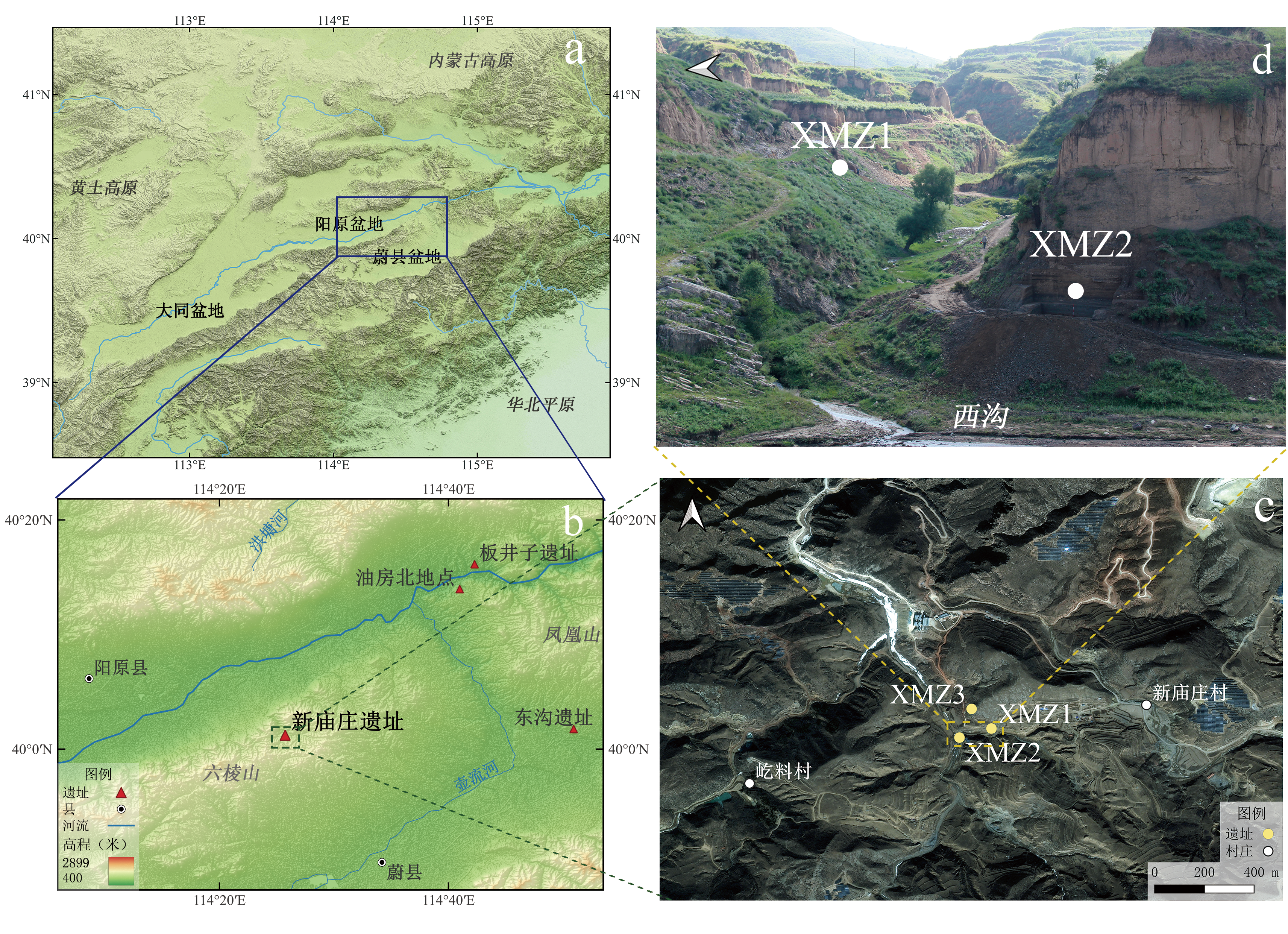
Xinmiaozhuang Locality 2 (XMZ2) is a significant Paleolithic site situated in the southern mountainous region of the Nihewan Basin, North China. Located on the fourth terrace of a tributary gully, it is part of a cluster of Late Pleistocene sites in this topographically complex area. In 2018, a stratigraphic test excavation targeting the lower cultural layer was carried out at the site, yielding 168 stone artifacts and 693 faunal specimens. Preliminary Optically Stimulated Luminescence (OSL) dating places the site in the early Late Pleistocene (approx. 120 ka), corresponding to Marine Isotope Stage 5.
The sedimentary sequence at XMZ2 is relatively thick and can be divided into eight layers, encompassing two cultural phases. Field excavation was restricted to the lower cultural layer, starting from the lower portion of Layer 2, while Layer 8 remained incompletely exposed. This excavated accumulation constitutes a slope deposit. Taphonomic analysis indicates some minor post-depositional disturbance but no clear directional pattern of the archaeological remains.
The lithic assemblage includes cores, flakes, retouched tools, shatters, debris, hammerstones and pebbles. Tuff dominates the lithic raw material assemblage (58.3%), supplemented by non-local siliceous rocks (chert, chalcedony, agate) and local dolomite. Reduction and retouch employed direct hard hammer percussion. Cores are predominantly simple cores (n=5, 83.3%) though platform rotation is frequently attested; one possible discoidal core is noted. Complete flakes are mainly Type V and VI, characterized by multiple dorsal scars, indicating efficient and sustained exploitation of the debitage surfaces. The retouched tool kit (n=24) is diverse, comprising denticulates, scrapers, points, and retouched flakes. These tools are primarily made on flake blanks with simple, unifacial retouch. The technological analysis reveals a selective strategy for raw material: the locally abundant tuff was primarily used for producing larger flakes, while the rarer, finer-grained siliceous materials were preferentially selected and more intensively utilized for the production of retouched tools.
Similar to faunal assemblages at most open-air sites in northern China, the faunal remains from this site are highly fragmented, with no anatomically complete skeletal elements preserved. The identifiable taxa are dominated by woolly rhinoceros (Coelodonta antiquitatis) and Bovini, and the overall faunal composition is consistent with an early Late Pleistocene steppe-grassland landscape. Preliminary taphonomic observations reveal that root etching and bioerosion are common on bone surfaces. Some specimens bear evidence of anthropogenic modification, including cut marks, while sporadic trampling marks and rodent gnaw marks are also present.
In conclusion, the lithic technology at XMZ2 combines simple core reduction with organized debitage and selective raw material use, demonstrating notable technological progression compared to earlier periods within the Nihewan Basin. Preliminary analysis of the faunal remains provides evidence for active hominin exploitation of animal resources. Situated in the southern uplands, XMZ2 enriches the spatial and behavioral record of the early Late Pleistocene in the region. The combined evidence from lithic reduction and faunal exploitation contributes significantly to our understanding of hominin settlement patterns, technological variability, and increasing behavioral complexity in northern China during MIS 5.
SHAN Jialu , LI Yixiao , WANG Fagang , GUO Yujie , LI Feng . Preliminary study on the 2018 excavation of Xinmiaozhuang Locality 2 in the Nihewan Basin[J]. Acta Anthropologica Sinica, 2026 , 45(03) : 447 -461 . DOI: 10.16359/j.1000-3193/AAS.2026.0041
| [1] | Yang SX, Deng CL, Zhu RX, et al. The Paleolithic in the Nihewan Basin, China: Evolutionary history of an Early to Late Pleistocene record in Eastern Asia[J]. Evolutionary Anthropology, 2020, 29(3): 125-142 |
| [2] | 谢飞, 李珺, 刘连强. 泥河湾旧石器文化[M]. 石家庄: 花山文艺出版社, 2006, 139-145 |
| [3] | Wang FG, Guo YJ, Xian Q, et al. Luminescence chronology for the Paleolithic site of Xinmiaozhuang Locality 1 (XMZ1) in the Nihewan Basin, northern China, and its paleoenvironmental and archaeological implications[J]. Journal of Human Evolution, 2021, 157: 103033 |
| [4] | 王法岗, 刘恒, 李锋, 等. 十大考古参评项目——河北阳原新庙庄遗址[N]. 中国文物报,2026-02-16(006-007) |
| [5] | 裴树文. 旧石器时代旷野遗址形成过程研究综述[J]. 人类学学报, 2019, 38(1): 1-18 |
| [6] | 卫奇, 裴树文. 石片研究[J]. 人类学学报, 2013, 32(4): 454-469 |
| [7] | Toth N. The stone technologies of early hominids at Koobi Fora, Kenya: An experimental approach[D]. PhD Thesis, Berkeley: University of California, 1982 |
| [8] | Toth N. The Oldowan reassessed: A close look at early stone artifacts[J]. Journal of Archaeological Science, 1985, 12: 101-120 |
| [9] | 刘武, 吴秀杰. 中更新世晚期中国古人类化石的形态多样性及其演化意义[J]. 人类学学报, 2022, 41(4): 563-575 |
| [10] | Bae CJ, Wu XJ. Making sense of eastern Asian Late Quaternary hominin variability[J]. Nature Communications, 2024, 15(1): 9479 |
| [11] | Yang SX, Martinón-Torres M, Petraglia M. Palaeoanthropological evidence from China is changing the picture of hominin evolutionary history[J]. Nature Ecology & Evolution, 2026, 10: 1-7 |
| [12] | 高星. 关于“中国旧石器时代中期”的探讨[J]. 人类学学报, 1999, 18(1): 3-17 |
| [13] | Gao X, Norton CJ. A critique of the Chinese ‘Middle Palaeolithic’[J]. Antiquity, 2002, 76(292): 397-412 |
| [14] | Li F. Fact or fiction: the Middle Palaeolithic in China[J]. Antiquity, 2014, 88(342): 1303-1309 |
| [15] | Lu Y, Sun XF, Zhao HL, et al. Luminescence dating of Youfangbei early late Pleistocene site, Nihewan Basin, North China[J]. Quaternary Research, 2021, 104: 159-169 |
| [16] | 赵海龙, 谭培阳, 孙雪峰, 等. 河北泥河湾盆地油房北旧石器地点的发现与研究[J]. 第四纪研究, 2021, 41(1): 164-177 |
| [17] | 中国科学院古脊椎动物与古人类研究所, 中国科学院大学, 河北省文物研究所. 河北阳原县板井子旧石器时代遗址2015年发掘简报[J]. 考古, 2018, 11: 3-14+2 |
| [18] | 任进成, 李锋, 陈福友, 等. 泥河湾盆地板井子遗址2015年出土石制品的剥片技术[J]. 人类学学报, 2024, 43(5): 712-726 |
| [19] | Ren JC, Li F, Chen FY, et al. Lithic technology at Banjingzi Locality 1: Implications for the Middle Paleolithic in northern China[J]. Journal of Archaeological Science: Reports, 2025, 65: 105193 |
| [20] | 周士航, 何湘栋, 徐静玥, 等. 蔚县盆地东沟遗址2017年度发掘简报[J]. 人类学学报, 2024, 43(1): 132-142 |
| [21] | 黄冰柔, 牛东伟, 裴树文, 等. 蔚县盆地东沟遗址的光释光年龄[J]. 人类学学报, 2026, 45(1): 1-16 |
/
| 〈 |
|
〉 |