


Luminescence dating of the Paleolithic site of Wujialiang Locality 1 in the Nihewan Basin
Received date: 2026-01-04
Accepted date: 2026-04-22
Online published: 2026-06-12
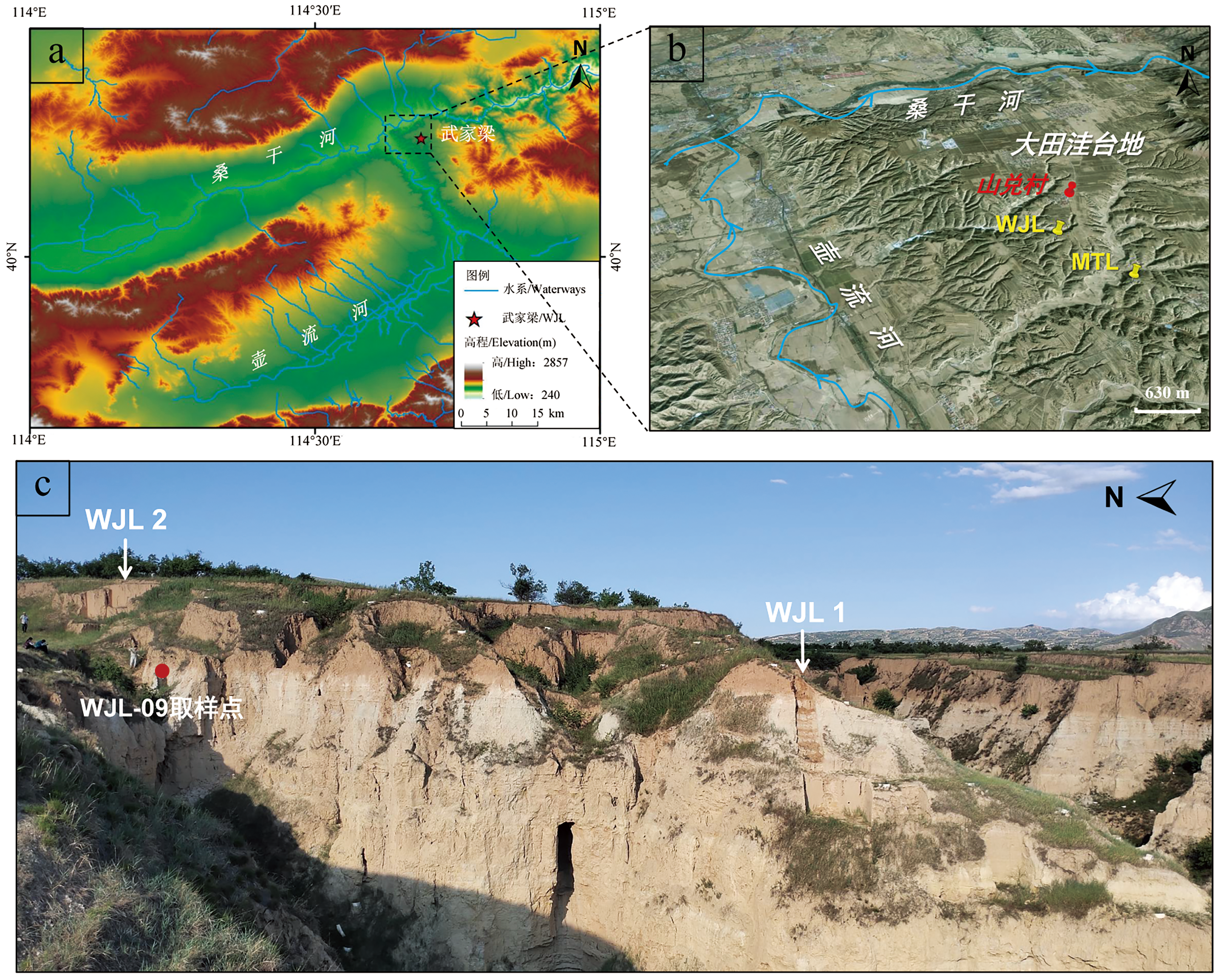
The Wujialiang Locality 1 (WJL1) site, situated on the eastern margin of the Nihewan Basin, is an important Palaeolithic locality within the Shandui site cluster and preserves a well-stratified sequence of lacustrine, fluvial, and aeolian deposits. A total of 285 stone artifacts and 115 animal fossils were unearthed at the WJL1 site. Through comprehensive analyses of the composition of the stone artifacts, their degree of weathering and abrasion, and their occurrence characteristics, it is inferred that the site was minimally disturbed by natural forces and belongs to an in-situ burial type. The raw materials for the stone artifacts at the WJL1 site were mainly rhyolite, flint, and siliceous dolomite, followed by quartzite, dolomite, and conglomerate. Based on the analyses of the types and technical characteristics of the stone artifacts, the stone tool technology at this site generally belongs to the long-existing stone-flake technology system in northern China.
To establish a reliable chronological framework for the site, nine samples were collected from the sedimentary profile for luminescence dating. Three of the nine samples were not dated due to the limited coarse grains (>63 µm) that could be extracted. The remaining six samples were measured for equivalent dose (De) using the multiple elevated temperature post-infrared infrared (MET-pIRIR) stimulated luminescence dating method on multi-grained single-aliquot potassium feldspars (K-feldspars). To reduce the instrument time, we employed the Standard Growth Curve (SGC) method to measure the De values for each sample. Based on the residual dose, dose recovery, fading tests, and the De-T plot, the MET-pIRIR250℃ CAM De was selected for the final age calculation.
The results indicate that the archaeological layer was deposited during the 378-359 ka period, corresponding to the earlier phase of the marine isotope stage (MIS) 10 and the loess-paleosoil unit L4. The luminescence age of the sample collected from the bottom of the top loess layer is about 87 ka, which roughly corresponds to the cultural layer of the Wujialiang Locality 2 (WJL2) site. The luminescence ages in this paper are of great significance for improving the chronological framework of the Pleistocene Paleolithic sites and exploring the process of ancient lake disappearance in the Nihewan Basin.
Key words: Nihewan Basin; Wujialiang; Palaeolithic site; MET-pIRIR; Standard Growth Curve
WANG Xinrui , ZHANG Zhiyao , HUANG Bingrou , WANG Fagang , GUO Yujie . Luminescence dating of the Paleolithic site of Wujialiang Locality 1 in the Nihewan Basin[J]. Acta Anthropologica Sinica, 2026 , 45(03) : 489 -499 . DOI: 10.16359/j.1000-3193/AAS.2026.0032
| [1] | 谢飞, 李珺, 刘连强. 泥河湾旧石器文化[M]. 石家庄: 花山文艺出版社, 2006, 1-2 |
| [2] | 王法岗, 孙永春. 泥河湾考古图典[M]. 石家庄: 河北美术出版社, 2023, 229-236 |
| [3] | Guo YJ, Li B, Zhang JF, et al. Luminescence ages for three ‘Middle Palaeolithic’sites in the Nihewan Basin, northern China, and their archaeological and palaeoenvironmental implications[J]. Quaternary Research, 2016, 85: 456-470 |
| [4] | Murray AS, Wintle AG. Luminescence dating of quartz using an improved single-aliquot regenerative-dose protocol[J]. Radiation Measurements, 2000, 32: 57-73 |
| [5] | Murray AS, Wintle AG. The single aliquot regenerative dose protocol: potential for improvements in reliability[J]. Radiation Measurements, 2003, 37: 377-381 |
| [6] | Li B, Li SH. Luminescence dating of K-feldspar from sediments: A protocol without anomalous fading correction[J]. Quaternary Geochronology, 2011, 6: 468-479 |
| [7] | Guo YJ, Li B, Zhang JF, et al. Luminescence-based chronologies for Palaeolithic sites in the Nihewan Basin, northern China: First tests using newly developed optical dating procedures for potassium feldspar grains[J]. Journal of Archaeological Science: Reports, 2015, 3: 31-40 |
| [8] | Guo YJ, Xian Q, Lu C, et al. Redating the Zhuwobu Paleolithic site in the Huailai basin, North China, using the MET-pIRIR procedure on K-feldspars[J]. Frontiers in Earth Science, 2022, 10: 932834 |
| [9] | Xu SX, Rui X, Guo YJ, et al. Testing micro-aliquot SGC and LnTn methods for age determination up to 780 ka using coarse K-feldspar grains from Nihewan Basin, northern china[J]. Quaternary Geochronology, 2025, 88: 101673 |
| [10] | Demiana YG, Rlshmawl. 泥河湾盆地武家梁1号地点初步研究[D]. 硕士研究生毕业论文, 石家庄: 河北师范大学, 2023, 49-50 |
| [11] | Aitken MJ. An Introduction to Luminescence Dating[M]. Oxford: Oxford University Press, 1998 |
| [12] | Rui X, Guo YJ, Zhang JF, et al. Luminescence chronology of the Palaeolithic-Neolithic transition in the Yujiagou site at the Nihewan Basin, northern China[J]. Journal of Quaternary Science, 2019, 34: 125-137 |
| [13] | Huntley DJ, Lamothe M. Ubiquity of anomalous fading in K-feldspars and the measurement and correction for it in optical dating[J]. Canadian Journal of Earth Sciences, 2001, 38: 1093-1106 |
| [14] | Durcan J, King GE, Duller G. DARC: Dose Rate and Age Calculator for trapped charge dating[J]. Quaternary Geochronology, 2015, 28: 54-61 |
| [15] | Li B, Roberts RG, Jacobs Z, et al. Construction of a ‘global standardised growth curve’ (gSGC) for infrared stimulated luminescence dating of K-feldspar[J]. Quaternary Geochronology, 2015, 27: 119-130 |
| [16] | Galbraith RF, Roberts RG, Laslett GM, et al. Optical dating of single and multiple grains of quartz from Jinmium rock shelter, northern Australia: Part I, experimental design and statistical models[J]. Archaeometry, 1999, 41: 339-364 |
| [17] | Wallinga J, Murray AS, Wintle A. The single-aliquot regenerative-dose (SAR) protocol applied to coarse-grain feldspar[J]. Radiation Measurements, 2000, 32: 529-533 |
| [18] | Wintle AG. Anomalous fading of thermoluminescence in mineral samples[J]. Nature, 1973, 245: 143-144 |
| [19] | Auclair M, Lamothe M, Huot S. Measurement of anomalous fading for feldspar IRSL using SAR[J]. Radiation Measurements, 2003, 37: 487-492 |
| [20] | Buylaert JP, Jain M, Murray AS, et al. A robust feldspar luminescence dating method for Middle and Late Pleistocene sediments[J]. Boreas, 2012, 41: 435-451 |
| [21] | Roberts HM. Testing post-IR IRSL protocols for minimising fading in feldspars, using Alaskan loess with independent chronological control[J]. Radiation Measurements, 2012, 47(9): 716-724 |
| [22] | Nian XM, Li F, Chen FY, et al. Optically stimulated luminescence ages for human occupation during the penultimate glaciation in the western Loess Plateau of China[J]. Journal of Quaternary Science, 2016, 31: 928-935 |
| [23] | E CY, Sohbati R, Murray AS, et al. Hebei loess section in the Anyemaqen Mountains, northeast Tibetan Plateau: A high-resolution luminescence chronology[J]. Boreas, 2018, 47: 1170-1183 |
| [24] | Rui X, Li B, Guo YJ. The effect of residual signal on dose measurements using MET-pIRIR signals from K-feldspar[J]. Quaternary Geochronology, 2020, 58: 101065 |
| [25] | Galbraith RF, Roberts RG. Statistical aspects of equivalent dose and error calculation and display in OSL dating: An overview and some recommendations[J]. Quaternary Geochronology, 2012, 11: 1-27 |
| [26] | 黄冰柔, 牛东伟, 裴树文, 等. 蔚县盆地东沟遗址的光释光年龄[J]. 人类学学报, 2026, 45(1): 1-16 |
| [27] | Ramsey CB. OxCal 4.4 Manual[DB/OL]. URL: https://c14.arch.ox.ac.uk/oxcalhelp/hlp_contents.html, 2021 |
| [28] | Lisiecki LE, Raymo ME. A Pliocene-Pleistocene stack of 57 globally distributed benthic δ18O records[J]. Paleoceanography, 2005, 20: PA1003 |
| [29] | Guo ZT, Berger A, Yin Q, et al. Strong asymmetry of hemispheric climates during MIS 13 inferred from correlating China loess and Antarctica ice records[J]. Climate of the Past, 2009, 5: 21-31 |
| [30] | Zhao H, Lu YC, Wang CM, et al. ReOSL dating of aeolian and fluvial sediments from Nihewan Basin, northern China and its environmental application[J]. Quaternary Geochronology, 2010, 5(2-3): 159-163 |
| [31] | 年小美, 周力平, 袁宝印. 泥河湾陆相沉积物光释光年代学研究及其对古湖泊演化的指示意义[J]. 第四纪研究, 2013, 33(3): 403-414 |
/
| 〈 |
|
〉 |