


Preliminary report on the excavation of Qianshangying-B Paleolithic site at Yuxian in the Nihewan Basin
Received date: 2025-06-27
Accepted date: 2025-08-04
Online published: 2026-06-12
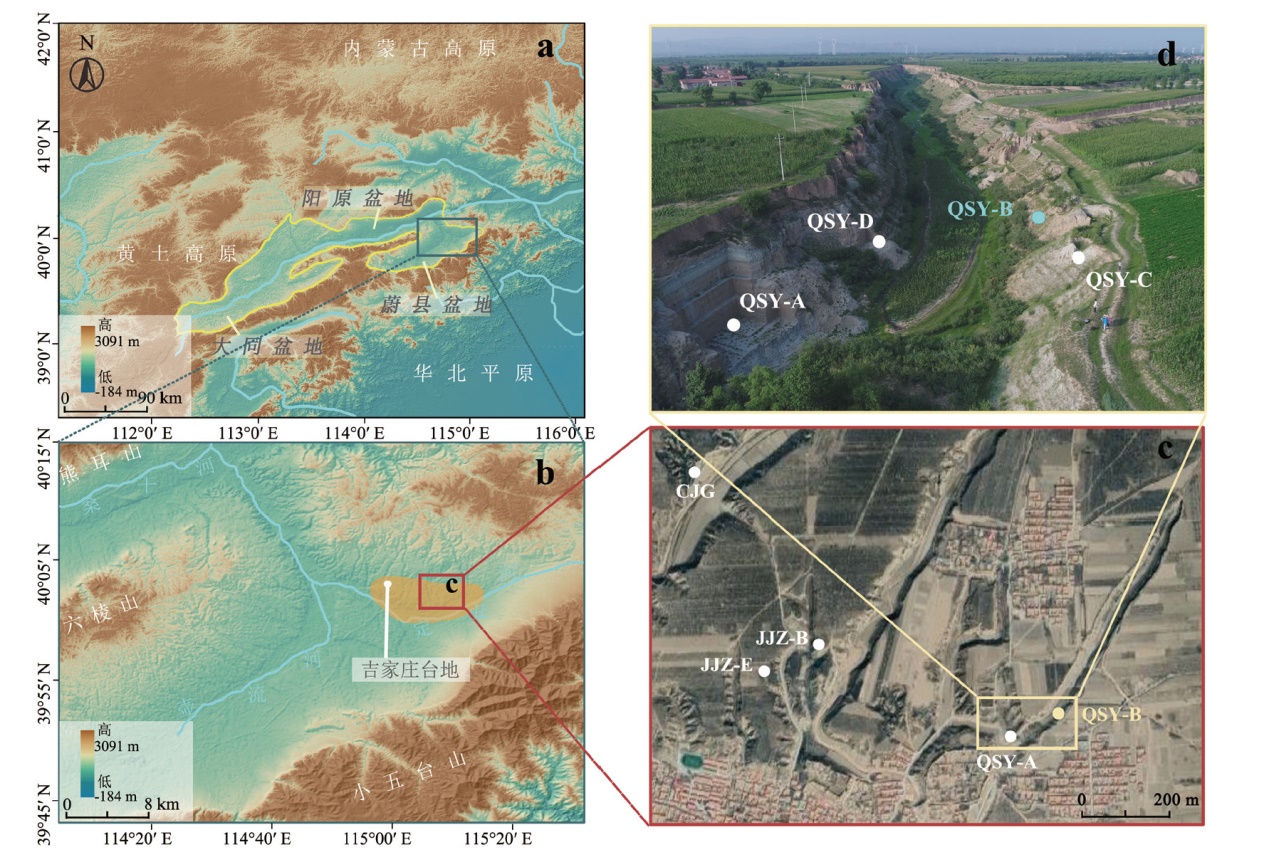
The Nihewan Basin of northern China preserves extensive Quaternary fluvio-lacustrine and loess sequences and hosts one of the highest concentrations of Palaeolithic sites in East Asia. While Early Pleistocene hominin activity in this region has been extensively studied, Middle Pleistocene sites remain rare and less understood. This study reports new evidence from the Locality B of Qianshangying site (QSY-B), discovered in 2015, with a focus on its geology, stratigraphy, chronology, stone artifacts assemblage, and human lithic technological strategies.
Geomorphological and sedimentological data show that the archaeo-stratigraphic sequence captures a full cycle of lake expansion, retreat, re-expansion, and final regression of the Nihewan paleolake, capped by Malan loess. Hominin occupation occurred in a marginal lacustrine setting during a low lake-level episode. QSY-B represents a brief, single-phase occupation, with minor post-depositional disturbance by gentle hydraulic event. The integrity of the assemblage allows for detailed technological and behavioral reconstruction.
ESR dating of sediments from the archaeological layer suggests that hominins occupied the site around 429 ± 39 ka, placing it firmly within the Middle Pleistocene. Geological surveys indicate that hominins procured raw materials—primarily lava and siliceous dolomite—from source 7-8 km away from the site. The lithic assemblage is marked by hard-hammer percussion, efficient core reduction, and abundant flakes, which bear traces of direct use without modification. A notable feature is the diverse range of retouched tools, contrasting with Early Pleistocene local industries and suggesting increased technological flexibility and environmental adaptability of early humans.
Faunal remains bearing cut marks further attest to animal processing activities. The findings from QSY-B enhance our understanding of hominin behavior during the Middle Pleistocene and offer new perspectives on the long sequence of technological evolution and adaptive strategies of early humans in the Nihewan Basin.
YE Zhi , PEI Shuwen , MA Dongdong , JIA Zhenxiu , WANG Fagang , YANG Haiyong . Preliminary report on the excavation of Qianshangying-B Paleolithic site at Yuxian in the Nihewan Basin[J]. Acta Anthropologica Sinica, 2026 , 45(03) : 515 -531 . DOI: 10.16359/j.1000-3193/AAS.2025.0109
| [1] | 袁宝印, 夏正楷, 牛平山. 泥河湾裂谷与古人类[M]. 北京: 地质出版社, 2011, 1-257 |
| [2] | Zhu RX, Hoffman KA, Potts R, et al. Earliest presence of humans in northeast Asia[J]. Nature, 2001, 413: 413-417 |
| [3] | Yang SX, Deng CL, Zhu RX, et al. The Paleolithic in the Nihewan Basin, China: Evolutionary history of an Early to Late Pleistocene record in Eastern Asia[J]. Evoluttionary Anthropology, 2020, 29: 125-142 |
| [4] | 杜雨薇, 张乐, 叶芷, 等. 蔚县盆地吉家庄旧石器遗址动物骨骼的埋藏学分析[J]. 人类学学报, 2023, 42(2):359-372 |
| [5] | 马东东, 牛东伟, 裴树文, 等. 蔚县盆地2017-2018年旧石器考古调查[J]. 人类学学报, 2021, 40(1): 128-136 |
| [6] | 牛东伟, 闫晓蒙, 马东东, 等. 蔚县盆地2019-2020年旧石器考古调查简报[J]. 人类学学报, 2022, 41(5): 936-944 |
| [7] | 裴树文. 泥河湾盆地南部(蔚县盆地)发现一处重要古人类活动遗址群[J]. 人类学学报, 2017, 36(1): 26 |
| [8] | 叶芷, 杜雨薇, 裴树文, 等. 蔚县盆地吉家庄旧石器遗址的形成过程[J]. 人类学学报, 2023, 42(1): 46-60 |
| [9] | 王法岗, 刘连强, 谢飞. 蔚县盆地前上营遗址发现的旧石器[A].见:董为(主编).第十三届中国古脊椎动物学学术年会论文集[C].北京: 海洋出版社, 2012, 165-170 |
| [10] | 裴树文, 马东东, 贾真秀, 等. 蔚县盆地吉家庄旧石器遗址发掘报告[J]. 人类学学报, 2018, 37(4): 510-528 |
| [11] | 夏正楷, 刘锡清. 泥河湾层古地理环境的初步认识[J]. 海洋地质与第四纪地质, 1984, 4(3): 101-110 |
| [12] | 白振平. 对蔚县盆地发育过程的初步认识[A]. 见:卫奇,谢飞(主编). 泥河湾研究论文选编[M]. 北京: 文物出版社, 1989, 466-474 |
| [13] | Alperson-Afil N, Sharon G, Kislev M, et al. Spatial organization of hominin activities at Gesher Benot Ya’aqov, Israel[J]. Science, 2009, 326(5960): 1677-1680 |
| [14] | Schick KD. Stone Age sites in the making: experiments in the formation and transformation of archaeological occurrences[M]. Oxford: British Archaeological Reports Limited, 1986 |
| [15] | Ma DD, Pei SW, Xie F, et al. Site formation processes at Cenjiawan (Nihewan Basin, North China): a case study on the structure of the Early Pleistocene archaeological record in lakeshore environments[J]. Journal of Quaternary Science, 2023, 38(4): 488-504 |
| [16] | Ding X, Pei SW, Ma DD, et al. Deciphering site formation processes in lakeshore environments: a case study of early pleistocene site of Feiliang (Nihewan Basin, China)[J]. Archaeological and Anthropological Sciences, 2024, 16: 92 |
| [17] | Pei SW, Xie F, Deng CL, et al. Early Pleistocene archaeological occurrences at the Feiliang site, and the archaeology of human origins in the Nihewan Basin, North China[J]. PLoS One, 2017, 12(11): e0187251 |
| [18] | 裴树文. 旧石器时代旷野遗址形成过程研究综述[J]. 人类学学报, 2019, 38(1): 1-18 |
| [19] | 任进成. 泥河湾盆地板井子旧石器时代遗址形成过程与石器技术研究[D]. 博士学位论文, 北京: 中国科学院大学, 2019 |
| [20] | Goren-Inbar N, Feibel CS, Verosub KL, et al. Pleistocene milestones on the out-of-Africa corridor at Gesher Benot Ya’aqov, Israel[J]. Science, 2000, 289(5481): 944-947 |
| [21] | de la Torre I, Wehr K. Site formation processes of the early Acheulean assemblage at EF-HR (Olduvai Gorge, Tanzania)[J]. Journal of Human Evolution, 2018, 120: 298-328 |
| [22] | de la Torre I, Mora R. Oldowan technological behaviour at HWK EE (Olduvai Gorge, Tanzania)[J]. Journal of Human Evolution, 2018, 120: 236-273 |
| [23] | de la Torre I, Mora R, 裴树文, 等. 旧石器时代早期石制品分析方案[J]. 人类学学报, 2021, 40(4): 547-567 |
| [24] | Pei SW, Deng CL, de la Torre I, et al. Magnetostratigraphic and archaeological records at the Early Pleistocene site complex of Madigou (Nihewan Basin): implications for human adaptations in North China[J]. Palaeogeography, Palaeoclimatology, Palaeoecology, 2019, 530: 176-189 |
| [25] | 裴树文, 侯亚梅. 东谷坨遗址石制品原料利用浅析[J]. 人类学学报, 2001, 20(4): 271-281 |
| [26] | Goldman-Neuman T, Hovers E. Raw material selectivity in late Pliocene Oldowan sites in the Makaamitalu Basin, Hadar, Ethiopia[J]. Journal of Human Evolution, 2012, 62(3): 353-366 |
| [27] | Geneste JM. Systèmes d’approvisionnement en matières premières au Paléolithique moyen et au Paléolithique supérieur en Aquitaine[J]. L’homme de Néandertal, 1988, 8: 61-70 |
| [28] | Goldman-Neuman T, Hovers E. Methodological considerations in the study of Oldowan raw material selectivity:insights from AL 894 (Hadar, Ethiopia)[A]. Interdisciplinary approaches to the Oldowan[M]. Dordrecht: Springer Netherlands, 2009, 71-84 |
| [29] | 贾真秀. 泥河湾盆地早更新世古人类遗址成因与石器技术比较研究:以东谷坨、麻地沟和飞梁遗址为例[D]. 博士学位论文, 北京: 中国科学院大学, 2018 |
| [30] | Blumenschine RJ, Masao FT, Tactikos JC, et al. Effects of distance from stone source on landscape-scale variation in Oldowan artifact assemblages in the Paleo-Olduvai Basin, Tanzania[J]. Journal of Archaeological Science, 2008, 35(1): 76-86 |
| [31] | Re?ek ?, Dibble HL, McPherron SP, et al. Two million years of flaking stone and the evolutionary efficiency of stone tool technology[J]. Nature ecology & evolution, 2018, 2(4): 628-633 |
| [32] | Dogand?i? T, Braun DR, McPherron SP. Edge length and surface area of a blank: experimental assessment of measures, size predictions and utility[J]. PLoS One, 2015, 10(9): e0133984 |
| [33] | Toth N. The stone technologies of early hominids at Koobi Fora, Kenya: an experimental approach[D]. MA thesis, Berkeley: University of California, 1982 |
| [34] | Toth N. The Oldowan reassessed: a close look at early stone artifacts[J]. Journal of Archaeological Science, 1985, 12(2): 101-120 |
| [35] | de la Torre I, Mora R, Dom??nguez-Rodrigo M, et al. The Oldowan industry of Peninj and its bearing on the reconstruction of the technological skills of LowerPleistocene hominids[J]. Journal of Human Evolution, 2003, 44(2): 203-224 |
| [36] | Delagnes A, Roche H. Late Pliocene hominid knapping skills: the case of Lokalalei 2C, West Turkana, Kenya[J]. Journal of Human Evolution, 2005, 48(5): 435-472 |
| [37] | Zaidner Y. Adaptive flexibility of Oldowan hominins: secondary use of flakes at Bizat Ruhama, Israel[J]. PLoS One, 2013, 8(6): e66851 |
| [38] | de la Torre I. The early stone age lithic assemblages of Gadeb (Ethiopia) and the developed Oldowan / early Acheulean in East Africa[J]. Journal of Human Evolution, 2011, 60(6): 768-812 |
| [39] | Gallotti R, Mussi M. The unknown Oldowan: -1.7-million-year-old standardized obsidian small tools from Garba IV, Melka Kunture, Ethiopia[J]. PLoS One, 2015, 10(12): e0145101 |
| [40] | Yang SX, Petraglia MD, Hou YM, et al. The lithic assemblages of Donggutuo, Nihewan basin: Knapping skills of Early Pleistocene hominins in North China[J]. PLoS One, 2017, 12(9): e0185101 |
| [41] | Cabanès J, Borel A, Baena Preysler J, et al. Palaeolithic polyhedrons, spheroids and bolas over time and space[J]. PloS One, 2022, 17(7): e0272135 |
| [42] | Sahnouni M, Schick K, Toth N. An experimental investigation into the nature of faceted limestone “spheroids” in the Early Palaeolithic[J]. Journal of Archaeological Science, 1997, 24(8): 701-713 |
| [43] | Wilkins J, Schoville BJ, Brown KS, et al. Evidence for early hafted hunting technology[J]. Science, 2012, 338(6109): 942-946 |
| [44] | Gallotti R, Mussi M. The emergence of the Acheulean in East Africa and beyond: contributions in honor of Jean Chavaillon[M]. Springer, 2018 |
| [45] | Van Kolfschoten T, Knul M, Buhrs E, et al. Butchered large bovids (Bos primigenius and Bison priscus) from the Palaeolithic throwing spear site Sch?ningen 13 II-4 (Germany)[J]. Groningen Archaeological Studies, 2012, 21: 32-45 |
| [46] | Van Kolfschoten T, Buhrs E, Verheijen I. The larger mammal fauna from the Lower Paleolithic Sch?ningen Spear site and its contribution to hominin subsistence[J]. Journal of Human Evolution, 2015. 89:138-53 |
| [47] | Ye Z, Pei S, Tu H, et al. 26Al/10Be burial dating and technological strategies of hominins at the Jijiazhuang Paleolithic site, Nihewan Basin, China: Implications for understanding Middle Pleistocene human adaptations in east Asia[J]. Quaternary Science Reviews, 2024, 339: 108837 |
/
| 〈 |
|
〉 |