


A report on 2013 excavation of the Nantaizi site in Nihewan Basin
Received date: 2026-02-24
Accepted date: 2026-05-08
Online published: 2026-06-12
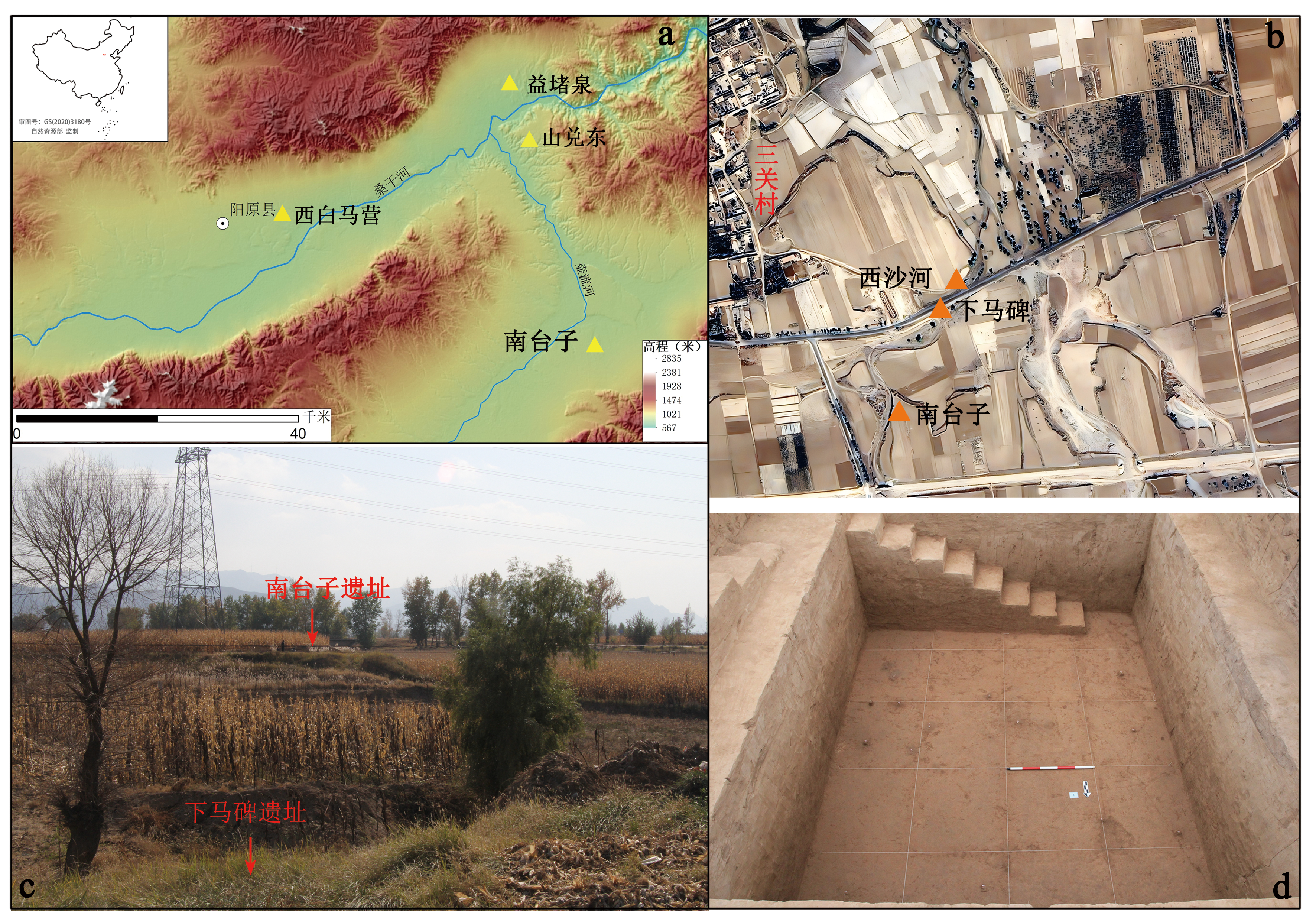
The Nantaizi site is located in the northeastern part of Yu County, Zhangjiakou City, Hebei Province, within the central-eastern Yuxian Basin, which lies in the southern part of the broader Nihewan Basin in northwestern Hebei. In 2013, the Hebei Provincial Institute of Cultural Relics and Archaeology and other units excavated an area of 20 m2, revealing three phases of cultural remains. The upper cultural layer dates to the Warring States-Han period. The middle cultural layer yielded microblade technology stone artifacts; based on the stratigraphy and lithic assemblage, these are estimated to approximately 20,000 years ago. According to the 14C dating results, the age of the lower layer is 33 ka before present, and 58 burnt stones and 74 stone artifacts were unearthed. The stone artifacts belong to the core-flake technology type, characteristic of the main industry dominated in northern China, representing the latest stage of core-flake technology in North China. The burnt stones may be remnants left from the “stone boiling” method used in the Late Paleolithic to heat water or liquid food, providing important clues for exploring fire-use behaviors of Late Paleolithic humans. The site is situated at a critical stage of the Late Paleolithic lithic technological transformation in North China. The discovery of core-flake and microblade technologies in stratigraphic superposition from the early to late layers holds significant value for exploring the relationship between core-flake technology and microblade technology in Northern China, as well as the emergence of the latter.
ZHAO Yongsheng , LIU Lianqiang , LIU Heng , YANG Haiyong , GAO Jianqiang , ZHANG Zhen , WANG Fagang . A report on 2013 excavation of the Nantaizi site in Nihewan Basin[J]. Acta Anthropologica Sinica, 2026 , 45(03) : 532 -542 . DOI: 10.16359/j.1000-3193/AAS.2026.0038
| [1] | 谢飞, 李珺, 刘连强. 泥河湾旧石器文化[M]. 石家庄: 花山文艺出版社, 2006, 1-7 |
| [2] | Guan Y, Wang XM, Wang FG, et al. Microblade remains from the Xishahe site, North China and their implications for the origin of microblade technology in Northeast Asia[J]. Quaternary International, 2020, 535: 38-47 |
| [3] | Wang FG, Yang SX, Ge JY, et al. Innovative ochre processing and tool use in China 40000 year ago[J]. Nature, 2022, 603: 284-289 |
| [4] | 尤玉柱. 论华北旧石器晚期遗址的分布、埋藏以及地质时代问题[J]. 人类学学报, 1984, 3(1): 68-75 |
| [5] | Guo YJ, Li B, Zhang JF, et al. New ages for the Upper Palaeolithic site of Xibaimaying in the Nihewan Basin, northern China: implications for small-tool and microblade industries in north-east Asia during Marine Isotope Stages 2 and 3[J]. Journal of Quaternary Science, 2017, 4: 540-552 |
| [6] | 盖培, 卫奇. 虎头梁旧石器时代晚期遗址的发现[J]. 古脊椎动物与古人类, 1977, 4: 287-300 |
| [7] | 谢飞, 成胜泉. 河北阳原油房细石器发掘报告[J]. 人类学学报, 1989, 1: 59-68 |
| [8] | Nian XM, Gao X, Xie F, et al. Chronology of the Youfang site and its implications for the emergence of microblade technology in North China[J]. Quaternary International, 2014, 347: 113-121 |
| [9] | 王法岗. “2024年中国考古新发现”史前遗址简介—河北阳原县新庙庄旧石器时代遗址[J]. 史前考古, 2025, 2: 134-137 |
| [10] | 张森水. 中国北方旧石器工业的区域渐进与文化交流[J]. 人类学学报, 1990, 4: 322-333 |
| [11] | 中国社会科学院考古研究所, 河北省文物研究所, 阳原县文物管理所. 河北阳原县西白马营旧石器时代遗址2015年试掘简报[J]. 考古, 2019, 10: 3-14 |
| [12] | 侯佳岐, 王法岗. 泥河湾盆地山兑东旧石器地点初步研究[J]. 人类学学报, 2023, 6: 742-750 |
| [13] | 王法岗, 杨石霞, 葛俊逸, 等. 泥河湾盆地下马碑遗址2013年发掘简报[J]. 人类学学报, 2024, 43(1): 143-156 |
| [14] | 周振宇. 热处理石料的力学打制实验研究[J]. 考古, 2017, 7: 88-97 |
| [15] | 顾玉才. 金牛山遗址发现的用火遗迹及相关的几个问题[A].韩国国立忠北大学校先史文化研究所,中国辽宁省文物考古研究所.东北亚旧石器文化[C]. 人类学学报, 1996, 267-272 |
| [16] | 贾兰坡, 盖培, 尤玉桂. 山西峙峪旧石器时代遗址发掘报告[J]. 考古学报, 1972, 1: 39-58 |
| [17] | 冯兴无, 李超荣, 郁金城. 王府井东方广场遗址石制品研究[J]. 人类学学报, 2006, 25(4): 285-298 |
| [18] | 杜水生, 周立, 庞海娇, 等. 河南栾川龙泉洞遗址2011年发掘报告[J]. 考古学报, 2017, 2: 227-252 |
| [19] | 高星, 王惠民. 烧石及古人类用火研究[A]. 宁夏文物考古研究所,中国科学院古脊椎动物与古人类研究所.水洞沟——2003-2007年度考古发掘与研究报告[C]. 北京: 科学出版社, 2013, 322-327 |
/
| 〈 |
|
〉 |