


Luminescence dating of the Donggou site in the Yuxian Basin of Hebei
Received date: 2024-12-05
Accepted date: 2025-04-06
Online published: 2026-06-12
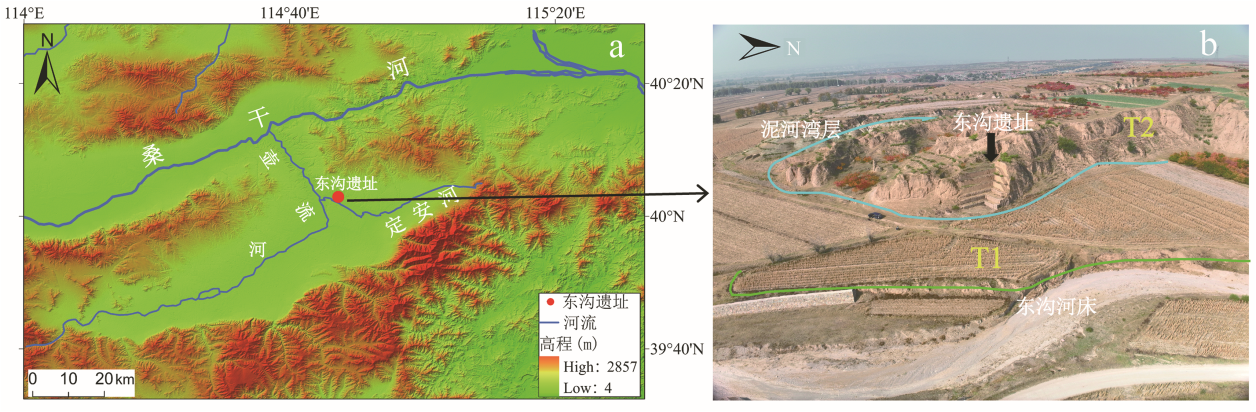
The Nihewan Basin is a pivotal region for investigating the evolutionary trajectory and cultural development of prehistoric human populations in China. The Donggou site, located in the Yuxian Basin, which is a sub-basin of the Nihewan Basin, is a significant Paleolithic site. The site had been excavated twice in 2017 and 2018. The excavation yielded abundant stone tools and animal fossils, with the stone tool industry belonging to the traditional flake tool industry of North China. The discovery and excavation of the Donggou site have provided rich materials for constructing the Paleolithic cultural sequence of the Yuxian Basin and the Nihewan Basin.
The sediments profile of this site is divided into seven layers: Layer 7 is fluvial channel deposits of coarse sand and gravel, Layers 6~3 are floodplain silt, Layer 2 is aeolian loess, and Layer 1 is disturbed modern soil from bottom to top. The cultural layer is Layer 5. Previous studies have shown that the age of the site exceeds the upper limit of radiocarbon dating. To determine the site's age, a total of twelve samples were collected from layers 6 to 2 for luminescence dating. The samples were dated using the multiple elevated temperatures (MET) post infrared (pIR) infrared stimulated luminescence (IRSL) (MET-pIRIR) procedure on both multi-grained single aliquots and single grains of potassium-rich feldspars (K-feldspars). Bayesian modeling was used to simulate the determined ages and establish a chronological sequence framework for the site profile. The dating results indicate that Layer 6 is approximately deposited between 126.1~98.4 kaBP, roughly corresponding to Marine Isotope Stage, MIS-5e~MIS-5c phases. The depositional age of Layer 5 is about 75.9~73.6 kaBP, roughly corresponding to the terminal phase of MIS-5a. The depositional age of Layer 4 is about 73.6~72.6 kaBP, Layer 3 is about 72.6~71.5 kaBP, and Layer 2 is about 71.5~70.1 kaBP. Layers 4~2 roughly correspond to the initial phase of MIS-4. The deposition rates are 0.03, 0.7, 3.30, 4.27, and 0.93 m/ka for Layer 6 to Layer 2. The variation in the deposition rates for each layer is mainly due to climate change from wet to dry.
The dating results indicate that the accumulation of the cultural layer occurred between 76~74 kaBP, corresponding to the late stage of MIS-5a, which places it within the Middle Paleolithic. The Donggou site provides new archaeological materials and evidence for the study of the development of stone tool technology and the survival strategies of ancient humans during the Middle Paleolithic in northern China.
Key words: Yuxian Basin; Donggou site; MET-pIRIR; Middle Paleolithic
HUANG Bingrou , NIU Dongwei , PEI Shuwen , GUO Yujie . Luminescence dating of the Donggou site in the Yuxian Basin of Hebei[J]. Acta Anthropologica Sinica, 2026 , 45(03) : 543 -555 . DOI: 10.16359/j.1000-3193/AAS.2025.0050
| [1] | 谢飞, 李珺, 刘连强. 泥河湾旧石器文化[M]. 石家庄: 花山文艺出版社, 2006, 1-2 |
| [2] | Guo YJ, Li B, Zhang JF, et al. Luminescence ages for three ‘Middle Palaeolithic’sites in the Nihewan Basin, northern China, and their archaeological and palaeoenvironmental implications[J]. Quaternary Research, 2016, 85: 456-470 |
| [3] | Wang FG, Yang SX, Ge JY, et al. Innovative ochre processing and tool use in China 40,000 years ago[J]. Nature, 2022, 603: 284-289 |
| [4] | 王法岗, 刘连强, 谢飞, 等. 蔚县盆地前上营遗址发现的旧石器[A].见:董为(主编).第十三届中国古脊椎动物学学术年会论文集[C].北京: 海洋出版社, 2012, 165-170 |
| [5] | 马东东, 牛东伟, 裴树文, 等. 蔚县盆地2017-2018年旧石器考古调查简报[J]. 人类学学报, 2021, 40(1): 128-136 |
| [6] | 裴树文, 马东东, 贾真秀, 等. 蔚县盆地吉家庄旧石器遗址发掘报告[J]. 人类学学报, 2018, 37(4): 510-528 |
| [7] | 周士航, 何湘栋, 徐静玥, 等. 蔚县盆地东沟遗址2017年度发掘简报[J]. 人类学学报, 2024, 43(1): 132-142 |
| [8] | Huntley DJ, Godfre-Smith DI, Thewalt MLW. Optical dating of sediments[J]. Nature, 1985, 313: 105-107 |
| [9] | Murry AS, Arnold LJ, Buylaert JP, et al. Optically stimulated luminescence dating using quartz[J]. Nature Reviews Methods Primers, 2021, 1: 72 |
| [10] | Li B, Li SH. Luminescence dating of K-feldspar from sedi-ments: A protocol without anomalous fading correction[J]. Quarternary Geochronology, 2011, 6: 468-479 |
| [11] | Guo YJ, Li B, Zhang JF, et al. Luminescence-based chronologies for Palaeolithic sites in the Nihewan Basin, northern China: First tests using newly developed optical dating procedures for potassium feldspar grains[J]. Journal of Archaeological Science: Reports, 2015, 3: 31-40 |
| [12] | Guo YJ, Li B, Zhao HL. Comparison of single-aliquot and single-grain MET-pIRIR De results for potassium feldspar samples from the Nihewan Basin, northen China[J]. Quaternary Geochronology, 2020, 56: 101040 |
| [13] | Guo YJ, Xian Q, Lu C, et al. Redating the Zhuwobu Paleolithic site in the Huailai basin, North China, using the MET-pIRIR procedure on K-feldspars[J]. Frontiers in Earth Science, 2022, 10: 932834 |
| [14] | Rui X, Li B, Guo YJ. Testing the upper limit of luminescence dating based on standardised growth curves for MET-pIRIR signals of K-feldspar grains from northern China[J]. Quaternary Geochronology, 2020a, 57: 101063 |
| [15] | Rui X, Li B, Guo YJ. The effect of residual signal on dose measurements using MET-pIRIR signals from K-feldspar[J]. Quaternary Geochronology, 2020b, 58: 101065 |
| [16] | Lu Y, Sun XF, Zhao HL, et al. Luminescence dating of Youfangbei early late Pleistocene site, Nihewan Basin, North China[J]. Quaternary Geochronology, 2021, 104: 1-11 |
| [17] | Wang FG, Guo YJ, Xian Q, et al. Luminescence chronology for the Paleolithic site of Xinmiaozhuang Locality 1 (XMZ1) in the Nihewan Basin, northern China, and its paleoenvironmental and archaeological implications[J]. Journal of Human Evolution, 2021, 157: 103033 |
| [18] | Lei HR, Zhou ZY, Guo YJ, et al. Chronology of the Paleolithic site of Xibaimaying in the Nihewan Basin, North China, inferred from optical dating of fine-grained quartz[J]. Quaternary Geochronology, 2022, 72: 101363 |
| [19] | Yang SX, Zhang JF, Yue JP, et al. Initial Upper Palaeolithic material culture by 45,000 years ago at Shiyu in northern China[J]. Nature Ecology & Evolution, 2024, 8: 552-563 |
| [20] | 徐静玥, 何湘栋, 牛东伟, 等. 泥河湾盆地蔚县东沟旧石器遗址的埋藏学[J]. 人类学学报, 2024, 43(6): 1075-1090 |
| [21] | Aitken MJ. An Introduction to Luminescence Dating[M]. Oxford University Press, 1998 |
| [22] | Rui X, Guo YJ, Zhang JF, et al. Luminescence chronology of the Palaeolithic-Neolithic transition in the Yujiagou site at the Nihewan Basin, northern China[J]. Journal of Quaternary Science, 2019, 34: 125-137 |
| [23] | Huntley DJ, Lamothe M. Ubiquity of anomalous fading in K-feldspars and the measurement and correction for it in optical dating[J]. Canadian Journal of Earth Sciences, 2001, 38: 1093-1106 |
| [24] | Durcan J, King GE, Duller G. DARC: Dose Rate and Age Calculator for trapped charge dating[J]. Quaternary Geochronology, 2015, 28: 54-61 |
| [25] | B?tter-Jensen L, Bulur E, Duller GAT, et al. Advances in luminescence instrument systems[J]. Radiation Measurements, 2000, 32: 523-528 |
| [26] | Galbraith RF, Roberts RG, Laslett GM, et al. Optical dating of single and multiple grains of quartz from Jinmium rock shelter, northern Australia: Part I, experimental design and statistical models[J]. Archaeometry, 1999, 41: 339-364 |
| [27] | Wallinga J, Murray AS, Wintle A. The single-aliquot regenerative-dose (SAR) protocol applied to coarse-grain feldspar[J]. Radiation Measurements, 2000, 32: 529-533 |
| [28] | Auclair M, Lamothe M, Huot S. Measurement of anomalous fading for feldspar IRSL using SAR[J]. Radiation Measurements, 2003, 37: 487-492 |
| [29] | Buylaert JP, Jain M, Murray AS, et al. A robust feldspar luminescence dating method for Middle and Late Pleistocene sediments[J]. Boreas, 2012, 41: 435-451 |
| [30] | Nian XM, Li F, Chen FY, et al. Optically stimulated luminescence ages for human occupation during the penultimate glaciation in the western Loess Plateau of China[J]. Journal of Quaternary Science, 2016, 31: 928-935 |
| [31] | E CY, Sohbati R, Murray AS, et al. Hebei loess section in the Anyemaqen Mountains, northeast Tibetan Plateau: A high-resolution luminescence chronology[J]. Boreas, 2018, 47: 1-14 |
| [32] | Li B, Roberts RG, Jacobs Z, et al. Construction of a ‘global standardised growth curve’ (gSGC) for infrared stimulated luminescence dating of K-feldspar[J]. Quaternary Geochronology, 2015, 27: 119-130 |
| [33] | Galbraith RF, Roberts RG. Statistical aspects of equivalent dose and error calculation and display in OSL dating: An overview and some recommendations[J]. Quaternary Geochronology, 2012, 11: 1-27 |
| [34] | Fan T, Fan Y, Zhao H, et al. Investigations on the degree of bleaching of quartz OSL signals using modern aeolian dust from western Loess Plateau, China[J]. Geochronometria, 2013, 40(3): 165-176 |
| [35] | Jacobs Z, Duller GAT, Wintle AG. Interpretation of single grain De distributions and calculation of De[J]. Radiation Measurements, 2006, 41: 264-277 |
| [36] | Blegen N, Tryon Christian A, et al. Distal tephras of the eastern Lake Victoria basin, equatorial East Africa: correlations, chronology and a context for early modern humans[J]. Quaternary Science Reviews, 2015, 122: 89-111 |
| [37] | Long H, Zhao JR, Huang XL, et al. Single-grain K-feldspar luminescence dating of the late Quaternary rapid decline in the largest Lake over the Tibetan Plateau[J]. Quaternary Geochronology, 2024, 81: 101503 |
| [38] | Ramsey CB. OxCal 4.4 Manual[DB/OL]. URL: https://c14.arch.ox.ac.uk/oxcalhelp/hlp_contents.html, 2021 |
| [39] | Lisiecki LE, Raymo ME. A Pliocene-Pleistocene stack of 57 globally distributed benthic δ18O records[J]. Paleoceanography, 2005, 20: PA1003 |
| [40] | Guo ZT, Berger A, Yin Q, et al. Strong asymmetry of hemispheric climates during MIS 13 inferred from correlating China loess and Antarctica ice records[J]. Climate of the Past, 2009, 5: 21-31 |
| [41] | Yang SL, Ding ZL. A 249 kyr stack of eight loess grain size records from northern China documenting millennial-scale climate variability[J]. Geochemistry, Geophysics, Geosystems, 2014, 15: 798-814 |
| [42] | 任进成, 李锋, 王晓敏, 等. 河北阳原板井子旧石器时代遗址2015年发掘简报[J]. 考古, 2018, 11: 3-14+2 |
/
| 〈 |
|
〉 |