


Taphonomic observation of the faunal remains from Locality A and B of the Caijiagou site in the Nihewan Basin
Received date: 2025-12-10
Accepted date: 2026-02-12
Online published: 2026-06-12
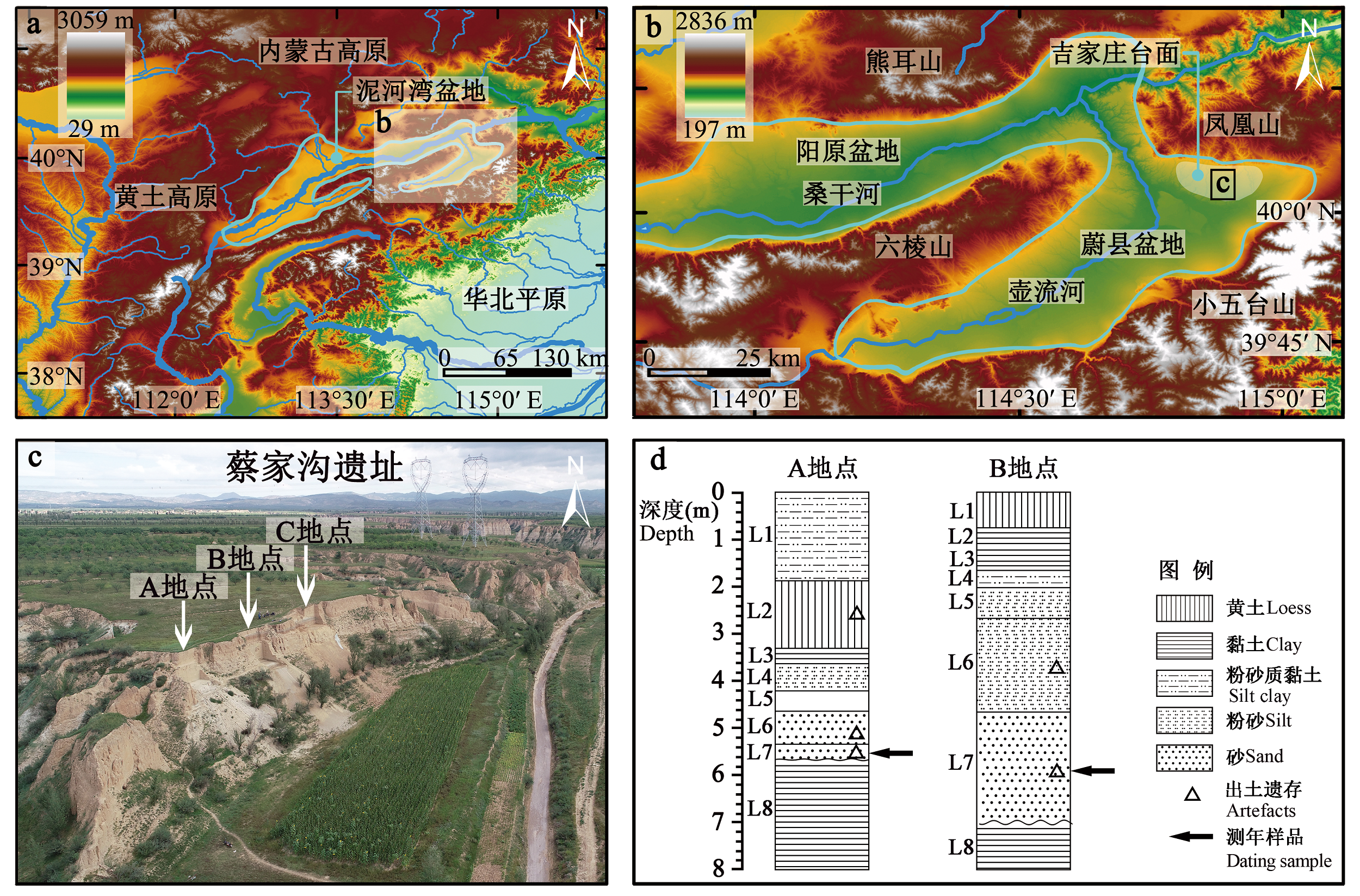
The relationship between hominins and animal resources is an important topic in studies of hominin subsistence strategies. However, zooarchaeological and taphonomic research on Early to Middle Pleistocene sites in East Asia remains relatively limited, particularly regarding the roles played by hominins and carnivores in the formation of faunal assemblages and the ways in which hominins acquired and processed animal resources. The Caijiagou site is situated within the Yuxian sub-basin on the southeastern margin of the Nihewan basin, North China, a region well known for its rich prehistoric archaeological record. Systematic excavations conducted between 2019 and 2021 at three localities (A, B and C) yielded abundant animal fossils and lithic artefacts. Cosmogenic 26Al/10Be burial dating indicates that the archaeological deposits date to approximately from 0.47 ± 0.13 Ma to 0.64 ± 0.21 Ma, corresponding to the early Middle Pleistocene.
This study focuses on the taphonomic analysis of faunal remains from Localities A and B. Detailed observations were conducted to assess the impacts of both natural and anthropogenic factors on the accumulation and modification of bones. Natural processes examined include weathering, biochemical corrosion, and carnivore gnawing, while anthropogenic modifications were assessed through the identification of cut marks, impact marks and other traces associated with carcass processing activities. These observations provide an important basis for evaluating the relative contribution of natural and anthropogenic agents in the formation of the faunal assemblage.
The results indicate that although natural factors have contributed to the formation of the animal assemblage to a certain extent, hominins were the primary agents responsible for the accumulation and modification of faunal remains at both localities. The faunal assemblage suggests that the Caijiagou hominins actively exploited medium- to large-sized ungulates, with horses representing the dominant component. The relatively high frequencies of cut marks and impact marks, along with their patterned distribution on specific skeletal elements, provide strong evidence for systematic carcass processing by hominins. Evidence of skinning, dismemberment, filleting and marrow extraction indicates that carcasses were intensively processed in the surrounding area of the site. They may also have transported certain highly nutritious or difficult-to-process bone elements away from the site for further consumption.
Overall, the taphonomic characteristics of the Caijiagou-A and B assemblages highlight the significant role of hominins in the formation of the faunal remains. This study provides new evidence for understanding the strategies of animal exploitation by early Middle Pleistocene hominins in the mid - to high - latitude regions of northern East Asia.
DU Yuwei , GENG Shuaijie , XU Jingyue , YE Zhi , ZHANG Yue , MA Dongdong , PEI Shuwen . Taphonomic observation of the faunal remains from Locality A and B of the Caijiagou site in the Nihewan Basin[J]. Acta Anthropologica Sinica, 2026 , 45(03) : 570 -585 . DOI: 10.16359/j.1000-3193/AAS.2026.0016
| [1] | Norton CJ, Gao X. Hominin-carnivore interactions during the Chinese Early Paleolithic: Taphonomic perspectives from Xujiayao[J]. Journal of Human Evolution, 2008, 55(1): 164-178 |
| [2] | 张双权. 河南许昌灵井动物群的埋藏学研究[D]. 博士研究生毕业论文, 北京: 中国科学院大学, 2009 |
| [3] | 黄慰文, 侯亚梅, 斯信强, 等. 盘县大洞:贵州旧石器初期遗址综合研究[M]. 北京: 科学出版社, 2012 |
| [4] | Li JS, Bunn HT, Zhang SQ, et al. Equid prey acquisition and Archaic Homo adaptability at the early Late Pleistocene site of Xujiayao, China[J]. International Journal of Osteoarchaeology, 2018, 28(1): 75-82 |
| [5] | 王晓敏, 王法岗, 陈福友, 等. 泥河湾盆地板井子晚更新世遗址古人类对动物资源的消费策略[J]. 人类学学报, 2022, 41(6): 1005-1016 |
| [6] | Xia H, Zhang DJ, Wang J, et al. Middle and Late Pleistocene Denisovan subsistence at Baishiya Karst Cave[J]. Nature, 2024, 632: 108-113 |
| [7] | Reitz EJ, Wing ES. Zooarchaeology[M]. Second edition, Cambridge: Cambridge University Press, 2008 |
| [8] | Pineda A, Saladié P. Beyond the problem of bone surface preservation in taphonomic studies of Early and Middle Pleistocene open-air sites[J]. Journal of Archaeological Method and Theory, 2022, 29(4): 1090-1130 |
| [9] | Stiner MC. Carnivory, coevolution, and the geographic spread of the genus Homo[J]. Journal of Archaeological Research, 2002, 10: 1-63 |
| [10] | Ferraro JV, Plummer TW, Pobiner BL, et al. Earliest archaeological evidence of persistent hominin carnivory[J]. PLOS One, 2013, 8(4): e62174 |
| [11] | Binford LR, Ho CK, Aigner JS, et al. Taphonomy at a distance: Zhoukoudian, the cave home of Beijing Man? [and Comments and Reply][J]. Current Anthropology, 1985, 26(4): 413-442 |
| [12] | Binford LR, Stone NM, Aigner JS, et al. Zhoukoudian: A closer look (and Comments and Reply)[J]. Current Anthropology, 1986, 27(5): 453-475 |
| [13] | Binford LR, Stone NM. On inferences from the Zhoukoudian fauna: Reply to Bunn and Kroll[J]. Current Anthropology, 1987, 28(3): 358-362 |
| [14] | Boaz NT, Ciochon RL, Xu QQ, et al. Large mammalian carnivores as a taphonomic factor in the bone accumulation at Zhoukoudian[J]. Acta Anthropologica Sinica, 2000, 19: 224-234 |
| [15] | Peterson CE, Shen C, Chen C, et al. Taphonomy of an Early Pleistocene archaeofauna from Xiaochangliang, Nihewan Basin, North China[A]. In: Shen C, Keates S. Current Research in the Chinese Pleistocene Archaeology[C]. Oxford: British Archaeological Reports, 2003 |
| [16] | Shen C, Zhang XL, Gao X. Zhoukoudian in transition: Research history, lithic technologies, and transformation of Chinese Palaeolithic archaeology[J]. Quaternary International, 2016, 400: 4-13 |
| [17] | 张双权, 高星, 陈福友, 等. 周口店第一地点西剖面2009-2010年发掘报告[J]. 人类学学报, 2016, 35(1): 63-75 |
| [18] | Gao X, Zhang SQ, Zhang Y, et al. Evidence of hominin use and maintenance of fire at Zhoukoudian[J], Current Anthropology, 2017, 58(16): S267-S277 |
| [19] | 杜雨薇, 张乐, 叶芷, 等. 蔚县盆地吉家庄旧石器遗址动物骨骼的埋藏学分析[J]. 人类学学报, 2023, 42(3): 359-372 |
| [20] | 王晓敏, 刘连强, 陈国鹏, 等. 泥河湾盆地马圈沟遗址哺乳动物破碎长骨反映的古人类行为[J]. 人类学学报, 2024, 43(1): 91-105 |
| [21] | Deng CL, Zhu RX, Zhang R, et al. Timing of the Nihewan formation and faunas[J]. Quaternary Research, 2008, 69: 77-90 |
| [22] | Ao H, An Z, Dekkers MJ, et al. Pleistocene magnetochronology of the fauna and Paleolithic sites in the Nihewan Basin: Significance for environmental and hominin evolution in North China[J]. Quaternary Geochronology, 2013, 18(6):78 92 |
| [23] | 马东东, 牛东伟, 裴树文, 等. 蔚县盆地2017-2018年旧石器考古调查简报[J]. 人类学学报, 2021, 40(1): 128-136 |
| [24] | Brain CK. The hunters or the hunted? An introduction to African cave taphonomy[M]. Chicago: University of Chicago Press, 1981 |
| [25] | Bunn HT, Bartram LE, Kroll EM. Variability in bone assemblage formation from Hadza hunting, scavenging, and carcass processing[J]. Journal of Anthropological Archaeology, 1988, 7(4): 412-457 |
| [26] | Binford LR. Faunal remains from Klasies River Mouth[M]. Orlando: Academic Press, 1984 |
| [27] | 张乐, Norton CJ, 张双权, 等. 量化单元在马鞍山遗址动物骨骼研究中的运用[J]. 人类学学报, 2008, 27(1): 79-90 |
| [28] | Villa P, Mahieu E. Breakage patterns of human long bones[J]. Journal of Human Evolution, 1991, 21: 27-48 |
| [29] | Outram AK. The identification and Palaeoeconomic context of prehistoric bone marrow and grease exploitation[D]. PhD thesis, Durham: Durham University, 1998 |
| [30] | Outram AK. A new approach to identifying bone marrow and grease exploitation: Why the “indeterminate’’ fragments should not be ignored[J]. Journal of Archaeological Science, 2001, 28: 401-410 |
| [31] | Johnson E, Parmenter PCP, Outram AK. A new approach to profiling taphonomic history through bone fracture analysis, with an example application to the Linearbandkeramik site of Ludwinowo 7[J]. Journal of Archaeological Science: Reports, 2016, 9: 623-629 |
| [32] | Behrensmeyer AK. Taphonomic and ecologic information from bone weathering[J]. Paleobiology, 1978, 4: 150-162 |
| [33] | Gümrük?ü M, Pante MC. Assessing the effects of fluvial abrasion on bone surface modifications using high-resolution 3-D scanning[J]. Journal of Archaeological Science: Reports, 2018, 21: 208-221 |
| [34] | Fernandez-Jalvo Y, Andrews P. Atlas of Taphonomic Identifications: 1001+ images of fossil and recent mammal bone modification[M]. Dordrecht: Springer, 2016 |
| [35] | Potts R. Shipman P. Cutmarks made by stone tools on bones from Olduvai Gorge, Tanzania[J]. Nature, 1981, 291: 577-580 |
| [36] | Blumenschine RJ, Marean CW, Capaldo SD. Blind tests of inter-analyst correspondence and accuracy in the identification of cut marks, percussion marks, and carnivore tooth marks on bone surfaces[J]. Journal of Archaeological Science, 1996, 23: 493-507 |
| [37] | 张乐, 王春雪, 张双权, 等. 马鞍山旧石器时代遗址古人类行为的动物考古学研究[J]. 中国科学:地球科学, 2009, 1256-1265 |
| [38] | Domínguez-Rodrigo M, Barba R. The behavioral meaning of cut marks at the FLK Zinj level: the carnivore-hominid-carnivore hypothesis falsified (II)[A]. In: Domínguez Rodrigo M, Barba R, Egeland CP. Deconstructing Olduvai: A Taphonomic Study of the Bed I Sites[C]. Dordrecht: Springer, 2007, 75-100 |
| [39] | Blumenschine RJ, Selvaggio MM. Percussion marks on bone surfaces as a new diagnostic of hominid behavior[J]. Nature, 1988, 333: 763-765 |
| [40] | Capaldo SD, Blumenschine R. A quantitative diagnosis of notches made by hammerstone percussion and carnivore gnawing on bovid long bones[J]. American Antiquity. 1994, 59(4): 724-748 |
| [41] | Galán AB, Rodríguez M, De Juana S, et al. A new experimental study on percussion marks and notches and their bearing on the interpretation of hammerstone-broken faunal assemblages[J]. Journal of Archaeological Science, 2009, 36(3): 776-784 |
| [42] | Lam YM, Chen XB, Pearson OM. Intertaxonomic variability in patterns of bone density and the differential representation of Bovid, Cervid, and Equid elements in the archaeological record[J]. American Antiquity, 1999, 64(2): 343-362 |
| [43] | Binford LR. Bones: ancient men and modern myths[M]. New York: Academic Press, 1981 |
| [44] | Nilssen J. An actualistic butchery study in South Africa and its implications for reconstructing hominid strategies of carcass acquisition and butchery in the Upper Pleistocene and Plio-Pleistocene[D]. PhD thesis, Cape Town: University of Cape Town, 2000 |
| [45] | Egeland CP, Pickering TR, Domínguez-Rodrigo M, et al. Disentangling Early Stone Age palimpsests: determining the functional independence of hominid- and carnivore-derived portions of archaeofaunas[J]. Journal of Human Evolution, 2004, 47(5): 343-357 |
| [46] | Feh C, Boldsukh T, Tourenq C. Are family groups in equids a response to cooperative hunting by predators? The case of Mongolian Kulans (Equus hemionus luteus Matschie)[J]. Revue d’écologie (La Terre et La Vie), 1994, 49(1): 11-20 |
| [47] | Stiner MC. Honor among Thieves: A zooarchaeological study of Neandertal ecology[M]. Princeton: Princeton University Press, 1994 |
| [48] | Gaudzinski S. On the variability of Middle Palaeolithic procurement tactics: the case of Salzgitter Lebenstedt, Northern Germany[J]. International Journal of Osteoarchaeology, 2000, 38: 497-521 |
| [49] | Driver JC, Maxwell D. Bison death assemblages and the interpretation of human hunting behaviour[J]. Quaternary International, 2013, 297: 100-109 |
| [50] | Discamps E, Costamagno S. Improving mortality profile analysis in zooarchaeology: A revised zoning for ternary diagrams[J]. Journal of Archaeological Science, 2015, 58: 62-76 |
| [51] | O’Connell JF, Hawkes K, Blurton-Jones NG. Patterns in the distribution, site structure and assemblage composition of Hadza kill-butchering sites[J]. Journal of Archaeological Science, 1992, 19(3): 319-345 |
| [52] | Morin E. Fat composition and Nunamiut decision-making: a new look at the marrow and bone grease indices[J]. Journal of Archaeological Science, 2007, 34: 69-82 |
/
| 〈 |
|
〉 |