


A preliminary report on the survey of Paleolithic sites in the Yuanzhou district section of the Qingshui River Basin, Ningxia
Received date: 2025-05-12
Revised date: 2025-09-14
Online published: 2026-08-12
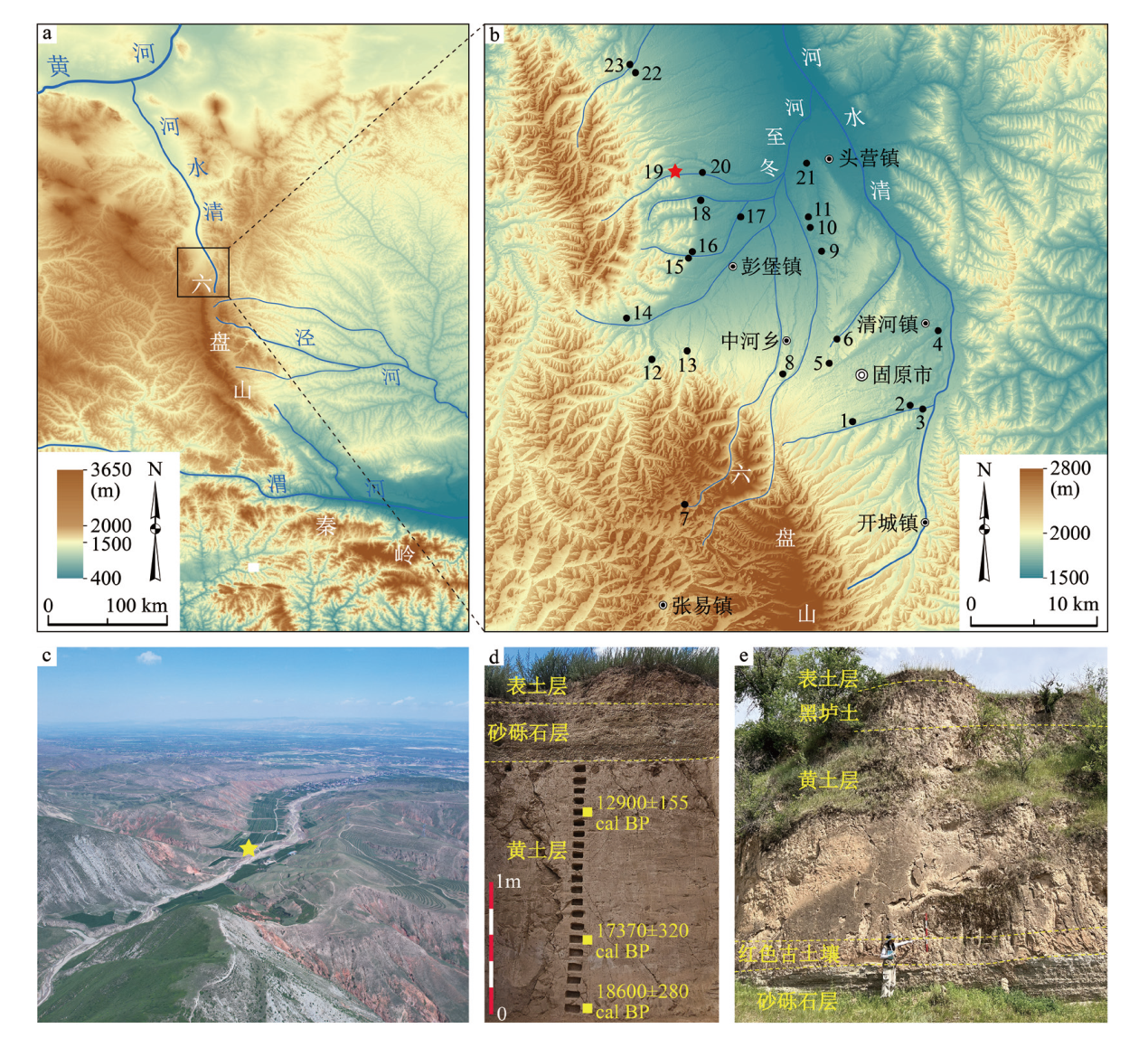
Extensive microlithic remains uncovered in Xinjiang and the Qinghai-Xizang Plateau indicate a likely westward dispersal of microlithic populations originating in North China. However, the discovery and study of microlithic remains in the Liupan Mountains, a critical transitional zone between North China and the western regions, have remained scarce, which has impeded a holistic understanding of the time, migration routes, and technological adaptation strategies involved in this dispersal. To address this issue, the Ningxia Institute of Cultural Relics and Archaeology, in collaboration with other institutions, carried out a systematic Paleolithic archaeological survey in May-June 2024 across the Yuanzhou district, Guyuan city, situated at the northern foothills of the Liupan Mountains and near the headwaters of the Qingshui River. The survey identified 23 Paleolithic sites, from 22 of which 85 lithic artifacts were collected. These included 15 ordinary cores, 24 flakes, 10 retouched tools, and 36 chunks and debris, all embedded within MIS 2 loess deposits. These artifacts are dominated by a small flake tool assemblage, with vein quartz constituting the predominant raw material (94.1%). Core reduction is primarily through the freehand hard hammer technique (80.0%), and scrapers were the most common formal tool type (40.0%).
A small test excavation (approximately 2 m2) was conducted at the remaining site, Daquantai, yielding 2,757 lithic artifacts along with abundant fragmented faunal remains. All cultural materials were embedded within a ca. 2-meter-thick loess layer sandwiched between two gravel layers. Radiocarbon dating indicates an occupation period between approximately 18,600 and 12,900 cal BP. The lithic assemblage includes 38 ordinary cores, 3 microblade cores, 28 microblades, 813 flakes, 46 retouched tools, and 1,829 chunks and debris. Vein quartz was the main raw material (73.5%), followed by chert (23.8%), with minor proportions of siliceous dolomite (2.0%) and quartz sandstone (0.7%). Bipolar cores account for the majority of ordinary cores (57.9%), with the remainder being the freehand hammer percussion cores (42.1%). The microblade cores include two boat-shaped cores and one expedient core. Retouched tools consist mainly of traditional small tools such as scrapers, alongside microlithic types including end-scrapers and small bifacial points. Retouching was primarily executed via freehand hard hammer technique (69.6%), with pressure-flaking retouch also present (30.4%). Overall, the Daquantai assemblage represents a technological tradition focused on small flake tool production, supplemented by microlithic technology.
The Daquantai site exhibits deep stratigraphy, rich cultural deposits, and a long chronological sequence spanning the entire Last Deglaciation. Notably, the boat-shaped microblade core technology shows similarities to that of North China. Further excavation at this site is expected to yield critical insights into the migration, dispersal, and ecological adaptation of microlithic populations in the Liupan Mountains region during the Last Deglaciation.
Key words: Qingshuihe River; boat-shaped microcore; microblade; flake tools; Last Deglaciation
YANG Jian , LI Sanling , HUO Yao , ZHANG Changjiang , LI Hao . A preliminary report on the survey of Paleolithic sites in the Yuanzhou district section of the Qingshui River Basin, Ningxia[J]. Acta Anthropologica Sinica, 2026 , 45(04) : 764 -772 . DOI: 10.16359/j.1000-3193/AAS.2025.0087
| [1] | Mao XW, Zhang HC, Qiao SY, et al. The deep population history of northern East Asia from the Late Pleistocene to the Holocene[J]. Cell, 2021, 184(12): 3256-3266 |
| [2] | Jin YS, Zhang XL, Wang SJ, et al. The earliest evidence for a microblade adaptation in the remote, high altitude regions of the Tibetan Plateau[J]. Science China Earth Sciences, 2024, 67(5): 1561-1573 |
| [3] | 毛晓伟, 平婉菁, 付巧妹. 古基因组解密末次盛冰期前后的东亚北部人群动态[J]. 遗传, 2021, 43(6): 526-530 |
| [4] | 冯玥. 晚更新世末华北细石器及人群与社会变迁[J]. 考古, 2024, 3: 74-87 |
| [5] | 王幼平. 华北细石器技术的出现与发展[J]. 人类学学报, 2018, 37(4): 565-576 |
| [6] | 仪明洁, 曹彧. 细石叶技术的起源、二元分化及环境驱动因素[J]. 人类学学报, 2024, 43(3): 355-366 |
| [7] | Nian XM, Gao X, Xie F, et al. Chronology of the Youfang site and its implications for the emergence of microblade technology in North China[J]. Quaternary International, 2014, 347: 113-121 |
| [8] | Guo YJ, Li B, Zhang JF, et al. New ages for the Upper Palaeolithic site of Xibaimaying in the Nihewan Basin, northern China: implications for small-tool and microblade industries in north-east Asia during Marine Isotope Stages 2 and 3[J]. Journal of Quaternary Science, 2017, 32(4): 540-552 |
| [9] | 孙启锐, 陈福友, 张子晓, 等. 山东临沂凤凰岭发现距今1.9至1.3万年的细石器遗存[N]. 中国文物报, 2018-6-15(008) |
| [10] | 靳英帅, 张晓凌, 何伟, 等. 自然地理分区视角下的青藏高原细石叶技术遗存[J]. 地理科学, 2023, 43(6): 961-971 |
| [11] | 侯光良, 曹广超, 鄂崇毅, 等. 青藏高原海拔4000 m区域人类活动的新证据[J]. 地理学报, 2016, 71(7): 1231-1240 |
| [12] | Madsen DB, Ma HZ, Brantingham PJ, et al. The late Upper Paleolithic occupation of the northern Tibetan Plateau margin[J]. Journal of Archaeological Science, 2006, 33: 1433-1444 |
| [13] | 冯玥, 黄奋, 李文成, 等. 新疆哈密七角井遗址2019年调查新发现[J]. 人类学学报, 2021, 40(6): 1086-1095 |
| [14] | 朱之勇, 王赫, 陈鹏, 等. 新疆哈密七角井细石器遗址石制品研究[J]. 西域研究, 2022, 3: 99-105+171-172 |
| [15] | 韩芳. 鸽子山第10地点细石叶工艺的行为生态视角[D]. 博士学位论文, 北京: 中国科学院大学, 2021 |
| [16] | 彭菲, 郭家龙, 王惠民, 等. 宁夏鸽子山遗址再获重大发现[J]. 中国文物报, 2017-02-10(005) |
| [17] | Yi MJ, Gao X, Chen FY, et al. Combining sedentism and mobility in the Palaeolithic-Neolithic transition of northern China: the site of Shuidonggou locality 12[J]. Antiquity, 2021, 95(380): 292-309 |
| [18] | 高星, 王惠民, 关莹. 水洞沟旧石器考古研究的新进展与新认识[J]. 人类学学报, 2013, 32(2): 121-132 |
| [19] | 固原市地方志编审委员会. 固原市志(上)[M]. 北京: 方志出版社, 2009 |
| [20] | 宁夏回族自治区地质调查院. 中国区域地质志·宁夏志[M]. 北京: 地质出版社, 2017 |
| [21] | 张玉柱, 黄春长, 庞奖励, 等. 长城塬全新世黄土剖面重金属元素揭示的成壤环境变化[J]. 水土保持通报, 2013, 33(4): 96-102 |
| [22] | 李昱龙, 杨剑, 霍耀, 等. 宁夏海原县南华山旧石器考古调查[J]. 人类学学报, 2022, 41(3): 491-500 |
| [23] | 吉笃学, 陈发虎, Bettinger RL, 等. 末次盛冰期环境恶化对中国北方旧石器文化的影响[J]. 人类学学报, 2005, 4: 270-282 |
| [24] | 侯光良, 许长军, 兰措卓玛, 等. 末次冰盛期中国人类活动的响应与适应[J]. 热带地理, 2018, 38(6): 819-827 |
| [25] | 张东菊, 陈发虎, Bettinger RL, 等. 甘肃大地湾遗址距今6万年来的考古记录与旱作农业起源[J]. 科学通报, 2010, 55(10): 883-890 |
| [26] | 任进成, 周静, 李锋, 等. 甘肃石峡口旧石器遗址第1地点发掘报告[J]. 人类学学报, 2017, 36(1): 1-16 |
| [27] | Li F, Zhou J, Ren JC, et al. Environmental reconstruction and dating of Shixiakou Locality 1 on China’s West Loess Plateau: implications for human adaptive changes apparent during the Last Glacial Maximum (LGM) and post-LGM periods[J]. Archaeological and Anthropological Sciences, 2024, 16(1): 01922-1 |
| [28] | 杜水生, 王晶, 王益人, 等. 山西沁水下川遗址小白桦圪梁地点2015年发掘报告[J]. 考古学报, 2019, 3: 383-408 |
| [29] | 宋艳花, 石金鸣. 山西吉县柿子滩遗址S29地点发掘简报[J]. 考古, 2017, 2: 35-51+2 |
| [30] | Zhao C, Wang YP, Gu WF, et al. The emergence of early microblade technology in the hinterland of North China: a case study based on the Xishi and Dongshi site in Henan Province[J]. Archaeological and Anthropological Sciences, 2021, 13(6): 01338-9 |
| [31] | 仪明洁, 高星. 中国北方地区细石叶技术的起源与兴衰过程[J]. 考古学报, 2024, 4: 449-472 |
| [32] | 朱之勇. 华北地区细石叶组合演变与生态适应研究[J]. 考古学报, 2023, 4: 435-458 |
/
| 〈 |
|
〉 |