


A 2020 excavation report of the Xiada Co site in Rutog County, Xizang Autonomous Region
Received date: 2025-05-15
Revised date: 2025-08-28
Online published: 2026-08-12
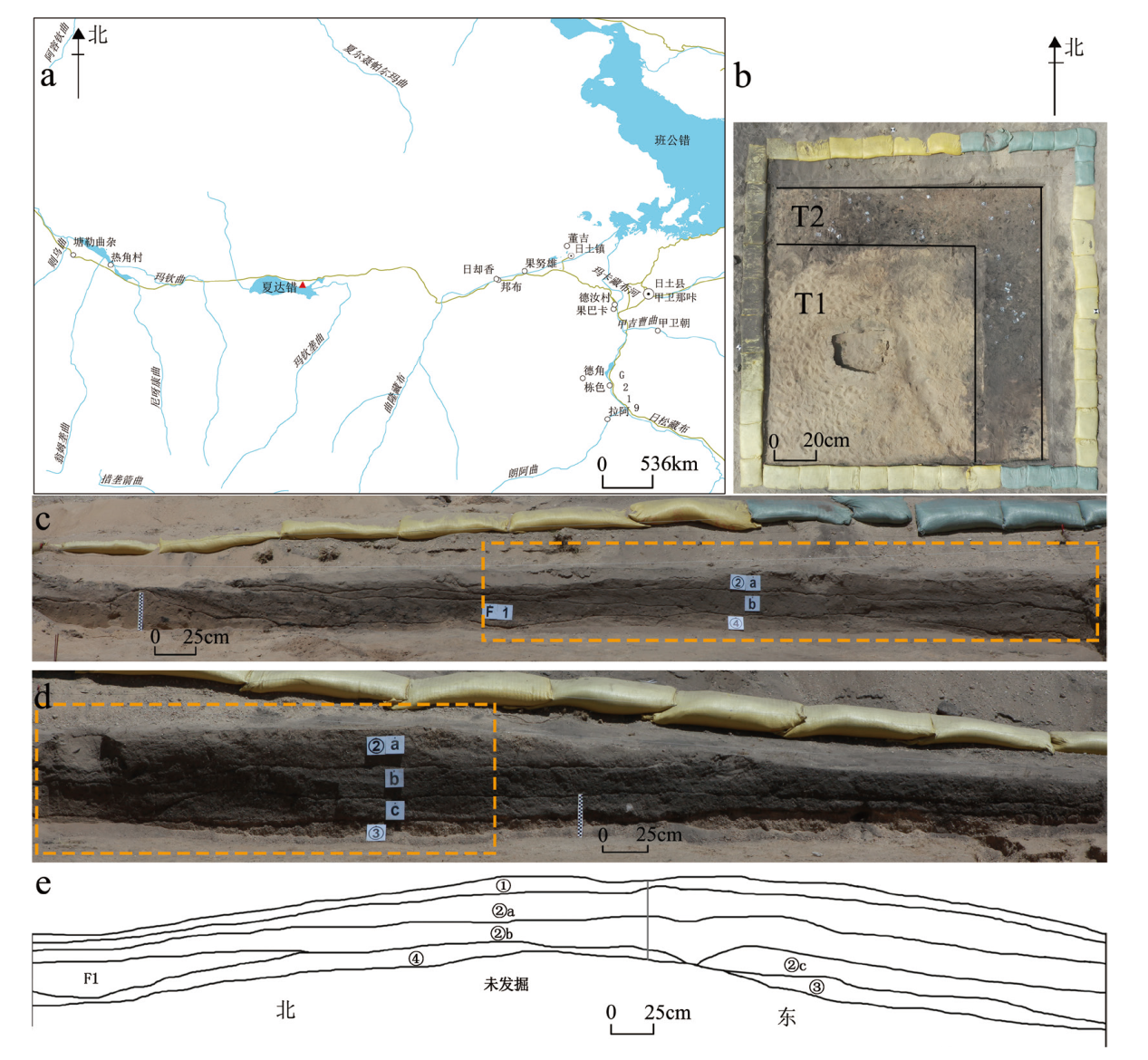
The Xiada Co open-air site (79°23′22.91″E, 33°23′34.17″N, 4237 meters above sea level) is located on the lake terrace on the north bank of Xiada Co Lake, about 40 km west of Rutog County, Ngari Prefecture, Xizang Autonomous Region. The site was discovered by investigation in 1992 and officially excavated in 2020. Here we report the archaeological remains from the 2020 excavation of the Xiada Co site. Seven Accelerator Mass Spectrometer dating results were obtained by charcoal fragments and animal bones from different cultural layers. The dating results were calibrated by the OxCal 4.20 software and the IntCal20 curves, which show that layers 2: a-c and 4 were accumulated during 8900~8500 BP cal. The 2020 excavation revealed four cultural layers, the cultural remains include a dwelling, five stone piles, two trampled surfaces, several hearths, 1488 stone artifacts and around 1300 animal bones. In addition, 348 pieces of burnt stone were collected and a total 1784 pieces of stone artifacts were sieved out from the four different layers. Layers 2a and 2b contained the richest cultural remains, including that the site was frequently visited by ancient humans during this period. Layer 3 is an intermittent layer, with little ancient human activity during this period. During the layer 4 time period, hunter-gatherers began to visit the site occasionally and some cultural remains were left behind. The lithic analysis of the unearthed stone artifacts indicates that the lithic industry is consistent through cultural layers at the Xiada Co site. The lithic assemblages include simple flake-core technology, microblade technology products and ground stone needles. The microblade technology at the Xiada Co site is represented by the wedge-shaped microblade core, a few conical and cylindrical microblade cores, which is very similar to the Xiachuan and Hutouliang techniques in Northern China. The six ground stone needles are the only type of ground stone tools at the site, which are discovered in layers 2a, 2b and 4. The discovery and systematic excavation of the Xiada Co site have provided crucial archaeological evidence for understanding human activities in this challenging high-altitude environment during the early Holocene. By studying the cultural remains uncovered at this site, we can gain a deeper appreciation of how early communities adapted to and thrived in the unique ecological and climatic conditions of the western Tibetan Plateau.
LYU Hongliang , CHEN Yun , TRINLE Tsering , HAN Fang . A 2020 excavation report of the Xiada Co site in Rutog County, Xizang Autonomous Region[J]. Acta Anthropologica Sinica, 2026 , 45(04) : 773 -789 . DOI: 10.16359/j.1000-3193/AAS.2025.0077
| [1] | 霍巍. 阿里夏达错湖滨旧石器的发现[J]. 中国西藏, 1994, 6: 27-28 |
| [2] | 索朗旺堆, 李永宪, 等. 阿里地区文物志[M]. 拉萨: 西藏人民出版社, 1993, 1-4 |
| [3] | 吕红亮. 西藏旧石器时代的再认识——以阿里日土县夏达错东北岸地点为中心[J]. 考古, 2011, 3: 59-68 |
| [4] | 王社江, 张晓凌, 陈祖军, 等. 藏北尼阿木底遗址发现的似阿舍利石器—兼论晚更新世人类向青藏高原的扩张[J]. 人类学学报, 2018, 37(2): 253-269 |
| [5] | 汤惠生. 青藏高原旧石器若干问题的讨论[J]. 青海民族大学学报(社会科学版), 2010, 36(1): 96-103 |
| [6] | Li XM, Wang MD, Hou JZ. Centennial-scale climate variability during the past 2000 years derived from lacustrine sediment on the western Tibetan Plateau[J]. Quaternary International, 2019, 510: 65-75 |
| [7] | 邱中郎. 青藏高原旧石器的发现[J]. 古脊椎动物学报, 1958, (2-3):157-164 |
| [8] | Zhang XL, Jin YS, He W, et al. A consideration of the spatiotemporal distribution of microblade industries on the Tibetan Plateau[J]. Quaternary International, 2020, 559(7756): 165-173 |
| [9] | 张晓凌, 王呈祥, 谭韵瑶, 等. 青藏高原旧石器时代考古发现与研究[J]. 人类学学报, 2024, 43(6): 967-978 |
/
| 〈 |
|
〉 |