


Current research status and future prospects of the Changbai Mountain obsidian provenance in the Northeast Asian context
Received date: 2024-11-22
Revised date: 2025-05-18
Online published: 2026-08-12
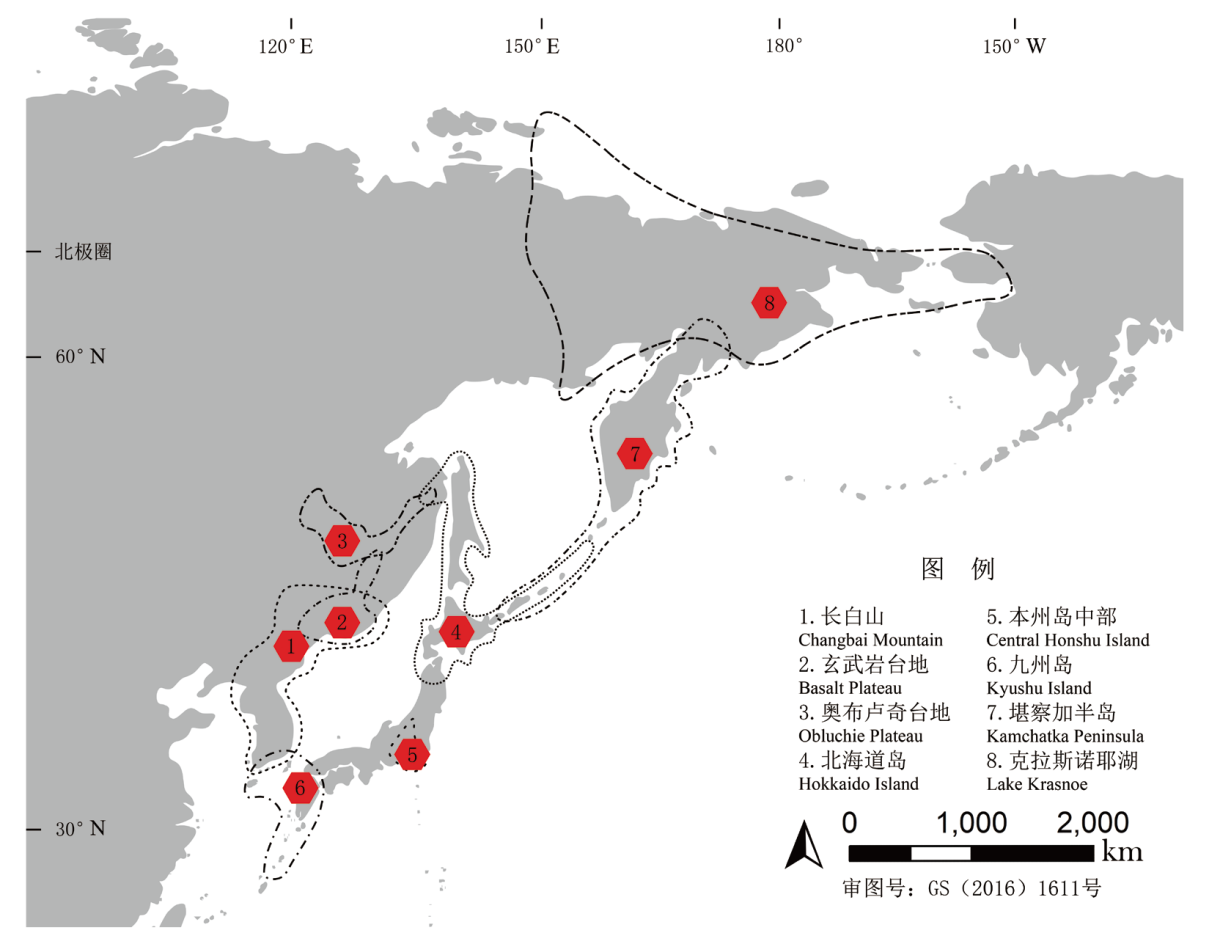
The study of obsidian provenance in Northeast Asia has significantly advanced since the 1970s, providing crucial insights into prehistoric populations’ raw material procurement and utilization strategies. This volcanically active region contains multiple obsidian sources, including those in the Changbai Mountain area, the Russian Far East, and the Japanese archipelago. Researchers have identified distinct geochemical signatures for these sources, enabling the tracing of obsidian artifacts to their origins. Since the Upper Paleolithic period, ancient humans in and around the Changbai Mountain region have consistently exploited obsidian resources. This practice offers valuable perspectives on raw material procurement strategies, mobility patterns, and subsistence behaviors in prehistoric societies.
The Changbai Mountain region, located in the eastern part of Jilin Province, China, serves as a crucial passage connecting the East Asian mainland with the Korean Peninsula and is densely populated with numerous archaeological sites dating from the late Pleistocene to the Holocene. As the largest composite volcano in China, Changbai Mountain has experienced frequent volcanic activities during the Quaternary period. Extensive research has been conducted by domestic and international geologists on the geological background, formation reasons, magmatic evolution sequence, volcanic eruption types, and ages of Changbai Mountain, including the formation age and distribution range of Changbai Mountain volcanic obsidian. This study reviews the geological history and volcanic eruptions of Changbai Mountain to explore the characteristics and provenance of Changbai Mountain obsidian. It is suggested that the various groups of obsidian raw materials unearthed at archaeological sites may be associated with different volcanic craters or outcrops within the Changbai Mountain region.
The availability, accessibility, and abundance of raw materials from different obsidian outcrops may vary, which could have significant implications for the raw material economic analyses of prehistoric populations. Therefore, during such analyses, the correspondence between each group of raw materials and their specific sources requires careful consideration. Furthermore, future research should focus more on the development and utilization strategies of obsidians within the sites in the Changbai Mountain area. This will not only provide additional information for the reconstruction of the obsidian circulation network in Northeast Asia but also offer more insights into the raw material economy of prehistoric populations.
Key words: Northeast Asia; Changbai Mountain; obsidian; provenance
GUO Yueting , LI Feng , GAO Xing . Current research status and future prospects of the Changbai Mountain obsidian provenance in the Northeast Asian context[J]. Acta Anthropologica Sinica, 2026 , 45(04) : 790 -800 . DOI: 10.16359/j.1000-3193/AAS.2025.0045
| [1] | Kuzmin Y. Geoarchaeological Aspects of Obsidian Source Studies in the Southern Russian Far East and Brief Comparison with Neighbouring Regions[A]. In: Ono A, Glascock M, Kuzmin Y, et al. Methodological Issues for Characterisation and Provenance Studies of Obsidian in Northeast Asia[C]. Oxford: BAR Publishing, 2014: 143-166 |
| [2] | Grebennikov A, Popov V, Kuzmin Y. Geochemistry of Volcanic Glasses and the Search Strategy for Unknown Obsidian Sources on Kamchatka Peninsula (Russian Far East)[A]. In: Ono A, Glascock M, Kuzmin Y, et al. Methodological Issues for Characterisation and Provenance Studies of Obsidian in Northeast Asia[C]. Oxford: BAR Publishing, 2014: 95-110 |
| [3] | Ono A, Glascock M, Kuzmin Y, et al. Methodological Issues for Characterisation and Provenance Studies of Obsidian in Northeast Asia[M]. Oxford: BAR Publishing, 2014 |
| [4] | Kuzmin Y. Obsidian as a commodity to investigate human migrations in the Upper Paleolithic, Neolithic, and Paleometal of Northeast Asia[J]. Quaternary International, 2017, 442: 5-11 |
| [5] | 徐廷, 赵海龙, 顾聆博. 吉林省和龙大洞旧石器遗址2010年发掘报告[J]. 人类学学报, 2023, 42(5): 651-666 |
| [6] | 李万博, 陈全家, 张福有. 吉林枫林旧石器遗址发现的石制品[J]. 人类学学报, 2019, 38(2): 191-199 |
| [7] | 陈全家, 赵海龙, 方启, 等. 延边和龙石人沟旧石器遗址2005年试掘报告[J]. 人类学学报, 2010, 29(2): 105-114 |
| [8] | 陈全家, 赵海龙, 王春雪. 抚松新屯子西山旧石器遗址试掘报告[J]. 人类学学报, 2009, 28(2): 147-153 |
| [9] | 陈全家, 王春雪, 方启, 等. 吉林和龙柳洞2004年发现的旧石器[J]. 人类学学报, 2006, 3: 208-219 |
| [10] | 陈全家. 延边地区图们江流域旧石器考古新发现[J]. 人类学学报, 2003, 1: 62 |
| [11] | 刘嘉麒. 中国火山[M]. 北京: 科学出版社, 1999 |
| [12] | 隋建立. 长白山火山成因:物理机制和化学演化[D]. 硕士研究生论文, 北京: 中国科学院大学, 2008 |
| [13] | Zhang M, Guo Z, Liu J, et al. The intraplate Changbaishan volcanic field (China/North Korea): A review on eruptive history, magma genesis, geodynamic significance, recent dynamics and potential hazards[J]. Earth-Science Reviews, 2018, 187: 19-52 |
| [14] | 邱家骧. 岩浆岩岩石学[M]. 北京: 地质出版社, 1985 |
| [15] | 刘若新. 长白山天池火山近代喷发[M]. 北京: 科学出版社, 1998 |
| [16] | 魏海泉(编). 长白山天池火山[M]. 北京: 地震出版社, 2014 |
| [17] | 刘宝珺. 沉积岩石学[M]. 北京: 地质出版社, 1980 |
| [18] | 钱程, 崔天日, 江斌, 等. 长白山地区晚新生代火山地貌形态研究及其地质应用[J]. 第四纪研究, 2014, 34(2): 312-324 |
| [19] | 金伯禄, 张希友(编著). 长白山火山地质研究[M]. 延吉: 东北朝鲜民族教育出版社, 1994 |
| [20] | 刘祥, 向天元. 中国东北地区新生代火山和火山碎屑堆积物资源与灾害[M]. 长春: 吉林大学出版社, 1997 |
| [21] | Sun C, Wang L, Plunkett G, et al. Ash From the Changbaishan Qixiangzhan Eruption: A New Early Holocene Marker Horizon Across East Asia[J]. Journal of Geophysical Research: Solid Earth, 2018, 123: 6442-6450 |
| [22] | 刘嘉麒, 王松山. 长白山火山与天池的形成时代[J]. 科学通报, 1982, 21: 1312-1315 |
| [23] | 魏海泉, 李春茂, 金伯禄, 等. 长白山天池火山造锥喷发岩浆演化系列与地层划分[J]. 吉林地质, 2005, 1: 22-27 |
| [24] | Singer B, Jicha B, He H, et al. 40Ar/39Ar Evidence for a 17 ka Geomagnetic Field Excursion at Changbaishan Volcano, Northeastern China[C]. AGU Fall Meeting Abstracts. 2011, 4-5 |
| [25] | Wei H, Liu G, Gill J. Review of eruptive activity at Tianchi volcano, Changbaishan, northeast China: Implications for possible future eruptions[J]. Bulletin of Volcanology, 2013, 75: 706-720 |
| [26] | 刘若新, 李继泰, 魏海泉, 等. 长白山天池火山:一座具潜在喷发危险的近代火山[J]. 地球物理学报, 1992, 35(5): 661-665 |
| [27] | 许东满, 郑祥身, 许湘希. 长白山天池地区全新世以来火山活动及其特征[J]. 第四纪研究, 1993, 13(1): 85-94 |
| [28] | 郑祥身. 长白山地区新生代火山岩的成因演化特征[A]. 中国科学院地质研究所1981届硕士论文集[C]. 北京: 北京科技出版社, 1983, 256-267 |
| [29] | 刘嘉麒. 中国东北地区新生代火山岩的年代学研究[J]. 岩石学报, 1987, 4: 21-31 |
| [30] | Doelman T, Torrence R, Popov V, et al. Source selectivity: An assessment of volcanic glass sources in the southern primorye region, far East Russia[J]. Geoarchaeology, 2008, 23(2): 243-273 |
| [31] | Wada K, Popov V, Mukai M, et al. Occurrence and microtexture of the mafic obsidian from the late Miocene basaltic plateau in the Primorye region, Russia[A]. Japan Geoscience Union Meeting Abstract, 2011, 9-10 |
| [32] | Tsurumaki K, Kannari T, Ono A, et al. 極東ロシア,シュコートヴォ台地産黒曜石の全岩化学組成 Whole-rock chemical composition of obsidian from the Shkotovo Plateau, Russian Far East[J]. 資源環境と人類, 2013, 3: 95-106 |
| [33] | Glascock M, Kuzmin Y, Grebennikov A, et al. Obsidian provenance for prehistoric complexes in the Amur River basin (Russian Far East)[J]. Journal of Archaeological Science, 2011, 38(8): 1832-1841 |
| [34] | Izuho M, Hirose W. A Review of Archaeological Obsidian Studies on Hokkaido Island (Japan)[A]. In: Kuzmin Y, Glascock M. Crossing the Straits: Prehistoric Obsidian Source Exploitation in the North Pacific Rim[C]. Oxford: BAR Publishing, 2010, 9-25 |
| [35] | Suda Y, Grebennikov A, Kuzmin Y, et al. Inter-laboratory validation of the WDXRF, EDXRF, ICP-MS, NAA and PGAA analytical techniques and geochemical characterisation of obsidian sources in northeast Hokkaido Island, Japan[J]. Journal of Archaeological Science: Reports, 2018, 17 |
| [36] | Kim C, Chang Y. Evidence of human movements and exchange seen from curated obsidian artifacts on the Korean Peninsula[J]. Journal of Archaeological Science: Reports, 2021, 39: 103184. |
| [37] | Grebennikov A, Kuzmin Y, Glascock M, et al. The Lake Krasnoe obsidian source in Chukotka (Northeastern Siberia): geological and geochemical frameworks for provenance studies in Beringia[J]. Archaeological and Anthropological Sciences, 2016, 10(3): 599-614 |
| [38] | Cann R, Renfrew C. The Characterization of Obsidian and its application to the Mediterranean Region[J]. Proceedings of the Prehistoric Society, 1964, 111-133 |
| [39] | Sohn P. A summary report on Pleistocene research in Korea[J]. Bulletin of the Indo-Pacific Prehistory Association, 1991, 10: 83-91 |
| [40] | Kuzmin Y, Popov V, Glascock M, et al. Sources of archaeological volcanic glass in the Primorye (Maritime) Province, Russian Far East[J]. Archaeometry, 2002, 44(4): 505-515 |
| [41] | Popov V, Sakhno V, Kuzmin Y, et al. Geochemistry of volcanic glasses from the Paektusan Volcano[J]. Doklady Earth Sciences, 2005, 403(5): 803-807 |
| [42] | Popov V, Kuzmin Y, Grebennikov A, et al. The “puzzle” of the primary obsidian source in the region of Paektusan (China/DPR Korea)[J]. Quaternary International, 2019, 519: 192-199 |
| [43] | Kim W, Hwang H, ???, et al. Petrological Characteristics and Provenance Estimation on the Stone Artefacts from the Pocheon Neulgeori Prehistoric Site, Korea[J]. The Journal of The Petrological Society of Korea, 2015, 24(1): 1-10 |
| [44] | Jia W, Doelman T, Chen C, et al. Moving sources: A preliminary study of volcanic glass artifact distributions in northeast China using PXRF[J]. Journal of Archaeological Science, 2010, 37(7): 1670-1677 |
| [45] | 陈全家, 贾伟明, Trudy Doelman, 等. 吉林东部地区考古遗址出土黑曜岩石制品产地的初步研究[J]. 东方考古, 2015, 442-454 |
| [46] | 刘爽. 中国东北地区旧石器时代晚期遗址黑曜岩制品原料来源探索[M]. 北京: 科学出版社, 2019 |
| [47] | 徐廷. 高分辨率环境背景下的和龙大洞遗址石器工业研究[D]. 硕士研究生论文, 北京: 中国科学院大学, 2022 |
| [48] | 李有骞, 陈全家. 长白山地黑曜岩旧石器的技术模式研究[J]. 东北史地, 2014, 5: 3-6+97 |
| [49] | 侯哲, 赵宇超, 高星, 等. 原料产地对中国东北和韩国旧石器时代晚期黑曜岩石器工业的影响[J]. 人类学学报, 2021(40): 1-12 |
| [50] | Ikeya N. 25 Maritime Transport of Obsidian in Japan during the Upper Paleolithic[A]. In: Kaifu Y, Izuho M, Goebel T, et al. Emergence and diversity of modern human behavior in Paleolithic Asia[C]. Texas: A&M Press, 2014, 362-375 |
| [51] | Kim C, Kim K, Youn M, et al. PIXE provenancing of obsidian artefacts from Paleolithic sites in Korea[J]. Indo-Pacific Prehistory Association Bulletin, 2007, 27: 122-128 |
| [52] | Jwa J, Yi S, Jin E, et al. Two Contrasting Provenances of Prehistoric Obsidian Artifacts in South Korea: Mineralogical and Geochemical Characteristics[J]. Open Archaeology, 2019, 5(1): 106-120 |
| [53] | Kuzmin Y. Obsidian provenance studies in the far eastern and northeastern regions of Russia and exchange networks in the prehistory of Northeast Asia[J]. Documenta Praehistorica, 2019, 46: 296-307 |
| [54] | Kaifu Y, Izuho M, Goebel T, et al. Emergence and diversity of modern human behavior in Paleolithic Asia[A]. Emergence and Diversity of Modern Human Behavior in Paleolithic Asia[C]. Texas: A&M Press, 2014, 589 |
| [55] | Kuzmin Y, Glascock M. Crossing the Straits: Prehistoric Obsidian Source Exploitation in the North Pacific Rim(B.A.R. International Series 2152)[M]. Oxford: BAR Publishing, 2010 |
| [56] | Grebennikov A, Kuzmin Y. The identification of archaeological obsidian sources on Kamchatka Peninsula (Russian Far East) using geochemical and geological data: Current progress[J]. Quaternary International, 2017, 442: 95-103 |
| [57] | Kuzmin Y, Dyakonov V, Glascock M, et al. Provenance analysis of obsidian artifacts from the Indigirka River basin (Northeast Siberia) and the long-distance exchange of raw material in prehistoric Siberian Arctic[J]. Journal of Archaeological Science: Reports, 2020, 30: 1-5 |
| [58] | 青木要祐. 津軽海峡を越えた旧石器時代人類の移住と交流[A].见:日本考古学協会2023年度宮城大会. 「災害と境界の考古学」 研究発表資料集[C]. 2023, 101-110 |
| [59] | 出穂雅実. 黒曜石の体系的産地分析からわかってきた古サハリン:北海道‐千島半島の後期旧石器時代における狩猟採集民行動の変化[A]. 见: 佐藤宏之, 山口哲, 出穂雅実. 晩氷期の人類社会:北方先史狩猟採集民の適応行動と居住形態[C]. 東京: 六一書房, 2016, 129-146 |
| [60] | Phillips C, Speakman J. Initial source evaluation of archaeological obsidian from the Kuril Islands of the Russian Far East using portable XRF[J]. Journal Of Archaeological Science, 2009, 36(6): 1256-1263 |
| [61] | Pitulko V, Kuzmin Y, Glascock M, et al. ‘They came from the ends of the earth’: long-distance exchange of obsidian in the High Arctic during the Early Holocene[J]. Antiquity, 2019, 93(367): 28-44 |
| [62] | Yang SX, Zhang JF, Yue JP, et al. Initial Upper Palaeolithic material culture by 45,000 years ago at Shiyu in northern China[J]. Nature Ecology & Evolution, 2024, 8(3): 552-563 |
| [63] | Jia W, Doelman T, Torrence R, et al. New pieces: the acquisition and distribution of volcanic glass sources in northeast China during the Holocene[J]. Journal Of Archaeological Science, 2013, 40(2): 971-982 |
| [64] | 樊祺诚, 刘若新, 张国辉, 等. 长白山望天鹅火山双峰式火山岩的成因演化[J]. 岩石学报, 1998, 14(3): 305-317 |
| [65] | 陈晓雨, 刘嘉麒, 郭正府, 等. 望天鹅火山岩石地球化学特征及其成因[J]. 岩石学报, 2008, 24(11): 2576-2584 |
| [66] | 刘嘉麒, 陈双双, 郭文峰, 等. 长白山火山研究进展[J]. 矿物岩石地球化学通报, 2015, 34: 710-723 |
| [67] | Yi S, Jwa J. On the provenance of prehistoric obsidian artifacts in South Korea[J]. Quaternary International, 2016, 392: 37-43 |
/
| 〈 |
|
〉 |