


A review and reflection of coloration studies on Paleolithic personal ornaments
Received date: 2024-11-06
Revised date: 2025-03-30
Online published: 2026-08-12
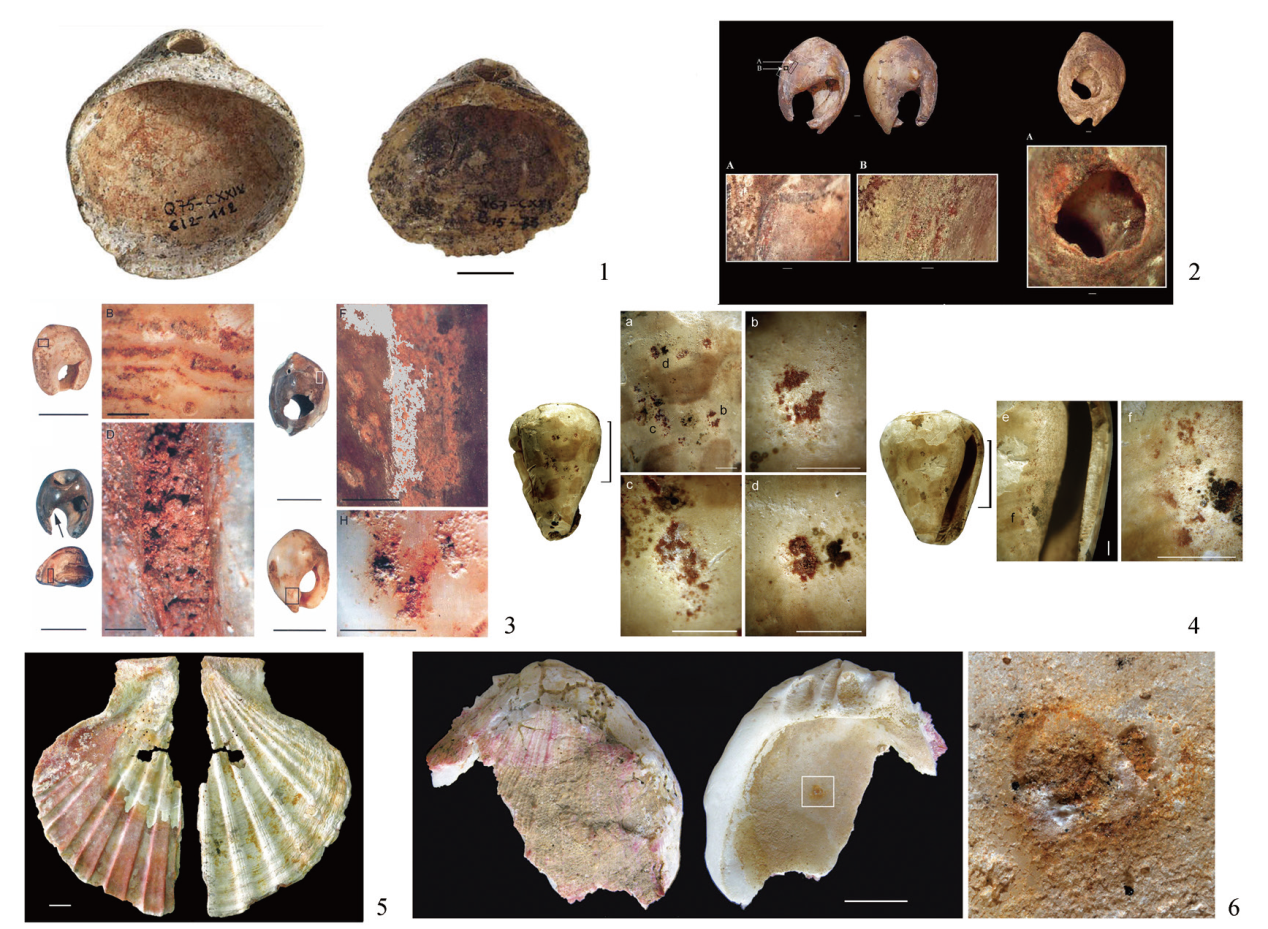
During human cognitive evolution, the emergence of symbolic thinking facilitated the birth of early human artistic creation and decorative practices. Archaeological evidence indicates that early humans possessed both the capacity to identify and collect decorative materials and the technical expertise to modify their appearance. The application of ochre pigments and heat treatment technologies represents a particularly significant development in this process. From the Middle to Late Paleolithic periods, humans employed ochre pigments and heat treatment to color early personal ornaments, deliberately changing their appearance to enhance visual impact and enrich symbolic meaning. The employment of ochre, heat treatment, and the advent of personal ornaments are regarded as hallmarks of behavioral modernity, garnering significant attention from Paleolithic archaeologists.
Archaeological evidence from Paleolithic sites demonstrates that ancient humans had already mastered ochre’s properties, applying it to personal ornament coloration following grinding and processing. Heat treatment technology reflects their capacity to manipulate temperature for modifying the color and texture of personal ornaments, thereby expanding the expression of these objects. However, the intentionality behind the color changes in these personal ornaments remains to be substantiated through detailed scientific analysis. Recent research has yielded important discoveries in this field, providing methodological frameworks and empirical evidence.
This study reviews current research on ochre pigments and heat treatment technologies applied in Paleolithic personal ornament coloration, both domestically and internationally, to comprehensively explore the technological innovations and cognitive development demonstrated in personal ornament production. This investigation aims to characterize behavioral modernity in Paleolithic populations and establish a comprehensive framework for personal ornament research. The analysis also approaches this phenomenon through the lens of the significance of color for early humans, examines the distinct behavioral patterns and cognitive levels reflected in different coloration behaviors, and attempts to briefly analyze the reasons for the temporal and spatial variations in personal ornament coloration practices documented in the archaeological record.
Future research can be conducted from multiple dimensions including archaeology, cognitive science, and sociocultural perspectives. It can not only reveal the complexity of Paleolithic personal ornament coloration techniques and interpret the social significance of symbolic behavior in early decorative traditions, but also contribute to understanding issues of social complexity characterized by specialized craft production. Advancements in research methods will continue to expand opportunities for retrieving information on personal ornament production techniques and color utilization, offering enhanced perspectives for in-depth analysis of early human complex behaviors.
Key words: Ochre pigment; heat treatment; Paleolithic; personal ornament
WEI Yi . A review and reflection of coloration studies on Paleolithic personal ornaments[J]. Acta Anthropologica Sinica, 2026 , 45(04) : 801 -814 . DOI: 10.16359/j.1000-3193/AAS.2025.0061
| [1] | Klein RG. Archeology and the evolution of human behavior[J]. Evolutionary Anthropology, 2000, 9(1): 17-36 |
| [2] | d’Errico F, Henshilwood C, Lawson G, et al. Archaeological evidence for the emergence of language, symbolism, and music-An alternative multidisciplinary perspective[J]. Journal of World Prehistory, 2003, 17(1): 1-7 |
| [3] | Chase PG, Dibble HL. Middle Paleolithic symbolism: a review of current evidence and interpretations[J]. Journal of Anthropological Archaeology, 1987, 6: 263-296 |
| [4] | Henshilwood CS, Marean CW. The origin of modern human behavior[J]. Current Anthropology, 2003, 44(5): 627-651 |
| [5] | Nowell A. Defining behavioral modernity in the context of Neandertal and anatomically modern human populations[J]. Annual Review of Anthropology, 2010, 39(1): 437-452 |
| [6] | Pettitt P. The living as symbols, the dead as symbols:Problematising the scale and pace of hominin symbolic evolution[A]. In: Henshilwood C, d’Errico F(Eds). Homo Symbolicus: The Dawn of Language Imagination and Spirituality[C]. Amsterdam/ Philadelphia: John Benjamins Publishing Company, 2011, 141-161 |
| [7] | Cornell RM, Schwertmann U. The Iron Oxides: Structure, Properties, Reactions, Occurrences and Uses[M]. Weinheim: Wiley-VCH, 2003 |
| [8] | Watts I, Chazan M., Wilkins J. Early Evidence for Brilliant Ritualized Display: Specularite Use in the Northern Cape (South Africa) between 500 and 300 ka[J]. Current Anthropology, 2016, 57: 287-310 |
| [9] | Clark DJ, Brown KS. The Twin Rivers Kopje, Zambia: Stratigraphy, Fauna, and Artefact Assemblages from the 1954 and 1956 Excavations[J]. Journal of Archaeological Science, 2001, 28: 305-330 |
| [10] | Barham LS. Systematic Pigment Use in the Middle Pleistocene of South-Central Africa[J]. Current Anthropology, 2002, 43(1): 181-190 |
| [11] | Zipkin AM, Hanchar JM, Brooks AS, et al. Ochre Fingerprints: Distinguishing among Malawian Mineral Pigment Sources with Homogenized Ochre Chip LA-ICPMS[J]. Archaeometry, 2015, 57: 297-317 |
| [12] | McBrearty S. The Middle Pleistocene of East Africa[A]. In: Barham L, Robson-Brown K(Eds). Human Roots: Africa and Asia in the Middle Pleistocene[C]. Bristol: Western Academic and Specialist Press, 2001, 81-98 |
| [13] | Van Peer P, Rots V, Vroomans JM. A Story of Colorful Diggers and Grinders: The Sangoan and Lupemban at Site 8-B-11, Sai Island, Northern Sudan[J]. Before Farming, 2004, 3: 1-28 |
| [14] | McBrearty S, Tryon C. From Acheulean to Middle Stone Age in the Kapthurin Formation, Kenya[A]. In: Hovers E, Kuhn SL(Eds). Transitions before the transition: Evolution and stability in the Middle Palaeolithic and Middle Stone Age[C]. New York: Springer, 2005, 257-277 |
| [15] | d’Errico F. Le rouge et le noir: Implications of early pigment use in Africa, the Near East, and Europe, for the origin of cultural modernity[J]. South African Archaeological Society Goodwin Series, 2008, 10: 168-174 |
| [16] | Henshilwood CS, d’Errico F, Van Niekerk KL, et al. An abstract drawing from the 73,000-year-old levels at Blombos Cave, South Africa[J]. Nature, 2018, 562(7725): 115-118 |
| [17] | Henshilwood CS, d’Errico F, Watts I. Engraved ochres from the Middle Stone Age levels at Blombos Cave, South Africa[J]. Journal of Human Evolution, 2009, 57(1): 27-47 |
| [18] | Wadley L, Langejans G. Preliminary Study of Scrapers Around Combustion Features in Layer SS, Sibudu, 58000 Years Ago[J]. South African Archaeological Bulletin, 2014, 69: 19-33 |
| [19] | Rifkin R. Assessing the Efficacy of Red Ochre as a Prehistoric Hide Tanning Ingredient[J]. Journal of African Archaeology, 2011, 9(2): 131-158 |
| [20] | Ambrose SH. Chronology of the Later Stone Age and food production in East Africa[J]. Journal of Archaeological Science, 1998, 25: 377-392 |
| [21] | Gibson NE., Wadley L, Williamson BS. Microscopic Residues as Evidence of Hafting on Backed Tools from the 60,000 to 68,000-Year-Old Howiesons Poort Layers of Rose Cottage Cave, South Africa[J]. Southern African Humanities, 2004, 16: 1-11 |
| [22] | Lombard M. The Gripping Nature of Ochre: The Association of Ochre with Howiesons Poort Adhesives and Later Stone Age Mastics from South Africa[J]. Journal of Human Evolution, 2007, 53(4): 406-419 |
| [23] | Lombard M. Finding Resolution for the Howiesons Poort through the Microscope: Micro-residue Analysis of Segments from Sibudu Cave, South Africa[J]. Journal of Archaeological Science, 2008, 35: 26-41 |
| [24] | Wadley L. Post-Depositional Heating May Cause Over-Representation of Red- Colored Ochre in Stone Age Sites[J]. The South African Archaeological Bulletin, 2009, 64(190): 166-171 |
| [25] | Shaham D, Grosman L, Goren-Inbar N. The Red-Stained Flint Crescent from Gesher: New Insights into PPNA Hafting Technology[J]. Journal of Archaeological Science, 2010, 37: 2010-2016 |
| [26] | Zipkin AM, Wagner M, McGrath K, et al. An Experimental Study of Hafting Adhesives and the Implications for Compound Tool Technology[J]. PLoS ONE, 2014, 9(11): e112560 |
| [27] | Peile AR. Colors that Cure[J]. Hemisphere, 1979, 23(4): 214-217 |
| [28] | Velo J. Ochre as Medicine: A Suggestion for the Interpretation of the Archaeological Record[J]. Current Anthropology, 1984, 25: 674 |
| [29] | Rifkin R. Ethnographic and Experimental Perspectives on the Efficacy of Red Ochre as a Mosquito Repellent[J]. South African Archaeological, 2015, 70: 64-75 |
| [30] | Rifkin RF, Dayet L, Queffelec A, et al. Evaluating the Photoprotective Effects of Red Ochre on Human Skin by in Vivo SPF Assessment: Implications for Human Evolution, Adaptation and Dispersal[J]. PLoS ONE, 2015, 10(9): e0136090 |
| [31] | Hodgskiss T. Ochre Use in the Middle Stone Age[A]. Oxford Research Encyclopedia of Anthropology[C]. Oxford University Press, 2020 |
| [32] | Botha R. Prehistoric Shell Beads as a Window on Language Evolution[J]. Language & Communication, 2008, 28: 197-212 |
| [33] | Wynn T. Hafted Spears and the Archaeology of Mind[J]. Proceedings of the National Academy of Sciences of the United States of America, 2009, 106(24): 9544-9545 |
| [34] | Haidle MN. Working-Memory Capacity and the Evolution of Modern Cognitive Potential: Implications from Animal and Early Human Tool Use[J]. Current Anthropology, 2010, 51(S1): 149-166 |
| [35] | Hodgskiss T. The Cognitive Requirements for Ochre Use in the Middle Stone Age at Sibudu, South Africa[J]. Cambridge Archaeological Journal, 2014, 24(3): 405-428 |
| [36] | Wynn T, Coolidge FL. The Implications of the Working Memory Model for the Evolution of Modern Cognition[J]. International Journal of Evolutionary Biology, 2011, 741357 |
| [37] | Wadley L. Recognizing Complex Cognition through Innovative Technology in Stone Age and Palaeolithic Sites[J]. Cambridge Archaeological Journal, 2013, 23(2): 163-183 |
| [38] | d’Errico F, Backwell LR, Villa P, et al. Early evidence of San material culture represented by organic artifacts from Border Cave, South Africa[J]. Proceedings of the National Academy of Sciences, 2012, 109: 13214-13219 |
| [39] | Sehasseh EM, Fernandez P, Kuhn S, et al. Early Middle Stone Age personal ornaments from Bizmoune Cave, Essaouira, Morocco[J]. Science Advances, 2021, 7(39): eabi8620 |
| [40] | Henshilwood C, d’Errico F, Vanhaeren M, et al. Middle Stone Age shell beads from South Africa[J]. Science, 2004, 304(5669): 404 |
| [41] | d’Errico F, Henshilwood C, Vanhaeren M, et al. Nassarius kraussianus shell beads from Blombos Cave: evidence for symbolic behaviour in the Middle Stone Age[J]. Journal of Human Evolution, 2005, 48: 3-24 |
| [42] | d’Errico F, Vanhaeren M, Wadley L. Possible shell beads from the Middle Stone Age layers of Sibudu Cave, South Africa[J]. Journal of Archaeological Science, 2008, 35: 2675-2685 |
| [43] | d’Errico F, Vanhaeren M, Barton N, et al. Additional evidence on the use of personal ornaments in the Middle Paleolithic of North Africa[J]. Proceedings of the National Academy of Sciences, 2009, 106: 16051-16056 |
| [44] | Vanhaeren M, d’Errico F, Stringer C, et al. Middle Palaeolithic shell beads in Israel and Algeria[J]. Science, 2006, 312: 1785-1788 |
| [45] | Vanhaeren M, d’Errico F, Van Niekerk KL, et al. Thinking strings: additional evidence for personal ornament use in the Middle Stone Age of Blombos Cave, South Africa[J]. Journal of Human Evolution, 2013, 64: 500-517 |
| [46] | Vanhaeren M, Wadley L, d’Errico F. Variability in Middle Stone Age Symbolic Traditions: The Marine Shell Beads from Sibudu Cave, South Africa[J]. Journal of Archaeological Science: Reports, 2019, 27: 101893 |
| [47] | Bouzouggar A, Barton N, Vanhaeren M, et al. 82,000-year-old shell beads from North Africa and implications for the origins of modern human behaviour[J]. Proceedings of the National Academy of Sciences, 2007, 104(24): 9964-9969 |
| [48] | Dibble HL, Aldeias V, Alvarez-Ferna?ndez E, et al. New excavations at the site of Contrebandiers Cave, Morocco[J]. PaleoAnthropology, 2012: 145-201 |
| [49] | Bar-Yosef Mayer DE, Vandermeersch B, Bar-Yosef O. Shells and ochre in Middle Paleolithic Qafzeh Cave, Israel: indications for modern behavior[J]. Journal of Human Evolution, 2009, 56: 307-314 |
| [50] | d’Errico F, Backwell L. Earliest Evidence of Personal Ornaments Associated with Burial: The Conus Shells from Border Cave[J]. Journal of Human Evolution, 2016, 93: 91-108 |
| [51] | Steele TE, álvarez-Ferna?ndez E, Hallett-Desguez E. A Review of Shells as Personal Ornamentation during the African Middle Stone Age[J]. PaleoAnthropology, 2019: 24-51 |
| [52] | Eiwanger J, Mikdad A, Moser J, et al. De?couverte de coquilles perfore?es de type Nassarius au site Ifri n’Ammar (Rif Oriental, Maroc)[J]. Bulletin d’Arche?ologie Marocaine, 2012, 22: 9-15 |
| [53] | Zilha?o J, Angelucci DE, Badal-Garcia E, et al. Symbolic use of marine shells and mineral pigments by Iberian Neandertals[J]. Proceedings of the National Academy of Sciences, 2010, 107: 1023-1028 |
| [54] | Peresani M, Vanhaeren M, Quaggiotto E, et al. An ochered fossil marine shell from the mousterian of fumane cave, Italy[J]. PLoS One, 2013, 8: e68572 |
| [55] | Plug I. Bone Tools and Shell, Bone and Ostrich Eggshell Beads from Bushman Rock Shelter (BRS), Eastern Transvaal[J]. The South African Archaeological Bulletin, 1982, 37: 57-62 |
| [56] | Vogelsang R, Richter J, Jacobs Z, et al. New excavations of Middle Stone Age deposits at Apollo 11 Rockshelter, Namibia: stratigraphy, archaeology, chronology and past environments[J]. Journal of African Archaeology, 2010, 8: 185-218 |
| [57] | d’Errico F, Garcia Moreno R, Rifkin RF. Technological, Elemental and Colorimetric Analysis of an Engraved Ochre Fragment from the Middle Stone Age Levels of Klasies River Cave 1, South Africa[J]. Journal of Archaeological Science, 2012, 39: 942-952 |
| [58] | d’Errico F, Shipton C, et al. Trajectories of cultural innovation from the Middle to Later Stone Age in Eastern Africa: Personal ornaments, bone artifacts, and ocher from Panga ya Saidi, Kenya[J]. Journal of Human Evolution, 2020, 141: 102737 |
| [59] | TaborinY. La mer et les premiers hommes modernes[A]. In: VandermeerschB.(Ed). E?changes et diffusion dans la pre?histroire Me?diterrane?enne[C]. Paris: Editions du comite? des travaux historiques et scientifiques, 2003, 113-122 |
| [60] | Vanhaeren M, d’Errico F. Aurignacian Ethno-linguistic Geography of Europe Revealed by Personal Ornaments[J]. Journal of Archaeological Science, 2006, 33(8): 1105-1128 |
| [61] | Shimelmitz R, Friesem DE, Clark JL, et al. The Upper Paleolithic and Epipaleolithic of Sefunim Cave, Israel[J]. Quaternary International, 2018, 464: 106-125 |
| [62] | Bar-Yosef Mayer DE. Mollusk shells at Kebara cave[A]. In: Bar-Yosef O, Meignen L(Eds). The Upper and Middle Paleolithic archaeology of Kebara Cave, Mt. Carmel, volume II[C]. Cambridge: Peabody Museum Publications, 2019, 403-412 |
| [63] | Tejero JM, Rabinovich R, Yeshurun R, et al. Personal ornaments from Hayonim and Manot caves (Israel) hint at symbolic ties between the Levantine and the European Aurignacian[J]. Journal of Human Evolution, 2021, 160: 102870 |
| [64] | Shunkov MV, Fedorchenko AY, Kozlikin MB, et al. Initial Upper Palaeolithic ornaments and formal bone tools from the East Chamber of Denisova Cave in the Russian Altai[J]. Quaternary International, 2020, 559: 47-67 |
| [65] | Pitarch A, Wei Y, Gao X, et al. The earliest evidence of coloured ornaments in China: The ochred ostrich eggshell beads from Shuidonggou Locality 2[J]. Journal of Anthropological Archaeology, 2017, 48: 102-113 |
| [66] | Langley MC, O’Connor S. An enduring shell artefact tradition from Timor-Leste: Oliva bead production from the Pleistocene to Late Holocene at Jerimalai, Lene Hara, and Matja Kuru 1 and 2[J]. PLoS One, 2016, 11(8): e0161071 |
| [67] | Langley MC, O’Connor S, Aplin K. A >46,000-year-old kangaroo bone implement from Carpenter’s Gap 1 (Kimberley, northwest Australia)[J]. Quaternary Science Reviews, 2016, 154: 199-213 |
| [68] | Langley MC, O’Connor S, Piotto E. 42,000-year-old worked and pigment- stained Nautilus shell from Jerimalai (Timor-Leste): evidence for an early coastal adaptation in ISEA[J]. Journal of Human Evolution, 2016, 97: 1-16 |
| [69] | Walter P. Caractérisation des traces rouges et noires sur les coquillages perforés de Qafzeh[A]. In: VandermeerschB(Ed). Echanges et diVusion dans la préhistoire méditerranéenne[C]. Paris: CTHS, 2003, 122 |
| [70] | Hoffmann DL, Angelucci DE, Villaverde V, et al. Symbolic use of marine shells and mineral pigments by Iberian Neandertals 115,000 years ago[J]. Science Advances, 2018, 4(2): eaar5255 |
| [71] | Godfrey-Smith DI, Ilani S. Past thermal history of goethite and hematite fragments from Qafzeh Cave deduced from thermal activation characteristics of the 110°C TL peak of enclosed quartz grains[J]. Revue d’Archéométrie, 2004, 28(1): 185-190 |
| [72] | d’Errico F, Salomon H, Vignaud C, et al. Pigments from the Middle Palaeolithic Levels of Es-Skhul (Mount Carmel, Israel)[J]. Journal of Archaeological Scince, 2010, 37: 3099-3110 |
| [73] | Salomon H, Vignaud C, Coquinot Y, et al. Selection and Heating of Colouring Materials in the Mousterian Level of Es-Skhul (ca. 100000 Years BP, Mount Carmel, Israel)[J]. Archaeometry, 2012, 54: 698-722 |
| [74] | Watts I. Ochre in the Middle Stone Age of Southern Africa: Ritualised Display or Hide Preservative?[J] The South African Archaeological Bulletin, 2002, 57: 1-14 |
| [75] | Hovers E, Ilani S, Bar-Yosef O, et al. An Early Case of Color Symbolism: Ochre Use by Modern Humans in Qafzeh Cave[J]. Current Anthropology, 2003, 44: 491-522 |
| [76] | Salomon H. Les Matie?res Colorantes Au De?but Du Pale?olithique Supe?rieur: Sources, Transformations et Fonctions[M]. Bordeaux:Universite? Bordeaux 1, 2009 |
| [77] | Watts I. Red Ochre, Body-Painting, and Language:Interpreting the Blombos Ochre[A]. In: Botha R, Knight C(Eds). The Cradle of Language[C]. Oxford: Oxford University Press, 2009, 62-92 |
| [78] | Roebroeks W, Sier MJ, Nielsen TK, et al. Use of Red Ochre by Early Neandertals[J]. Proceedings of the National Academy of Sciences, 2012, 109: 1889-1894 |
| [79] | Cavallo G, Fontana F, Gonzato F, et al. Textural, Microstructural, and Compositional Characteristics of Fe-Based Geomaterials and Upper Paleolithic Ocher in the Lessini Mountains, Northeast Italy: Implications for Provenance Studies[J]. Geoarchaeology, 2017, 32: 437-455 |
| [80] | Henshilwood CS, d’Errico F, Van Niekerk KL, et al. A 100,000-Year-Old Ochre-Processing Workshop at Blombos Cave, South Africa[J]. Science, 2011, 334: 219-222 |
| [81] | Gialanella S, Belli R, Dalmeri G, et al. Artificial or Natural Origin of Hematite-Based Red Pigments in Archaeological Contexts: The Case of Riparo Dalmeri (Trento, Italy)[J]. Archaeometry, 2011, 53: 950-962 |
| [82] | Dayet L. Invasiveand Non-Invasive Analyses of Ochre and Iron-Based Pigment Raw Materials: A Methodological Perspective[J]. Minerals, 2021, 11: 210 |
| [83] | 魏屹, d’Errico F, 高星. 旧石器时代装饰品研究:现状与意义[J]. 人类学学报, 2016, 35(1): 132-148 |
| [84] | Kandel AW, Conard NJ. Production sequences of ostrich eggshell beads and settlement dynamics in the Geelbek Dunes of the Western Cape, South Africa[J]. Journal of Archaeological Science, 2005, 32: 1711-1721 |
| [85] | Lange K, Perle?s C, Vanhaeren M, et al. Heat induced modification of marine shells as personal ornaments at the prehistoric site of Franchthi Cave, Greece: first results of a multianalytical approach[A]. 9th International Conference on NDT of Art, Jerusalem, Israel, 2008 |
| [86] | Perle?s C, Vanhaeren M. Black Cyclope neritea marine shell ornaments in the Upper Palaeolithic and Mesolithic of Franchthi Cave, Greece: arguments for intentional heat treatment[J]. Journal of Field Archaeology, 2010, 35(3): 298-309 |
| [87] | Schoeman S. Eloquent beads, the semantics of a Zulu art form[J]. Africa Insight, 1983, 13(2): 5-25 |
| [88] | Wickler W, Seibt I. Syntax and semantics in a Zulu bead colour communication system[J]. Anthropos, 1995, 90: 391-405 |
| [89] | d’Errico F, Vanhaeren M, Van Niekerk K, et al. Assessing the accidental versus deliberate colour modification of shell beads: a case study on perforated Nassarius kraussianus from Blombos Cave Middle Stone Age levels[J]. Archaeometry, 2015, 57: 51-76 |
| [90] | Janssen JD, Mutch GW, Hayward JL. Taphonomic effects of high temperature on avian eggshell[J]. Palaios, 2011, 26: 658-664 |
| [91] | McLarty SJ. Taphonomic Effects of Fire on Ostrich and Emu Eggshell[D]. Honors Thesis. Michigan: Andrews University, 2013 |
| [92] | Collins B, Steele TE. An often overlooked resource: Ostrich (Struthio spp.) eggshell in the archaeological record[J]. Journal of Archaeological Science: Reports, 2017, 13: 121-131 |
| [93] | Craig C, Collins B, Nowell A, et al. The effects of heating ostrich eggshell on bead manufacturing: An experimental approach[J]. Journal of Archaeological Science: Reports, 2020, 31: 102287 |
| [94] | Wei Y, d’Errico F, Vanhaeren M, et al. An Early Instance of Upper Palaeolithic Personal Ornamentation from China: The Freshwater Shell Bead from Shuidonggou 2[J]. Plos One, 2016, 11(5): e0155847 |
| [95] | 高星, 王惠民, 裴树文, 等. 水洞沟——2003-2007年度考古发掘与研究报告[M]. 北京: 科学出版社, 2013 |
| [96] | 黄慰文, 傅仁义. 小孤山——辽宁海城史前洞穴遗址综合研究[M]. 北京: 科学出版社, 2009 |
| [97] | Pei WC. The Upper Cave Industry of Choukoutien[M]. Palaeontologia Sinica 120. Peking:Geological Survey of China, 1939 |
| [98] | d’Errico F, Wei Y, et al. Zhoukoudian Upper Cave personal ornaments and ochre: Rediscovery and reevaluation[J]. Journal of Human Evolution, 2021, 161: 103088 |
| [99] | 宋艳花, 石金鸣. 山西吉县柿子滩旧石器时代遗址出土装饰品研究[J]. 考古, 2013, 8: 46-57 |
| [100] | Zhang Y, Doyon L, Peng F, et al. An Upper Paleolithic Perforated Red Deer Canine With Geometric Engravings From QG10, Ningxia, Northwest China[J]. Frontiers in Earth Science, 2022, 10: 814761 |
| [101] | Wei Y, d’Errico F, Vanhaeren M, et al. A Technological and Morphological Study of Late Paleolithic Ostrich Eggshell Beads from Shuidonggou, North China[J]. Journal of Archaeological Science, 2017, 85: 83-104 |
| [102] | Song YH, Cohen DJ, Shi JM. Diachronic Change in the Utilization of Ostrich Eggshell at the Late Paleolithic Shizitan Site, North China[J]. Frontiers in Earth Science, 2022, 9: 818554 |
| [103] | TurnerV. Color classification in Ndembu ritual:A problem in primitive classification[A]. In: BartonM(Ed). Anthropological approaches to the study of religion[C]. London: Tavistock, 1966, 47-84 |
| [104] | SagonaA. The quest for the red gold[A]. In: SagonaA(Ed). Bruising the red earth: Ochre mining and ritual in aboriginal Tasmania[C]. Melbourne: Melbourne University Press, 1994, 8-38 |
| [105] | Varichon A. Couleurs - pigments et teintures dans les mains des peuples[M]. Paris: Seuil, 2000 |
| [106] | Varichon A. Le corps des peuples[A]. Us et coutumes de la proprete? et de la se?duction[M]. Paris: Seuil, 2003, 204 |
| [107] | Berlin B, Kay P. Basic color terms: Their universality and evolution[M]. Berkeley and Los Angeles: University of California Press, 1969 |
| [108] | Kay P, Berlin B, Maffi M, et al. Color naming across languages[A]. In: Hardin C, Maffi C, Maffi L(Eds). Color categories in thought and language[C]. Cambridge: Cambridge University Press, 1997, 21-58 |
| [109] | Watts I. The pigments from Pinnacle Point Cave 13B, Western Cape, South Africa[J]. Journal of Human Evolution, 2010, 59(3-4): 392-411 |
| [110] | Rifkin RF. Ethnographic insight into the prehistoric significance of red ochre[J]. The Digging Stick, 2015, 32(2): 7-10 |
| [111] | Hodgskiss T, Wadley L. How people used ochre at Rose Cottage Cave, South Africa: Sixty thousand years of evidence from the Middle Stone Age[J]. PLoS ONE, 2017, 12(4): e0176317 |
| [112] | Wadley L, Prinsloo LC. Experimental heat treatment of silcrete implies analogical reasoning in the Middle Stone Age[J]. Journal of Human Evolution, 2014, 70: 49-60 |
| [113] | Schmidt P, Morala A. First insights into the technique of heat treating prehistoric silcrete artefacts: An experimental approach[J]. Journal of Archaeological Science: Reports, 2018, 21: 1006-1019 |
| [114] | Velliky EC, Schmidt P, Bellot-Gurlet L, et al. Early anthropogenic use of hematite on Aurignacian ivory personal ornaments from Hohle Fels and Vogelherd caves, Germany[J]. Journal of Human Evolution, 2021, 150: 102900 |
| [115] | Dayet L, Faivre JP, Le Bourdonnec FX, et al. Manganese and iron oxide use at Combe-Grenal (Dordogne, France): A proxy for cultural change in Neanderthal communities[J]. Journal of Archaeological Science: Reports, 2019, 25: 239-256 |
/
| 〈 |
|
〉 |