


Hesperotherium remains newly discovered in the Renzidong Cave site, Fanchang, Anhui and its paleoecological significance
Received date: 2026-06-22
Revised date: 2026-08-05
Online published: 2026-10-16
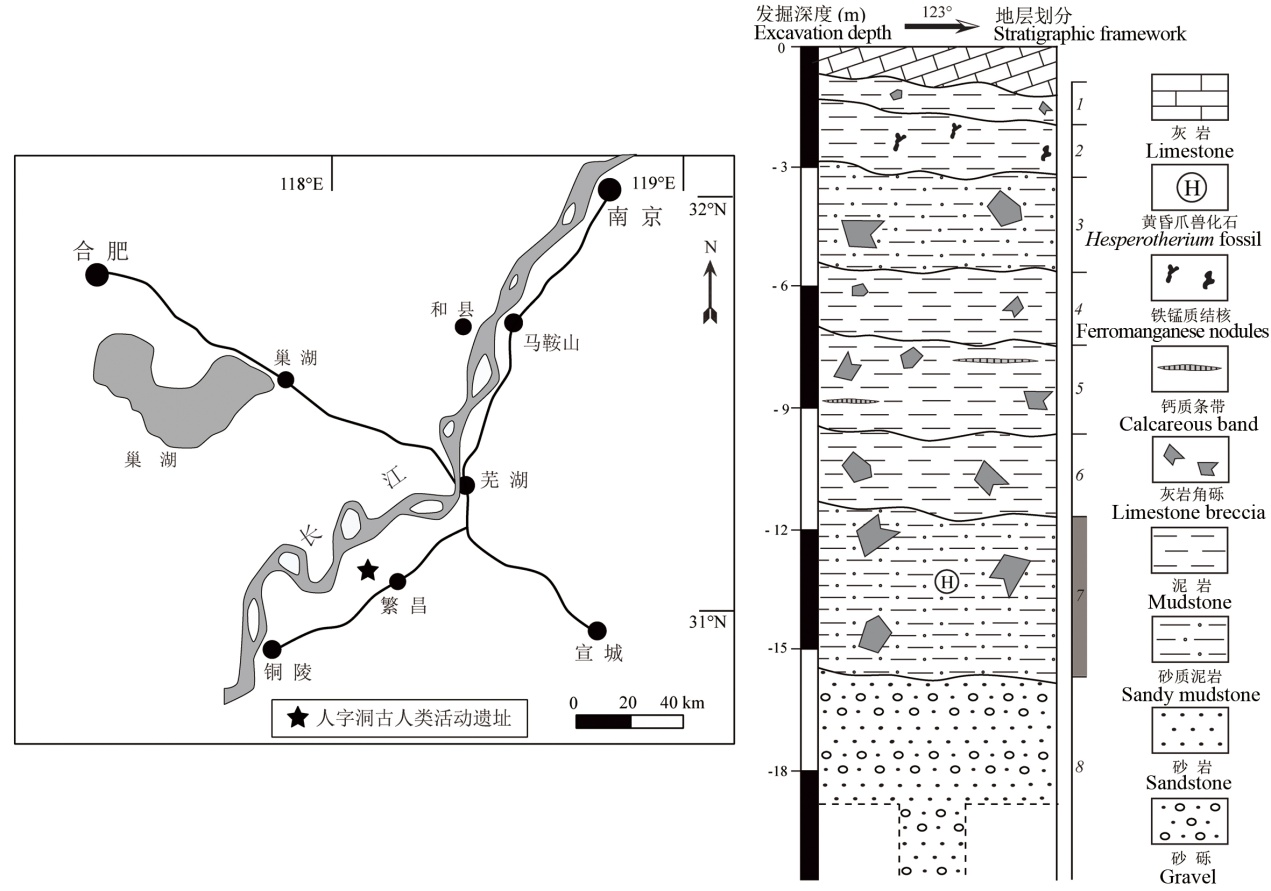
The Renzidong Cave site is one of the oldest Paleolithic localities in East Asia. During the excavation as part of the State Key Project of the Ninth Five-Year Plan, numerous stone and bone artifacts were discovered during 1998 to 2005. In addition, abundant vertebrate fossils were also yielded. All four Quaternary perissodacty l families (Equidae, Rhinocerotidae, Tapiridae, and Chalicotheriidae) have been reported, including Hesperotherium huaiheense. From 2020 to 2024, a joint team from the Institute of Vertebrate Paleontology and Paleoanthropology (Chinese Academy of Sciences) and the People’s Government of Fanchang District, Wuhu City, conducted a second round of excavations at the Renzidong Site. Several well-preserved teeth of Chalicotheriidae were collected. Quaternary chalicotheres represent a relict Neogene lineage and were among the first fossil vertebrates reported from China. After decades of debate and revision, most Quaternary chalicothere specimens had been as assigned to Hesperotherium sinense. The known distribution of H. huaiheense is limited to the Renzidong site. The new chalicothere specimens from Renzidong are much better preserved than the type specimens and exhibit a moderate degree of wear, thereby retaining important morphological characters. The new molars exhibit a reduced posterior part of the metacone and a distinctly trapezoidal occlusal outline of M3 with a constricted posterior part; the lingual cingulum is absent at the opening of the central valley of M3. All of these features are identical to those of H. huaiheense but differ from typical H. sinense. Some authors once regarded H. huaiheense as a subspecies of H. sinense based on the view that all morphological differences fall within the variation of H. sinense. We interpret the reduced metacone and absent lingual cingulum as having evolutionary and ecological significance, respectively. We therefore recognize H. huaiheense as a valid species. Another subspecies, H. sinense primigenius, retains primitive characters (e.g., a remnant protoloph), which also have evolutionary significance. Hesperotherium had a long temporal range spanning much of the Early Pleistocene (from 2.6 Ma to 1.0 Ma). Recognizing multiple species within this genus is a reasonable approach, although it depends on further discovery and research. Morphological similarities between Hesperotherium and the South American Megatherium suggest analogous ecological adaptations. Recent paleoecologic analyses indicate that both genera likely occupied similar habitats.
SUN Boyang , WANG Yuan , ZHAO Keliang , HUANG Baiting , HU Xiaowei , JIN Changzhu . Hesperotherium remains newly discovered in the Renzidong Cave site, Fanchang, Anhui and its paleoecological significance[J]. Acta Anthropologica Sinica, 2026 , 45(05) : 861 -870 . DOI: 10.16359/j.1000-3193/AAS.2026.0060
| [1] | 金昌柱, 郑龙亭, 董为, 等. 安徽繁昌早更新世人字洞古人类活动遗址及其哺乳动物群[J]. 人类学学报, 2000, 19(3): 184-198 |
| [2] | 金昌柱, 刘金毅. 安徽繁昌人字洞——早期人类活动遗址[M]. 北京: 科学出版社, 2009, 1-439 |
| [3] | 王元, 刘文晖, 刘立家, 等. 安徽繁昌人字洞遗址2020-2024年发掘简报[J]. 第四纪研究, 2026, 46(4): 908-924. doi: 10.11928/j.issn.1001-7410.2026.04.20 |
| [4] | 严亚玲, 王元, 黄柏挺, 等. 安徽繁昌人字洞自然遗产价值分析:基于哺乳动物化石群的研究[J]. 自然与文化遗产研究, 2025, 10(6): 15-23 |
| [5] | Anquetin J, Antoine PO, Tassy P. Middle Miocene Chalicotheriinae (Mammalia, Perissodactyla) from France, with a discussion on chalicotheriine phylogeny[J]. Zoological Journal of the Linnean Society, 2007, 151(3): 577-608 |
| [6] | Tassy P. Chalicotherium: le ‘cheval-gorille’[J]. La Recherche, 1978, 87: 283-285 |
| [7] | 陈少坤, 庞丽波, 胡鑫, 等. 重庆万州盐井沟地区黄昏爪兽(爪兽科,奇蹄目)化石新发现[J]. 第四纪研究, 2017, 37(1): 166-173 |
| [8] | Owen R. On fossil remains of Mammals found in China[J]. Quarterly Journal of the Geological Society of London, 1870, 26(1-2): 417-436 |
| [9] | Matthew WD, Granger W. New fossil mammals from the Pliocene of Sze-chuan, China[J]. Bulletin of the American Museum of Natural History, 1923, 48: 563-598 |
| [10] | Teilhard de Chardin P, Piveteau J. Les mammifères fossiles de Nihowan (Chine)[J]. Annales de Paléontologie, 1930, 19: 1-134 |
| [11] | Holland WJ, Peterson OA. The osteology of the Chalicotheroidea with special reference to a mounted skeleton of Moropus elatus Marsh, now installed in the Carnegie Museum[J]. Memoirs of the Carnegie Museum, 1914, 3: 189-406 |
| [12] | Colbert EH. Chalicotheres from Mongolia and China in the American Museum[J]. Bulletin of the American Museum of Natural History, 1934, 67: 353-387 |
| [13] | Colbert EH, Hooijer DA. Pleistocene mammals from the limestone fissures of Szechwan, China[J]. Bulletin of the American Museum of Natural History, 1953, 102(1): 1-134 |
| [14] | 林一璞, 潘悦容, 陆庆五. 云南元谋早更新世哺乳动物群[A].见:中国科学院古脊椎动物与古人类研究所.古人类论文集[C]. 北京: 科学出版社, 1978, 101-120 |
| [15] | 胡长康, 齐陶. 陕西蓝田公王岭更新世哺乳动物群[M].中国古生物志·新丙种第21号. 北京: 科学出版社, 1978, 21: 1-64 |
| [16] | 黄万波, 方其仁, 等. 巫山猿人遗址[M]. 北京: 海洋出版社, 1991, 1-230 |
| [17] | 邱占祥. Hesperotherium(黄昏兽)——后期爪兽一新属[J]. 古脊椎动物学报, 2002, 40(4): 317-325 |
| [18] | 李晓晨, 邓凯. 记陕西镇安早更新世的两种爪兽化石[J]. 古脊椎动物学报, 2003, 41(4): 332-336 |
| [19] | 同号文. 爪兽科[A].见:郑绍华(主编).建始人遗址[C]. 北京: 科学出版社, 2004, 251-253 |
| [20] | 同号文. 广西柳城巨猿洞早更新世爪兽化石(奇蹄目,哺乳动物纲)[J]. 古脊椎动物学报, 2006, 44(4): 347-365 |
| [21] | Yan YL, Wang Y, Zhu M, et al. New Early Pleistocene Perissodactyl remains associated with Gigantopithecus from Yangliang Cave, Guangxi of southern China[J]. Historical Biology, 2016, 28(1-2): 237-251 |
| [22] | 同号文, 邱占祥. 奇蹄目[A].见:金昌柱,刘金毅(主编).安徽繁昌人字洞:早期人类活动遗址[M]. 北京: 科学出版社, 2009, 286-320 |
| [23] | 陈少坤. 中国晚新生代的爪兽化石[D].博士学位论文, 北京: 中国科学院古脊椎动物与古人类研究所, 2017, 1-161 |
| [24] | Zan JB, Fang XM, Zhang WL, et al. Palaeoenvironmental and chronological constraints on the Early Pleistocene mammal fauna from loess deposits in the Linxia Basin, NE Tibetan Plateau[J]. Quaternary Science Reviews, 2016, 148: 234-242 |
| [25] | 陈少坤, 庞丽波, 贺存定, 等. 重庆市盐井沟第四纪哺乳动物化石经典产地的新发现与时代解释[J]. 科学通报, 2013, 58(20): 1962-1968 |
| [26] | Hu HQ, Tong HW, Han F, et al. Chronological and palaeoecological insights into the Dayakou fauna in Yanjinggou, Chongqing, China: responses of large mammals to the Early-Middle Pleistocene Climate Transition[J]. Quaternary Science Reviews, 2025, 352: 109199 |
| [27] | 金昌柱, 郑家坚, 王元, 等. 中国南方早更新世主要哺乳动物群层序对比和动物地理[J]. 人类学学报, 2008, 27(4): 304-317 |
| [28] | Mainou LS, Correa-Lau J, Labarca R, et al. Written in bones: palaeoclimate histotaphonomic history inferred from a complete Megatherium skeleton preserved in the Atacama Desert[J]. Palaeontology, 2025, 68(4): e70011 |
| [29] | Oliveira T, da Costa JP, da Silva Cruz EN, et al. Taxonomy, radiocarbon dating (14C AMS), and isotopic palaeoecology (δ13C, δ18O) of the Late Pleistocene mammals from Toca Fria cave, Bahia, Brazil[J]. Pal?ontologische Zeitschrift, 2026, doi: 10.1007/s12542-026-00775-y |
/
| 〈 |
|
〉 |