


A preliminary report on the excavation of Wujialiang Paleolithic Locality 1 in the Nihewan Basin, North China
Received date: 2026-01-28
Revised date: 2026-05-28
Online published: 2026-10-16
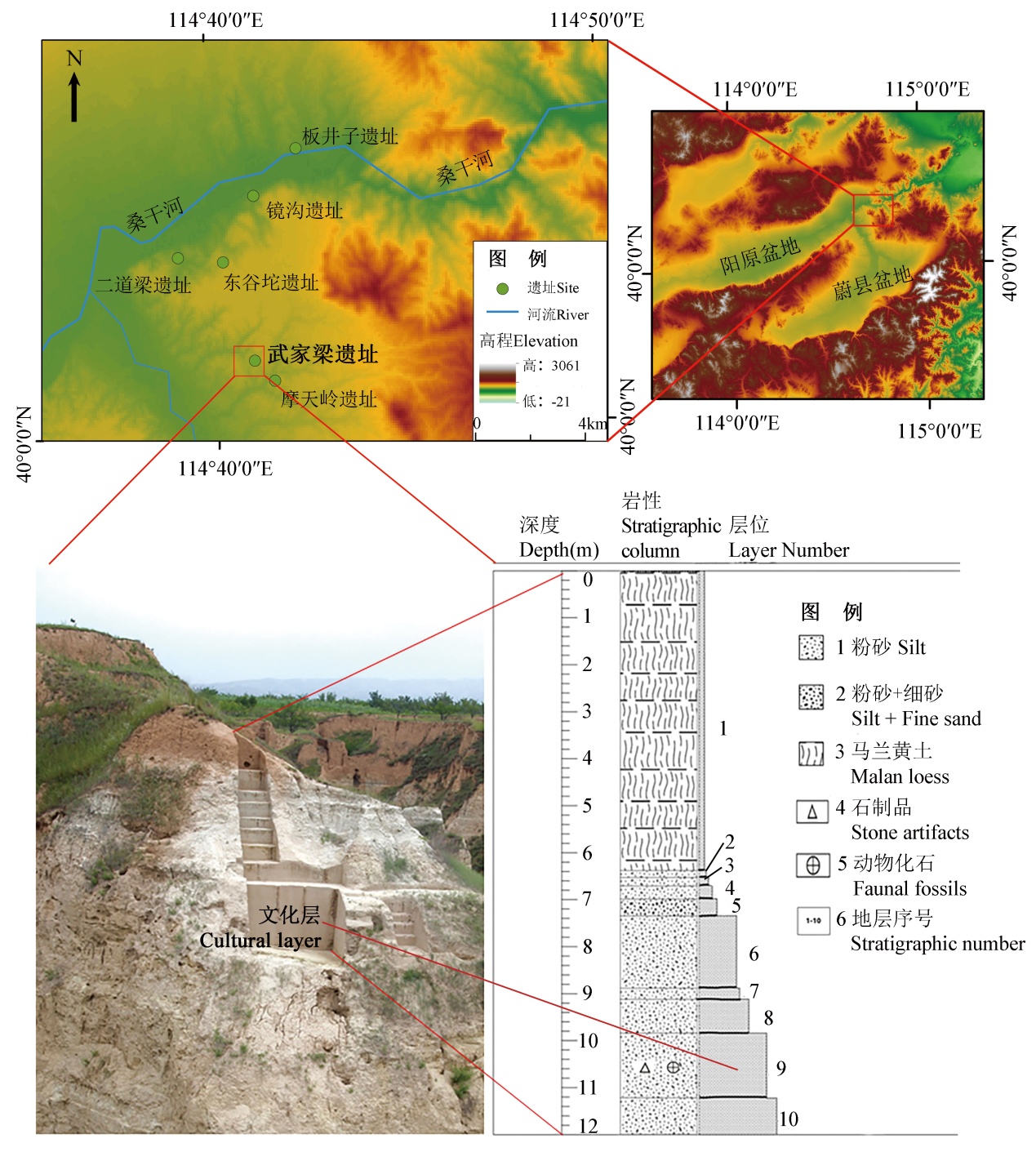
As a key area to explore the origin and evolution of human beings in the world, Nihewan Basin is renowned for the continuity of Quaternary sediments and the richness of ancient human occupations. Wujialiang Locality 1 (WJL 1) is an important site of the Shandui Site cluster, located in the southern part of Datianwa platform on the eastern edge of Nihewan Basin. It was first discovered in 1992, and a small area of archaeological excavation was carried out in 2015. The site is buried in the upper part of Nihewan bed, and the stratigraphic sequence is complete. The cultural layer is well preserved, and a large number of cultural remains such as stone artifacts and animal fossils have been unearthed. It is estimated by the OSL dating that the age of this site is between 378 ka BP—359 ka BP, which belongs to the middle Middle Pleistocene.
It could be inferred from the geomorphological environment, the lithic assemblages and their preservation conditions that Wujialiang Locality 1 belongs to an in-situ burial type of archaeological site, with ancient human activities being the primary cause of cultural artifact accumulation and deposition at the site. Analysis of lithic raw materials reveals that ancient humans mainly utilized locally abundant materials such as rhyolite, flint, and siliceous limestone for lithic core reduction and tool fabrication. Lithic technological analysis indicates that ancient humans primarily employed the hard hammer percussion method for core reduction, supplemented by bipolar technique; cores were not systematically prepared before flake removal, primarily utilizing core rotation to obtain more flake products, resulting in mostly wide and thin flakes with irregular shape. Tool types mainly consist of small scrapers, with blanks predominantly being large-sized flakes, indicating a preference for the unifacial development and utilization of tool edges by ancient humans.
Overall, based on the types and technological characteristics of lithic artifacts, the lithic technology at Wujialiang Locality 1 belongs to the predominant flake tool technology system in northern China. The features of lithic industry at the Shandui site cluster are relatively consistent, representing the inheritance and development of earlier stages of lithic industry in this region.
Key words: WJL 1; flake tool technology; Nihewan Basin; Middle Pleistocene
MA Chao , TIE Weidong , QIU Wenyan , XUE Feng , DEMIANA YG Rishmawi , NIU Dongwei , HOU Jiaqi , WANG Fagang . A preliminary report on the excavation of Wujialiang Paleolithic Locality 1 in the Nihewan Basin, North China[J]. Acta Anthropologica Sinica, 2026 , 45(05) : 939 -947 . DOI: 10.16359/j.1000-3193/AAS.2026.0053
| [1] | 王法岗, 孙永春. 泥河湾考古图典[M]. 石家庄: 河北美术出版社, 2023 |
| [2] | 谢飞, 李珺, 刘连强. 泥河湾旧石器文化[M]. 石家庄: 花山文艺出版社, 2006 |
| [3] | 卫奇. 《西侯度》石制品之浅见[J]. 人类学学报, 2000, 19(2): 85-96 |
| [4] | Toth N. The oldowan reassessed: a close look at early stone artifacts[J]. Journal of Archaeological Science, 1985, 12(2): 101-120 |
| [5] | Guo YJ, Li B, Zhang JF, et al. Luminescence ages for three ‘Middle Palaeolithic’ sites in the Nihewan Basin, northern China, and their archaeological and palaeoenvironmental implications[J]. Quaternary Research, 2016, 85(3): 456-470 |
| [6] | 王心蕊, 张芷瑶, 黄冰柔, 等. 泥河湾盆地武家梁旧石器遗址1号地点的光释光测年[J]. 人类学学报, 2026, 45(3): 489-499 |
| [7] | 谢飞. 泥河湾的科学意义[N]. 中国文物报,2012-12-05(003) |
| [8] | 郭晓明, 王法岗. 泥河湾百年科学探索述略[J]. 文物春秋, 2021(4): 3-13 |
| [9] | 谢飞. 品读“泥河湾”[J]. 人类学学报, 2024, 43(1): 3-4 |
/
| 〈 |
|
〉 |