


Craniofacial characteristics of She people in Fujian
Received date: 2024-02-07
Accepted date: 2024-09-11
Online published: 2025-08-07
This study randomly selected 518 She ethnic adults aged 18 years and above (293 males and 225 females) from Fu’an and Fuding cities in Fujian Province. Twenty-two craniofacial characteristics were measured, and twelve indexes of craniofacial exponent characteristics were calculated. The results showed that the She ethnic group has a medium head type, high head type, and narrow head type; a narrow face; and a medium nose type. There were significant gender differences in the craniofacial characteristics and indexes of the She ethnic group in Fujian, except for the intraocular angular width and zygomatic frontal index. There were significant age differences in head width, face width, intraocular width, lip - related indicators (upper lip height, lip height, lip thickness, mouth breadth), ear length, vertical cephalo - facial index, and oral index. Facial features are mainly determined by genetic factors.
When comparing the craniofacial characteristics of the She ethnic group in Fujian with those of the She ethnic group 28 years ago, the results showed that the craniofacial characteristics of the She ethnic group in this study had changed significantly compared to those 28 years ago. The reasons were related to urban - rural differences, environmental and dietary changes, and an increase in intermarriage with the Han and other ethnic groups.
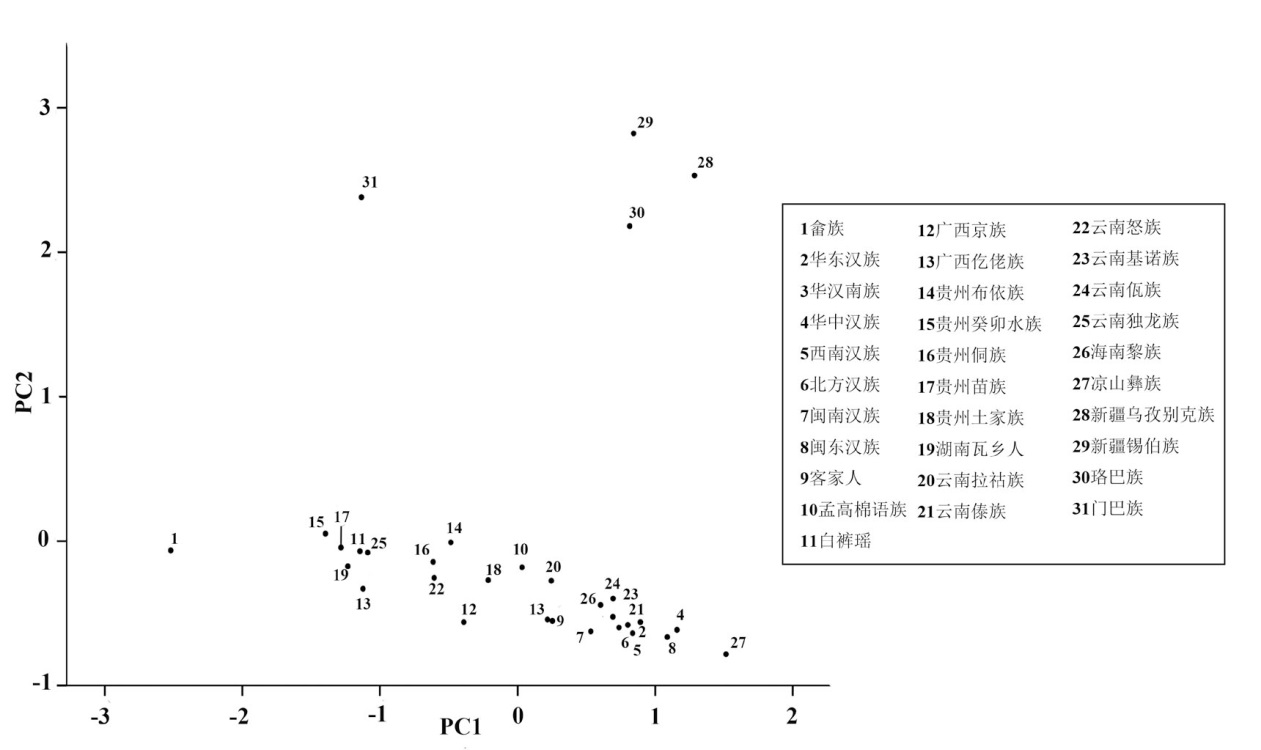
Principal component analysis and cluster analysis were conducted on the head - face data of the She, Han, and other ethnic minority populations. It was found that the She people, as an independent group, were between the northern ethnic minorities, southern ethnic minorities, and the Han. Furthermore, the craniofacial characteristics of the She in Fujian were closer to those of the Han in South China, the Miao, the Yao, the Shui, and the Wa, and had significant differences from other southern ethnic minorities in Yunnan, Guangxi, Guizhou, and northern ethnic groups.
The She ethnic group has long lived in the border areas of Guangdong, Fujian, and Jiangxi in South China. Therefore, compared to the Han and minority ethnic groups in North China, the Han and minority ethnic groups in South China have more similar physical characteristics to the She ethnic group. The migration and integration of ethnic groups is an important historical process in the formation of ethnic groups in history. The genetic and cultural blending between ethnic groups has influenced their physical characteristics. This paper, together with evidence from Ethnology, Molecular Anthropology, and Linguistics, shows that the She ethnic group had intricate connections with minority ethnic groups such as the Miao - Yao, Min, Yue, as well as the Han ethnic group in the past. People with different physical characteristics participated in this process and ultimately formed the modern She ethnic group’s “diverse and integrated” physical characteristics.
HU Rong , YIN Jiahao . Craniofacial characteristics of She people in Fujian[J]. Acta Anthropologica Sinica, 2025 , 44(04) : 631 -641 . DOI: 10.16359/j.1000-3193/AAS.2025.0005
| [1] | 徐规. 畬族的名称、来源和迁徙[J]. 杭州大学学报(人文科学版), 1962, 1: 57-62 |
| [2] | 施联朱. 关于畲族来源与迁徙[J]. 中央民族学院学报, 1983, 2: 34-42+33 |
| [3] | 禄佳妮, 王传超. 分子人类学视域中畲族族源新探[J]. 北方民族大学学报(哲学社会科学版), 2019, 1: 98-107 |
| [4] | Cai XY, Qin ZD, Wen B, et al. Human Migration through Bottlenecks from Southeast Asia into East Asia during Last Glacial Maximum Revealed by Y Chromosomes[J]. PLoS One, 2011, 6(8): e24282 |
| [5] | Liu SH, Chen GC, Huang HH, et al. Patrilineal background of the She minority population from Chaoshan Fenghuang Mountain, an isolated mountain region, in China[J]. Genomics, 2017, 109(3-4): 284-289 |
| [6] | 胡荣. 福建畲族人群体型特征[J]. 人类学学报, 2021, 40(5): 824-833 |
| [7] | 张振标. 现代中国人体质特征及其类型的分析[J]. 人类学学报, 1988, 7(4): 314-323 |
| [8] | 徐杰舜. 雪球:汉民族的人类学分析[M]. 上海: 上海人民出版社, 1999 |
| [9] | 曾宪智, 戴福珍, 史习舜, 等. 福建省福安市畲族成人体质调查报告[J]. 福建医药杂志, 1996, 18(5): 211-216 |
| [10] | 孙思, 何学华, 曹显明, 等. 贵州南部地区苗族、畲族和汉族头面部形态特征调查[J]. 黔南民族医专学报, 2006, 19(3): 211-216 |
| [11] | 席焕久, 陈昭. 人体测量方法(第二版)[M]. 北京: 科学出版社, 2010 |
| [12] | 李咏兰, 宇克莉, 陆舜华, 等. 中国南方汉族群体的头面部特征[J]. 人类学学报, 2014, 33(1): 101-108 |
| [13] | 宇克莉, 郑连斌, 李咏兰, 等. 中国北方、南方汉族头面部形态学特征的差异[J]. 解剖学报, 2016, 47(3): 404-408 |
| [14] | 张兴华, 郑连斌, 宇克莉, 等. 闽南人的体质特征[J]. 人类学学报, 2015, 34(4): 516-527 |
| [15] | 郑连斌, 李咏兰, 陆舜华, 等. 中国客家人体质特征[J]. 中国科学:生命科学, 2013, 43(3): 213-222 |
| [16] | 孙泽阳, 郑连斌, 宇克莉, 等. 孟高棉语族未识别民族的体质特征[J]. 人类学学报, 2021, 40(5): 811-823 |
| [17] | 罗载刚, 杨家力, 余跃生, 等. 白裤瑶体质人类学研究[J]. 人类学学报, 2003, 22(2): 150-160 |
| [18] | 郑连斌, 陆舜华, 丁博. 仫佬族体质特征研究[J]. 人类学学报, 2006, 25(3): 242-250 |
| [19] | 余跃生, 任光祥, 戎聚全, 等. 贵州布依族体质人类学研究[J]. 人类学学报, 2005, 24(3): 204-214 |
| [20] | 余跃生, 王克松, 陆玉炯, 等. 贵州“过卯”水族的体质人类学研究[J]. 人类学学报, 2007, 26(2): 155-164 |
| [21] | 杨秀海, 余跃生, 欧德灯, 等. 贵州侗族体质人类学研究[J]. 人类学学报, 2010, 29(1): 73-81 |
| [22] | 余跃生, 陆玉炯, 罗载刚, 等. 贵州王卡苗族体质人类学研究[J]. 人类学学报, 2007, 26(1): 54-63 |
| [23] | 任光祥, 余跃生, 杨胜文, 等. 贵州土家族体质人类学研究[J]. 人类学学报, 2012, 31(3): 289-298 |
| [24] | 皮建辉, 黎杰, 李林, 等. 湖南瓦乡人体质特征研究[J]. 人类学学报, 2011, 30(2): 218-226 |
| [25] | 李明, 李跃敏, 余发昌, 等. 云南拉祜族的体质特征[J]. 人类学学报, 2001, 20(1): 39-44 |
| [26] | 宇克莉, 郑连斌, 李咏兰. 西双版纳傣族的人种学特点:来自人体测量学的数据[J]. 人类学学报, 2017, 36(4): 553-560 |
| [27] | 郑连斌, 陆舜华, 罗东梅, 等. 怒族的体质调查[J]. 人类学学报, 2008, 27(2): 158-166 |
| [28] | 包金萍, 郑连斌, 宇克莉, 等. 基诺族体质特征及35年来体质的变化[J]. 人类学学报, 2021, 40(2): 261-271 |
| [29] | 李咏兰, 郑连斌, 金丹. 黎族的体成分与体质特征[J]. 人类学学报, 2019, 38(1): 77-87 |
| [30] | 宇克莉, 董文静, 李咏兰. 四川凉山彝族的人体测量学[J]. 人类学学报, 2018, 37(3): 478-483 |
| [31] | 郑连斌, 崔静, 陆舜华, 等. 乌孜别克族体质特征研究[J]. 人类学学报, 2004, 23(1): 35-45 |
| [32] | 徐国昌, 马长德, 裴林国, 等. 伊犁锡伯族成人头面部表型特征[J]. 南阳理工学院学报, 2021, 13(4): 113-117 |
| [33] | 郑连斌, 陆舜华, 张兴华, 等. 珞巴族与门巴族的体质特征[J]. 人类学学报, 2009, 28(4): 401-407 |
| [34] | Reddy BM, Pferrer A, Crawford MH, et al. Population substructure and patterns of quantitative variation among the Gollas of southern Andhra Pradesh,India[J]. Human Biology, 2001, 291-306 |
| [35] | Arya R, Duggirala R, Comuzzie AG. Heritability of anthropometric phenotypes in caste populations of Visakhapatnam, India[J]. Human Biology, 2002, 74(3): 325-344 |
| [36] | Karafet TM, Hallmark B, Cox MP, et al. Major East-west Division Underlies Y Chromosome Stratification Across Indonesia[J]. Molecular Biology and Evolution, 2010, 27(8): 1833-1844 |
/
| 〈 |
|
〉 |