


Production and processing of large flakes by hominins during the Middle to Late Pleistocene in the Chaohu Lake Region, Anhui Province
Received date: 2024-10-05
Revised date: 2025-04-28
Online published: 2025-10-13
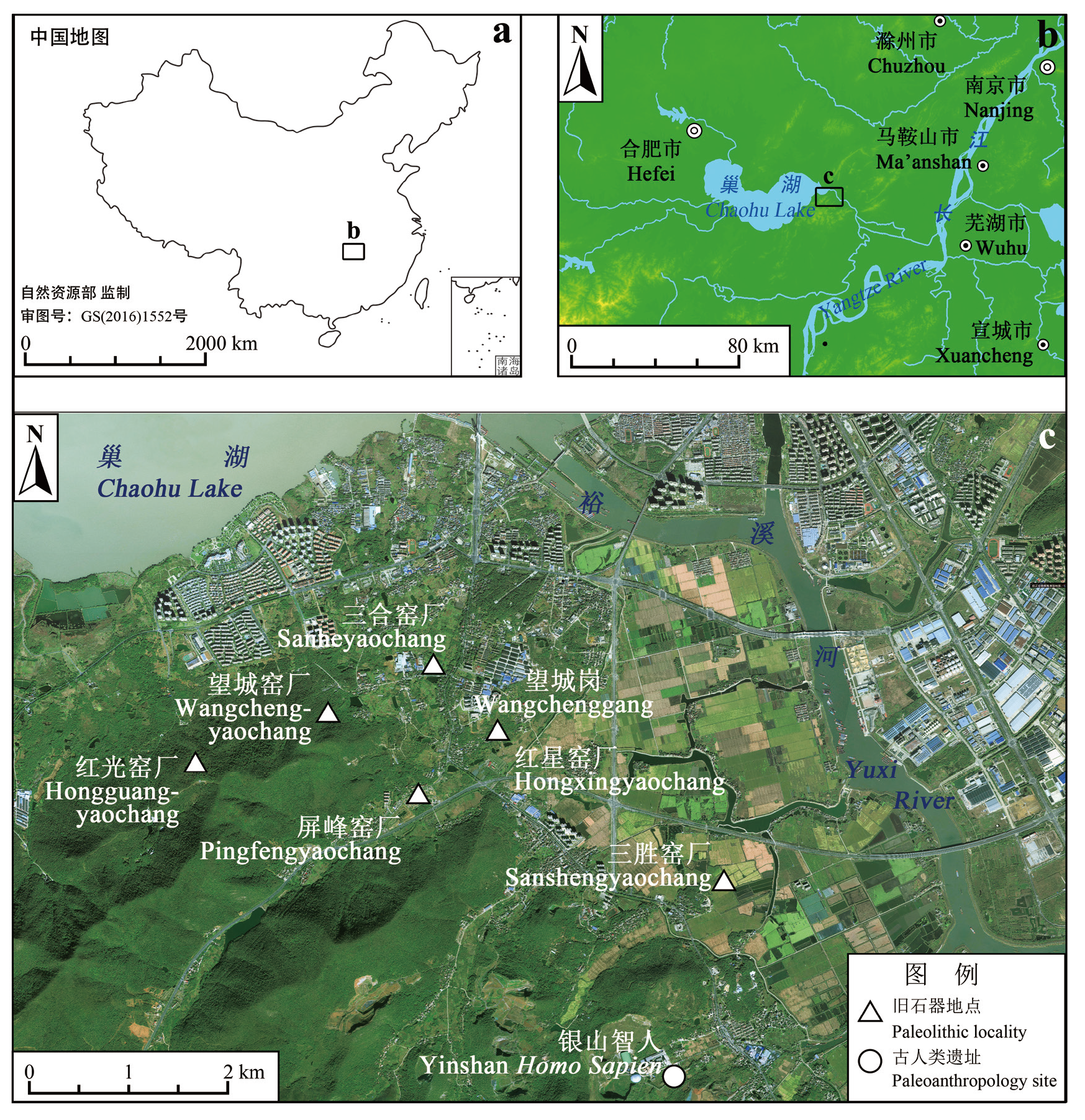
Although quantities of Acheulean large cutting tools discovered in different areas and sites in China have been insightfully analyzed, there have been few studies focusing on large flake production and large or giant core exploitation until now. In fact, producing large flakes with the expected morphology from giant or large cores through special percussion methods is a key criterion of Acheulean technology. During the 1980s-1990s, the Institute of Archaeology and Cultural Relics of Anhui Province conducted several Paleolithic investigations and excavations in the Chaohu Lake Region (CLR). A total of 319 stone artifacts embedded in red clay were discovered on the surface and in situ, among which 107 Large Flake Acheulean products could be identified. All of these artifacts were detached from quartzite river cobbles using free-hand stone hammer percussion technology. Traditionally, these artifacts were assigned to the Pebble Tool Industry. Based on lithic technological typological analysis, it can be deduced that hominins detached large flakes from large cores via the cobble-opening method and slab-slicing method, and further shaped them into large cutting tools (LCTs) such as bifaces, knives, cleavers, and picks—alongside Acheulean large tools, particularly massive scrapers and massive denticulates.
Based on the OSL dating results from the Wangjia'ao Locality (near Wangchenggang, the 1980s' and 1990s' work area), early humans occupied this site around 70 kaBP. Recently, two additional OSL dating analyses were conducted at the Liujia 2 Locality and Zhangjiawan Locality, both approximately 4.5 kilometers from the Wangjia'ao Locality. At the Liujia 2 Locality, hominins exploited large cores, detached large flakes, and further used these flakes as blanks to manufacture LCTs during two distinct periods: 225~70 kaBP and 70~30 kaBP. In contrast, the OSL dating result from the Zhangjiawan Locality indicated that early humans detached large flakes no later than 125 kaBP.
All the aforementioned OSL dating results from the CLR demonstrate that ancient humans in this region exhibited diverse adaptive behaviors, as they were capable of producing large flakes and manufacturing LCTs no later than Marine Isotope Stage 4 (MIS 4). A similar pattern has also been observed at the Wenquan Site in Henan Province, and an even earlier occurrence has been documented in the Luonan Basin and Bose Basin. This research holds great significance for studying the transition of lithic technology and the production of large flakes in Acheulean technology in South China from the late Middle Pleistocene to the Late Pleistocene.
Key words: Chaohu Lake Region; large flake; massive scrapers; massive denticulates; Pleistocene
ZHAN Shijia , DONG Zhe , YI Shuangwen . Production and processing of large flakes by hominins during the Middle to Late Pleistocene in the Chaohu Lake Region, Anhui Province[J]. Acta Anthropologica Sinica, 2025 , 44(05) : 874 -883 . DOI: 10.16359/j.1000-3193/AAS.2025.0062
| [1] | Toth N, Schick K. Evolution of tool use[A]. In: Michael P. Muehlenbein, Basics in Human Evolution[C]. Academic Press, 2015 |
| [2] | Beyene Y, Katoh S, Wolde-Gabriel G, et al. The characteristics and chronology of the earliest Acheulean at Konso, Ethiopia[J]. Proceedings of the National Academy of Sciences, 2013, 110(5): 1584-1591 |
| [3] | Larick R, Ciochon RL. The African emergence and Asian early dispersals of Genus Homo[J]. American Anthropologist, 1996, 84: 538-551 |
| [4] | Kuman K. The Acheulean industry complex[A]. In: SmithCEds. Encyclopedia of global archaeology[M]. New York: Springer, 2014 |
| [5] | Clarke R.The history of research in human evolution in Africa and what lessons have been learned[A]. In: Sanz N(Eds). Human origin sites and the World Heritage Convention in Africa[C]. Paris: United Nations Educational, Scientific and Cultural Organization 7, 2012 |
| [6] | Wang W, Lycett SJ, von Cramon-Taubadel N, et al. Comparison of Handaxes from Bose Basin (China) and the Western Acheulean Indicates Convergence of Form, Not Cognitive Differences[J]. PLoS one, 2012, 7(4): e35804 |
| [7] | Pope MI. The Signi cance of biface-rich assemblages: an examination of behavioural controls on lithic assemblage formation in the Lower Palaeolithic[D]. Southampton: University of Southampton, PhD dissertation, 2002 |
| [8] | Sharon G, Alperson-Afil N, Goren-Inbar N. Cultural conservatism and variability in the Acheulian sequence of Gesher Benot Ya'aqov[J]. Journal of Human Evolution, 2011, 60: 387e397 |
| [9] | Gamble C, Marshall G. The shape of handaxes, the structure of the Acheulian world[A]. In: Milliken S, Cook J(Eds). A very remote period indeed: Papers on the Palaeolithic presented to Derek Roe[M]. Oxford: Oxbow Books, 2001 |
| [10] | Lycett SJ. Acheulean variation and selection: does handaxe symmetry neutral expectations?[J]. Journal of Archaeological Science, 2008, 35(9): 2640e2648 |
| [11] | Schick K, Clark JD.Biface technological development and variability in the Acheulean industrial complex in the Middle Awash Region of the Afar Rift, Ethiopia[A]. In: Soressi M, Dibble HL (Eds). Multiple approaches to the study of bifacial technologies[D]. Philadelphia: University of Pennsylvania Museum of Archaeology and Anthropology, PhD dissertation, 2003 |
| [12] | McPherron SP.Technological and typological variability in the bifaces from Tabun Cave, Israel[A]. In: Soressi M, Dibble HL(Eds).Multiple approaches to the study of bifacial technologies[D]. Philadelphia: University of Pennsylvania Museum of Archaeology and Anthropology, PhD dissertation 2003 |
| [13] | Archer W, Braun DR. Variability in bifacial technology at Elandsfontein, Western cape, South Africa: a geometric morphometric approach[J]. Journal of Archaeological Science, 2010, 37: 201e209 |
| [14] | Semaw S, Rogers M, Stout D. The Oldowan-Acheulean transition: Is there a “Developed Oldowan” artifact tradition?[A]. In: Camps M, Chauhan P (Eds). Sourcebook of Paleolithic transitions[M]. Springer Science+Business Media, LLc, 2009 |
| [15] | 雷蕾, 李大伟, 麻晓荣, 等. 阿舍利大石片的生产方式与策略[J]. 人类学学报, 2020, 39(2): 183-192 |
| [16] | Sharon G. Large flake Acheulian[J]. Quaternary International, 2010, 223(5): 226-233 |
| [17] | 安徽省地矿局区域地质调查队. 安徽省地层志:第四系分册[M]. 合肥: 安徽科学技术出版社,1985 |
| [18] | 许春华, 张银运, 陈才弟, 等. 安徽巢县发现的人类枕骨化石和哺乳动物化石[J]. 人类学学报, 1984, 3(3): 202-209, 301 |
| [19] | 许春华, 张银运, 方笃生. 安徽巢县人类化石地点的新材料[J]. 人类学学报, 1986, 5(4): 305-310 |
| [20] | 方笃生, 韩立刚. 安徽巢湖市钓鱼台发现第四纪哺乳动物化石[J]. 文物研究, 1986, 2: 34-36 |
| [21] | 郑龙亭. 安徽巢县猫儿洞哺乳动物群[J]. 文物研究, 1988, 4: 35-46 |
| [22] | 方笃生. 巢湖市望城岗旧石器的发现与研究[J]. 文物研究, 1990, 6: 19-35 |
| [23] | 方笃生, 韩立刚. 巢湖市望城岗旧石器地点发掘报告[J]. 文物研究, 1993, 8: 80-92 |
| [24] | Sharon G. Acheulian large flake industries: technology, chronology, and significance[M]. British Archaeological Reports Ltd, 2007 |
| [25] | Kleindienst MR. Components of the East African Acheulian assemblage: An analytic approach[A]. In: Mortelmans G(Ed.). Actes du IVe`me Congre`s Panafricain de Pre-histoire et de l'Etude du Quaternaire, vol 40[C]. Tervuren (Belgique): Muse e Royal de l'Afrique Centrale, 1962, 81-105 |
| [26] | Goren-Inbar N, Sharon G, Alperson-Afil N, et al. The Acheulean massive scrapers of Gesher Benot Ya'aqov— a product of the biface cha?ne opératoire[J]. Journal of Human Evolution, 2008, 55: 702-712 |
| [27] | Tixier J. Le hachereau dans l' Acheulèen nord aficain. notes typologique[A]. In: Congrès Prèhistorique de Fran?aise, 15ème session, Poitiers-Angoulème[C]. Paris: Sociètè prèhistorique fran?aise, 1956, 914-923 |
| [28] | Isaac GL. Olorgesailie: archaeological studies of a Middle Pleistocene lake basin, Kenya[M]. Chicago: The University of Chicago Press, 1977 |
| [29] | 董哲. 安徽巢湖市柳家2号旧石器时代遗址的发掘[J]. 考古, 2025, 6: 3-17 |
| [30] | 战世佳, 董哲, 弋双文, 等. 安徽巢湖地区2019年旧石器考古调查的新发现[J]. 人类学学报, 2022, 41(5): 927-935 |
| [31] | Wang SJ. Perspectives on hominid behaviour and settlement patterns: a study of the Lower Palaeolithic sites in the Luonan Basin, China[M]. British Archaeological Reports International Series 1406, Oxford, 2005 |
| [32] | Yang SX, Hou YM, Pelegrin J. A Late Acheulean Culture on the Chinese Loess Plateau: The techno-economic behavior of the Dingcun lithic industry[J]. Quaternary International, 2016, 400: 73-85 |
| [33] | 赵清坡, 张水木, 宿凯, 等. 河南汝州温泉遗址的发现与初步研究[J]. 人类学学报, 2023, 42(5): 616-625 |
| [34] | Leaky MD. Olduvai Gorge, volume 3: Excavations in Beds I and II, 1960-1963[M]. London: Cambridge University Press, 1971 |
| [35] | Goren-Inbar N, Alperson-Afil N, Sharon G, et al. The Acheulian Site of Gesher Benot Ya'aqov (Volume IV)[M]. Springer International Publishing, 2018 |
| [36] | Li H, Wang SJ, Lotter MG, et al. The temporal-spatial evolution of handaxe technology in China: Recent progress and future directions[J] Science Bulletin, 2024, 69: 2161-2165 |
/
| 〈 |
|
〉 |