Acta Anthropologica Sinica ›› 2026, Vol. 45 ›› Issue (05): 839-850.doi: 10.16359/j.1000-3193/AAS.2025.0102

• Research Articles • Previous Articles     Next Articles

Formation processes of the Yangshang Paleolithic site, Gansu

ZHAO Yuchao1,2(), LI Feng3,4,5(), ZHOU Jing6, CHEN Fuyou2, LIAO Lishan7, SHAO Xinya7, GAO Xing2,8   

  1. 1 Negaunee Integrative Research Center, Field Museum of Natural History, Chicago, IL 60605, USA
    2 Key Laboratory of Vertebrate Evolution and Human Origins of Chinese Academy of Sciences, Institute of Vertebrate Paleontology and Paleoanthropology, Chinese Academy of Sciences, Beijing 100044
    3 Center for the Study of Chinese Archaeology, Peking University, Beijing 100871
    4 School of Archaeology and Museology, Peking University, Beijing 100871
    5 Key Laboratory of Archaeological Science, Ministry of Education, Peking University, Beijing 100871
    6 Gansu Provincial Institute of Cultural Relics and Archaeology, Lanzhou 730000
    7 School of Archaeology, Joint International Research Laboratory of Environmental and Social Archaeology, Shandong University, Qingdao 266237
    8 University of Chinese Academy of Sciences, Beijing 100049
  • Received:2024-06-03 Revised:2025-05-30 Online:2026-10-15 Published:2026-10-16

Abstract:

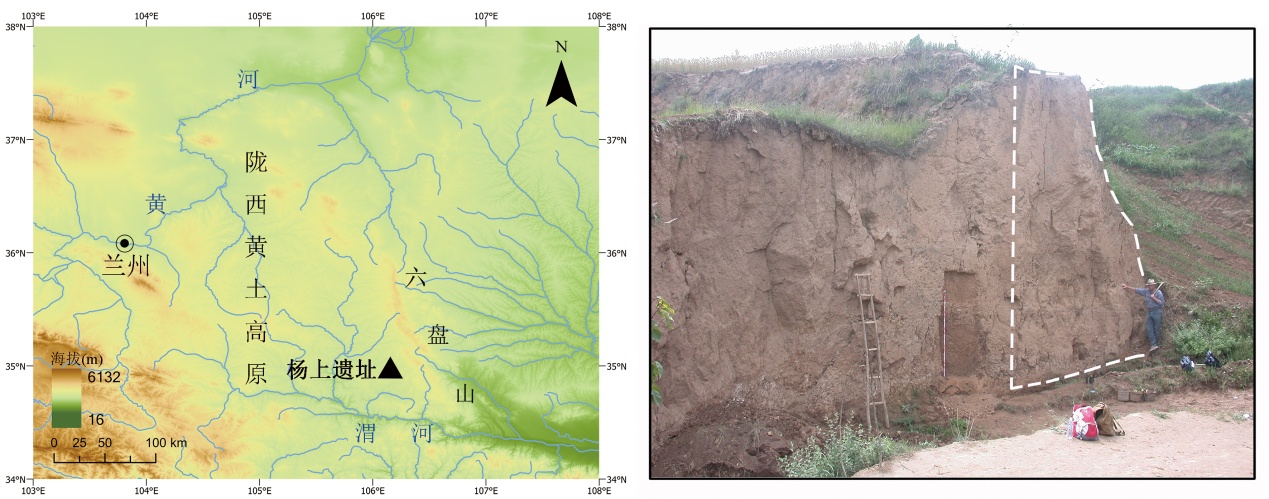
The Quaternary “loess-paleosol” sequence on the Loess Plateau preserves a complete record of global glacial-interglacial cycles and a continuous chronological framework, making it an essential reference for studying Paleolithic archaeological site formation processes in terms of chronology and paleoclimate. Research on snail fossils, phytoliths, pollen, grain size, and magnetic susceptibility within the loess strata also provides effective indicators of sedimentary environments. The Yangshang site, one of the earliest Middle Pleistocene sites in the western Loess Plateau, spans a human activity period of from 220 to 104 ka BP. This study employs geoarchaeological methods and taphonomic analysis of unearthed artifacts to evaluate the intensity of natural modifications during the formation of the Yangshang site.

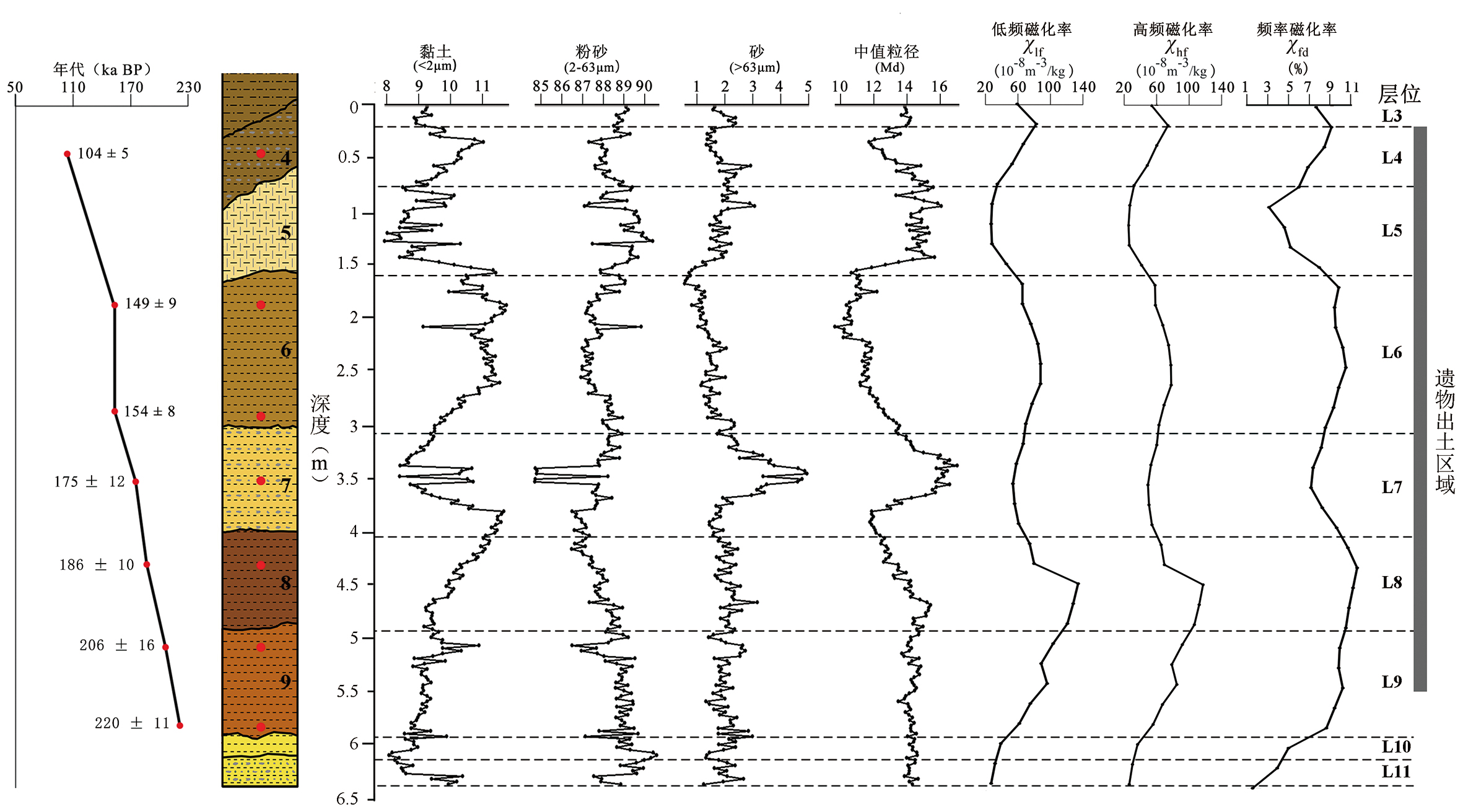
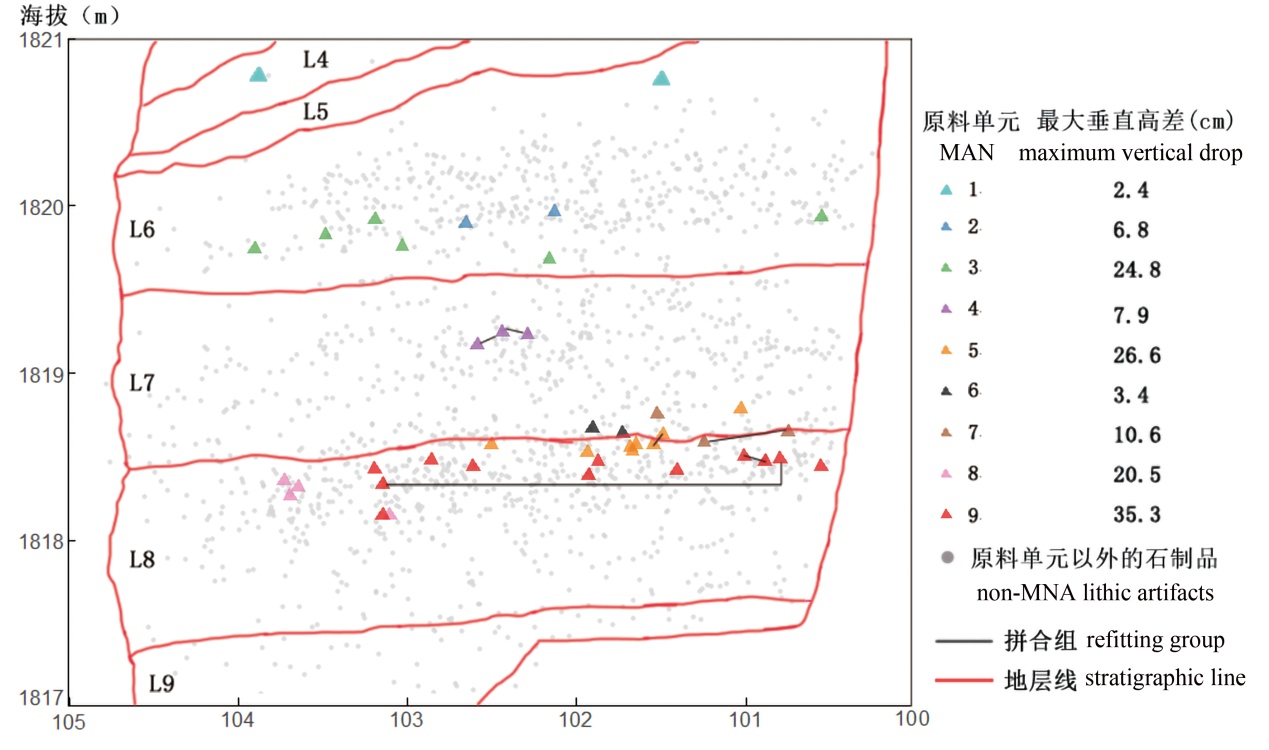
The results indicate that the lower to middle stratigraphic layers (L6~L9) primarily represent in situ slow sedimentation with minimal post-depositional disturbance. The brownish-red paleosol layers of L9 and L8, characterized by their high fine-grained particle content and elevated magnetic susceptibility (MS) values, indicate that the utilization of the site began during the warm and humid MIS 7 interglacial period, with the sediments belonging to the S2 layer of the loess-paleosol sequence. In contrast, L7, which corresponds to the MIS 6 glacial period, exhibits a yellowish soil color, with peak values in sand content and median grain size, alongside a significant decline in MS, classifying it as part of the L2 layer of the loess-paleosol sequence. Although L6 also falls within MIS 6, its soil color, grain size, and MS point to a strong pedogenic environment, distinguishing it from typical loess. This may be attributed to smaller-scale climatic fluctuations within the glacial period, L6 could represent a weakly developed paleosol formed during an interstadial phase of MIS 6. In contrast, the overlying deposits (above L6) exhibit severe tilting, uneven thickness, and unconformable contacts between layers, indicating that the late cultural deposits of the site have undergone significant erosion, transport, and large-scale secondary sedimentation.

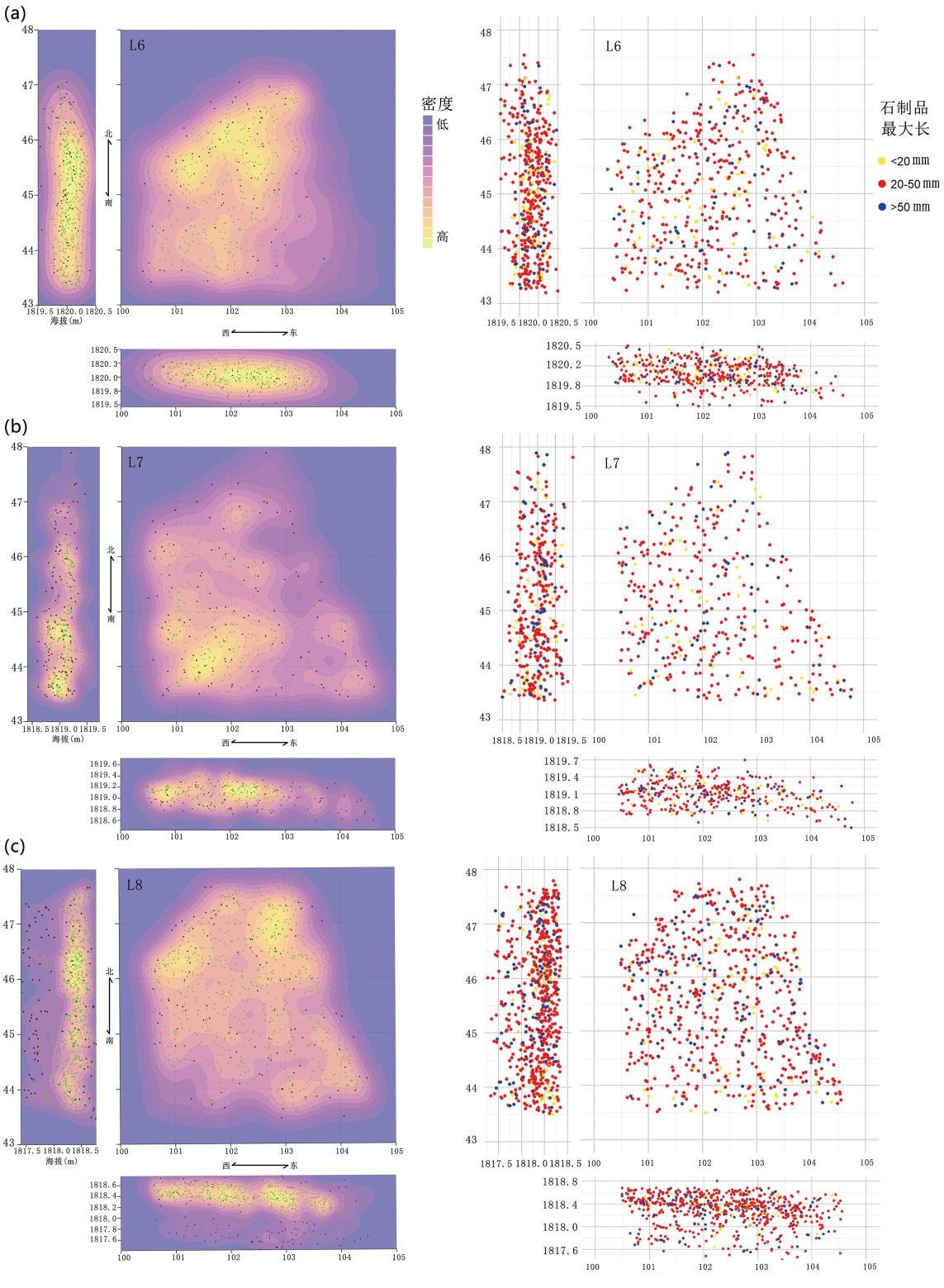
Spatial distribution patterns of artifacts reveal a strong correlation between hominin activity intensity and large-scale climatic fluctuations. During the MIS 7 interglacial (L9~L8), hominin occupation gradually intensified, culminating in the formation of the first high-density artifact concentration zone in the upper part of L8. However, the transition into the MIS 6 glacial period (L7~L6) is marked by dispersed artifact distributions in L7 and a near-absence of cultural materials at the L7/L6 boundary, suggesting increased mobility of site occupants due to increased resource patchiness and a consequent decline in site occupation continuity. It was not until the subsequent pedogenic enhancement during the MIS 6 interstadial (L6) that hominin activity at the Yangshang site regained intensity.

Key words: Site formation, Loess-Paleosol sequence, Glacial-interglacial period, Yangshang site

CLC Number: