

主管:中国科学院
主办:中国科学院古脊椎动物与古人类研究所
出版:科学出版社
主办:中国科学院古脊椎动物与古人类研究所
出版:科学出版社
人类学学报 ›› 2025, Vol. 44 ›› Issue (06): 1019-1033.doi: 10.16359/j.1000-3193/AAS.2025.0091cstr: 32091.14.j.1000-3193/AAS.2025.0091
胡越( )
)
收稿日期:2025-02-05
接受日期:2025-06-24
出版日期:2025-12-15
发布日期:2025-12-15
作者简介:胡越,博士,副教授,主要研究方向为旧石器考古与光释光年代学。E-mail: yh280@scu.edu.cn
基金资助:
HU Yue()
Received:2025-02-05
Accepted:2025-06-24
Online:2025-12-15
Published:2025-12-15
摘要:
传统上,学界认为东亚旧石器时代中期的石器技术以简单的石核-石片工业为主,整体表现出较低的复杂性和有限的创新性。最近,越来越多的考古发现和研究成果对这一观点提出质疑。本文基于观音洞遗址的最新研究进展,系统梳理并深入分析该遗址石器工业的主要特征及其在区域技术演化中的意义。研究表明,在距今18万~8万年期间,观音洞古人类掌握了多种剥片策略及熟练的工具修整技术。除了常规的单极剥片(单台面、双台面及多台面剥片)外,还采用了勒瓦娄哇剥片技术、盘状剥片、体积剥片及石片-石核剥片等多种剥片方法。工具类型丰富多样,重复利用率高,存在简单修理和精细修理两种不同的加工策略。观音洞遗址石器工业的技术特征显示出与欧亚大陆西部及非洲旧石器时代中期遗址相似的复杂性,为重新评估东亚旧石器时代中期工业在全球石器工业体系中的地位提供了重要证据。
中图分类号:
胡越. 贵州观音洞遗址的石核剥片策略和修理技术[J]. 人类学学报, 2025, 44(06): 1019-1033.
HU Yue. Core reduction strategies and retouch technologies at Guanyindong site, Guizhou Province[J]. Acta Anthropologica Sinica, 2025, 44(06): 1019-1033.
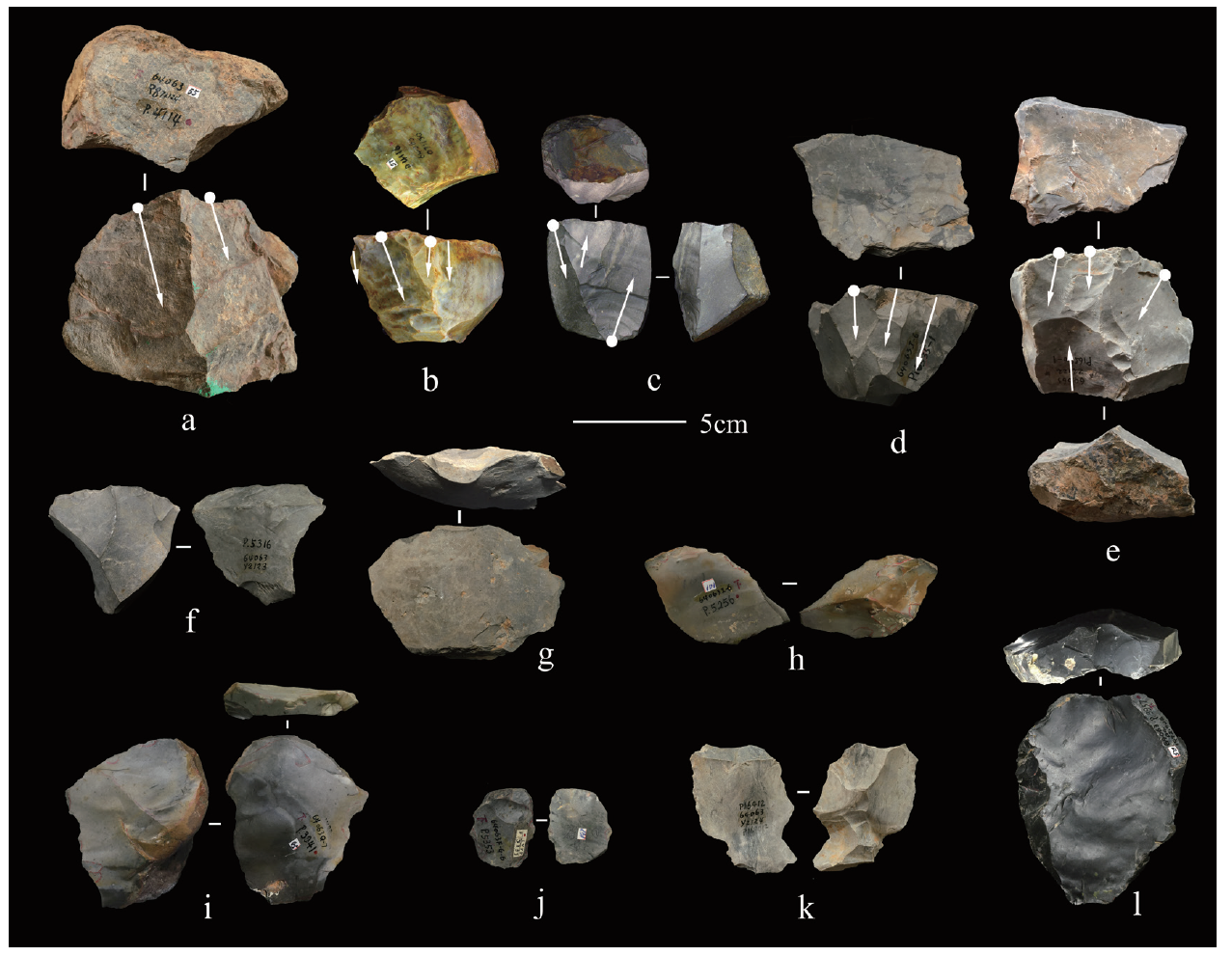
图 1 观音洞遗址石核与石片 a, b, d.单台面石核single platform cores;c, e.双台面石核double platform cores;f-i.石片flakes。本图改自[16] / Modified from [16]
Fig.1 Selected cores and flakes of Guanyindong site
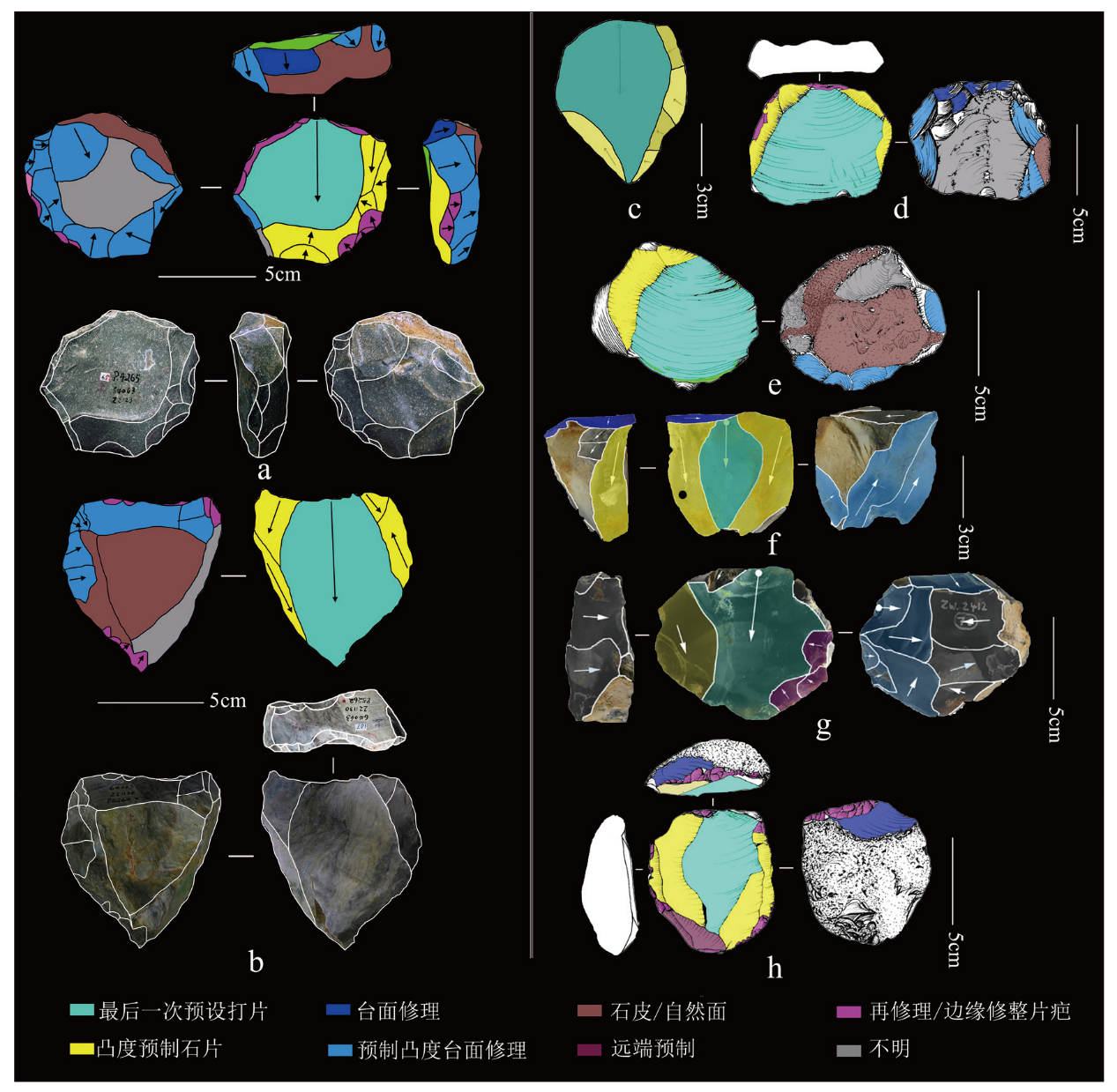
图2 观音洞与其他遗址的勒瓦娄哇石核对比 a, b.优先勒瓦娄哇石核,观音洞遗址/ preferential Levallois cores of Guanyindong site;c. 勒瓦娄哇石核,Skhul 遗址/ Levallois cores, Skhul site[30];d, e, h. 勒瓦娄哇石核,Nor Geghi 1 遗址/Levallois cores, Nor Geghi 1 site[31];f, g. 勒瓦娄哇石核,Zwochau遗址/ Levallois cores, Zwochau site [32]
Fig.2 Analytic comparison between preferential Levallois cores of Guanyindong site and other sites
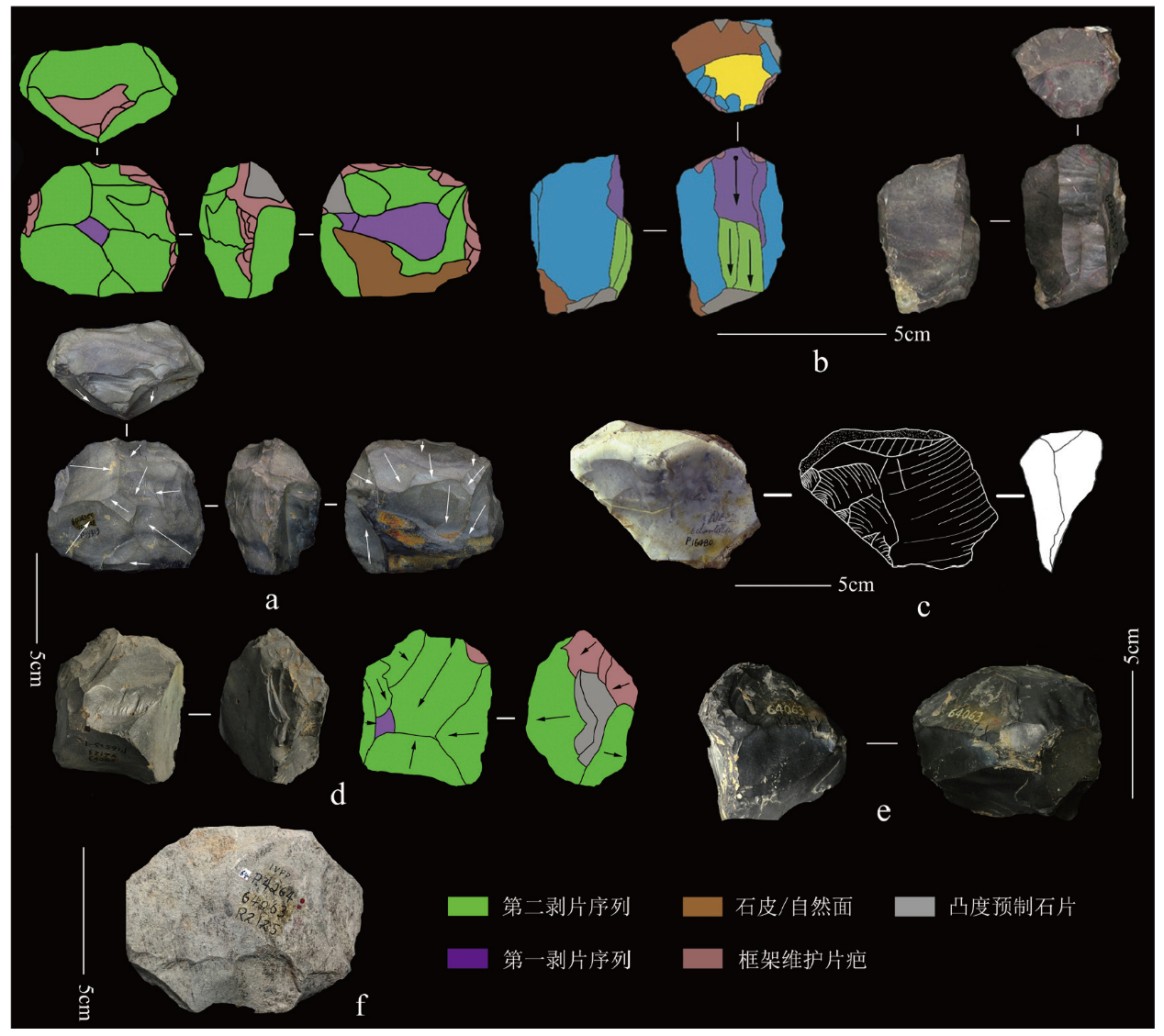
图3 观音洞石核 a, d, e.盘状石核Discoidal cores;b.体积剥片石核Volumetric exploitation cores;c,f.石片-石核Core-on-flakes。 改自[16] / Modified from[16]
Fig.3 Cores of Guanyindong site
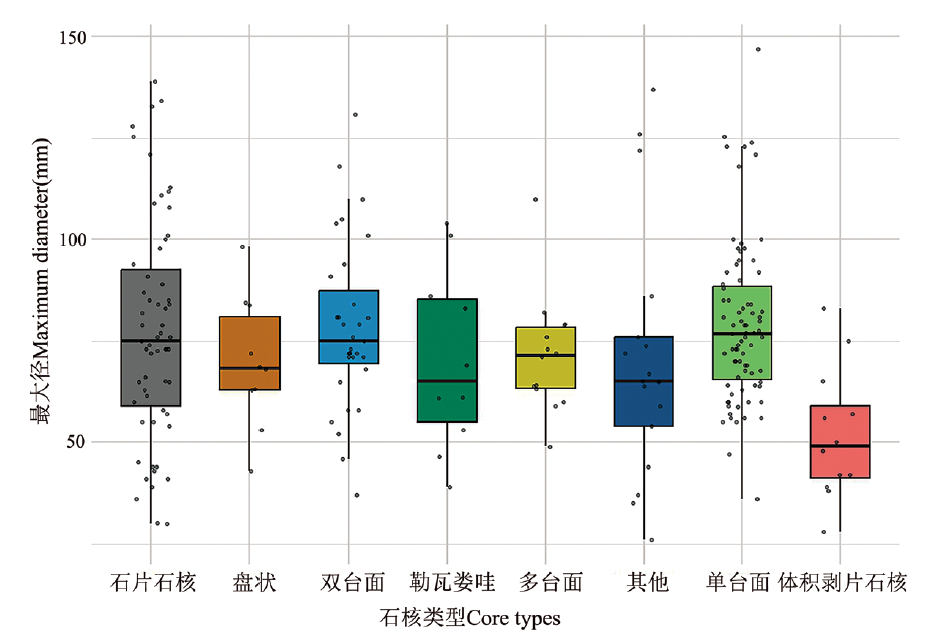
图4 不同石核种类最大径箱型图
Fig.4 Boxplot of maximum dimensions of different core types
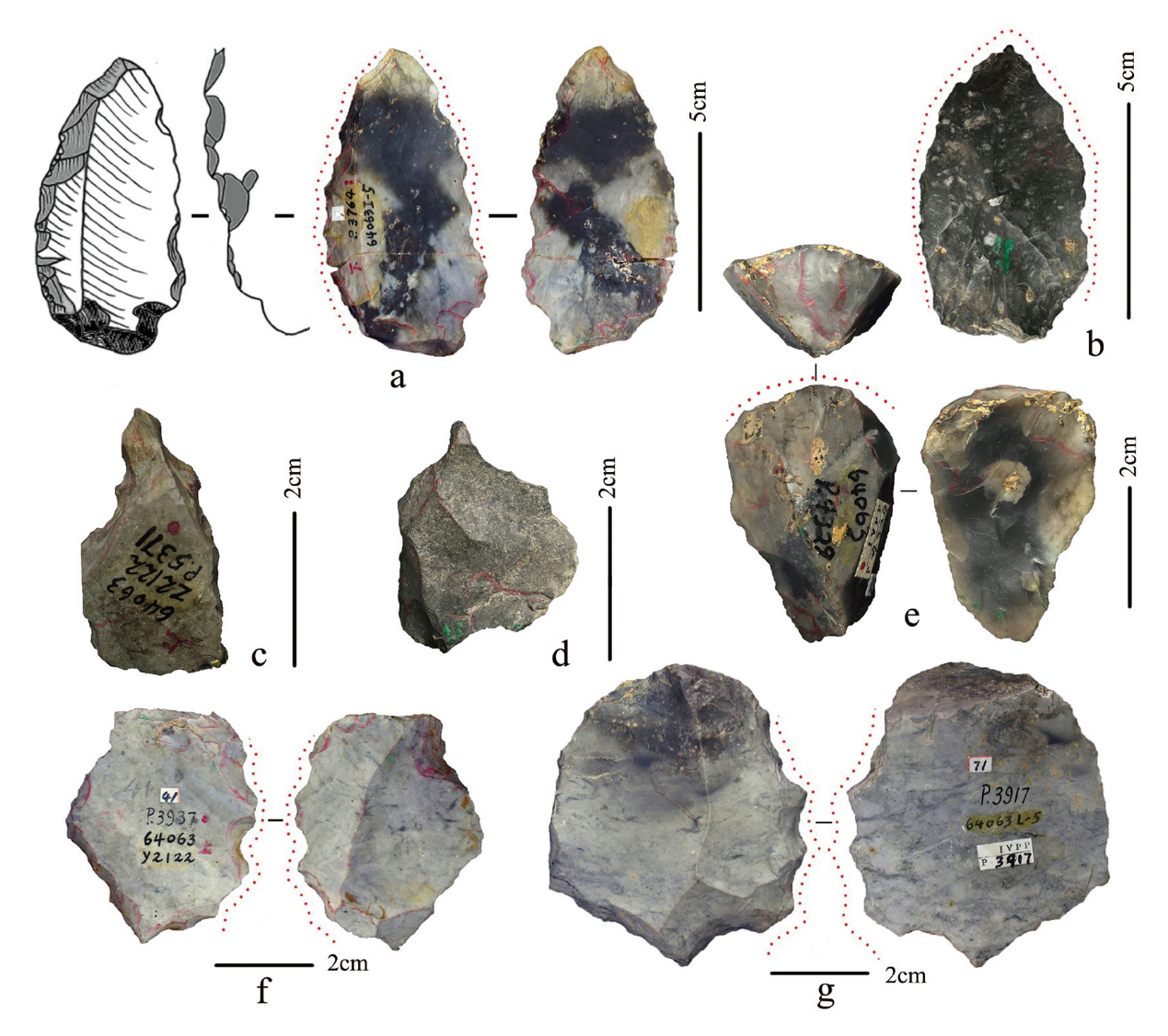
图5 观音洞精修工具 a-b.长型尖状工具elongated-pointed pieces;c-d.石钻borers;e.端刮器the end-scraper;f-g.锯齿刃器denticulates。 本图改绘自[16] / This drawing is modified from [16]
Fig.5 Tools with regular forms
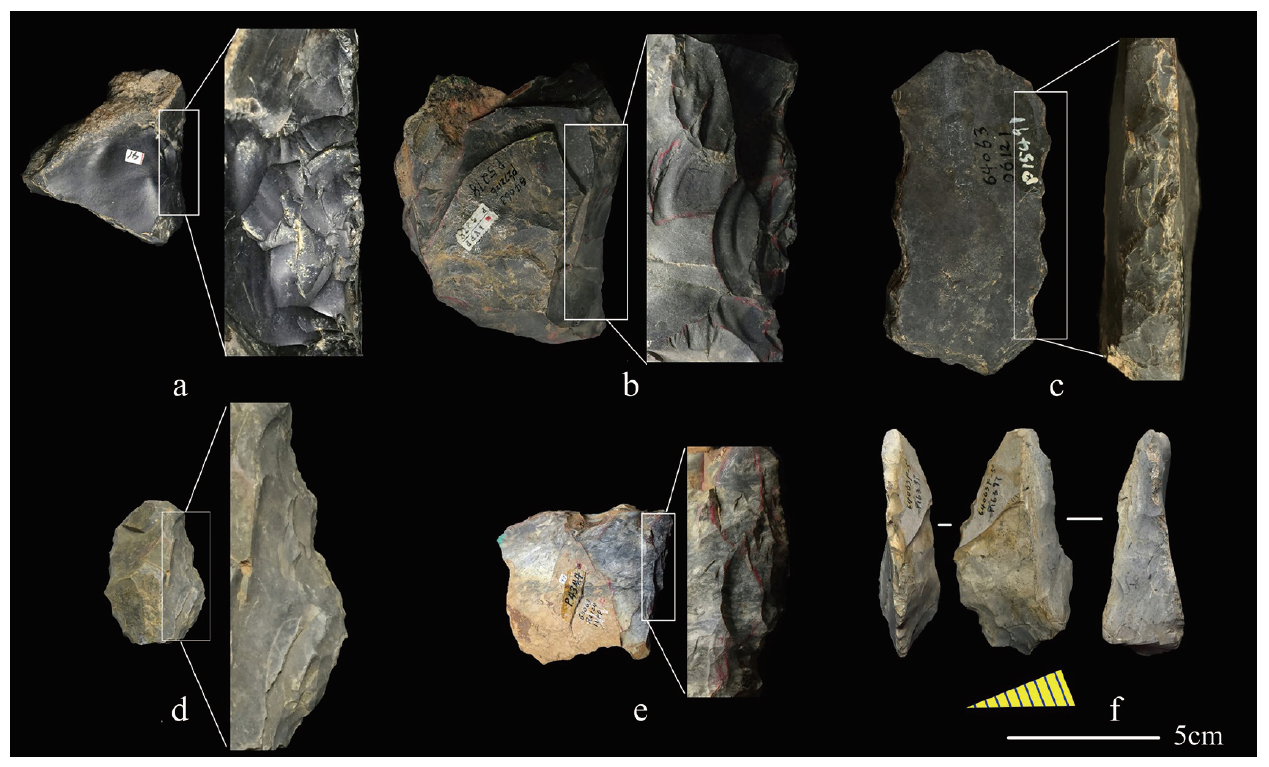
图6 基纳修理工具(a-e)和毛坯(f)(改自[16] )
Fig.6 Tools with Quina retouches (a-e) and Quina blank (f) (Modified from [16])
| [1] | Tryon CA, Faith JT. Variability in the Middle Stone Age of Eastern Africa[J]. Current Anthropology, 2013, 54(S8): 234-254 |
| [2] | Kuhn SL. Roots of the Middle Paleolithic in Eurasia[J]. Current Anthropology, 2013, 54(S8): 255-268 |
| [3] |
Dibble HL, McPherron SP. The Missing Mousterian[J]. Current Anthropology, 2006, 47(5): 777-803
doi: 10.1086/506282 URL |
| [4] |
Tryon CA, McBrearty S, Texier PJ. Levallois Lithic Technology from the Kapthurin Formation, Kenya: Acheulian Origin and Middle Stone Age Diversity[J]. African Archaeological Review, 2005, 22(4): 199-229
doi: 10.1007/s10437-006-9002-5 URL |
| [5] | Fontana F, Moncel MH, Nenzioni G, et al. Widespread diffusion of technical innovations around 300,000 years ago in Europe as a reflection of anthropological and social transformations? New comparative data from the western Mediterranean sites of Orgnac (France) and Cave dall’Olio (Italy)[J]. Journal of Anthropological Archaeology, 2013, 32(4): 478-498 |
| [6] | Goren-Inbar N. Behavioral and Cultural Origins of Neanderthals: A Levantine Perspective[A]. In: Condemi S, Weniger GC (Eds.). Continuity and Discontinuity in the Peopling of Europe: One Hundred Fifty Years of Neanderthal Study[C]. Dordrecht: Springer Netherlands, 2011, 89-100 |
| [7] |
Moncel MH, Ashton N, Arzarello M, et al. Early Levallois core technology between Marine Isotope Stage 12 and 9 in Western Europe[J]. Journal of Human Evolution, 2020, 139: 102735
doi: 10.1016/j.jhevol.2019.102735 URL |
| [8] |
Li H, Li ZY, Gao X, et al. Technological behavior of the early Late Pleistocene archaic humans at Lingjing (Xuchang, China)[J]. Archaeological and Anthropological Sciences, 2019, 11: 3477-3490
doi: 10.1007/s12520-018-0759-7 |
| [9] | Yang SX, Wang FG, Xie F, et al. Technological innovations at the onset of the Mid-Pleistocene Climate Transition in high-latitude East Asia[J]. National Science Review, 2021, 8(1): nwaa053 |
| [10] |
Hu Y, Ruan Q, Liu J, et al. Luminescence chronology and lithic technology of Tianhuadong Cave, an early Upper Pleistocene Paleolithic site in southwest China[J]. Quaternary Research, 2019, 94: 121-136
doi: 10.1017/qua.2019.67 URL |
| [11] | Ma DD, Pei SW, Xie F, et al. Earliest Prepared core technology in Eurasia from Nihewan (China): Implications for early human abilities and dispersals in East Asia[J]. Proceedings of the National Academy of Sciences, 2024, 121(11): e2313123121 |
| [12] |
Hu Y, Marwick B, Zhang JF, et al. Late Middle Pleistocene Levallois stone-tool technology in southwest China[J]. Nature, 2019, 565(7737): 82-85
doi: 10.1038/s41586-018-0710-1 |
| [13] |
Hu Y, Marwick B, Zhang JF, et al. Robust technological readings identify integrated structures typical of the Levallois concept in Guanyindong Cave, south China[J]. National Science Review, 2019, 6(6): 1096-1099
doi: 10.1093/nsr/nwz192 URL |
| [14] |
Hu Y, Marwick B, Lu H, et al. Evidence of Levallois strategies on cores at Guanyindong cave, Southwest China during the Late Middle Pleistocene[J]. Journal of Archaeological Science: Reports, 2023, 47: 103727
doi: 10.1016/j.jasrep.2022.103727 URL |
| [15] |
Hu Y, Zhang J, Lu H, et al. New chronology of the deposits from the inner chambers of the Guanyindong cave, southwestern China[J]. Journal of Archaeological Science, 2023, 159: 105872
doi: 10.1016/j.jas.2023.105872 URL |
| [16] |
Hu Y, Marwick B, Lu H, et al. Lithic technologies at Guanyindong cave, Southwest China: diversity and innovation during the Chinese Middle Palaeolithic[J]. Archaeological and Anthropological Sciences, 2024, 16(8): 119
doi: 10.1007/s12520-024-02022-4 |
| [17] | 李炎贤, 文本亨. 观音洞:贵州黔西旧石器时代初期文化遗址[M]. 北京: 文物出版社, 1986, 1-181 |
| [18] | Leng J. Early Paleolithic technology in Eastern and Southern Asia[M]. Oxford: BAR Publishing, 2001, 1-152 |
| [19] |
Li YH, Hou YM, Boëda E. Mode of débitage and technical cognition of hominids at the Guanyindong site[J]. Chinese Science Bulletin, 2009, 54(21): 3864-3871
doi: 10.1007/s11434-009-0612-6 URL |
| [20] |
Forestier HJP, Revue d’Archéologie Préhistorique. Le Clactonien: mise en application d’une nouvelle méthode de débitage s’ inscrivant dans la variabilité des systèmes de production lithique du Paléolithique ancien[J]. Paléo, 1993, 5(1): 53-82
doi: 10.3406/pal.1993.1104 URL |
| [21] | Boëda E. Levallois: A volumetric construction, methods, a technique[A]. In: Dibble H, Bar-Yosef O (Eds.). The Definition and Interpretation of Levallois Technology[M]. Madison: Prehistory Press, 1995, 41-68 |
| [22] |
White M, Ashton N. Lower Palaeolithic core technology and the origins of the Levallois method in North-Western Europe[J]. Current Anthropology, 2003, 44(4): 598-608
doi: 10.1086/377653 URL |
| [23] |
Shea JJ. The Middle Paleolithic of the East Mediterranean Levant[J]. Journal of World Prehistory, 2003, 17(4): 313-394
doi: 10.1023/B:JOWO.0000020194.01496.fe |
| [24] | Goder-Goldberger M, Cheng H, Edwards RL, et al. Emanuel Cave: the site and its bearing on early Middle Paleolithic technological variability[J]. Paléorient, 2012, 203-225 |
| [25] | Bar-Yosef O. The Lower and Middle Palaeolithic in the Mediterranean Levant: Chronology, and cultural entities[A]. In: Ullrich H (Ed.). Man and Environment in the Palaeolithic[C]. Liege: Université de Liège, 1995, 247-263 |
| [26] |
Shea JJ. The Middle Stone Age archaeology of the Lower Omo Valley Kibish Formation: excavations, lithic assemblages, and inferred patterns of early Homo sapiens behavior[J]. J Hum Evol, 2008, 55(3): 448-485
doi: 10.1016/j.jhevol.2008.05.014 pmid: 18691735 |
| [27] | Eren MI, Lycett SJ. Why Levallois? A morphometric comparison of experimental ‘preferential’ Levallois flakes versus debitage flakes[J]. PLoS ONE, 2012, 7(1): 1-10 |
| [28] |
Lycett SJ, Eren MI. Levallois economics: an examination of ‘waste’ production in experimentally produced Levallois reduction sequences[J]. Journal of Archaeological Science, 2013, 40(5): 2384-2392
doi: 10.1016/j.jas.2013.01.016 URL |
| [29] |
Picin A, Vaquero M. Flake productivity in the Levallois recurrent centripetal and discoid technologies: New insights from experimental and archaeological lithic series[J]. Journal of Archaeological Science: Reports, 2016, 8: 70-81
doi: 10.1016/j.jasrep.2016.05.062 URL |
| [30] |
Groucutt HS, Scerri EML, Stringer C, et al. Skhul lithic technology and the dispersal of Homo sapiens into Southwest Asia[J]. Quaternary International, 2019, 515: 30-52
doi: 10.1016/j.quaint.2017.12.027 |
| [31] |
Adler DS, Wilkinson KN, Blockley S, et al. Early Levallois technology and the Lower to Middle Paleolithic transition in the Southern Caucasus[J]. Science, 2014, 345(6204): 1609-1613
doi: 10.1126/science.1256484 pmid: 25258079 |
| [32] |
Picin A. Technological adaptation and the emergence of Levallois in Central Europe: new insight from the Markkleeberg and Zwochau open-air sites in Germany[J]. Journal of Quaternary Science, 2018, 33(3): 300-312
doi: 10.1002/jqs.v33.3 URL |
| [33] |
Moncel MH, Moigne AM, Combier J. Towards the Middle Palaeolithic in Western Europe: The case of Orgnac 3 (southeastern France)[J]. Journal of Human Evolution, 2012, 63(5): 653-666
doi: 10.1016/j.jhevol.2012.08.001 URL |
| [34] | Otte M, Weiwen H, Hu Y, et al. Panxian Dadong et le Levallois chinois[J]. L’Anthropologie, 2017, 121(3): 255-269 |
| [35] | 黄慰文, 侯亚梅, 斯信强. 盘县大洞:贵州旧石器初期遗址综合研究[M]. 北京: 科学出版社, 2012, 1-176 |
| [36] |
Lycett SJ, von Cramon-Taubadel N. Toward a “Quantitative Genetic” Approach to Lithic Variation[J]. Journal of Archaeological Method and Theory, 2015, 22(2): 646-675
doi: 10.1007/s10816-013-9200-9 URL |
| [37] |
Hérisson D, Brenet M, Cliquet D, et al. The emergence of the Middle Palaeolithic in north-western Europe and its southern fringes[J]. Quaternary International, 2016, 411: 233-283
doi: 10.1016/j.quaint.2016.02.049 URL |
| [38] | Owen WE. The Kombewa Culture,Kenya Colony[M]. Man, 1938, 203-205 |
| [39] | Solecki RL, Solecki RS. A new secondary flaking technique at the Nahr Ibrahim cave site, Lebanon[J]. Bulletin Du Musee De Beyrouth, 1970, 23: 137-142 |
| [40] | Goren-Inbar N. Too Small to Be True? Reevaluation of Cores on Flakes in Levantine Mousterian Assemblages assemblages[J]. Lithis Technology, 1988, 17:(1): 37-44 |
| [41] |
Rossoni-Notter E, Notter O, Simone S, et al. Acheulean breccias of Prince cave (Liguria, Italy): New insights and regional issues[J]. Quaternary International, 2016, 411: 236-253
doi: 10.1016/j.quaint.2016.01.072 URL |
| [42] |
Mathias C, Bourguignon L. Cores-on-flakes and ramification during the middle palaeolithic in Southern France: A gradual process from the early to late middle palaeolithic?[J]. Journal of Archaeological Science: Reports, 2020, 31: 102336
doi: 10.1016/j.jasrep.2020.102336 URL |
| [43] | Hovers E. The many faces of cores-on-flakes: a perspective from the Levantine Mousterian[A]. In: McPherron SP (Ed.). Cores or Tools? Alternative Approaches to Stone Tool Analysis[C]. Cambridge: Cambridge Scholars Press, 2007, 42-74 |
| [44] | Schroeder B. Truncated-faceted pieces from Jerf Al-Ajla[A]. In: McPherron SP (Ed.). Tools Versus Cores Alternative Approaces to Stone Tool Analysis[C]. Newcastle: Cambridge Scholars Publishing, 2007, 17-41 |
| [45] |
Wallace IJ, Shea JJ. Mobility patterns and core technologies in the Middle Paleolithic of the Levant[J]. Journal of Archaeological Science, 2006, 33(9): 1293-1309
doi: 10.1016/j.jas.2006.01.005 URL |
| [46] |
Brantingham PJ, Olsen JW, Rech JA, et al. Raw Material Quality and Prepared Core Technologies in Northeast Asia[J]. Journal of Archaeological Science, 2000, 27(3): 255-271
doi: 10.1006/jasc.1999.0456 URL |
| [47] | Inizan ML, Reduron-Ballinger M, Roche H, et al. Technology and Terminology of Knapped Stone[M]. Paris: CREP, 1999 |
| [48] | 王建, 陶富海, 王益人. 丁村旧石器时代遗址群调查发掘简报[J]. 文物世界, 1994, 3: 1-75 |
| [49] | Zhang P, Huang W, Wang W. Acheulean handaxes from Fengshudao, Bose sites of South China[J]. Quaternary International, 2010, (223-224): 440-443 |
| [50] | Simanjuntak T, Sémah F, Gaillard C. The palaeolithic in Indonesia: Nature and chronology[J]. Quaternary International, 2010, (223-224): 418-421 |
| [51] | Gaillard C, Mishra S, Singh M, et al. Lower and Early Middle Pleistocene Acheulian in the Indian sub-continent[J]. Quaternary International, 2010, (223-224): 234-241 |
| [52] | Wang SJ. Perspectives on Hominid Behaviour and Settlement Patterns: A Study of the Lower Palaeolithic Sites in the Luonan Basin, China[M]. Oxford: Archaeopress, 2005, 1-260 |
| [53] | Terradas X. Discoid flaking method: conception and technological variability[A]. In: Peresani M. Discoid Lithic Technology: advances and implications[C]. Oxford: BAR International Series 1120, 2003, 19-31 |
| [54] |
Peresani M. La variabilité du débitage discoïde dans la grotte de Fumane (Italie du Nord) / The variability of discoid production at the grotte de Fumane[J]. Paléo, 1998, 10: 123-146
doi: 10.3406/pal.1998.1133 URL |
| [55] | Delagnes A, Meignen L. Diversity of Lithic Production Systems During the Middle Paleolithic in France[A]. In: Hovers E, Kuhn SL (Eds.). Transitions Before the Transition: Evolution and Stability in the Middle Paleolithic and Middle Stone Age[C]. Boston: Springer US, 2006, 85-107 |
| [56] | Thiébaut C. Discoid debitage stricto sensus: a method adapted to highly mobile Middle Paleolithic groups?[J]. Palethnologie, 2013, 1-17 |
| [57] |
Delpiano D, Peresani M. Exploring Neanderthal skills and lithic economy. The implication of a refitted Discoid reduction sequence reconstructed using 3D virtual analysis[J]. Comptes Rendus Palevol, 2017, 16(8): 865-877
doi: 10.1016/j.crpv.2017.06.008 URL |
| [58] |
Faivre JP, Gravina B, Bourguignon L, et al. Late Middle Palaeolithic lithic technocomplexes (MIS 5-3) in the northeastern Aquitaine Basin: Advances and challenges[J]. Quaternary International, 2017, 433: 116-131
doi: 10.1016/j.quaint.2016.02.060 URL |
| [59] | Carmignani L, Moncel MH, Fernandes P, et al. Technological variability during the Early Middle Palaeolithic in Western Europe. Reduction systems and predetermined products at the Bau de l’Aubesier and Payre (South-East France)[J]. PLoS ONE, 2017, 12(6): e0178550 |
| [60] |
Eren MI, Greenspan A, Sampson CG. Are Upper Paleolithic blade cores more productive than Middle Paleolithic discoidal cores? A replication experiment[J]. Journal of Human Evolution, 2008, 55(6): 952-961
doi: 10.1016/j.jhevol.2008.07.009 pmid: 18835009 |
| [61] | Delagnes A. Blade production during the Middle Paleolithic in Northwestern Europe[J]. Acta Anthropogica Sinica, 2000, S19: 181-188 |
| [62] | Meignen L. Early Middle Palaeolithic blade technology in Southwestern Asia[J]. Acta Anthropogica Sinica, 2000, S19: 158-168 |
| [63] | 李炎贤. 中国旧石器时代晚期文化的划分[J]. 人类学学报, 1993, 12(3): 214-223 |
| [64] |
Bar-Yosef O, Kuhn SL. The big deal about blades: Laminar technologies and human evolution[J]. American Anthropologist, 1999, 101(2): 322-338
doi: 10.1525/aa.1999.101.2.322 URL |
| [65] | Wojtczak DB. More than blades. Early Middle Palaeolithic of the Levant[J]. L’Anthropologie, 2022, 126(3): 103046 |
| [66] |
Meignen L, Bar-Yosef O. Acheulo-Yabrudian and Early Middle Paleolithic at Hayonim Cave (Western Galilee, Israel): Continuity or break?[J]. Journal of Human Evolution, 2020, 139: 102733
doi: 10.1016/j.jhevol.2019.102733 URL |
| [67] | Kuhn SL. A geometric index of reduction for unifacial stone tools[J]. Journal of Archaeological Science, 1990, 17(5): 581-593 |
| [68] |
Hiscock P, Tabrett A. Generalization, inference and the quantification of lithic reduction[J]. World Archaeology, 2010, 42(4): 545-561
doi: 10.1080/00438243.2010.517669 URL |
| [69] |
Hiscock P, Clarkson C. Experimental evaluation of Kuhn’s geometric index of reduction and the flat-flake problem[J]. Journal of Archaeological Science, 2005, 32(7): 1015-1022
doi: 10.1016/j.jas.2005.02.002 URL |
| [70] |
Agam A, Zupancich A. Interpreting the Quina and demi-Quina scrapers from Acheulo-Yabrudian Qesem Cave, Israel: Results of raw materials and functional analyses[J]. Journal of Human Evolution, 2020, 144: 102798
doi: 10.1016/j.jhevol.2020.102798 URL |
| [71] | Hiscock P, Clarkson C. The Construction of Morphological Diversity: A Study of Mousterian Implement Retouching at Combe Grenal[A]. In: Andrefsky JW (Ed.). Lithic Technology: Measures of Production, Use and Curation. Cambridge[C]. Cambridge: Cambridge University Press, 2008: 106-135 |
| [72] |
Lin SC, Marreiros J. Quina retouch does not maintain edge angle over reduction[J]. Lithic Technology, 2021, 46(1): 45-59
doi: 10.1080/01977261.2020.1819048 URL |
| [73] |
Hardy BL. Neanderthal behaviour and stone tool function at the Middle Palaeolithic site of La Quina, France[J]. Antiquity, 2004, 78(301): 547-565
doi: 10.1017/S0003598X00113213 URL |
| [74] | Preysler J. Experimental approach to the function and technology of Quina side-scrapers[A]. In: Nami HG (Ed.). Experiments and Interpretation of Traditional Technologies: Essays in Honor of Errett Callahan[C]. Buenos Aires: Arqueolog ía Contemporánea. 2010, 171-202 |
| [75] | Hiscock P, Turq A, Faivre JP, et al. Quina Procurement and Tool Production[A]. In: Adams B, Blades BS (Eds.). Lithic Materials and Paleolithic Societies[C]. Hoboken: Wiley-Blackwell, 2009, 232-246 |
| [76] | Yang SX, Hou YM, Yue JP, et al. The Lithic Assemblages of Xiaochangliang, Nihewan Basin: Implications for Early Pleistocene Hominin Behaviour in North China[J]. PLoS ONE, 2016, 11(5): e0155793 |
| [77] | Yang SX, Petraglia MD, Hou YM, et al. The lithic assemblages of Donggutuo, Nihewan basin: Knapping skills of Early Pleistocene hominins in North China[J]. PLoS ONE, 2017, 12(9): e0185101 |
| [78] |
Li H, Lotter MG. Lithic production strategies during the late Middle Pleistocene at Dali, Shaanxi Province, China: implications for understanding late archaic humans[J]. Archaeological and Anthropological Sciences, 2019, 11(5): 1701-1712
doi: 10.1007/s12520-018-0626-6 |
| [79] |
Li H, Li Y, Yu L, et al. Continuous technological and behavioral development of late Pleistocene hominins in central South China: Multidisciplinary analysis at Sandinggai[J]. Quaternary Science Reviews, 2022, 298: 107850
doi: 10.1016/j.quascirev.2022.107850 URL |
| [80] | 阮齐军, 刘建辉, 胡越, 等. 云南鹤庆天华洞旧石器遗址石制品研究[J]. 人类学学报, 2019, 38(2): 166-181 |
| [81] | Ruan QJ, Li H, Xiao PY, et al. Delpiano, Quina lithic technology indicates diverse Late Pleistocene human dynamics in East Asia[J]. Proc. Natl. Acad. Sci. USA, 2025, 122(14): e2418029122 |
| [82] |
Wang Y, Zhang X, Sun X, et al. A new chronological framework for Chuandong Cave and its implications for the appearance of modern humans in southern China[J]. Journal of Human Evolution, 2023, 178: 103344
doi: 10.1016/j.jhevol.2023.103344 URL |
| [83] |
Peng W, Huang X, Storozum MJ, et al. An updated chronology and paleoenvironmental background for the Paleolithic Loufangzi site, North China[J]. Journal of Human Evolution, 2021, 152: 102948
doi: 10.1016/j.jhevol.2020.102948 URL |
| [84] | 刘武. 二十一世纪中国人类演化研究的发现、认识与理论探索[J]. 人类学学报, 2024, 43(6): 881-899 |
| [1] | 黄冰柔, 牛东伟, 裴树文, 郭玉杰. 河北蔚县盆地东沟遗址的光释光年龄[J]. 人类学学报, 2026, 45(03): 543-555. |
| [2] | 肖培源, 阮齐军, 李浩. 中国西南基纳型旧石器中期技术的发现与研究进展[J]. 人类学学报, 2025, 44(06): 1009-1018. |
| [3] | 王潇玉, 高星. 勒瓦娄哇的剥片模式与技术组合[J]. 人类学学报, 2025, 44(01): 1-13. |
| [4] | 李浩, 肖培源, 彭培洺, 王雨晴, 陈清懿, Ikram QAYUM, 贾真秀, 阮齐军, 陈发虎. 西南丝绸之路上的旧石器文化与人群交流[J]. 人类学学报, 2024, 43(06): 979-992. |
| [5] | 肖培源, 阮齐军, 高玉, 贾真秀, 张明, 杨李靖, 刘建辉, 李三灵, 李浩. 2022年云南宾川盆地旧石器遗址调查报告[J]. 人类学学报, 2024, 43(03): 448-457. |
| [6] | 慕占雄, 陈国科, 杜水生, 王辉. 甘肃环县楼房子遗址2018年发掘简报[J]. 人类学学报, 2022, 41(01): 121-134. |
| [7] | 袁文明, 夏宏茹, 兰会才, 王益人. 山西襄汾洞门遗址发掘简报[J]. 人类学学报, 2021, 40(06): 1072-1085. |
| [8] | 牛东伟, 裴树文, 王惠民, 高星. 宁夏水洞沟遗址第7地点石制品的剥片与修理技术[J]. 人类学学报, 2020, 39(03): 367-378. |
| [9] | 李锋, 李英华, 高星. 贵州观音洞遗址石制品剥片技术辨析[J]. 人类学学报, 2020, 39(01): 1-11. |
| [10] | 阮齐军, 刘建辉, 胡越, 李波, 杨长城, 罗兴荣. 云南鹤庆天华洞旧石器遗址石制品研究[J]. 人类学学报, 2019, 38(02): 166-181. |
| [11] | 高星;裴树文;彭菲;张铁男;冯兴无;陈福友;张乐;张晓凌;阿普都热苏勒·伊第利斯. 2004年新疆旧石器考古调查简报[J]. 人类学学报, 2018, 37(04): 499-509. |
| [12] | 武仙竹;王照魁. 重庆丰都瓦啄嘴遗址的小哺乳动物[J]. 人类学学报, 2018, 37(03): 452-466. |
| [13] | 刘扬;侯亚梅;杨泽蒙. 鄂尔多斯乌兰木伦遗址石制品拼合研究及其对遗址成因的指示意义[J]. 人类学学报, 2015, 34(01): 41-54. |
| [14] | 李占扬; 张双权; 张乐; 高星. 河南灵井许昌人遗址普通马(Equus caballus)化石居群的死亡年龄曲线[J]. 人类学学报, 2011, 30(01): 45-54. |
| [15] | 王晓琨; 魏坚; 陈全家; 汤卓炜; 王春雪. 内蒙古金斯太洞穴遗址发掘简报[J]. 人类学学报, 2010, 29(01): 15-32. |
| 阅读次数 | ||||||
|
全文 |
|
|||||
|
摘要 |
|
|||||
 京ICP证05002819号-3