


云南元谋丙弄丙洪遗址的石器工业
收稿日期: 2024-04-11
录用日期: 2024-06-25
网络出版日期: 2025-08-07
基金资助
国家社科基金青年项目“考古新发现与岭南-东南亚大陆旧新石器时代过渡研究”(22CKG001)
Preliminary study of the knapped stone artefacts from the Bingnong-Binghong site in Yuanmou, Yunnan Province
Received date: 2024-04-11
Accepted date: 2024-06-25
Online published: 2025-08-07
云南元谋丙弄丙洪是金沙江中游地区一处新石器时代晚期至青铜时代遗址,包含大量打制石器遗存。该遗址石制品原料基本为砂岩类砾石,以硬锤直接修型或剥坯后再修理成各类石器;石制品类别包括砾石、使用砾石、石核、石片、石器和断块,石器组合包括打制斧锛类、石刀、石镞、刮削器、砍砸器、盘状石器等。比较研究的结果显示:1)该遗址打制砾石器承继了当地传统,并表现出与和平石器工业相似的类型与技术特征,显现了中国西南与东南亚大陆地区史前文化的联系;2)两侧带缺口的石刀等新的工具类型,可能是连同栽培作物等、受中原-甘青地区仰韶中晚期-马家窑文化人群影响而传入的新文化因素;3)金沙江中游地区打制石器的长期流行与当地石制品原料的丰富及其获取的便利密切相关,也是云贵高原地区独特的自然环境使然。
邓婉文 , 闵锐 . 云南元谋丙弄丙洪遗址的石器工业[J]. 人类学学报, 2025 , 44(04) : 568 -582 . DOI: 10.16359/j.1000-3193/AAS.2024.0106
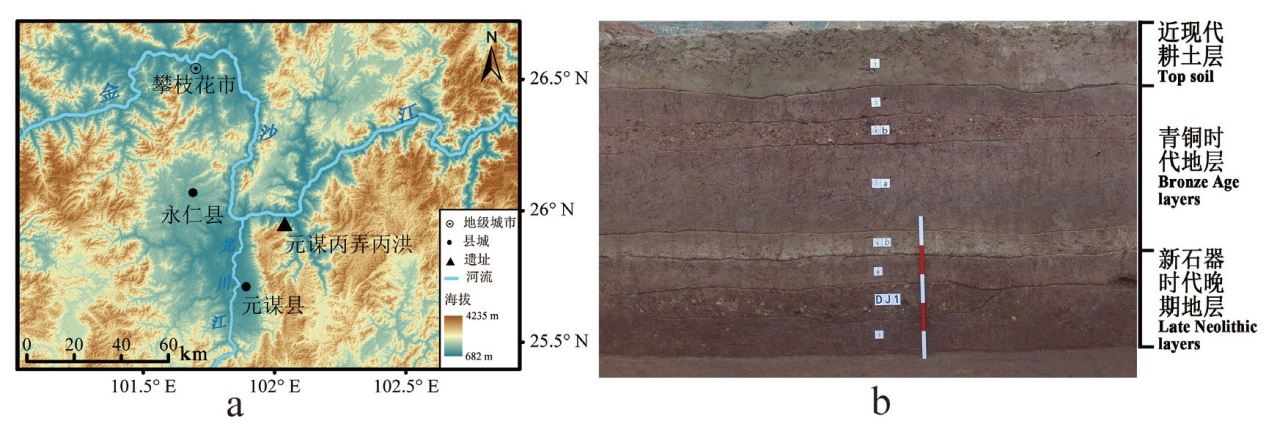
The Bingnong-Binghong site is situated in Yuanmou county, north-central Yunnan Province. It contains a lower cultural layer dated as early as 4600 BP, around the Mid-Holocene. While the upper cultural layer of the site contains a few bronze implements, estimated to be lasting until 2500 BP or so. A large number of knapped stone artefacts were uncovered from both cultural layers, about 12694 pieces in total. Techno-typological analyses of the lithic artefacts indicate that Late Neolithic to Bronze Age populations inhabited in the middle reaches of the Jinsha River utilised knapped stone tools quite often. The lithic raw materials are mostly sedimentary rocks in the form of river cobbles. Considering that the site is located on the second terrace of the Jinsha River, large quantities of river cobbles would be easily accessed. The lithic assemblages from the Bingnong-Binghong site contain cobbles, used elongated cobbles, cores, flakes, tools and debris. Most of the stone tools were either shaped directly from large oval cobbles, or to split cobbles into two halves and then retouch split cobbles into different kinds of tools. Among the knapped stone tools, there found quadrilateral axes/adzes made of either cobbles or split cobbles, and slightly shouldered stone axes made of split cobbles. There also found knives made of primary oval flakes, either with notches on both sides or not. Besides, there are scrapers retouched on flakes, side-edged choppers shaped from oval cobbles, discoids bifacially worked from cobbles, net sinkers made of large flat pebbles, chisels and arrows. Our study shows that: 1) Techno-typological features of the knapped stone tools from the Bingnong-Binghong site exhibit an indigenous cobble tool tradition in Southwest China since the Late Upper Pleistocene. It seems to bear remarkable similarities to the Hoabinhian technocomplex in Mainland Southeast Asia, which reveals a close relationship between the populations and archaeological cultures of both regions originated as early as the Late Upper Pleistocene. 2) New tool types such as stone knives with notches on both sides, and quadrilateral stone axes / adzes, are also found in the lithic assemblages. They may have been introduced into Southwest China around the Mid-Holocene, together with cultivated crops by farming populations of the Late Yangshao-Majiayao cultures from the Central Plains-Gansu-Qinghai region. Neolithic cultural factors should have dispersed along with continuous human movements from Central Plains through Northwest China to Southwest China since Early Holocene. 3) The long-lasting cobble tool tradition in the middle reaches of the Jinsha River is very likely resulted from the abundance of raw materials for stone tool production and the convenience of obtaining cobbles in nearby areas. The characteristics of Bingnong-Binghong lithic industries appear to be highly related to the unique natural environment of the Yunnan-Guizhou Plateau.
| [1] | 李浩. 探究早期现代人的南方扩散路线[J]. 人类学学报, 2022, 41(4): 630-648 |
| [2] | 王幼平. 现代人扩散南线的考古学观察[J]. 南方文物, 2023, 3: 147-156 |
| [3] | Tao L, Yuan H, Zhu K, et al. Ancient genomes reveal millet farming-related demic diffusion from the Yellow River into southwest China[J]. Current Biology, 2023, 33: 1-8 |
| [4] | 张森水. 管窥新中国旧石器考古学的重大发展[J]. 人类学学报, 1999, 18(3): 193-214 |
| [5] | 王幼平. 更新世环境与中国南方旧石器文化发展[M]. 北京: 北京大学出版社, 1997 |
| [6] | 四川省文物考古研究院, 北京大学考古文博学院. 四川稻城县皮洛旧石器时代遗址[J]. 考古, 2022, 7: 3-14 |
| [7] | 阮齐军, 刘建辉, 叶荣波, 等. 云南鹤庆蝙蝠洞旧石器遗址2019年度发掘报告[J]. 人类学学报, 2023, 42(4): 503-513 |
| [8] | 曹泽田. 猫猫洞旧石器之研究[J]. 古脊椎动物与古人类, 1982, 20(2): 155-164 |
| [9] | Ji XP, Kuman K, Clark RJ, et al. The oldest Hoabinhian technocomplex in Asia (43.5 ka) at Xiaodong rockshelter, Yunnan Province, southwest China[J]. Quaternary International, 2016, 400: 166-174 |
| [10] | Zhou YD, Ji XP, Li YH, et al. Tangzigou open-air site: A unique lithic assemblage during the Early Holocene in Yunnan Province, Southwest China[J]. Quaternary International, 2020, 563: 105-118 |
| [11] | Wu Y, Qiu KW, Luo Y, et al. Dedan Cave: Extending the evidence of the Hoabinhian technocomplex in southwest China[J]. Journal of Archaeological Science: Reports, 2022, 44: 103524 |
| [12] | Zhou YD, Cai SF, Liu XD, et al. Cobbles during the final Pleistocene-early Holocene transition: An original lithic assemblage from Maomaodong rockshelter, Guizhou Province, southwest China[J]. Archaeological Research in Asia, 2022, 32: 100411 |
| [13] | Clark G. Aspects of Prehistory[M]. California: University of California Press, 1970 |
| [14] | 吴超明, 宋国定. 中国新石器时代石器工业研究的回顾与思考:兼及郑州地区仰韶文化石器研究的若干问题[J]. 南方文物, 2021, 5: 18-34 |
| [15] | 张弛. 中国新石器时代的石叶技术:汉水中游仰韶文化石叶石镞[J]. 江汉考古, 2021, 6: 71-78 |
| [16] | 成都文物考古研究所, 阿坝藏族羌族自治州文物管理所, 茂县羌族博物馆. 茂县营盘山新石器时代遗址[R]. 北京: 文物出版社, 2019 |
| [17] | 中国社会科学院考古研究所华南一队, 贵州省文物考古研究所, 贵安新区社会事务管理局. 贵州贵安新区牛坡洞遗址[J]. 考古, 2017, 7: 3-17 |
| [18] | 贵州省文物考古研究所. 贵州开阳打儿窝岩厦遗址试掘简报[J]. 长江文明, 2013, 1: 1-19 |
| [19] | 云南省文物考古研究所. 元谋丙弄丙洪遗址[EB/OL]. 2019-04-01, http://www.ynkgs.com/view/ynkgPC/1/4/view/1380.html |
| [20] | Hu G, Min R, Zhou Y, et al. Luminescence dating of a megaflood event on a terrace of the Jinsha River, China[J]. Quaternary Geochronology, 2022, 70: 101303 |
| [21] | 卫奇. 石制品观察格式探讨[A]. 见:邓涛,王原(主编). 第八届中国古脊椎动物学学术年会论文集[C]. 北京: 海洋出版社, 2001, 209-218 |
| [22] | Toth N. The Stone Technologies of Early Hominids at Koobi Fora, Kenya: An Experimental Approach[D]. Berkeley: University of California, 1982 |
| [23] | 广东省文物考古研究所, 北京大学考古文博学院, 英德市博物馆. 广东英德市青塘遗址[J]. 考古, 2019, 7: 3-15 |
| [24] | Nguyen GD. Results of recent research into the lithic industries from Late Pleistocene/Early Holocene sites in northern Vietnam[J]. Indo-Pacific Prehistory Association Bulletin, 2005, 25(3): 95-97 |
| [25] | 曹泽田. 贵州水城硝灰洞旧石器文化遗址[J]. 古脊椎动物与古人类, 1978, 16(1): 67-72 |
| [26] | 李炎贤, 蔡回阳. 贵州白岩脚洞石器的第二步加工[J]. 江汉考古, 1986, 2: 56-64 |
| [27] | 张森水. 穿洞史前遗址(1981年发掘)初步研究[J]. 人类学学报, 1995, 14(2): 132-146 |
| [28] | 陈胜前, 刘睿喆, 周怡昕, 等. 锐棱砸击技术与旧新石器时代过渡[J]. 江汉考古, 2022, 3: 59-69 |
| [29] | 中国社会科学院考古研究所. 枝江关庙山[M]. 北京: 文物出版社, 2017 |
| [30] | 中国科学院考古研究所. 京山屈家岭[M]. 北京: 科学出版社, 1965 |
| [31] | 蔡回阳, 王新金, 许春华. 贵州毕节扁扁洞的旧石器[J]. 人类学学报, 1991, 10(1): 50-57 |
| [32] | 阮齐军, 周建威, 和金梅, 等. 云南鹤庆龙潭旧石器遗址2019—2020年度发掘简报[J]. 南方文物, 2021, 1: 105-118 |
| [33] | Ha VT. The Hoabinhian and before[J]. Indo-Pacific Prehistory Association Bulletin (Chiang Mai Papers), 1997, 16(3): 35-41 |
| [34] | 甘肃省文物考古研究所. 秦安大地湾新石器时代遗址发掘报告[M]. 北京: 文物出版社, 2006 |
| [35] | 成都文物考古研究所, 阿坝藏族羌族自治州文物管理所, 茂县羌族博物馆. 四川茂县营盘山遗址2003年的发掘[J]. 见:四川大学博物馆,四川大学考古学系,成都文物考古研究所(编). 南方民族考古(第十三辑)[C]. 2018, 1-90 |
| [36] | 李英华, 林美蓉, 邓鸿山, 等. 越南和平文化石器技术分析及对华南东南亚砾石石器工业研究的启示[J]. 南方文物, 2020, 5: 90-105 |
| [37] | Matthews JM. A review of the Hoabinhian in Indo-China[J]. Asian Perspectives, 1966, IX: 86-95 |
| [38] | Ha VT. The Hoabinhian in the context of Viet Nam[J]. Vietnamese Studies, 1976, 46: 127-197 |
| [39] | Forestier H, Sophady H, Celiberti V. Le techno-complexe hoabinhien en Asie du Sud-est continentale: L’histoire d’un galet qui cache la forêt[J]. Journal of Lithic Studies, 2017, 4(2): 305-349 |
| [40] | 安志敏. 中国古代的石刀[J]. 考古学报, 1955, 2: 27-51 |
| [41] | 邓振华. 金沙江流域农业的形成与早期发展[J]. 中华文化论坛, 2023, 1: 142-153 |
| [42] | 阿坝藏族羌族自治州文物管理所, 成都文物考古研究所, 马尔康县文化体育局. 四川马尔康哈休遗址2006年的试掘[J]. 见:四川大学博物馆,四川大学考古学系,成都文物考古研究所(编). 南方民族考古(第六辑)[C]. 2010, 295-374 |
| [43] | 四川省文物考古研究院, 阿坝藏族羌族自治州文物考古研究所, 金川县文物管理所. 四川金川县刘家寨遗址2012年发掘简报[J]. 考古, 2022, 4: 3-21 |
| [44] | 何锟宇, 郑漫丽. 试论姜维城遗址史前文化遗存的分期、年代及文化属性[J]. 见:四川大学博物馆,四川大学考古学系,成都文物考古研究所(编). 南方民族考古(第十辑)[C]. 2014: 61-74 |
| [45] | 成都文物考古研究院, 凉山彝族自治州博物馆, 盐源县文物管理所. 四川盐源县皈家堡遗址2016年新石器时代遗存的发掘[J]. 考古, 2023, 6: 3-18 |
| [46] | 成都文物考古研究所, 凉山彝族自治州博物馆, 西昌市文物管理所. 西昌市大兴乡横栏山遗址2011年试掘简报[M].见:成都文物考古研究所(编). 成都考古发现(2012)[C]. 北京: 科学出版社, 2014, 78-91 |
| [47] | 四川省文物考古研究院, 凉山彝族自治州博物馆, 会理县文物管理所. 四川会理县大坪遗址Ⅲ区新石器时代遗存发掘简报[J]. 四川文物, 2022, 1: 4-16 |
| [48] | 任瑞波, 陈苇. 试论川西北高原仰韶时代晚期遗存[J]. 考古, 2022, 8: 84-97 |
| [49] | 云南省博物馆. 元谋大墩子新石器时代遗址[J]. 考古学报, 1977, 1: 43-72 |
| [50] | 云南省文物考古研究所, 中国社会学院考古研究所云南工作队, 成都市文物考古研究所, 等. 云南永仁菜园子、磨盘地遗址2001年发掘报告[J]. 考古学报, 2003, 2: 263-296 |
| [51] | 云南省博物馆. 云南宾川白羊村遗址[J]. 考古学报, 1981, 3: 349-368 |
| [52] | 周志清. 论金沙江中游新石器文化圈[J]. 中华文化论坛, 2023, 1: 131-141 |
| [53] | 周毅恒, 闵锐, 车德才. 云南元谋丙弄丙洪遗址[M]. 2019中国重要考古发现[C]. 北京: 文物出版社, 2020, 39-42 |
| [54] | 中国社会科学院考古研究所. 师赵村与西山坪[R]. 北京: 中国大百科全书出版社, 1999 |
| [55] | 张强禄, 王辉. 甘肃武都县大李家坪新石器时代遗址发掘报告[J].见:中国社会科学院考古研究所(编). 考古学集刊(第十三辑)[C]. 2000, 1-40 |
| [56] | 张强禄. 白龙江流域新石器时代文化谱系的初步研究[J]. 考古, 2005, 2: 54-70 |
| [57] | 安志敏. 略论新石器时代的一些打制石器[J]. 古脊椎动物与古人类, 1960, 2(2): 120-128 |
| [58] | 罗二虎. 中国古代系绳石刀研究[J].见:中国社会科学院考古研究所(编). 考古学集刊(第十四辑)[C]. 2004, 1: 311-391 |
| [59] | 中国社会科学院考古研究所. 庙底沟与三里桥(黄河水库考古报告之二).中国田野考古报告集考古学专刊·丁种第九号[R]. 北京: 科学出版社, 1959, 57 |
| [60] | 张强禄. 马家窑文化与仰韶文化的关系[J]. 考古, 2002, 1: 47-60 |
| [61] | 韩建业. 半山类型的形成与东部文化的西迁[J]. 考古与文物, 2007, 3: 33-38 |
| [62] | 童恩正. 试论我国从东北至西南的边地半月形文化传播带[A].见:文物出版社编辑部(编). 文物与考古论集:文物出版社成立三十周年纪念[C]. 北京: 文物出版社, 1986, 17-43 |
| [63] | Zhang XL, Ha B, Wang SJ, et al. The earliest human occupation of the high-altitude Tibetan Plateau 40 thousand to 30 thousand years ago[J]. Science, 2018, 362(6418): 1049-1051 |
| [64] | 靳英帅, 张晓凌, 王社江, 等. 青藏高原腹地发现最早细石叶技术遗址[J]. 中国科学:地球科学, 2024, 54(5): 1588-1601 |
| [65] | 冯玥. 七角井遗址与史前丝绸之路上的细石器[J]. 西域研究, 2023, 3: 82-87 |
| [66] | 邓婉文, 刘锁强. 广东高明古椰贝丘遗址的细石器及相关问题[J]. 南方文物, 2023, 3: 187-194 |
| [67] | Qi XB, Cui CY, Peng Y, et al. Genetic evidence of Paleolithic colonization and Neolithic expansion of modern humans on the Tibetan Plateau[J]. Molecular Biology and Evolution, 2013, 30: 1761-1778 |
| [68] | Zhao M, Kong QP, Wang HW, et al. Mitochondrial genome evidence reveals successful Late Paleolithic settlement on the Tibetan Plateau[J]. Proceedings of the National Academy of Sciences of the United States of America, 2009, 106(50): 21230-21235 |
| [69] | 辛中华. 岷江上游新石器时代遗存及相关问题探讨[J]. 四川文物, 2005, 1: 9-14 |
| [70] | 周志清. 南北文化交流拓荒者:横断山区中段距今5000年新石器文化遗存分析[J]. 早期中国研究, 2023, 38-51 |
| [71] | Liu L, Chen J, Wang JJ, et al. Archaeological evidence for initial migration of Neolithic Proto Sino-Tibetan speakers from Yellow River valley to Tibetan Plateau[J]. Proceedings of the National Academy of Sciences of the United States of America, 2022, 119(51): e2082961177 |
| [72] | 韩建业. 5000年前的中西文化交流通道[J]. 社会科学战线, 2012, 6: 102-106 |
| [73] | 洪玲玉, 崔剑锋, 王辉, 等. 川西马家窑类型彩陶产源分析与探讨[J].见:四川大学博物馆,四川大学考古学系,成都文物考古研究所(编). 南方民族考古(第七辑), 2011, 1-58 |
| [74] | Bai F, Zhang XL, Ji XP, et al. Paleolithic genetic link between southern China and Mainland Southeast Asia revealed by ancient mitochondrial genomes[J]. Journal of Human Genetics, 2020, 65: 1125-1128 |
| [75] | Wang TY, Wang W, Xie GM, et al. Human population history at the crossroads of East and Southeast Asia since 11,000 years ago[J]. Cell, 2021, 184: 3829-3841 |
| [76] | He GL, Wang MG, Zou X, et al. Peopling history of the Tibetan Plateau and multiple waves of admixture of Tibetans inferred from both ancient and modern genome-wide data[J]. Frontiers in Genetics, 2021, 12: 725243 |
| [77] | Yang MA, Fan X, Sun B, et al. Ancient DNA indicates human population shifts and admixture in northern and southern China[J]. Science, 2020, 369(6501): 282-288 |
| [78] | Wang CC, Yeh HY, Popov AN, et al. Genomic insights into the formation of human populations in East Asia[J]. Nature, 2021, 591: 413-419 |
/
| 〈 |
|
〉 |
 京ICP证05002819号-3