


甘肃漳县墩坪墓地东周人群的牙齿磨耗
收稿日期: 2024-05-13
录用日期: 2025-01-08
网络出版日期: 2025-08-07
基金资助
国家社科基金资助项目(24CKG050);生物考古视野下欧亚草原早期东西方文化交流研究(23VLS007);欧亚草原东部地区青铜—早期铁器时代人群的体质人类学综合研究(23VRC034)
Dental wear studies of the Eastern Zhou Dynasty people in the Dunping Cemetery, Zhangxian County, Gansu
Received date: 2024-05-13
Accepted date: 2025-01-08
Online published: 2025-08-07
本文结合牙齿的磨耗等级、3D磨耗与微磨耗研究,统计了甘肃漳县墩坪墓地东周时期古代人群69例个体的775枚牙齿磨耗数据,从牙齿的平面形态、立体形貌和微观形态三方面分别量化了墩坪人群的牙齿磨耗特征。采用不同生业模式人群牙齿磨耗数据进行组间对比,进一步讨论该人群的食性特征。结果表明,该人群的牙齿磨耗表现为臼齿磨耗水平相对较低、前牙磨耗高于后牙、前牙磨损程度高、臼齿磨耗深度浅、颊侧垂直方向条痕微磨耗占比高等特征,暗示了该人群所摄入的食物以肉类为主。墩坪墓地东周时期墓葬的出土遗存中少见农业经济特征,盛行使用大量的牛、马、羊等动物骨骼作为殉牲,推测该墓地人群的生业模式主要依靠畜牧业经济,农业占比较小,食物结构以肉食为主。
杨诗雨 , 郭结 , 毛瑞林 , 张全超 . 甘肃漳县墩坪墓地东周人群的牙齿磨耗[J]. 人类学学报, 2025 , 44(04) : 618 -631 . DOI: 10.16359/j.1000-3193/AAS.2025.0025
Dental attrition patterns, affected by dental health, occlusal morphology, masticatory mechanics, and dietary habits, offer crucial insights into ancient subsistence strategies. To systematically explore these relationships, this study combines macroscopic wear grading, three - dimensional occlusal analysis, and microwear striation quantification to reconstruct the dietary patterns of the Eastern Zhou people (770-221 BC) from Dunping Cemetery in Gansu Province. Methodologically, 775 dental specimens from 69 individuals were analyzed, covering wear grades, 3D wear indices, and microwear metrics.
First, based on Smith’s (1984) classification for dental wear, the values of tooth wear grades and the wear index ratios between anterior and posterior teeth were calculated. The results show that the Dunping people had greater wear in anterior teeth than in posterior teeth in both the maxillary and mandibular dentitions, and this difference was more significant in the mandible. Compared with other ancient Chinese groups from the Neolithic to the early Iron Age, the Dunping people presents a distinct pattern. Generally, it has lower anterior tooth wear relative to posterior tooth wear, a trend that differs from the main characteristics seen in contemporaneous comparative peoples.
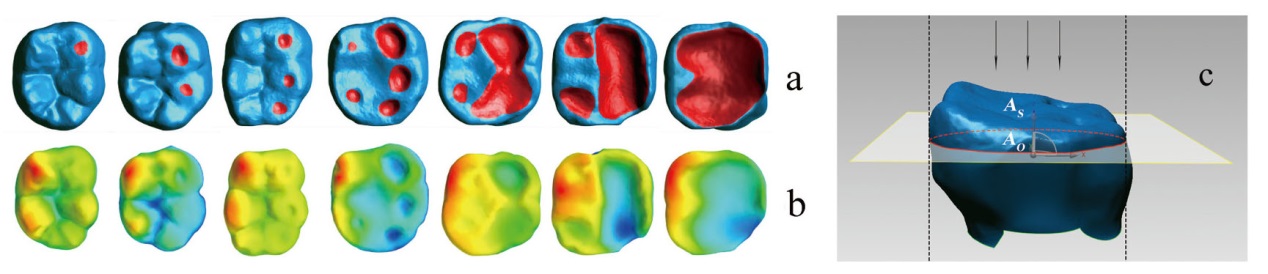
Subsequently, an integrated approach involving high-precision dental model fabrication, three-dimensional laser scanning, and computer-aided analysis software was employed to systematically analyze and collect crown surface area and outline projection area data for 3D occlusal topography reconstruction. Three-dimensional wear index (IWS) and occlusal surface index (IOS) were calculated to quantify crown wear severity for comparative analysis. The results revealed that the Dunping people had lower IWS and IOS values. This indicates a distinct wear pattern with limited dentine exposure, reduced cuspal attrition, and preserved occlusal topography that had not yet reached the planarization stage, which is consistent with light occlusal wear. These findings are in line with previous dental wear grade assessments showing lower molar attrition levels in this people.
In addition, dental microwear analysis was carried out using extended depth - of - field electron microscopy, with intergroup comparisons based on striation length ratios at different angles on the buccal surfaces. Principal component analysis showed that the Lh/Lv index (104.73%) of the Dunping group was closer to that of the pastoralist Jiayi group. This suggests that, compared with agricultural peoples, the Dunping group had relatively lower proportions of plant - derived components in their dietary composition. This quantitative pattern implies potential subsistence strategies with mixed dietary sources and significant consumption of animal products.
In conclusion, the integrated research findings show that the Dunping people has distinct dental wear characteristics: relatively low molar attrition levels, greater anterior tooth wear than posterior teeth, obvious anterior dental abrasion, shallow occlusal grooves in molars, and a predominance of vertically oriented buccal microwear striations. This pattern suggests a protein-rich dietary profile mainly composed of animal products. Archaeological evidence from Eastern Zhou period burials at the Dunping cemetery supports this interpretation. The mortuary assemblage shows little evidence of agricultural features but reveals extensive use of animal remains, such as cattle, horses, and sheep, as sacrificial offerings. These findings support the conclusion that the subsistence economy was mainly based on pastoralism with minimal agricultural integration. The dietary structure likely emphasized animal - derived nutrition, which is consistent with the observed dental wear signatures indicating less mastication of fibrous plant materials and more processing of softer, meat-based foods.
Key words: Dunping cemetery; Eastern Zhou Dynasty; dental wear; dietary
| [1] | Schmidt C, Watson J. Dental Wear in Evolutionary and Biocultural Contexts[M]. San Diego: Elsevier Academic Press, 2020, 1-10 |
| [2] | Berthaume M, Schroer K. Extant ape dental topography and its implications for reconstructing the emergence of early Homo[J]. Journal of Human Evolution, 2017, 112: 15-29 |
| [3] | Molnar S. Sex, age, and tooth position as factors in the production of tooth wear[J]. American Antiquity, 1971, 2: 182-188 |
| [4] | Scott E. Dental wear scoring technique[J]. American Journal of Physical Anthropology, 1979, 51: 213-218 |
| [5] | Brothwell D. Digging up Bones[M]. Ithaca: Cornell University Press, 1981 |
| [6] | Smith H. Patterns of molar wear in hunger-gatherers and agriculturalists[J]. American Journal of Physical Anthropology, 1984, 1: 39-56 |
| [7] | 吴汝康, 柏蕙英. 华北人颅骨臼齿磨耗的年龄变化[J]. 古脊椎动物与古人类, 1965, 2: 217-222 |
| [8] | 刘武, 张全超, 吴秀杰, 等. 新疆及内蒙古地区青铜:铁器时代居民牙齿磨耗及健康状况的分析[J]. 人类学学报, 2005, 1: 32-53 |
| [9] | 周蜜, 潘雷, 邢松, 等. 湖北郧县青龙泉新石器时代居民牙齿磨耗及健康状况[J]. 人类学学报, 2013, 3: 330-344 |
| [10] | 张全超, 张雯欣, 王龙, 等. 新疆吐鲁番加依墓地青铜:早期铁器时代居民牙齿的磨耗[J]. 人类学学报, 2017, 4: 438-456 |
| [11] | 张雯欣. 新疆吐鲁番加依墓地青铜:早期铁器时代居民牙齿磨耗研究[D]. 硕士研究生毕业论文, 长春: 吉林大学, 2018 |
| [12] | 邓婉文. 军都山古代人群牙齿磨耗及其饮食[J]. 人类学学报, 2018, 1: 29-40 |
| [13] | 张雅军, 仝涛, 李林辉, 等. 西藏故如甲木墓地人群牙齿磨耗和食物结构的关系[J]. 人类学学报, 2019, 1: 107-118 |
| [14] | 周亚威, 张晓冉, 顾万发. 郑州汪沟遗址仰韶文化居民的牙齿磨耗及口腔健康状况[J]. 人类学学报, 2021, 1: 49-62 |
| [15] | 陈峰, 曾雨欣, 付昶, 等. 新疆且末扎滚鲁克墓地二期居民的牙齿磨耗[J]. 人类学学报, 2024, 2: 273-286 |
| [16] | Pérez-Pérez A, Lalueza C, Turbón D. Intraindividual and intragroup variability of buccal tooth striation pattern[J]. American Journal of Physical Anthropology, 1994, 2: 175-187 |
| [17] | 张群, 周蜜, 张全超. 曾侯乙墓出土人骨的牙齿微磨耗形态研究[J]. 江汉考古, 2017, 6: 109-114 |
| [18] | 张全超, 韩涛, 张群. 新疆鄯善洋海墓地出土人骨的牙齿微磨耗痕迹研究[J]. 西域研究, 2018, 3: 83-88+145-146 |
| [19] | Lalueza C, Péréz-Perez A, Turbón D. Dietary inferences through buccal microwear analysis of middle and upper Pleistocene human fossils[J]. American Journal of Physical Anthropology, 1996, 3: 367-387 |
| [20] | Carrascal S, Estebaranz-Sánchez F, Dyowe-Roig A, et al. Evaluating a dentin exposure proxy for wear rates estimations on mesolithic and neolithic populations from the near East and the Iberian Peninsula: A comparative analysis[J]. Journal of Archaeological Science: Reports, 2025, 61: 104936 |
| [21] | Yang S, Martínez L, Romero A, et al. Rethinking wear rate analysis: a new dentin exposure proxy and its applications to ancient Chinese populations[J]. Journal Archaeological of Method and Theory, 2024, 4: 2053-2081 |
| [22] | 甘肃省文物考古研究所. 甘肃漳县墩坪墓地2014年发掘简报[J]. 考古, 2017, 8: 34-51+2 |
| [23] | 甘肃省文物考古研究所, 漳县文物管理所. 甘肃漳县墩坪墓地2015年发掘简报[J]. 文物, 2019, 3: 19-37+2+1 |
| [24] | 杨月光, 毛瑞林. 甘肃漳县墩坪遗址发现春秋战国戎人墓地[N]. 中国文物报,2015-06-19(008) |
| [25] | 杨诗雨. 甘肃漳县墩坪墓地东周时期人骨研究[D]. 博士研究生毕业论文, 长春: 吉林大学, 2023 |
| [26] | 肖晓鸣. 吉林大安后套木嘎遗址人骨研究[D]. 博士研究生毕业论文, 长春: 吉林大学, 2014 |
| [27] | 高云逸. 中国东北地区公元前三千年前的文化演进与社会发展[D]. 博士研究生毕业论文, 长春: 吉林大学, 2021 |
| [28] | Kunikita D, Wang L, Onuki S, et al. Radiocarbon dating and dietary reconstruction of the early Neolithic Houtaomuga and Shuangta sites in the Song-Nen Plain, Northeast China[J]. Quaternary International, 2017, 441: 62-68 |
| [29] | 熊增珑, 樊圣英. 辽宁朝阳半拉山墓地考古发掘取得重大收获[N]. 中国文物报,2016-12-30(005) |
| [30] | 张全超, 张群, 韩涛. 辽宁省朝阳市半拉山墓地出土人骨的稳定同位素分析[J].见:辽宁省文物考古研究所,朝阳市龙城区博物馆.辽宁朝阳市半拉山红山文化墓地的发掘(附录)[J]. 考古, 2017, 2: 3-34+2 |
| [31] | 吐鲁番学研究院, 新疆文物考古研究所. 吐鲁番加依墓地发掘简报[J]. 吐鲁番学研究, 2014, 1: 1-19+157-161 |
| [32] | 王安琦. 新疆吐鲁番加依墓地青铜:早期铁器时代人骨研究[D]. 博士研究生毕业论文, 长春: 吉林大学, 2022 |
| [33] | 邵象清. 人体测量手册[M]. 上海: 上海辞书出版社, 1985 |
| [34] | 朱泓. 体质人类学[M]. 北京: 高等教育出版社, 2004 |
| [35] | White T, Folkens P. The Human Bone Manual[M]. San Diego: Elsevier Academic Press, 2005 |
| [36] | Smith B. Patterns of molar wear in hunger-gatherers and agriculturalists[J]. American Journal of Physical Anthropology, 1984, 1: 39-56 |
| [37] | Ungar P. Dental microwear of european miocene catarrhines: evidence for diets and tooth use[J]. Journal of Human Evolution, 1996, 1: 335-366 |
| [38] | Ungar P, Spencer M. Incisor Microwear, Diet, and Tooth Use in Three Amerindian Populations[J]. American Journal of Physical Anthropology, 1999, 3: 387-396 |
| [39] | Teaford M, Oyen O. Live Primates and Dental Replication: New Problems and New Techniques[J]. American Journal of Physical Anthropology, 1989, 1: 73-81 |
| [40] | 杨诗雨, Pérez-Pérez A. 体质人类学中的高精度牙齿模型制作技术[J]. 大众考古, 2023, 1: 56-59 |
| [41] | Romero A, Ramírez-Rozzi F, Cuesta-Torralvo E, et al. Age-related Tooth Wear in African Rainforest Hunter-gatherers[J]. American Journal of Physical Anthropology, 2019(4): 622-628 |
| [42] | Romero A, Galbany J, De Juan J, et al. Brief Communication: Short- and long-term in Vivo Human Buccal-dental Microwear Turnover[J]. American Journal of Physical Anthropology, 2012(3): 467-472 |
| [43] | 张全超, 李墨岑, 张群, 等. 内蒙古哈民忙哈遗址史前居民牙齿微磨耗形态观察与研究[A].见:教育部人文社会科学重点研究基地,吉林大学边疆考古研究中心,边疆考古与中国文化认同协同创新中心. 边疆考古研究(第22辑)[M]. 北京: 科学出版社, 2018, 357-366 |
| [44] | 刘武, 武仙竹, 吴秀杰, 等. 人类牙齿表面痕迹与人类生存适应及行为特征:湖北郧西黄龙洞更新世晚期人类牙齿使用痕迹[J]. 第四纪研究, 2008, 6: 1014-1022 |
| [45] | 上海辞书出版社(编). 辞海[M]. 上海: 上海辞书出版社, 2020 |
| [46] | [清]王先慎. 韩非子集解[M]. 北京: 中华书局, 1998, 72 |
| [47] | 陈相龙. 从家畜饲养方式看距今4000年前后中原与甘青地区生业经济的分化[J]. 早期中国研究, 2018, 91-110 |
| [48] | 张寅. 两周时期西戎族群生业模式的转变[J]. 北方文物, 2019, 2: 30-35 |
| [49] | 马强. 北方草原游牧文化经济形态的转变及原因:基于宁夏考古材料的分析[J]. 华夏考古, 2018, 3: 57-61 |
/
| 〈 |
|
〉 |
 京ICP证05002819号-3