


华龙洞古人类化石及其在人类演化上的意义
收稿日期: 2025-03-07
修回日期: 2025-04-01
网络出版日期: 2025-10-13
基金资助
国家自然科学基金(42472006);国家自然科学基金(42372001)
The hominin fossils from Hualongdong and their significance on human evolution
Received date: 2025-03-07
Revised date: 2025-04-01
Online published: 2025-10-13
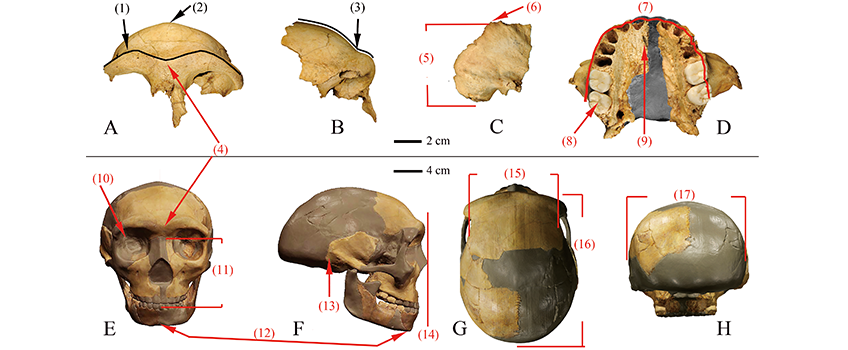
2014年以来,对华龙洞遗址的发掘和剖面清理发现了50余件古人类化石(包括1件较为完整的头骨)以及古人类制作的石器等古人类生存活动证据。研究发现,华龙洞人类头骨、下颌骨、牙齿以及肢骨呈现与东亚中更新世直立人、更新世晚期人类及现代人分别相似的一些混合特征。华龙洞人头骨具有一系列与周口店等东亚更新世中期直立人相似的原始特征,包括略低矮的颅穹窿、额骨矢状脊、发达的眶上圆枕,以及相对小的颅容量等。同时,华龙洞人头骨、面骨、下颌骨和牙齿化石还呈现出一些与更新世晚期人类及现代人相似的特征,表现为头骨较薄,上面部扁平、颅穹窿部圆隆和面部形态纤细、下颌骨联合接近垂直并出现颏三角雏形、牙齿结构简单及尺寸较小等。这些研究发现提示,30万年前的华龙洞人已经出现向现代人演化过渡的趋势,是东亚地区迄今发现的年代最早、包含现代人特征最多的中更新世古人类。华龙洞人类化石的发现和研究为东亚中更新世晚期人类演化多样性提供了新的证据。
刘武 , 吴秀杰 . 华龙洞古人类化石及其在人类演化上的意义[J]. 人类学学报, 2025 , 44(05) : 727 -741 . DOI: 10.16359/j.1000-3193/AAS.2025.0065
Starting in 2014, ten years field work of excavations and deposit cleaning at the Hualongdong site, Dongzhi County, Anhui Province have resulted in more than fifty pieces of hominin fossils (including one well preserved skull), and stone tools and other evidence of hominin activities. Through fauna composition analysis and isotope dating, the hominin fossils were dated to about 300 ka. With these findings, the Hualongdong has been ranked as the most abundant hominin fossils and stone tool sites of Middle Pleistocene with Zhoukoudian. For the past ten years, a series of research with hominin fossils of cranium, facial bones, mandible, limb bones and teeth from Hualongdong have been conducted. Some new discoveries and understandings have been achieved from these studies. Our studies indicate the morphological traits of cranium, facial bones, mandible, limb bones and teeth from Hualongdong exhibit mosaics with combinations of East Asian Middle Pleistocene Homo erectus, Late Pleistocene hominin and modern human patterns. The cranium of Hualongdong has a suit of archaic features resembling those of East Asian Homo erectus, including low cranial vault, frontal keel, pronounced supraorbital torus, low position of maximum cranial breadth, slopping nasal floor and relatively small cranial capacity. Moreover, the cranium, facial bones, mandible and teeth show some derived features linking with Later Pleistocene hominins and modern humans. The modern human features in the Hualongdong hominin fossils include thin cranial wall, flat and gracile face, nearly vertical mandible symphysis, occurrence of initial mandibular trigon, and small and simple morphology teeth.
The hominin fossils discovered from the Hualongdong site were regarded as the one population living in the same time from 270~330 ka. During the studies of the hominin fossils, we noticed some variabilities in the expressions of some morphological features. The lower second molar and the frontal bone discovered in 2006 exhibit a suit of feature patterns that are usually found in East Asian Homo erectus. The frontal bone shows a robust temporal line and thick cranial wall. Besides, the frontal bone has a metopic suture and enlarged frontal sinus. The occlusal surface of the molar has cusp 5, cusp 6 and cusp 7 plus complicated occlusal morphological pattern. Crown dimensions are within variations of Homo erectus and much larger than those of early modern human, contemporary human and European Middle Pleistocene humans. With these feature patterns, we proposed they may represent Homo erectus living during the Middle Pleistocene. In addition, the three pieces of Hualongdong femurs exhibit mosaic patterns with resemblance to Middle Pleistocene archaic hominins and Late Pleistocene early modern humans respectively, including lacking a pilaster, subtrochanteric pieces similar to Middle Pleistocene, and a prominent gluteal buttress and a small third trochanter resembling to many Upper Paleolithic hominins.
These morphological patterns suggest that the 300 ka Hualongdong hominin fossils already exhibit the evolutionary trend towards the modern humans, and the Hualongdong hominins are the earliest Middle Pleistocene hominins in East Asia with most modern human features. The discoveries and related studies of Hualongdong hominin fossils provide new evidence for the hominin evolutionary diversities of East Asian late Middle Pleistocene.
| [1] | Wu XJ, Pei SW, Cai YJ, et al. Archaic human remains from Hualongdong, China, and Middle Pleistocene human continuity and variation[J]. PNAS, 2019, 116: 9820-9824 |
| [2] | Wu XJ, Pei SW, Cai YJ, et al. Morphological description and evolutionary significance of 300 ka hominin facial bones from Hualongdong, China[J]. Journal of Human Evolution, 2021, 161: 103052 |
| [3] | Wu XJ, Pei SW, Cai YJ, et al. Morphological and morphometric analyses of a late Middle Pleistocene hominin mandible from Hualongdong, China[J]. Journal of Human Evolution, 2023, 182: 103411 |
| [4] | Xing S, Wu XJ, Liu W, et al. Middle Pleistocene human femoral diaphyses from Hualongdongdong, Anhui Province, China[J]. American Journal of Physical Anthropology, 2020, 174: 285-298 |
| [5] | Weidenreich F. The Skull of Sinanthropus pekinensis: A Comparative Study of A Primitive Hominid Skull[M]. Palaeontologica Sinica N.S. D10, 1943, 1-484 |
| [6] | 吴汝康, 董兴仁. 安徽和县猿人化石的初步研究[J]. 人类学学报, 1982, 1: 2-102 |
| [7] | 吴汝康, 张银运, 吴新智.南京直立人1号头骨[A].见:吴汝康,李星学,吴新智,等(编). 南京直立人[C]. 南京: 江苏科学技术出版社, 2002, 35-67 |
| [8] | 吴新智. 大荔中更新世人类颅骨[M]. 北京: 科学出版社, 2020, 1-205 |
| [9] | Li ZY, Wu XJ, Zhou LP, et al. Late Pleistocene archaic human crania from Xuchang, China[J]. Science, 2017, 355: 969-972 |
| [10] | Ni XJ, Ji Q, Wu WS, et al. Massive cranium from Harbin in northeastern China establishes a new Middle Pleistocene human lineage[J]. The Innovation, 2021, 2: 100130 |
| [11] | Aiello L and Dean C. Human Evolutionary Anatomy[M]. London: Academic Press, 1990, 1-596 |
| [12] | 刘武, 何嘉宁, 吴秀杰. 中国更新世人类头骨梨状孔区域形态变异[J]. 人类学学报, 2025, DOI:10.16359/j.1000-3193/AAS.2025.0001 |
| [13] | Wu XJ Maddx S, Pan L, et al. Nasal floor variation among eastern Eurasian Pleistocene Homo[J]. Anthropological Science, 2012, 120: 217-226 |
| [14] | White T, Asfaw B, DeGusta D, et al. Pleistocene Homo sapiens from Middle Awash, Ethiopia[J]. Nature, 2003, 423: 742-747 |
| [15] | Hublin JJ, Ben-Ncer A, Bailey S, et al. New fossils from Jebel Irhoud, Morocco and the pan-African origin of Homo sapiens[J]. Nature, 2017, 546: 289-292 |
| [16] | Hershkovitz I, Weber G, Quam R, et al. The earliest modern humans outside Africa[J]. Science, 2018, 359: 456-459 |
| [17] | 刘武, 惠家明, 何嘉宁, 等. 门齿孔位置在中国古人类化石与现代人群的表现及其演化意义[J]. 人类学学报, 2021, 40(5): 739-750 |
| [18] | Dobson SD, Trinkaus E. Cross-sectional geometry and morphology of the mandibular symphysis in Middle and Late Pleistocene Homo[J]. Journal of Human Evolution, 2002, 43: 67-87 |
| [19] | Chang CH, Kaifu Y, Takai M, et al. The first archaic Homo from Taiwan[J]. Nature Communication, 2015, 6: 6037 |
| [20] | Chen FH, Welker F, Shen CC, et al. A late Middle Pleistocene Denisovan mandible from the Tibetan plateau[J]. Nature, 2019, 569: 409-412 |
| [21] | Shang H, Tong HW, Zhang SQ, et al. An early modern human from Tianyuan Cave, Zhoukoudian, China[J]. PNAS, 2007, 104: 6573-6578 |
| [22] | Liu W, Jin CZ, Zhang YQ, et al. Human remains from Zhirendong, South China, and modern human emergence in East Asia[J]. PNAS, 2010, 107: 19201-19206 |
| [23] | Wu Liu, María Martinón-Torres, Yousuke Kaifu, et al. A mandible from the Middle Pleistocene Hexian site and its significance in relation to the variability of Asian Homo erectus[J]. American Journal of Physical Anthropology, 2017, 162: 715-731 |
| [24] | Wu XJ, Trinkaus E. The Xujiayao 14 mandibular ramus and Pleistocene Homo mandibular variation. Comptes Rendus Palevol[J]. 2014, 13: 333-341 |
| [25] | Weidenreich F. The mandible of Sinanthropus pekinensis: A comparative study[M]. Palaeontologica Sinica N.S. D7, 1936, 1-132 |
| [26] | Richards GD, Jabbour RS, Anderson JY. Medial mandibular ramus. Ontogenetic, idiosyncratic, and geographic variation in recent Homo, great apes and fossil hominids[M]. Br. Archaeol. Rep. 2003, S1138, 1-113 |
| [27] | Bermúdez de Castro JM, Quam R, Martinon-Torres M, et al. The medial pterygoid tubercle in the Atapuerca Early and Middle Pleistocene mandibles: Evolutionary implications[J]. American Journal of Physical Anthropology, 2015,156: 102-109 |
| [28] | Wu XJ, Martinón-Torres M, Xing S, et al. The hominin teeth from the late Middle Pleistocene Hualongdong site, China[J]. Journal of Human Evolution, 2025, 206:103727 |
| [29] | Bermúdez de Castro JM, Martinón-Torres M, Lozano M, et al. Paleodemography of the Atapuerca: Sima De Los Huesos Hominin Sample: A Revision and New Approaches to the Paleodemography of the European Middle Pleistocene Population[J]. Journal of Anthropological Research, 2004, 60: 5-26 |
| [30] | Skov L, Peyrégne S, Popli D, et al. Genetic insights into the social organization of Neanderthals[J]. Nature, 2022, 610: 519-525 |
| [31] | 吴新智. 从中国晚期智人颅牙特征看中国现代人的起源[J]. 人类学学报, 1998, 17: 276-282 |
| [32] | 吴新智. 中国古人类进化连续性新辩[J]. 人类学学报, 2006, 25: 17-25 |
| [33] | 宫希成, 郑龙亭, 邢松, 等. 安徽东至华龙洞出土的人类化石[J]. 人类学学报, 2014, 33: 427-436 |
| [34] | 蔡演军, 裴树文. 华龙洞6号头骨的年代测定[J]. 人类学学报, 2025, 44(5): 742-753 |
| [35] | 同号文, 江左其杲, 李强, 等. 安徽东至华龙洞哺乳动物化石新材料[J]. 人类学学报, 2025, 44(5): 779-798 |
| [36] | Delson E. An early dispersal of modern humans from Africa to Greece[J]. Nature, 2019, 571: 487-488 |
| [37] | Lahr M. The complex landscape of recent human evolution[J]. Science, 2021, 372: 1395-1396 |
| [38] | Roksandic M, Radovic P, Wu XJ, et al. Resolving the “muddle in the middle”: The case for Homo bodoensis sp. nov.[J]. Evolutionary Anthropology, 2022, 31: 20-29 |
| [39] | Bae C, Aiello L, Hawks J, et al. Moving away from “the Muddle in the Middle” toward solving the Chibanian puzzle[J]. Evolutionary Anthropology, 2023, 33: e22011 |
| [40] | Rightmire GP. Human evolution in the Middle Pleistocene: the role of Homo heidelbergensis[J]. Evolutionary Anthropology, 1998, 6: 218-227 |
| [41] | Rightmire GP. Homo in the Middle Pleistocene: Hypodigms, variation and species recognition[J]. Evolutionary Anthropology, 2008, 17: 8-21 |
| [42] | Reich D, Green RE, Kircher M, et al. Genetic history of an archaic hominin group from Denisova Cave in Siberia[J]. Nature, 2010, 468:1053-1060 |
| [43] | Wu XJ, Bae CJ, Friess M, et al. Evolution of cranial capacity revisited: A view from the late Middle Pleistocene cranium from Xujiayao, China[J]. Journal of Human Evolution, 2022, 163: 103119 |
| [44] | Wu XJ, Bae CJ. Xujiayao Homo: A new form of large brained hominin in Eastern Asia[J]. PaleoAnthropology, 2024, https://paleoanthropology.org/ojs/index.php/paleo/libraryFiles/downloadPublic/18 |
| [45] | 刘武, 吴秀杰. 中更新世晚期中国古人类化石的形态多样性及其演化意义[J]. 人类学学报, 2022, 41(4): 563-575 |
| [46] | Liu W, Schepartz L, Xing S, et al. Late Middle Pleistocene hominin teeth from Panxian Dadong, South China[J]. Journal of Human Evolution, 2013, 64: 337-355 |
/
| 〈 |
|
〉 |
 京ICP证05002819号-3