


华龙洞遗址发现的石制品及人类行为
收稿日期: 2025-04-07
修回日期: 2025-05-23
网络出版日期: 2025-10-13
基金资助
国家自然科学基金项目(42472006);国家自然科学基金项目(42371165)
Lithic assemblage and adaptive behaviors of hominins at Hualongdong site
Received date: 2025-04-07
Revised date: 2025-05-23
Online published: 2025-10-13
华龙洞遗址发现距今30万年前东亚地区向智人(现代人)演化的最早古人类及相关石制品与动物化石。本文首次对遗址发现的石制品进行报道,尝试揭示华龙洞人的技术与行为特点。古人类选取遗址周边的基岩露头岩块和溪流河滩内的砾石制作石制品,石英是主要原料,燧石、火山岩、灰岩和石英岩也被用来剥片和加工石器。古人类对燧石、火山岩和相对优质的石英岩块多采用锤击法剥片,而个体较小的砾石和劣质的石英岩块则采取砸击法。石核剥片相对简单,对原料的利用率较低;石片个体变异较大,多为初级剥片产品。石器修理为锤击法,刮削器是主要类型。初步观察表明,优质燧石产品边缘保存使用痕迹,与动物骨骼表面人工痕迹印证古人类在遗址进行过肢解动物骨骼的行为。华龙洞石制品制作流程相对较短,古人类熟练掌握模式1(石核-石片)技术体系,具备依据不同原料的特点采取砸击法-锤击法并用的技术策略,石制品组合指示以功能为诉求的技术特色。对石制品功能和动物考古的进一步分析,将有望揭示华龙洞人的灵活多样性适应行为,对探明东亚最早现代人特征出现时期的技术与行为方式具有重要意义。
裴树文 , 董哲 , 耿帅杰 , 叶芷 , 马东东 , 张亚盟 , 金泽田 . 华龙洞遗址发现的石制品及人类行为[J]. 人类学学报, 2025 , 44(05) : 765 -778 . DOI: 10.16359/j.1000-3193/AAS.2025.0070
The Hualongdong (HLD) site (latitude 30°06′34.1′′N, longitude 116°56′54.2′′E, 40 m above sea level) is located in Dongzhi County, Anhui Province, China. It was initially discovered in 1988, the excavations at the site in 2006, and from 2014 to 2024 resulted in the discovery of more than 20 individual human fossils, an abundance of lithic artifacts and mammalian fauna. The original cave deposits was about 20 m higher above its current location. Synsedimentary dismantlement, downward slippage, and bedrock weathering are indicated by the brecciated arrangement of the limestone rock blocks, cemented angular, subangular clasts and archaeological remains within the excavation area. Uranium-Thorium dating of speleothems and animal teeth from the brecciated deposits indicated that early human occupied the site most probably took place in the late Middle Pleistocene, ca. 300 ka (270~330 ka). This paper presents the lithic technology and the adapted behaviors adopted by humans at the site.
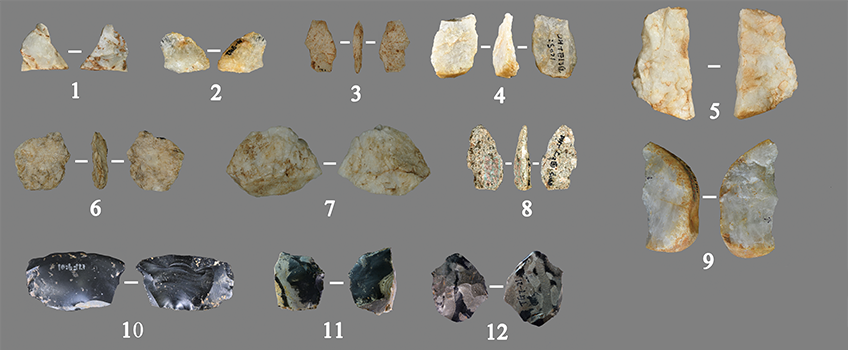
The Hualongdong lithic assemblage consists of 322 artifacts which can be divided into Detatched pieces [flakes (N=79; 24.6%), debitage shatters (N=96; 29.8%), bipolar elements (N=45; 14.0%)], Flaked pieces [cores (N=65, 20.2%), core fragments (N=4; 0.3%), bipolar cores (N=2; 0.6%), retouched pieces (N=22; 6.8%)] and Pounded pieces (8 hammerstones and 1 anvil). Lithic raw material includes quartz/quartzite and lava show fluvial cortex and suggests sourcing from streams, while chert nodules and some quartz rock block derive from the outcrop of chert and quartz -bearing bed in bands within siliceous carbonate-clastic strata formation in the surrounding landscape. Quartz is the predominant (87.9%) rock type. Technologically, cores, debitage shatter, and bipolar elements from HLD indicate that freehand percussion was the major knapping technique, while the use of hammer-and-anvil technique is the complementary technique to knap cobble and low-quality quartz. HLD reduction sequences are relatively short, non-organized and without core preparation, resulting in a low degree of standardization in flake morphologies and dimensions. Albeit scarce, retouched pieces are present in HLD lithic assemblage, with an average proportion of 6.8%. Retouch is normally on flakes or flake fragments even cobbles. Scraper dominants the tool type, followed by chopper, denticulate, notch and point. Retouch is casual in HLD assemblages, with no imposition of standardized shapes on blanks. The HLD lithic assemblage can be assigned to Oldowan-like or Mode 1 technology in east Asia as characterized by a simple technological design, low degree of standardization, expedient flaking, and a few non-standardized retouched flakes.
All in all, the HLD core and flake technology includes bipolar flaking of low-quality quartz rock block and cobbles, and freehand flaking of chert, lava and quartz block fragments, which demonstrate knappers intentionally selected good-quality raw materials to manufacture small flakes and use them for some function. Most chert and relatively good quality of quartz flakes show use wear, probably associated with carcass processing given the presence of cutmarks on some bones. Furthermore, it can be inferred that the general feature of HLD toolkits were expediently made for the function of getting food from animal resources and the knapping strategy was adapted to the local resources in the HLD archaeological landscape.
| [1] | 宫希成, 郑龙亭, 邢松, 等. 安徽东至华龙洞出土的人类化石[J]. 人类学学报, 2014, 33(4): 427-436 |
| [2] | 陈胜前, 罗虎. 安徽东至县华龙洞旧石器时代遗址发掘简报[J]. 考古, 2013, 4: 7-13 |
| [3] | 裴树文, 蔡演军, 董哲, 等. 安徽东至华龙洞遗址洞穴演化与古人类活动[J]. 人类学学报, 2022, 41(4): 593-607 |
| [4] | Wu XJ, Pei SW, Cai YJ, et al. Archaic human remains from Hualongdong, China, and Middle Pleistocene human continuity and variation[J]. PNAS, 2019, 116: 9820-9824 |
| [5] | 蔡演军, 裴树文, 金泽田. 安徽东至华龙洞遗址沉积演化过程及其年代[J]. 人类学学报, 2025, 44(5): 742-753 |
| [6] | Wu XJ, Pei SW, Cai YJ, et al. Morphological description and evolutionary significance of 300 ka hominin facial bones from Hualongdong, China[J]. Journal of Human Evolution, 2021, 161: 103052 |
| [7] | Wu XJ, Pei SW, Cai YJ, et al. Morphological and morphometric analyses of a late Middle Pleistocene hominin mandible from Hualongdong, China[J]. Journal of Human Evolution, 2023, 182: 103411 |
| [8] | 裴树文.旧石器时代石制品室内观测项目探讨[A].见:董为(主编). 第十四届中国古脊椎动物学学术年会论文集[C]. 北京: 海洋出版社, 2014, 181-194 |
| [9] | de la Torre I. The Early Stone Age lithic assemblages of Gadeb (Ethiopia) and the Developed Oldowan / early Acheulean in East Africa[J]. Journal of Human Evolution, 2011, 60: 768-812 |
| [10] | de la Torre I, Mora R, 裴树文, 等. 旧石器时代早期石制品分析方案[J]. 人类学学报, 2021, 40(4): 547-567 |
| [11] | Toth N. The stone technologies of early hominids at Koobi Fora, Kenya: An experimental approach[D]. Ph.D. Thesis, Berkeley: University of California, 1982 |
| [12] | Toth N. The Oldowan reassessed: A close look at early stone artifacts[J]. Journal of Archaeological Science, 1985, 12: 101-120 |
| [13] | de la Torre I, Mora R, Domínguez-Rodrigo M, et al. The Oldowan industry of Peninj and its bearing on the reconstruction of the technological skills of Lower Pleistocene hominids[J]. Journal of Human Evolution, 2003, 44: 203-224 |
| [14] | 李潇丽, 董哲, 裴树文, 等. 安徽东至华龙洞洞穴发育与古人类生存环境[J]. 海洋地质与第四纪地质, 2017, 37(3): 169-179 |
| [15] | 安徽省地质矿产局. 1:5万中华人民共和国区域地质调查报告:香隅坂幅(H-50-66-D)、张溪镇幅(H-50-67-A)、东至县幅(H-50-66-C)区域地质调查报告(地质部分)[R]. 合肥: 安徽省地质矿产局, 1991,1-139 |
| [16] | de la Torre I, Mora R. Unmodified lithic material at Olduvai Bed I: manuports or ecofacts?[J]. Journal of Archaeological Science, 2005, 32: 273-285 |
| [17] | Pei S, Xie F, Deng C, et al. Early Pleistocene archaeological occurrences at the Feiliang site, and the archaeology of human origins in the Nihewan Basin, North China[J]. Plos One, 2017, 12(11): e0187251 |
| [18] | Knight J. Technological analysis of the anvil (bipolar) technique[J]. Lithics, 1991, 12: 57-87 |
| [19] | van Riet Lowe C. The Coastal Smithfield and bipolar technique[J]. South African Journal of Science, 1946, 42: 240-246 |
| [20] | Crabtree DE.An introduction to flint working[A].In: Idaho State University Museum(ed.). Occasional Papers of the Idaho State University Museum (No. 8)[C]. Pocatello, 1972 |
| [21] | 张森水.中国旧石器工业中的砸击技术[A].见:北京大学考古学系(编). 迎接二十一世纪的中国考古学国际学术研讨会论文集[C]. 北京: 科学出版社,1998: 51-74 |
| [22] | 林圣龙. 砸击技术和砸击制品:国外发现概况[J]. 人类学学报, 1987, 6(4): 352-361 |
| [23] | 陈淳. 两极法[J]. 人类学学报, 1998, 17(1): 73-80 |
| [24] | 马东东, 裴树文. 旧石器时代砸击法剥片技术相关问题探讨[J]. 人类学学报, 2019, 38(4): 584-597 |
| [25] | Shott MJ. Bipolar industries: ethnographic evidence and archaeological implications[J]. North American Archaeologist, 1989, 10(1): 1-24 |
| [26] | Barham LS. The bipolar technique in Southern Africa: A replication experiment[J]. The South African Archaeological Bulletin, 1987, 42(145): 45-50 |
| [27] | Goodyear AC. Tool kit entropy and bipolar reduction: A study of interassemblage lithic variability among Paleo-Indian sites in the Northeastern United States[J]. North American Archaeologist, 1993, 14(1): 1-23 |
| [28] | Gao X, Norton C J. A critique of the Chinese “Middle Palaeolithic”[J]. Antiquity, 2002, 76: 397-412 |
| [29] | 同号文, 吴秀杰, 董哲, 等. 安徽东至华龙洞古人类遗址哺乳动物化石的初步研究[J]. 人类学学报, 2018, 37(2): 284-305 |
| [30] | 同号文, 江左其杲, 李强, 等. 安徽东至华龙洞哺乳动物化石新材料[J]. 人类学学报, 2025, 44(5): 779-798 |
| [31] | Schick K, Toth N. Making Silent Stones Speak: Human Evolution and the Dawn of Technology[M]. New York: Simon & Schuster, 1993 |
| [32] | Xing S, Wu XJ, Liu W, et al. Middle Pleistocene human femoral diaphyses from Hualongdongdong, Anhui Province, China[J]. American Journal of Physical Anthropology, 2020, 174: 285-298 |
| [33] | 刘武, 吴秀杰. 华龙洞发现的古人类化石及其在人类演化上的意义[J]. 人类学学报, 2025, 44(5): 727-741 |
| [34] | Li H, Wang SJ, Lotter MG, et al. The temporal-spatial evolution of handaxe technology in China: Recent progress and future directions[J]. Science Bulletin, 2024, 69: 2161-2165 |
| [35] | Binford LR. Willow smoke and dog's tails: hunter-gatherer settlement systems and archaeological site formation[J]. American Antiquity, 1980, 45: 2-20 |
| [36] | Kuhn SL. Mousterian Lithic Technology: An Ecological Perspective[M]. Princeton: Princeton University Press, 1995 |
/
| 〈 |
|
〉 |
 京ICP证05002819号-3