


从大额牛牙齿看华龙洞人的狩猎行为
收稿日期: 2025-05-08
修回日期: 2025-08-11
网络出版日期: 2025-10-13
基金资助
国家重点研发计划(2023YFF0804502);国家自然科学基金(42372001);国家自然科学基金(42472006)
Hunting behavior of Hualongdong Hominid based on the teeth of gaur
Received date: 2025-05-08
Revised date: 2025-08-11
Online published: 2025-10-13
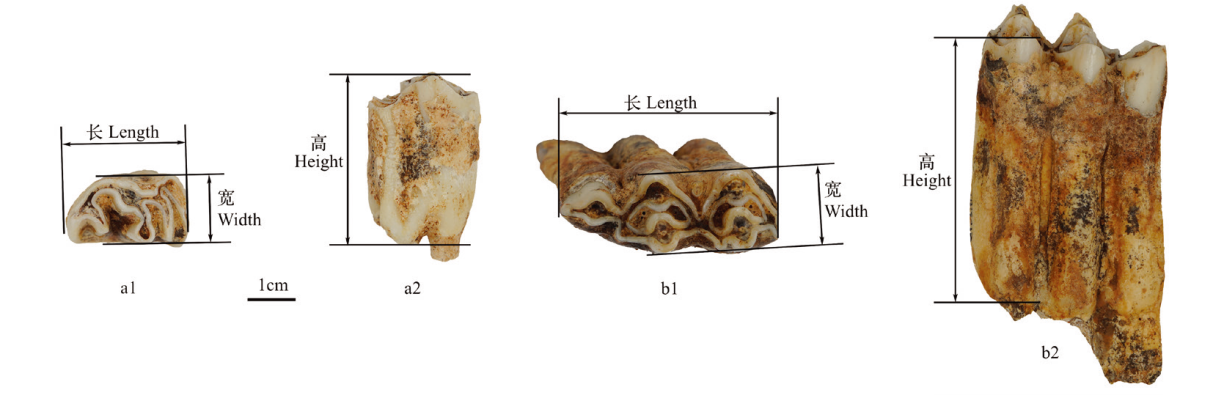
安徽省东至县华龙洞遗址出土了丰富的古人类化石及大量哺乳动物骨骼和牙齿。为探讨华龙洞人与这些哺乳动物之间的关系,本文对该遗址2014~2024年发掘出土的大额牛牙齿化石进行了研究。研究结果显示:1)已发掘出的大额牛牙齿有1205颗,包括门齿139颗(包含门齿化犬齿),残缺颊齿202颗和完整可测量颊齿864颗(乳齿69颗,恒齿795颗);2)最小个体数量为53例;3)牙齿的大小尺寸与白龙洞遗址出土的大额牛最接近;4)华龙洞大额牛的年龄结构为:幼年组占38%、壮年组占44%、老年组占18%;5)华龙洞大额牛的年龄结构对应灾难型死亡模式;6)华龙洞大额牛幼年个体比例偏高,这可能说明了华龙洞古人类采取了多种狩猎方式或者在繁殖季节狩猎了更多的幼年个体。本研究为探讨华龙洞人的狩猎行为提供了新证据。
刘博轩 , 刘驷统 , 金泽田 , 邓国栋 , 吴秀杰 . 从大额牛牙齿看华龙洞人的狩猎行为[J]. 人类学学报, 2025 , 44(05) : 862 -873 . DOI: 10.16359/j.1000-3193/AAS.2025.0076
The Hualongdong site in Dongzhi County, Anhui Province has yielded abundant hominin fossils along with numerous mammalian bones and teeth. Among the large mammal fossils unearthed at the site, cervid remains are the most common, followed by those of large bovids. To investigate the relationship between the Hualongdong hominins and these mammals, this study focuses on the gaur [Bos (Bibos) sp.] dental fossils excavated from the site between 2014 and 2024. The subgenus Bos (Bibos) represents an extinct group of the Bos (Bibos) sp., distinct from extant Bos frontalis. Fossils of these bovids are frequently found in Pleistocene cave sites in southern China, with a temporal range spanning from the Early to the Late Pleistocene. In this study, the dental sequence was first identified, and the tooth dimensions were measured and compared with those of bovids from other sites as well as extant gaur. Based on this analysis, the minimum number of individuals (MNI) was calculated. The age-at-death was estimated using crown height measurements, and age groups were classified to construct the mortality profile. The mortality pattern of the Hualongdong bovids was identified using a ternary diagram and its possible causes inferred through comparative analysis.
The results indicate that: 1) A total of 1,205 bovid teeth were unearthed, including 139 incisors (Including incisiform canines), 202 fragmented cheek teeth, and 864 complete and measurable cheek teeth (69 deciduous teeth and 795 permanent teeth); 2) The MNI was estimated at 53, based on the combination of 39 left M3s and 14 right DP3s; 3) The tooth dimensions of the Hualongdong bovids most closely resemble those of Bos (Bibos) gaurus from the Bailong Cave site; 4) Using a quadratic crown height equation for permanent teeth and a linear equation for deciduous teeth, the age distribution of the Hualongdong bovids was determined to be 38% juveniles, 44% prime adults, and 18% old adults; 5) The age profile plotted on a ternary diagram closely aligns with that of extant wild gaur and European bison, indicating a catastrophic mortality pattern; 6) The relatively high proportion of juveniles suggests that the Hualongdong hominins may have employed multiple hunting strategies, such as a combination of non-selective ambush and endurance hunting, or that they may have targeted more juvenile bovids during the breeding season.
Teeth are among the most well-preserved animal remains at archaeological sites and contain rich information about the animals themselves. By analyzing the dental fossils of large bovids from Hualongdong, this study reconstructs their mortality profile and provides new evidence for interpreting the hunting behavior of the Hualongdong hominins.
Key words: Hualongdong; Bos (Bibos) sp.; MNI; mortality profile; Middle Pleistocene
| [1] | Speth JD, Tchernov E.Neandertal hunting and meat-processing in the near East: Evidence from Kebara Cave (Israel)[A]. In: Stanford CB, Bunn HT(eds.). Meat-Eating and Human Evolution[C]. Oxford: Oxford University Press, 2001, 52-72 |
| [2] | Norton CJ, Gao X. Hominin-carnivore interactions during the Chinese Early Paleolithic: Taphonomic perspectives from Xujiayao[J]. J Hum Evol, 2008, 55: 164-178 |
| [3] | Li JS, Zhang SQ, Bunn HT, et al. A preliminary application of dental cementum incremental analysis to determine the season-of death of equids from the Xujiayao site, China[J]. Science China Earth Sciences, 2017, 60: 1183-1188 |
| [4] | 张双权, 李占扬, 张乐, 等. 河南灵井许昌人遗址大型食草类动物死亡年龄分析及东亚现代人类行为的早期出现[J]. 科学通报, 2009, 54: 2857-2863 |
| [5] | Klein RG. The Human Career (2nd edition)[M]. Chicago: University of Chicago Press, 1999, 840 |
| [6] | Lee R, Devore I.Problems in the study of hunters and gatherers[A]. In: Lee R, Devore I(eds). Man the Hunter[C]. Aldine Transaction, 2009, 3-12 |
| [7] | Wu XJ, Pei SW, Cai YJ, et al. Archaic human remains from Hualongdong, China, and Middle Pleistocene human continuity and variation[J]. Proceedings of the National Academy of Sciences the United States of America, 2019, 116: 9820-9824 |
| [8] | 同号文, 吴秀杰, 董哲, 等. 安徽东至华龙洞2014-2016出土哺乳动物化石初步研究[J]. 人类学学报, 2018, 36(2): 284-305 |
| [9] | 同号文, 江左其杲, 李强, 等. 安徽东至华龙洞哺乳动物化石新材料[J]. 人类学学报, 2025, 44(4): 779-798 |
| [10] | 常美静, 李强, 倪喜军, 等. 非飞行小哺乳动物化石反映的东至人生存环境[J]. 人类学学报, 2025, 44(4): 799-815 |
| [11] | 同号文, 张贝, 武仙竹, 等. 湖北郧西白龙洞中更新世古人类遗址的哺乳动物化石[J]. 人类学学报, 2019, 38(4): 613 |
| [12] | 王晓敏, 许春华, 同号文. 湖北郧西白龙洞古人类遗址的大额牛化石[J]. 人类学学报, 2015, 34(3): 338 |
| [13] | Colbert EH, Hooijer DA, Granger W. Pleistocene mammals from the limestone fissures of Szechwan, China[J]. Bulletin of the AMNH, 1953, 102 |
| [14] | 王晓敏. 湖北郧西白龙洞更新世大额牛Bos (Bibos) gaurus及其年龄结构研究[D].硕士学位毕业论文, 北京: 中国科学院大学, 2013, 1-83 |
| [15] | Von Den Driesch A. A guide to the measurement of animal bones from archaeological sites[M]. Cambridge, Massachusetts: Peabody museum press, 1976, 148 |
| [16] | Klein RG, Wolf C, Freeman LG, et al. The use of dental crown heights for constructing age profiles of red deer and similar species in archaeological samples[J]. Journal of Archaeological Science, 1981, 8(1): 1-31 |
| [17] | Klein RG. Stone Age predation on large African bovids[J]. Journal of Archaeological Science, 1978, 5(3): 195-217 |
| [18] | Gaastra JS. The Quadratic Crown Height Method and bovidae: Ageing sheep (Ovis aries), goats (Capra hircus) and cattle (Bos taurus)[J]. Journal of Archaeological Science: Reports, 2016, 10: 172-190 |
| [19] | Klein RG, Cruz-Uribe K. The computation of ungulate age (mortality) profiles from dental crown heights[J]. Paleobiology, 1983, 9(1): 70-78 |
| [20] | Pike-Tay A, Morcomb CA, O Farrell M. Reconsidering the quadratic crown height method of age estimation for Rangifer from archaeological sites[J]. Archaeozoologia, 2001, 11(1-2): 145-174 |
| [21] | Steele TE. Accuracy of age determinations from tooth crown heights: a test using an expanded sample of known age red deer (Cervus elaphus)[J]. Recent advances in ageing and sexing animal bones, 2006, 119: 119 |
| [22] | Klein RG. The calculation and interpretation of ungulate age profiles from dental crown heights[J]. Hunter-gatherer economy in prehistory: A European perspective, 1983, 47-57 |
| [23] | Ahrestani FS, Prins HHT. Age and sex determination of gaur Bos gaurus (Bovidae)[J]. Biology & Ecology of Mammals, 2011, 75(2): 151-155 |
| [24] | Crandall LS. The management of wild mammals in captivity[M]. Chicago (& London): University of Chicago Press, 1964, 761 |
| [25] | Ahrestani FS, Iyer S, HEITK?NIG IMA, et al. Life-history traits of gaur Bos gaurus: a first analysis[J]. Mammal Review, 2011, 41(1): 75-84 |
| [26] | W?grzyn M, Serwatka S. Bisoniana LXXXII. Teeth eruption in the European bison[J]. Acta Theriologica, 1984, 29(9): 111-121 |
| [27] | Jones GG, Sadler P. Age at death in cattle: methods, older cattle and known-age reference material[J]. Environmental Archaeology, 2012, 17(1): 11-28 |
| [28] | Gifford-Gonzalez D. Examining and refining the quadratic crown height method of age estimation[A]. In: Human predators and prey mortality[C]. London: Routledge, 2019, 41-78 |
| [29] | Grimsdell JJR. Age determination of the African buffalo, Syncerus caffer Sparrman[J]. African Journal of Ecology, 1973, 11(1): 31-53 |
| [30] | Poplin F. A propos du nombre de restes et du nombre d'individus dans les échantillons d'ossements[J]. Cahier du Centre de Recherche Préhistorique, 1976, 5: 61-74 |
| [31] | Caughley G. Mortality patterns in mammals[J]. Ecology, 1966, 47(6): 906-918 |
| [32] | Caughley G. Analysis of vertebrate populations[M]. London: Wiley, 1977, 234 |
| [33] | Klein RG. Age (mortality) profiles as a means of distinguishing hunted species from scavenged ones in Stone Age archeological sites[J]. Paleobiology, 1982, 8(2): 151-158 |
| [34] | Klein RG, Cruz-Uribe K. The bovids from Elandsfontein, South Africa, and their implications for the age, palaeoenvironment, and origins of the site[J]. African Archaeological Review, 1991, 9(1): 21-79 |
| [35] | Stiner MC.An interspecific perspective on the emergence of the modern human predatory niche[A]. In: Stiner MC(ed). Human predators and prey mortality[C]. London: Routledge, 2019, 149-185 |
| [36] | Stiner MC. Honor among Thieves[M]. Princeton, NJ: Princeton University Press, 1994, 448 |
| [37] | Klein RG, Cruz-Uribe K. The analysis of animal bones from archeological sites[M]. Chicago: University of Chicago press, 1984, 273 |
| [38] | Stiner MC. The use of mortality patterns in archaeological studies of hominid predatory adaptations[J]. Journal of anthropological archaeology, 1990, 9(4): 305-351 |
| [39] | Discamps E, Costamagno S. Improving mortality profile analysis in zooarchaeology: a revised zoning for ternary diagrams[J]. Journal of Archaeological Science, 2015, 58: 62-76 |
| [40] | 董为, 金昌柱, 王元, 等. 广西崇左三合大洞的早更新世猪属新材料[J]. 人类学学报, 2013, 32(1): 63-76 |
| [41] | 韩德芬.广西柳城巨猿洞偶蹄目化石[A].见:中国科学院古脊椎动物与古人类研究所(编). 中国科学院古脊椎动物与古人类研究所集刊[C]. 北京: 科学出版社, 1987, 18: 135-208 |
| [42] | 黄万波, 方其仁. 巫山猿人遗址[M]. 北京: 海洋出版社,1991 |
| [43] | 宗冠福. 四川盐源盆地哺乳类化石及其意义[J]. 古脊椎动物学报, 1987, 25(2): 137-145 |
| [44] | Hooijer DA. Fossil Bovidae from the Malay archipelago and the Punjab[J]. Zoologische verhandelingen, 1958, 38(1): 1-112 |
| [45] | Spinage CA. African ungulate life tables[J]. Ecology, 1972, 53(4): 645-652 |
| [46] | Krasiński ZA. Bisoniana LXVII. Dynamics and structure of the European bison population in the Bia?owie?a Primeval Forest[J]. Acta Theriologica, 1978, 23(1): 3-48 |
| [47] | Schaller GB. The Serengeti lion: a study of predator-prey relations[M]. Chicago: University of Chicago press, 2009 |
| [48] | Spinage CA. Geratodontology and horn growth of the impala (Aepyceros melampus)[J]. Journal of Zoology, 1971, 164(2): 209-225 |
/
| 〈 |
|
〉 |
 京ICP证05002819号-3