


安徽华龙洞熊科动物的稳定同位素古生态
收稿日期: 2025-03-26
修回日期: 2025-06-03
网络出版日期: 2025-10-13
基金资助
国家重点研发计划项目(2023YFF0804501);国家自然科学基金(42002005);中科院青年创新促进会项目(2022070);中国科学院南京地质古生物研究所现代古生物学和地层学国家重点实验室开放课题(223119)
Isotopic paleoecology of Ursidae from Hualongdong, Anhui
Received date: 2025-03-26
Revised date: 2025-06-03
Online published: 2025-10-13
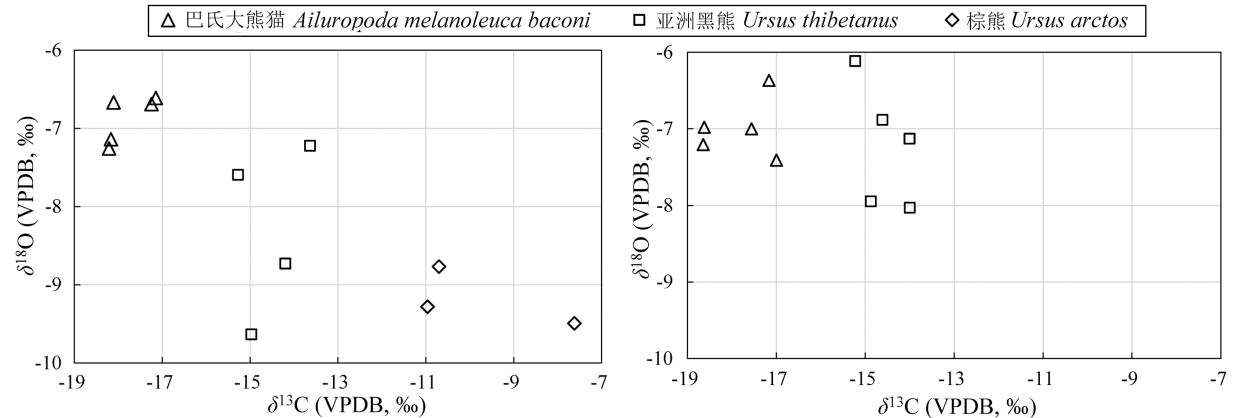
本研究聚焦华龙洞3种熊科动物——巴氏大熊猫(Ailuropoda melanoleuca baconi)、亚洲黑熊(Ursus thibetanus)和棕熊(Ursus arctos)的摄食生态,探讨共生熊类的生态位差异及变化。通过牙釉质碳氧稳定同位素分析,发现第1地点棕熊栖息于半开阔林地,大熊猫与黑熊则占据密闭森林,黑熊的食性更为多样化;第3地点棕熊消失,大熊猫与黑熊依然占据密林,但黑熊的摄食行为可能有所变化。区域对比显示,中晚更新世巴氏大熊猫与亚洲黑熊在广西和安徽地区均以密林为核心生境,但二者普遍存在生态位差异。通过对更新世大熊猫的数据进行整合分析,我们发现从早更新世的小种大熊猫和武陵山大熊猫,到中晚更新世的巴氏大熊猫,其碳氧同位素数据均呈现出时空差异。这些差异不仅反映了不同种类大熊猫的古生态特征,也与中国南方地区更新世气候环境的区域性差异密切相关。本研究首次聚焦于更新世共生熊科动物的稳定同位素古生态,为理解南方古人类与动物协同演化提供生态背景。
马姣 , 江左其杲 , 金泽田 , 邓国栋 , 陈逸迎 , 严毅 . 安徽华龙洞熊科动物的稳定同位素古生态[J]. 人类学学报, 2025 , 44(05) : 884 -894 . DOI: 10.16359/j.1000-3193/AAS.2025.0068
This study investigates the dietary ecology of three sympatric Ursidae species— Ailuropoda melanoleuca baconi, Ursus thibetanus, and Ursus arctos — from two sites at Hualonglong (locality 1: ~300 ka; locality 3: late Middle Pleistocene to Late Pleistocene) in Anhui Province, southern China. Through stable carbon and oxygen isotope (δ13C, δ18O) analysis of tooth enamel, this study reveals distinct ecological strategies: at locality 1, U. arctos (n=3) occupied intermediate woodlands (δ13Cdiet= −23.1‰±1.9‰), while A. melanoleuca baconi (n=5) and U. thibetanus (n=4) inhibited close-canopy forests (δ13Cdiet values are −27.8‰±0.6‰ and −27.8‰±0.8‰, respectively). The latter exhibites more diverse dietary ecology, as reflected by their varied δ18O values (−6.9‰±0.3‰ and −8.3‰±1.1‰). By locality 3, U. arctos were absent, but A. melanoleuca baconi (n=5) and U. thibetanus (n=5) continue to inhabit close-canopy forests. The δ18O convergence between A. melanoleuca baconi (−7.0‰±0.4‰) and U. thibetanus (−7.2‰±0.8‰) suggests possible ecological shifts in U. thibetanus. Regional comparisons (Guangxi: Baxian Cave, Quzai Cave, and Yugong Cave from previous studies; Anhui: two localities at Hualongdong in this study) indicate that during the middle-late Pleistocene, both A. melanoleuca baconi (δ13Cdiet values were −27.1‰±1.0‰ (n=20) in Guangxi and −27.8‰±0.6‰ (n=10) in Anhui) and U. thibetanus (δ13Cdiet values were −27.7‰±1.7‰ (n=10) in Guangxi and −27.8‰±0.6‰ (n=9) in Anhui) consistently exploited close-canopy forests in Guangxi and Anhui, yet maintained niche partitioning at each sites. By integrating isotopic data from Pleistocene Ailuropoda, we observed a gradual shift towards more positive δ13Cdiet values from the Early Pleistocene Ailuropoda microta (data from Gigantopithecus Cave and Yanliang Cave in Guangxi, δ13Cdiet= −28.2‰±1.0‰, n=8) and A. melanoleuca wulingshanensis (data from Longgu Cave in Hubei, δ13Cdiet= −27.7‰±0.7‰, n=4) to the middle-late Pleistocene A. melanoleuca baconi (all aforementioned specimens from Guangxi and Anhui, δ13Cdiet= −27.3‰ ±0.9‰, n=30). Their δ18O values also varied by regions and periods. The spatiotemporal isotopic differences in Pleistocene Ailuropoda, linked to their specialized bamboo-diet, underscore the differences in regional paleoenvironments in southern China. In Guangxi, A. melanoleuca baconi exhibited slightly higher δ13Cdiet values and a broader range of δ18O values compared to A. microta. This may suggest that, with the increase in body mass and food intake, A. melanoleuca baconi occupied more open habitats and utilized bamboo more diversely, as potentially evidenced by a wider variety of bamboo species, parts, and distribution ranges. This study provides the first isotopic evidence for sympatric Ursidae niche partitioning in southern China, offering critical paleoenvironmental context for understanding the coevolution between human and non-human animals in this region.
Key words: Hualongdong; Ailuropoda; Ursus thibetanus; Ursus arctos; Carbon and oxygen isotopes
| [1] | 江左其杲, 刘金毅, 王元, 等. 大连骆驼山金远洞埃楚斯堪熊(Ursus etruscus)新材料及中国Ursus cf. etruscus材料的简要回顾[J]. 第四纪研究, 2017, 37(4): 828-837 |
| [2] | 刘金毅, 赵凌霞, 陈津, 等. 贵州毕节扒耳岩巨猿动物群的年代与环境——来自食肉类化石的分析和研究[J]. 第四纪研究, 2011, 31(4): 654-666 |
| [3] | 魏辅文, 杨奇森, 吴毅, 等. 中国兽类名录(2024版)[J]. 兽类学报, 2025, 45: 1-16 |
| [4] | 胡锦矗. 大熊猫的分类地位与演化[J]. 四川师范学院学报:自然科学版, 1992, 13: 151-155 |
| [5] | H.D.卡尔克, 胡长康. 关于中国南方剑齿象-熊猫动物群和巨猿的时代[J]. 古脊椎动物学报, 1961, (2): 3-28 |
| [6] | 金昌柱, 郑家坚, 王元, 等. 中国南方早更新世主要哺乳动物群层序对比和动物地理[J]. 人类学学报, 2008, 27(4): 304-317 |
| [7] | Jiangzuo QG, Huang Z, Yu C, et al. Dental shape evolution of the giant panda (Ailuropoda, Ursidae) during the Quaternary[J]. Historical Biology, 2025, 37: 695-701 |
| [8] | Hu H, Tong H, Yu H, et al. New study sheds light on the impressive intraspecific variation of Quaternary Asiatic black bears in China[J]. Quaternary International, 2023, 22-33 |
| [9] | Qiu Z. Quaternary environmental changes and evolution of large mammals in North China[J]. Vertebrata PalAsiatica, 2006, 44(2): 109-132 |
| [10] | 王文, 马建章, 余辉亮, 等. 小兴安岭地区黑熊的食性分析[J]. 兽类学报, 2008, 28: 7-13 |
| [11] | Dahle B, S?rensen OJ, Wedul EH, et al. The diet of brown bears Ursus arctos in central Scandinavia: effect of access to free-ranging domestic sheep Ovis aries[J]. Wildlife Biology, 1998, 4(1): 147-158 |
| [12] | Kohn MJ, Cerling TE. Stable isotope compositions of biological apatite[J]. Reviews in Mineralogy and Geochemistry, 2002, 48(1): 455-488 |
| [13] | O'Leary MH. Carbon isotope fractionation in plants[J]. Phytochemistry, 1981, 20(4): 553-567 |
| [14] | 林光辉. 稳定同位素生态学[M]. 北京: 高等教育出版社, 2013 |
| [15] | Ehleringer JR, Lin ZF, Field CB, et al. Leaf carbon isotope ratios of plants from a subtropical monsoon forest[J]. Oecologia, 1987, 72(1): 109-114 |
| [16] | Cernusak LA, Tcherkez G, Keitel C, et al. Why are non-photosynthetic tissues generally 13C enriched compared with leaves in C3 plants? Review and synthesis of current hypotheses[J]. Functional Plant Biology, 2009, 36(3): 199-213 |
| [17] | Cerling TE, Harris JM. Carbon isotope fractionation between diet and bioapatite in ungulate mammals and implications for ecological and paleoecological studies[J]. Oecologia, 1999, 120(3): 347-363 |
| [18] | Clark ID, Fritz P. Environmental isotopes in hydrogeology[M]. Boca Raton: Lewis Publishers, 1997 |
| [19] | Dansgaard W. Stable isotopes in precipitation[J]. Tellus, 1964, 16(4): 436-468 |
| [20] | Quade J, Cerling TE, Andrews P, et al. Paleodietary reconstruction of Miocene faunas from Pa?alar, Turkey using stable carbon and oxygen isotopes of fossil tooth enamel[J]. Journal of Human Evolution, 1995, 28(4): 373-384 |
| [21] | Dongmann G, Nürnberg HW, F?rstel H, et al. On the enrichment of H218O in the leaves of transpiring plants[J]. Radiation and environmental biophysics, 1974, 11(1): 41-52 |
| [22] | Luz B, Kolodny Y. Oxygen isotope variations in phosphate of biogenic apatites, IV. Mammal teeth and bones[J]. Earth and planetary science letters, 1985, 75(1): 29-36 |
| [23] | Hillson S. Teeth[M]. Cambridge: Cambridge university press, 2005 |
| [24] | Wu X, Pei S, Cai Y, et al. Archaic human remains from Hualongdong, China, and Middle Pleistocene human continuity and variation[J]. Proceedings of the National Academy of Sciences, 2019, 116(20): 9820-9824 |
| [25] | Wu X, Pei S, Cai Y, et al. Morphological description and evolutionary significance of 300 ka hominin facial bones from Hualongdong, China[J]. Journal of Human Evolution, 2021, 161: 103052 |
| [26] | 同号文, 吴秀杰, 董哲, 等. 安徽东至华龙洞古人类遗址哺乳动物化石的初步研究[J]. 人类学学报, 2018, 37(2): 284-305 |
| [27] | Wright LE, Schwarcz HP. Stable carbon and oxygen isotopes in human tooth enamel: identifying breastfeeding and weaning in prehistory[J]. American Journal of physical anthropology, 1998, 106(1): 1-18 |
| [28] | Tieszen LL, Boutton TW, Tesdahl KG, et al. Fractionation and turnover of stable carbon isotopes in animal tissues: Implications for δ13C analysis of diet[J]. Oecologia, 1983, 57(1-2): 32-37 |
| [29] | Tejada-Lara JV, Macfadden BJ, Bermudez L, et al. Body mass predicts isotope enrichment in herbivorous mammals[J]. Proceedings of the Royal Society B: Biological Sciences, 2018, 285: 20181020 |
| [30] | Han H, Wei W, Nie Y, et al. Distinctive diet-tissue isotopic discrimination factors derived from the exclusive bamboo-eating giant panda[J]. Integrative Zoology, 2016, 11(6): 447-456 |
| [31] | Passey BH, Robinson TF, Ayliffe LK, et al. Carbon isotope fractionation between diet, breath CO2, and bioapatite in different mammals[J]. Journal of Archaeological Science, 2005, 32: 1459-1470 |
| [32] | Bacon A, Bourgon N, Welker F, et al. A multiproxy approach to exploring Homo sapiens' arrival, environments and adaptations in Southeast Asia[J]. Scientific Reports, 2021, 11: 21080 |
| [33] | Stacklyn S, Wang Y, Jin C, et al. Carbon and oxygen isotopic evidence for diets, environments and niche differentiation of early Pleistocene pandas and associated mammals in South China[J]. Palaeogeography, Palaeoclimatology, Palaeoecology, 2017, 468: 351-361 |
| [34] | Kohn MJ. Carbon isotope compositions of terrestrial C3 plants as indicators of (paleo) ecology and (paleo) climate[J]. Proceedings of the National Academy of Sciences, 2010, 107: 19691-19695 |
| [35] | Tejada JV, Flynn JJ, Antoine PO, et al. Comparative isotope ecology of western Amazonian rainforest mammals[J]. Proceedings of the National Academy of Sciences, 2020, 117: 26263-26272 |
| [36] | Smith A, 解焱. 中国兽类野外手册[M]. 长沙: 湖南教育出版社, 2009 |
| [37] | Bryant JD, Froelich PN. A model of oxygen isotope fractionation in body water of large mammals[J]. Geochimica et Cosmochimica Acta, 1995, 59: 4523-4537 |
| [38] | Sponheimer M, Lee-Thorp JA. Oxygen isotopes in enamel carbonate and their ecological significance[J]. Journal of Archaeological Science, 1999, 26(6): 723-728 |
| [39] | Hashimoto Y. Seasonal food habits of the Asiatic black bear (Ursus thibetanus) in the Chichibu Mountains, Japan[J]. Mammal Study, 2002, 27(1): 65-72 |
| [40] | Ma J, Wang Y, Jin C, et al. Isotopic evidence of foraging ecology of Asian elephant (Elephas maximus) in South China during the Late Pleistocene[J]. Quaternary International, 2017, 443: 160-167 |
| [41] | Ma J, Wang Y, Jin C, et al. Ecological flexibility and differential survival of Pleistocene Stegodon orientalis and Elephas maximus in mainland southeast Asia revealed by stable isotope (C, O) analysis[J]. Quaternary Science Reviews, 2019, 212: 33-44 |
| [42] | Sun F, Wang Y, Wang Y, et al. Paleoecology of Pleistocene mammals and paleoclimatic change in South China: Evidence from stable carbon and oxygen isotopes[J]. Palaeogeography, Palaeoclimatology, Palaeoecology, 2019, 524: 1-12 |
| [43] | Zhang Y, Westaway KE, Haberle S, et al. The demise of the giant ape Gigantopithecus blacki[J]. Nature, 2024, 625: 535-539 |
| [44] | Jiang Q, Zhao L, Hu Y. Isotopic (C, O) variations of fossil enamel bioapatite caused by different preparation and measurement protocols: a case study of Gigantopithecus fauna[J]. Vertebrata Palasiatica, 2020, 58: 159-168 |
| [45] | Zhang Y, Harrison T. Gigantopithecus blacki: a giant ape from the Pleistocene of Asia revisited[J]. American Journal of Physical Anthropology, 2017, 162: 153-177 |
| [46] | Zhang Y, Jin C, Kono RT, et al. A fourth mandible and associated dental remains of Gigantopithecus blacki from the Early Pleistocene Yanliang Cave, Fusui, Guangxi, South China[J]. Historical Biology, 2016, 28: 95-104 |
| [47] | Jiang Q, Zhao L, Guo L, et al. First direct evidence of conservative foraging ecology of early Gigantopithecus blacki (-2 Ma) in Guangxi, southern China[J]. American Journal of Physical Anthropology, 2021, 176(1): 93-108 |
| [48] | Nelson SV. The paleoecology of early Pleistocene Gigantopithecus blacki inferred from isotopic analyses[J]. American Journal of Physical Anthropology, 2014, 155(4): 571-578 |
| [49] | Pederzani S, Britton K. Oxygen isotopes in bioarchaeology: Principles and applications, challenges and opportunities[J]. Earth-Science Reviews, 2019, 188: 77-107 |
| [50] | Wang X, Su DF, Jablonski NG, et al. Earliest giant panda false thumb suggests conflicting demands for locomotion and feeding[J]. Scientific Reports, 2022, 12(1): 10538 |
| [51] | Jiangzuo Q, Wang D, Zhang C, et al. Body mass evolution of the Quaternary giant panda coincides with climate change of southern China[J]. The Innovation Geoscience, 2024: 100096 |
| [52] | Louys J, Roberts P. Environmental drivers of megafauna and hominin extinction in Southeast Asia[J]. Nature, 2020, 586: 402-406 |
| [53] | Qin Z, Sun X. Glacial-interglacial cycles and early human evolution in China[J]. Land, 2023, 12(9): 1683 |
| [54] | An Z, Zhou W, Zhang Z, et al. Mid-Pleistocene climate transition triggered by Antarctic Ice Sheet growth[J]. Science, 2024, 385(6708): 560-565 |
| [55] | 金昌柱, 郑龙亭, 董为, 等. 安徽繁昌早更新世人字洞古人类活动遗址及其哺乳动物群[J]. 人类学学报, 2000, 19: 184-198 |
/
| 〈 |
|
〉 |
 京ICP证05002819号-3