


安徽华龙洞遗址大额牛的食性
收稿日期: 2025-04-30
修回日期: 2025-06-30
网络出版日期: 2025-10-13
基金资助
国家重点研发计划项目(2022YFF0801502);国家自然科学基金项目(42472006);国家自然科学基金项目(41877427)
Dietary ecology of gaur from the Hualongdong site in Anhui Province
Received date: 2025-04-30
Revised date: 2025-06-30
Online published: 2025-10-13
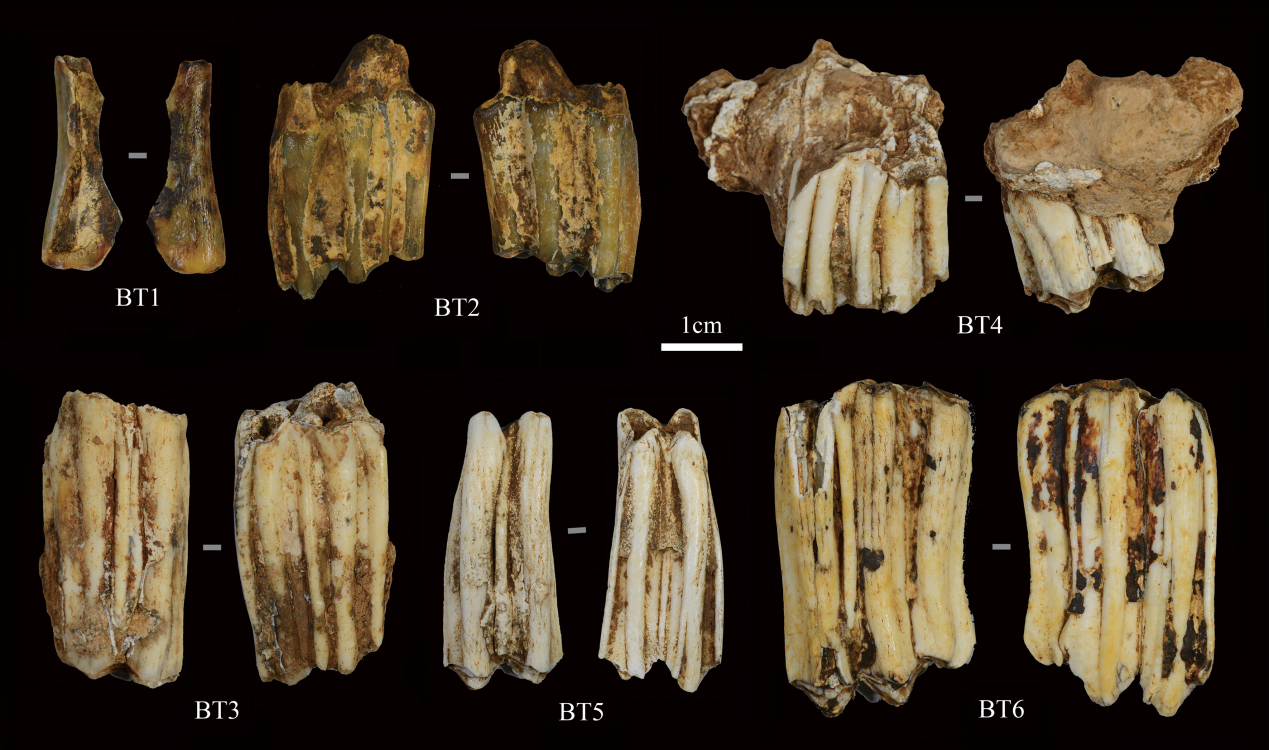
为探索安徽华龙洞遗址大额牛的食性以及生态环境背景,本文对遗址中出土的6颗大额牛牙齿化石进行了牙结石植硅体分析及牙釉质稳定同位素分析等研究。结果显示,华龙洞地区的大额牛主要以不同高度的草本植物为食;牙结石中的诊断性植硅体形态鉴定结果表明,姜目和禾本科植物是大额牛饮食的重要组成部分;大额牛牙齿样本的δ13C值在-10.3‰~-4.6‰,平均约-8.6‰,指示其食用的植物类型以C3植物为主,少量C4植物为辅。综合其食性及其化石常发现的地点,推测华龙洞遗址的大额牛生存于森林较疏朗地带,且食谱中姜目植物的发现也暗示其生存于温暖的气候背景中。本研究结果为了解华龙洞遗址大额牛的食性、栖息地以及气候背景提供了新的植物微体化石与同位素记录,也为重建安徽地区中更新世的古环境提供了依据。
郑明聪 , 汪静怡 , 严毅 , 陈逸迎 , 吴妍 . 安徽华龙洞遗址大额牛的食性[J]. 人类学学报, 2025 , 44(05) : 895 -905 . DOI: 10.16359/j.1000-3193/AAS.2025.0071
The Hualongdong site in Dongzhi County, Anhui Province, represents the most comprehensive Paleolithic site in China since Zhoukoudian, yielding abundant hominin fossils alongside stone tools and other evidence of human activities. Notably, it has also produced a substantial assemblage of mammalian fossils. As a key species in China's Quaternary mammalian fauna, the Pleistocene gaur [Bos (Bibos) sp.] shares close phylogenetic relationships with its extant counterparts. However, systematic understanding of this fossil Bos (Bibos) sp. species remains limited due to fragmentary fossil materials and methodological constraints. The dental fossils of Bos (Bibos) sp. from Hualongdong site provide crucial materials for investigating its dietary habits, ecological niche, paleoenvironment and ecosystem. This study employs multidisciplinary approaches including CT three-dimensional modeling, phytolith analysis, and stable isotope analysis to systematically investigate Bos (Bibos) sp. dental fossils. CT modeling precisely identified dental calculus locations, enabling subsequent phytolith extraction and morphological characterization from calculus deposits. Concurrently, carbon stable isotope analysis was conducted on tooth enamel. Results reveal that the late Middle Pleistocene Hualongdong site Bos (Bibos) sp. feed on herbaceous plants of varying heights. Carbon isotope data indicate a primary reliance on C3 plants from the site and surrounding areas, supplemented by limited C4 plant consumption (δ13C values: -10.3‰ to -4.6‰). Phytolith analysis specifically indicates frequent ingestion of Poaceae and Zingiberales species. These findings collectively indicate that Bos (Bibos) sp. primarily foraged in warm environments dominated by C3 vegetation during the late Middle Pleistocene. The diverse phytolith assemblages and isotopic signatures reflect rich regional vegetation heterogeneity, providing ample food resources. Furthermore, the common occurrence of Pleistocene Bos (Bibos) sp. fossils in alluvial plains, mountain valleys, and karst caves suggests their preference for open forest areas with grassy patches. This ecological pattern aligns with their mixed dietary strategy of feeding on both C3 and C4 plants. This research establishes novel phytolith and isotopic records for understanding Bos (Bibos) sp. paleodietary ecology while contributing to Middle-Late Pleistocene paleoclimatic and paleoecological reconstructions in Anhui Province. The integrated methodology demonstrates the efficacy of combining Plant microfossils and geochemical proxies in paleodietary studies, offering insights into herbivore-environment interactions during the Pleistocene.
Key words: Pleistocene; Hualongdong site; Bibos sp.; phytoliths; diet
| [1] | 裴树文, 蔡演军, 董哲, 等. 安徽东至华龙洞遗址洞穴演化与古人类活动[J]. 人类学学报, 2022, 41(4): 593-607 |
| [2] | 陈胜前, 罗虎. 安徽东至县华龙洞旧石器时代遗址发掘简报[J]. 考古, 2012, 4: 7-13 |
| [3] | 同号文, 吴秀杰, 董哲, 等. 安徽东至华龙洞古人类遗址哺乳动物化石的初步研究[J]. 人类学学报, 2018, 37(2): 284-305 |
| [4] | Wu XJ, Pei SW, Cai YJ, et al. Archaic human remains from Hualongdong, China, and Middle Pleistocene human continuity and variation[J]. Proceedings of the National Academy of Sciences, 2019, 116(20): 9820-9824 |
| [5] | 同号文, 江左其杲, 李强, 等. 安徽东至华龙洞哺乳动物化石新材料[J]. 人类学学报, 2025, 44(5): 779-798 |
| [6] | 王晓敏, 许春华, 同号文. 湖北郧西白龙洞古人类遗址的大额牛化石[J]. 人类学学报, 2015, 34(3): 338-352 |
| [7] | Ahrestani F S. Bos frontalis and Bos gaurus (Artiodactyla: Bovidae)[J]. Mammalian Species, 2018, 50(959): 34-50 |
| [8] | 宗冠福. 四川盐源盆地哺乳类化石及其意义[J]. 古脊椎动物学报, 1987, 25(2): 137-145 |
| [9] | 黄万波, 方其仁. 巫山猿人遗址[M]. 北京: 海洋出版社,1991 |
| [10] | 林一璞, 张兴永.云南丽江木家桥发现的哺乳类化石和旧石器[A].见:中国地质科学院地层古生物论文集编委会(编著). 地层古生物论文集[C]. 北京: 地质出版社, 1978, 4: 80-85+210 |
| [11] | 潘悦容, 李庆辰, 林一璞, 等. 云南元谋发现的晚更新世哺乳动物群[J]. 人类学学报, 1991, 10(2): 167-175 |
| [12] | 宗冠福. 云南省迪庆州更新世早期哺乳类化石的发现[J]. 古脊椎动物学报, 1987, 25(1): 69-76 |
| [13] | 韩德芬. 广西大新黑洞哺乳动物化石[J]. 古脊椎动物与古人类, 1982, 20(1): 58-63 |
| [14] | 董为, 潘文石, 孙承凯, 等. 广西崇左三合大洞的早更新世反刍类[J]. 人类学学报, 2011, 30(2): 192-205 |
| [15] | 董为, 潘文石, 徐钦琦, 等.广西崇左泊岳山的早更新世偶蹄类[A].见:董为(主编). 第十二届中国古脊椎动物学学术年会论文集[C]. 北京: 海洋出版社, 2010, 67-74 |
| [16] | Gad SD, Shyama SK. Diet composition and quality in Indian bison (Bos gaurus) based on fecal analysis[J]. Zoological Science, 2011, 28(4): 264-267 |
| [17] | Chaiyarat R, Prasopsin S, Bhumpakphan N. Food and nutrition of gaur (Bos gaurus CH Smith, 1827) at the edge of Khao Yai National Park, Thailand[J]. Scientific Reports, 2021, 11(1): 3281 |
| [18] | Haleem A, Ilyas O. Food and feeding habits of gaur (Bos gaurus) in highlands of Central India: a case study at Pench Tiger Reserve, Madhya Pradesh (India)[J]. Zoological science, 2018, 35(1): 57-67 |
| [19] | Nayak BK, Patra AK. Food and feeding habits of Indian bison, Bos gaurus (Smith, 1827) in Kuldiha Wildlife Sanctuary, Balasore, Odisha, India and its conservation[J]. International Research Journal of Biological Sciences, 2015, 4(5): 73-79 |
| [20] | Chetri M. Diet analysis of gaur (Bos gaurus gaurus smith, 1827) by micro-histological analysis of fecal samples in parsa wildlife reserve, Nepal[J]. Our Nature, 2006, 4(1): 20-28 |
| [21] | Ahrestani FS, Heitk?nig IMA, Prins HHT. Diet and habitat-niche relationships within an assemblage of large herbivores in a seasonal tropical forest[J]. Journal of Tropical Ecology, 2012, 28(4): 385-394 |
| [22] | 王永吉, 吕厚远. 植物硅酸体研究及应用[M]. 北京: 海洋出版社,1993, 1-10 |
| [23] | Gobetz KE, Bozarth SR. Implications for late Pleistocene mastodon diet from opal phytoliths in tooth calculus[J]. Quaternary Research, 2001, 55(2): 115-122 |
| [24] | Cerling TE, Harris JM, MacFadden BJ, et al. Global vegetation change through the Miocene / Pliocene boundary[J]. Nature, 1997, 389(6647): 153-158 |
| [25] | 魏明瑞, 郭建崴. 宁夏同心中中新世三种植食性哺乳动物牙齿碳同位素分析[J]. 古脊椎动物学报, 2002, 40(4): 300-304 |
| [26] | 赵凌霞, 张立召, 张福松, 等. 根据步氏巨猿与伴生动物牙釉质稳定碳同位素分析探讨其食性及栖息环境[J]. 科学通报, 2011, 56(35): 2981-2987 |
| [27] | Biasatti D, Yang W, Tao D. Paleoecology of Cenozoic rhinos from northwest China: a stable isotope perspective[J]. Vertebrata PalAsiatica, 2018, 56(1): 45-68 |
| [28] | Hardy FC, Rowland SM. Stable isotopic analysis of fossil Bison tooth enamel indicates flexible dietary ecology across Pleistocene North America[J]. Quaternary Science Reviews, 2024, 334: 108741 |
| [29] | Feranec RS. Geographic variation in the diet of hypsodont herbivores from the Rancholabrean of Florida[J]. Palaeogeography, Palaeoclimatology, Palaeoecology, 2004, 207(3-4): 359-369 |
| [30] | Wu Y. Advances and perspectives of dental calculus in archaeological and paleontological research[J]. The Innovation Geoscience, 2025, 100146: 1-2 |
| [31] | Wu Y, Ge Y, Hu H, et al. Intra-gastric phytoliths provide evidence for folivory in basal avialans of the Early Cretaceous Jehol Biota[J]. Nature communications, 2023, 14(1): 4558 |
| [32] | Chen ST, Smith SY. Phytolith variability in Zingiberales: a tool for the reconstruction of past tropical vegetation[J]. Palaeogeography, Palaeoclimatology, Palaeoecology, 2013, 370: 1-12 |
| [33] | Cerling TE, Harris JM. Carbon isotope fractionation between diet and bioapatite in ungulate mammals and implications for ecological and paleoecological studies[J]. Oecologia, 1999, 120: 347-363 |
| [34] | Neumann K, Str?mberg Caroline AE, et al. International code for phytolith nomenclature (ICPN) 2.0[J]. Annals of botany, 2019, 124(2): 189-199 |
| [35] | Deborah M. Pearsall. Phytoliths in the Flora of Ecuador: The University of Missouri Online Phytolith Database[DB]. URL: http://phytolith.missouri.edu, 2015 |
| [36] | Poliakova A, Ciotti G, Helman-Wazny A, et al. Phytolith assemblages from palm leaves and palm-leaf manuscripts: what is the difference and what it could mean?[J]. Frontiers in Plant Science, 2025, 15: 1482790 |
| [37] | 韩家懋, 王国安, 刘东生. C4植物的出现与全球环境变化[J]. 地学前缘, 2002, 9(1): 233-243 |
| [38] | 李潇丽, 董哲, 裴树文, 等. 安徽东至华龙洞洞穴发育与古人类生存环境[J]. 海洋地质与第四纪地质, 2017, 37(3): 169-179 |
| [39] | 金昌柱, 郑家坚, 王元, 等. 中国南方早更新世主要哺乳动物群层序对比和动物地理[J]. 人类学学报, 2008, 27(4): 304-317 |
| [40] | Prince LM, Kress WJ. Zingiberales (Ginger and Bananas)[J]. Encyclopedia of life sciences, 2002 |
| [41] | Kress WJ, Specht CD.Between Cancer and Capricorn: Phylogeny, evolution and ecology of the primarily tropical[A]. In: Friis I and Balslev H (Eds). Plant Diversity and Complexity Patterns: Local, Regional, and Global Dimensions: Proceedings of an International Symposium Held at the Royal Danish Academy of Sciences and Letters in Copenhagen[C]. Denmark: Kgl. Danske Videnskabernes Selskab, 2005, 55: 459-478 |
| [42] | Kress WJ, Specht CD. The evolutionary and biogeographic origin and diversification of the tropical monocot order Zingiberales[J]. Aliso: A Journal of Systematic and Floristic Botany, 2006, 22(1): 621-632 |
| [43] | Greenwood DR, Wing SL. Eocene continental climates and latitudinal temperature gradients[J]. Geology, 1995, 23(11): 1044-1048 |
/
| 〈 |
|
〉 |
 京ICP证05002819号-3