


华龙洞遗址古人类生存的植被与环境背景
收稿日期: 2025-05-08
修回日期: 2025-08-04
网络出版日期: 2025-10-13
基金资助
国家自然科学基金项目(42471185);国家自然科学基金项目(T2192952)
Vegetation and environmental context of archaic human occupation at the Hualongdong site, Anhui
Received date: 2025-05-08
Revised date: 2025-08-04
Online published: 2025-10-13
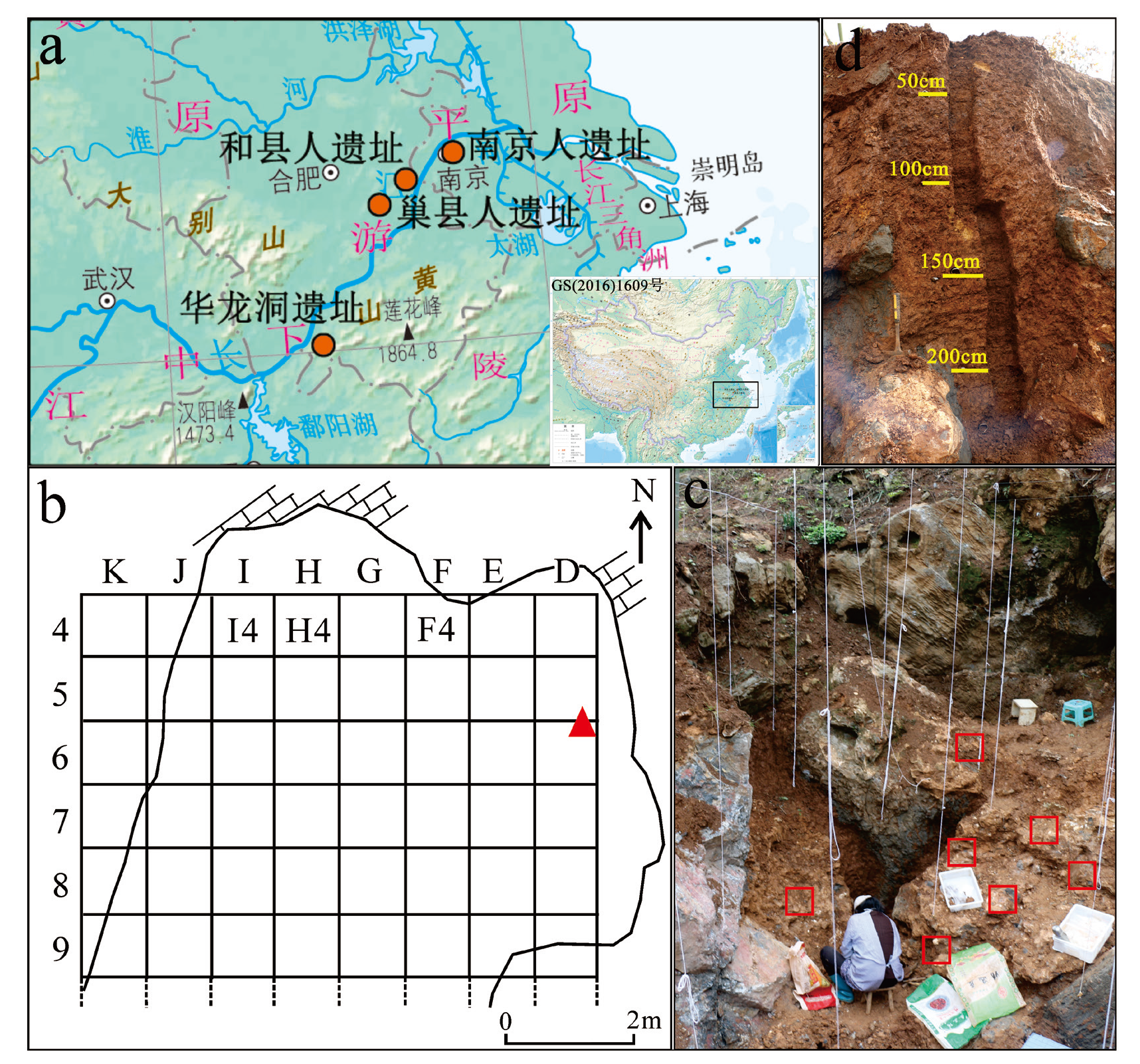
华龙洞遗址作为中更新世时期古人类活动的重要遗址,为揭示东亚地区古人类演化及环境适应提供了关键证据。本文通过对2016年发掘区域角砾岩以及棕红色黏土沉积样品的孢粉分析,重建了该遗址的古植被,并探讨了华龙洞古人类生存的气候环境背景。孢粉分析结果显示古人类生存时期研究区植被是以榆属、栎属等为主的落叶阔叶林,周边分布有禾本科、蒿属、藜科等植物组成的草地。华龙洞遗址孢粉组合所指示的落叶阔叶林植被类型不同于现今的亚热带常绿植被,说明当时的气候条件较现在凉干。对比研究表明,华龙洞植被环境与南京人遗址比较相似。但相较于周口店、大荔人等遗址,其植被覆盖更为密闭,而与庙后山、许家窑遗址相比则相对开阔。
赵克良 , 白广一 , 惠家明 , 张玄 , 李小强 . 华龙洞遗址古人类生存的植被与环境背景[J]. 人类学学报, 2025 , 44(05) : 906 -916 . DOI: 10.16359/j.1000-3193/AAS.2025.0074
As a crucial Middle Pleistocene hominin activity site, Hualongdong (HLD) provides pivotal evidence for understanding ancient human evolution and environmental adaptation in East Asia. The site's hominin fossils and stone tools were unearthed from breccia and brownish-red clay deposits. To reconstruct the paleovegetation and better understand the paleoenvironmental context of the Hualongdong hominins, this study conducted pollen analysis on 20 sediment samples collected from these strata in the 2016 excavation area. A total of 41 pollen taxa were identified across the samples. From the breccia deposits (7 samples), 94 pollen grains were recovered, whereas 1,148 grains were counted in the 13 samples from the HLD2016 section. Uranium-series dating of stalagmites and animal teeth fossils indicates that the breccia deposits formed between 331 and 275 ka BP. Although the HLD2016 section lacks direct dating, published chronostudies suggest that the brownish-red clay was deposited during the late Middle Pleistocene, approximately 0.4~0.1 Ma. Notably, the pollen assemblages from the lower portion of the HLD2016 section (below 150 cm) closely resemble those of the breccia deposits. This similarity suggests that the sedimentary layer between 240 and 150 cm may correspond temporally to the breccia deposits.
In the breccia samples and the HLD2016 sediments below 150 cm, arboreal pollen dominates (67.7%), followed by herbaceous (31.9%) and shrub pollen (0.4%). The assemblage reflects a deciduous broad-leaved forest dominated by Ulmus and Quercus, with an understory and surrounding grasslands composed of Poaceae, Chenopodiaceae, and Artemisia. This vegetation structure is distinct from the region's current subtropical environment but similar to the warm-temperate deciduous broad-leaved forests of southern North China suggests that the climate during the Hualongdong hominin occupation was cooler and drier than today. The landscape likely consisted of a forest and grassland mosaic, offering diverse ecological resources. Comparative analysis reveals that Hualongdong's paleoenvironment shares similarities with that of the Nanjing site but exhibits denser vegetation cover than Zhoukoudian and Dali, along with intermediate openness compared to Miaohoushan and Xujiayao. These environmental features may reflect the ecological adaptation strategies of Middle Pleistocene hominins in East Asia, particularly their utilization of mixed forest-grassland ecotones. The mosaic of deciduous broad-leaved forests and open grasslands would have provided both shelter and hunting opportunities, supporting a dynamic subsistence strategy.
Key words: Dongzhi; Middle Pleistocene; pollen analysis; paleoenvironment; glacial-interglacial
| [1] | 刘武, 吴秀杰. 中更新世晚期中国古人类化石的形态多样性及其演化意义[J]. 人类学学报, 2022, 41(4): 563-575 |
| [2] | 吴秀杰. 周口店发现的人类化石及其研究进展[J]. 人类学学报, 2024, 43(6): 900-912 |
| [3] | 吴汝康, 董兴仁. 安徽和县猿人化石的初步研究[J]. 人类学学报, 1982, 1(1): 2-13 |
| [4] | Liu W, Zhang YY, Wu XZ. Middle Pleistocene human cranium from Tangshan (Nanjing), Southeast China: A new reconstruction and comparisons with Homo erectus from Eurasia and Africa[J]. American Journal of Physical Anthropology, 2005, 127(3): 253-262 |
| [5] | 吴新智. 大荔中更新世人类颅骨[M]. 北京: 科学出版社, 2020 |
| [6] | Wu XJ, Pei SW, Cai YJ, et al. Archaic human remains from Hualongdong, China, and Middle Pleistocene human continuity and variation[J]. Proceedings of the National Academy of Sciences, 2019, 116(20): 9820-9824 |
| [7] | Ni XJ, Ji Q, Wu WS, et al. Massive cranium from Harbin in northeastern China establishes a new Middle Pleistocene human lineage[J]. The Innovation, 2021, 2(3): 100130 |
| [8] | Wu XJ, Bruner E. The Endocranial Anatomy of Maba 1[J]. American Journal of Physical Anthropology, 2016, 160(4): 633-643 |
| [9] | 许春华, 张银运, 陈才弟, 等. 安徽巢县发现的人类枕骨化石和哺乳动物化石[J]. 人类学学报, 1984, 3(3): 202-301 |
| [10] | 吴汝康. 辽宁营口金牛山人化石头骨的复原及其主要性状[J]. 人类学学报, 1988, 7(2): 97-101+191 |
| [11] | Liu W, Schepartz LA, Xing S, et al. Late Middle Pleistocene hominin teeth from Panxian Dadong, South China[J]. Journal of Human Evolution, 2013, 64(5): 337-355 |
| [12] | 原思训, 陈铁梅, 高世君. 华南若干旧石器时代地点的铀系年代[J]. 人类学学报, 1986, 5(2): 179-190 |
| [13] | Wu XJ, Bae CJ, Friess M, et al. Evolution of cranial capacity revisited: A view from the late Middle Pleistocene cranium from Xujiayao, China[J]. Journal of Human Evolution, 2022, 163: 103119 |
| [14] | Chen FH, Welker F, Shen CC, et al. A late Middle Pleistocene Denisovan mandible from the Tibetan Plateau[J]. Nature, 2019, 569(7756): 409-412 |
| [15] | 陈铁梅, 原思训, 高世君. 铀子系法测定骨化石年龄的可靠性研究及华北地区主要旧石器地点的铀子系年代序列[J]. 人类学学报, 1984, 3(3): 259-269 |
| [16] | Li ZY, Wu XJ, Zhou LP, et al. Late Pleistocene archaic human crania from Xuchang, China[J]. Science, 2017, 355(6328): 969-972 |
| [17] | Liu W, Athreya S, Xing S, et al. Hominin evolution and diversity: a comparison of earlier-Middle and later-Middle Pleistocene hominin fossil variation in China[J]. Philosophical Transactions of the Royal Society B: Biological Sciences, 2022, 377(1847): 20210040 |
| [18] | 宫希成, 郑龙亭, 邢松, 等. 安徽东至华龙洞出土的人类化石[J]. 人类学学报, 2014, 33(4): 427-436 |
| [19] | 陈胜前, 罗虎. 安徽东至县华龙洞旧石器时代遗址发掘简报[J]. 考古, 2012, 4: 7-13 |
| [20] | 董哲, 裴树文, 盛锦朝, 等. 安徽东至华龙洞古人类遗址2014-2016年出土的石制品[J]. 第四纪研究, 2017, 37(4): 778-788 |
| [21] | 同号文, 吴秀杰, 董哲, 等. 安徽东至华龙洞古人类遗址哺乳动物化石的初步研究[J]. 人类学学报, 2018, 37(2): 284-305 |
| [22] | 李潇丽, 董哲, 裴树文, 等. 安徽东至华龙洞洞穴发育与古人类生存环境[J]. 海洋地质与第四纪地质, 2017, 37(3): 169-179 |
| [23] | 裴树文, 蔡演军, 董哲, 等. 安徽东至华龙洞遗址洞穴演化与古人类活动[J]. 人类学学报, 2022, 41(4): 593 |
| [24] | 张新时. 中国植被及其地理格局:中华人民共和国植被图(1 : 1000000)说明书[M]. 北京: 地质出版社,2007: 728-793 |
| [25] | Faegri K, Kaland PE, Krzywinski K. Textbook of pollen analysis (4th Edition)[M]. New York: John Wiley and Sons, 1989 |
| [26] | 王伏雄, 钱南芬, 张玉龙, 等. 中国植物花粉形态(第二版)[M]. 北京: 科学出版社,1995 |
| [27] | 唐领余, 毛礼米, 舒军武, 等. 中国第四纪孢粉图鉴[M]. 北京: 科学出版社, 2016 |
| [28] | 赵其国, 杨浩. 中国南方红土与第四纪环境变迁的初步研究[J]. 第四纪研究, 1995, 15(2): 107-116 |
| [29] | 袁宝印, 夏正楷, 李保生, 等. 中国南方红土年代地层学与地层划分问题[J]. 第四纪研究, 2008, 28(1): 1-13 |
| [30] | Bae CJ, Li F, Cheng LL, et al. Hominin distribution and density patterns in Pleistocene China: Climatic influences[J]. Palaeogeography, Palaeoclimatology, Palaeoecology, 2018, 512: 118-131 |
| [31] | 杨子赓, 谢又予, 牟昀智, 等. 周口店上新世及更新世的古气候与地层[J]. 地质论评, 1983, 29(3): 209-219 |
| [32] | 刘金陵, 穆西南, 许汉奎, 等. 关于南京猿人生存时期的气候环境讨论[J]. 地层学杂志, 1998, 22(1): 60-64 |
| [33] | 辽宁省博物馆. 庙后山:辽宁省本溪市旧石器文化遗址[M]. 北京: 文物出版社, 1986, 67-78 |
| [34] | 孙建中, 赵景波, 等(著). 黄土高原第四纪[M]. 北京: 科学出版社, 1991, 144-153 |
| [35] | 韩辉友. 和县猿人生活时期的古气候探讨[J]. 南京大学学报(自然科学版), 1983, 1: 164-170 |
| [36] | 穆会双, 许清海, 张生瑞, 等. 孢粉资料定量重建泥河湾盆地侯家窑遗址时期的古气候[J]. 第四纪研究, 2015, 35(3): 698-711 |
| [37] | Lisiecki LE, Raymo ME. A Pliocene-Pleistocene stack of 57 globally distributed benthic δ18O records[J]. Paleoceanography, 2005, 20(1): 1-17 |
| [38] | 俞锦标, 张兆平, 朱诚, 等. 南京直立人生存环境探讨[J]. 中国岩溶, 1998, 17(1): 27-34 |
| [39] | 朱诚, 张建新, 俞锦标. 南京汤山猿人生存古环境重建探讨[J]. 地理科学, 1998, 18(5): 433-441 |
| [40] | 穆西南, 许汉奎, 穆道成, 等. 南京汤山古人类化石的发现及其意义[J]. 古生物学报, 1993, 32(4): 393-399 |
| [41] | 徐钦琦. 南京汤山早期人类及南方几个猿人遗址的生活环境[J]. 人类学学报, 1999, 18(4): 263-269 |
| [42] | Grün R, Huang PH, Huang WP, et al. ESR and U-series analyses of teeth from the palaeoanthropological site of Hexian, Anhui Province, China[J]. Journal of Human Evolution, 1998, 34(6): 555-564 |
| [43] | 黄万波, 黄赐璇.和县猿人动、植物群的性质及古气候的初步探讨[A].见:中国地理学会冰川冻土分会,中国科学院兰州冰川冻土研究所(主编). 中国第四纪冰川冰缘学术讨论会文集[C]. 北京: 科学出版社, 1985, 180-182 |
| [44] | 徐钦琦. 和县猿人时代的气候[J]. 人类学学报, 1984, 3(4): 383-391 |
| [45] | 郑绍华. 和县猿人小哺乳动物群的性质及意义[J]. 科学通报, 1982, 11: 683-685 |
| [46] | 杜乃秋, 于浅黎. 周口店鬣狗(Hyaena)粪化石的孢粉分析[J]. 古脊椎动物与古人类, 1980, 3: 259 |
| [47] | Wu XJ, Bae CJ. Xujiayao Homo: A New Form of Large Brained Hominin in Eastern Asia[J]. PaleoAnthropology, 2024, 1-14 |
| [48] | Wang H, Li H, Qiu YH, et al. Seasonal landscape variability advances Lantian hominin's recognition capacity to strategically adapt to changing environments[J]. Quaternary Science Reviews, 2024, 336: 108786 |
| [49] | Carrión JS, Yll EI, Walker MJ, et al. Glacial refugia of temperate, Mediterranean and Ibero-North African flora in south-eastern Spain: new evidence from cave pollen at two Neanderthal man sites[J]. Global Ecology and Biogeography, 2003, 12(2): 119-129 |
| [50] | Yang QJ, Zhao KL, Zhou XY, et al. Evaluation of the potential of surface pollen spectra from caves in SW China for vegetation reconstruction[J]. Quaternary International, 2021, 591: 119-128 |
/
| 〈 |
|
〉 |
 京ICP证05002819号-3