


收稿日期: 2024-03-12
录用日期: 2025-05-14
网络出版日期: 2025-12-15
基金资助
国家自然科学基金(42471180);全国考古人才振兴计划项目资助(2024-278);全国考古人才振兴计划项目资助(2025-198)
Discovery and advances in the study of Middle Paleolithic Quina technology in Southwest China
Received date: 2024-03-12
Accepted date: 2025-05-14
Online published: 2025-12-15
旧石器时代中期是人类技术演化与多种人群(尼安德特人、丹尼索瓦人和早期现代人等)交流互动的关键阶段。这一时期的石器工业以勒瓦娄哇技术最具代表,呈现出明显的复杂性和进步性。然而,中国是否存在旧石器时代中期技术,一度是学术界关注和争论的重要问题。近年来,以勒瓦娄哇技术、盘状技术等为特色的石制品组合的发现,为解决上述问题提供了重要材料。在此基础上,本文系统介绍了中国西南地区新近发现和报道的基纳型旧石器中期石制品组合,并对世界范围内基纳技术的具体特征、内涵及时空分布模式进行了梳理。基纳技术的发现,不仅进一步揭示了中国旧石器时代中期技术体系的多样性和复杂性,也推动了对于中国旧石器技术发展演化脉络以及古人类生存适应行为的重新理解和认识。
肖培源 , 阮齐军 , 李浩 . 中国西南基纳型旧石器中期技术的发现与研究进展[J]. 人类学学报, 2025 , 44(06) : 1009 -1018 . DOI: 10.16359/j.1000-3193/AAS.2025.0096
The Middle Paleolithic or Middle Stone Age, dating approximately between 300,000 and 40,000 years ago, represents a critical phase in human evolution, characterized by significant advancements in technology, adaptive behaviors, and complex interactions among different hominin groups, including Homo erectus, Neanderthals, Denisovans, and early modern humans. During this period, lithic technology underwent substantial diversification and refinement, reflecting key cognitive and behavioral developments. Among these innovations, the emergence and widespread adoption of Levallois technology—also known as prepared core technology—stands out as a representative feature of Middle Paleolithic technological innovation.
Despite the global significance of these developments, the present and nature of Middle Paleolithic technologies in East Asia—particularly in China—have long been debated. A dominant perspective has maintained that lithic technologies in China lacked the innovative characteristics observed in other regions before the Upper/Late Paleolithic. However, this view has been increasingly challenged by recent archaeological discoveries, which have identified diagnostic Middle Paleolithic elements—such as Levallois and discoid core reduction strategies—at several sites spanning diverse geographical regions of China. These findings suggest that technological innovations were not absent in East Asia but may have followed distinct regional trajectories.
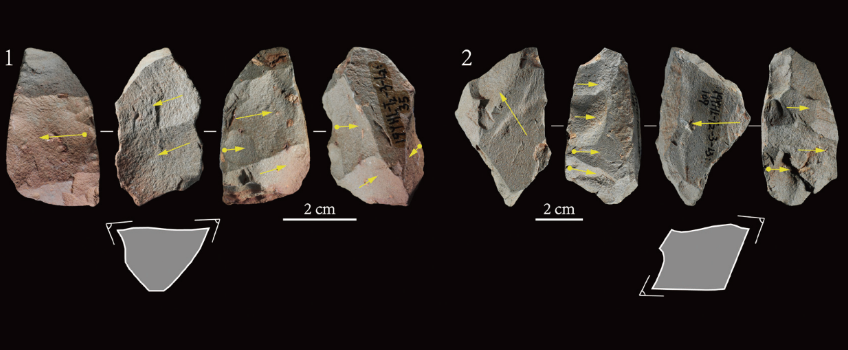
This study provides a comprehensive global review of Quina technology, focusing on its core diagnostic features: 1) plan-secant volumetric organization for blank production, 2) scalariform stepped retouch (i.e. Quina retouch) on thick, asymmetric and lateral flakes, and 3) complex ramification of the Quina chaîne opératoire. The Quina Mousterian is one of the major technological variants of the European Middle Paleolithic, often interpreted as a Neanderthal adaptation to cold climates, marked by high degrees of tool curation and repeated maintenance during seasonal subsistence.
By synthesizing archaeological reports and incorporating new evidence from northwestern Yunnan, this research demonstrates the presence of a well-defined Quina techno-complex in southwestern China. This discovery significantly expands the known geographical distribution of Quina technology beyond its traditional association with Europe.
The identification of Quina techno-complex underscores the diversity and complexity of Middle Paleolithic traditions in China, offering important insights into cultural transmission, regional adaptation, and potential interactions among hominin populations across East and West. Future research should prioritize targeted excavations and interdisciplinary studies at Quina-related sites in northwestern Yunnan. Such investigations will be crucial for establishing a more precise spatial-temporal framework for Quina technology in East Asia and, for exploring the behavioral and taxonomic identity of the hominins who produced it.
| [1] | Hublin JJ, Ben-Ncer A, Bailey SE, et al. New fossils from Jebel Irhoud, Morocco and the pan-African origin of Homo sapiens[J]. Nature, 2017, 546(7657): 289-292 |
| [2] | Slon V, Mafessoni F, Vernot B, et al. The genome of the offspring of a Neanderthal mother and a Denisovan father[J]. Nature, 2018, 561(7721): 113-116 |
| [3] | Chen F, Welker F, Shen CC, et al. A late middle Pleistocene Denisovan mandible from the Tibetan Plateau[J]. Nature, 2019, 569(7756): 409-412 |
| [4] | Richter J. When did the Middle Paleolithic begin?[A]. In: Conard NJ, Richter J(Eds). Neanderthal lifeways, subsistence and technology: One hundred fifty years of Neanderthal study[M]. Dordrecht: Springer Netherlands, 2011: 7-14 |
| [5] | Kuhn SL. Roots of the middle Paleolithic in Eurasia[J]. Current Anthropology, 2013, 54(S8): S255-S268 |
| [6] | 高星. 关于“中国旧石器时代中期”的探讨[J]. 人类学学报, 1999, 18(1): 1-15 |
| [7] | Gao X, Norton CJ. A critique of the Chinese ‘Middle Palaeolithic’[J]. Antiquity, 2002, 76(292): 397-412 |
| [8] | Li H, Li Z, Gao X, et al. Technological behavior of the early Late Pleistocene archaic humans at Lingjing (Xuchang, China)[J]. Archaeological and Anthropological Sciences, 2019, 11: 3477-3490 |
| [9] | Doyon L, Li Z, Li H, et al. Discovery of circa 115,000-year-old bone retouchers at Lingjing, Henan, China[J]. PLoS One, 2018, 13(3): e0194318 |
| [10] | 于建军, 王幼平, 何嘉宁, 等. 新疆吉木乃县通天洞遗址[J]. 考古, 2018, 7: 3-14 |
| [11] | Li F, Kuhn SL, Chen F, et al. The easternmost middle paleolithic (Mousterian) from Jinsitai cave, north China[J]. Journal of Human Evolution, 2018, 114: 76-84 |
| [12] | Hu Y, Marwick B, Zhang JF, et al. Late Middle Pleistocene Levallois stone-tool technology in southwest China[J]. Nature, 2019, 565(7737): 82-85 |
| [13] | Li F, Li Y, Gao X, et al. A refutation of reported Levallois technology from Guanyindong Cave in south China[J]. National Science Review, 2019, 6(6): 1094-1096 |
| [14] | 单明超, 娜仁高娃, 周兴启, 等. 内蒙古赤峰三龙洞发现距今5万年旧石器遗址[N]. 中国文物报,2017-10-20(008) |
| [15] | Wang F, Guo Y, Xian Q, et al. Luminescence chronology for the Paleolithic site of Xinmiaozhuang Locality 1 (XMZ1) in the Nihewan Basin, northern China, and its paleoenvironmental and archaeological implications[J]. Journal of Human Evolution, 2021, 157: 103033 |
| [16] | 吉学平. 大河洞穴之魅:富源大河旧石器遗址揭秘[J]. 中国文化遗产, 2009, 6: 78-83 |
| [17] | 阮齐军, 刘建辉, 胡越, 等. 云南鹤庆天华洞旧石器遗址石制品研究[J]. 人类学学报, 2019, 38(2): 166-181 |
| [18] | 阮齐军, 周建威, 和金梅, 等. 云南鹤庆龙潭旧石器遗址2019—2020年度发掘简报[J]. 南方文物, 2021, 1: 105-118 |
| [19] | 陈宥成, 曲彤丽. 盘状石核相关问题探讨[J]. 考古, 2016, 2: 88-94 |
| [20] | 陈宥成, 曲彤丽. “勒瓦娄哇技术”源流管窥[J]. 考古, 2015, 2: 71-78 |
| [21] | 王潇玉, 高星. 勒瓦娄哇的剥片模式与技术组合[J]. 人类学学报, 2025, 44(1): 1-13 |
| [22] | Jelinek AJ. Neandertal lithic industries at La Quina[M]. Tucson: University of Arizona Press, 2013 |
| [23] | Bordes F, Bourgon M. Le complexe Moustérien: moustériens, levalloisien et tayacien[J]. Anthropologie, 1951, 55: 1-23 |
| [24] | Turq A. Approche technologique et économique du faciès Moustérien de type Quina: étude préliminaire[J]. Bulletin de la Société préhistorique fran?aise, 1989, 86(8): 244-256 |
| [25] | Turq A. Raw material and technological studies of the Quina Mousterian[A]. In: Dibble HL, Mellars P(Eds). The Middle Palaeolithic: Adaptation, Behavior, and Variability[C]. Philadelphia: University of Pennsylvania, 1992: 75-85 |
| [26] | Bourguignon L. Le Moustérien de type Quina: nouvelle définition d’une technique[D]. PhD, Nanterre: Université de Paris X-Nanterre, 1997 |
| [27] | Bourguignon L, Frère-Sautot MC, Ortega I. Apports de l’expérimentation et de l’analyse techno-morpho-fonctionnelle à la reconnaissance du processus d’aménagement de la retouche Quina[A]. In: Préhistoire et approche expérimentale[C]. Montagnac: éditions Monique Mergoil, 2001, 35-66 |
| [28] | Delpiano D, Zupancich A, Bertola S, et al. Flexibility within Quina lithic production systems and tool-use in Northern Italy: implications on Neanderthal behavior and ecology during early MIS 4[J]. Archaeological and Anthropological Sciences, 2022, 14(12): 219 |
| [29] | Hiscock P, Turq A, Faivre JP, Bourguignon L. Quina procurement and tool production[A]. In: Adams B, Blades BS (Eds). Lithic Materials and Paleolithic Societies[C]. Wiley-Blackwell, 2009, 232-246 |
| [30] | Delagnes A, Rendu W. Shifts in Neandertal mobility, technology and subsistence strategies in western France[J]. Journal of Archaeological Science, 2011, 38(8): 1771-1783 |
| [31] | Bourguignon L, Faivre JP, Turq A. Ramification des cha?nes opératoires: une spécificité du Moustérien[J]. Paléo, 2004, 16: 37-48 |
| [32] | Lemorini C, Bourguignon L, Zupancich A, et al. A scraper's life history: Morpho-techno-functional and use-wear analysis of Quina and demi-Quina scrapers from Qesem Cave, Israel[J]. Quaternary International, 2016, 398: 86-93 |
| [33] | Peresani M, Bourguignon L, Delpiano D, et al. Quina on the edge. Insights from a Middle Palaeolithic lithic assemblage of Grotta di Fumane, Italy[J]. Journal of Archaeological Science: Reports, 2023, 49: 103998 |
| [34] | Agam A, Zupancich A. Interpreting the Quina and demi-Quina scrapers from Acheulo-Yabrudian Qesem Cave, Israel: Results of raw materials and functional analyses[J]. Journal of Human Evolution, 2020, 144: 102798 |
| [35] | Claud é, Soressi M, Jaubert J, et al. étude tracéologique de l’outillage moustérien de type Quina de bonebed de Chez-Pinaud à Jonzac (Charente-Maritime)[J]. Gallia Préhistoire-Préhistoire de la France dans son contexte européen, 2012, 54: 3-32 |
| [36] | Britton K, Grimes V, Niven L, et al. Strontium isotope evidence for migration in late Pleistocene Rangifer: Implications for Neanderthal hunting strategies at the Middle Palaeolithic site of Jonzac, France[J]. Journal of Human Evolution, 2011, 61(2): 176-185 |
| [37] | Frouin M, Lahaye C, Valladas H, et al. Dating the middle Paleolithic deposits of La Quina Amont (Charente, France) using luminescence methods[J]. Journal of Human evolution, 2017, 109: 30-45 |
| [38] | Bourguignon L, Djema H, Bertran P, et al. Le gisement Saalien de Petit-Bost (Neuvic, Dordogne) à l’origine du Moustérien d’Aquitaine?[A]. In: Jaubert J, Bordes J, Ortega I(Eds). Les Sociétés Du Paléolithique Dans Un Grand Sud-Ouest de La France: Nouveaux Gisements, Nouveaux Résultats, Nouvelles Méthodes[C]. Paris: Société préhistorique fran?aise, mémoire 47, 2006, 1: 41-55 |
| [39] | Mihailovi? D, Kuhn SL, Bogi?evi? K, et al. Connections between the Levant and the Balkans in the late Middle Pleistocene: archaeological findings from Velika and Mala Balanica Caves (Serbia)[J]. Journal of Human Evolution, 2022, 163: 103138 |
| [40] | Meignen L, Bar-Yosef O. Acheulo-Yabrudian and Early Middle Paleolithic at Hayonim Cave (Western Galilee, Israel): Continuity or break?[J]. Journal of Human Evolution, 2020, 139: 102733 |
| [41] | Falguères C, Richard M, Tombret O, et al. New ESR/U-series dates in Yabrudian and Amudian layers at Qesem Cave, Israel[J]. Quaternary International, 2016, 398: 6-12 |
| [42] | 裴文中, 周明镇. 云南宜良发现之旧石器[J]. 古脊椎动物与古人类, 1961, 2: 139-142 |
| [43] | 邱中郎, 张银运, 胡绍锦. 昆明呈贡龙潭山第2地点的人化石和旧石器[J]. 人类学学报, 1985, 4(3): 233-241 |
| [44] | Hu Y, Marwick B, Lu H, et al. Lithic technologies at Guanyindong cave, Southwest China: diversity and innovation during the Chinese Middle Palaeolithic[J]. Archaeological and Anthropological Sciences, 2024, 16(8): 119 |
| [45] | 肖培源, 阮齐军, 高玉, 等. 2022年云南宾川盆地旧石器遗址调查报告[J]. 人类学学报, 2024, 43(3): 448-457 |
| [46] | Hu Y, Ruan QJ, Liu J, et al. Luminescence chronology and lithic technology of Tianhuadong Cave, an early Upper Pleistocene Paleolithic site in southwest China[J]. Quaternary Research, 2020, 94: 121-136 |
| [47] | Ruan QJ, Li H, Xiao PY, et al. Quina lithic technology indicates diverse Late Pleistocene human dynamics in East Asia[J]. Proceedings of the National Academy of Sciences, 2025, 122(14): e2418029122 |
| [48] | 刘武, 吴秀杰. 中更新世晚期中国古人类化石的形态多样性及其演化意义[J]. 人类学学报, 2022, 41(4): 563-575 |
| [49] | 杨济达, 张志明, 沈泽昊, 等. 云南干热河谷植被与环境研究进展[J]. 生物多样性, 2016, 24(4): 462-474 |
/
| 〈 |
|
〉 |
 京ICP证05002819号-3