


中国北方全新世中晚期人群的颅骨性状
收稿日期: 2024-01-22
录用日期: 2024-09-03
网络出版日期: 2026-02-13
基金资助
教育部人文社会科学研究项目(22YJCZH027);国家社会科学基金冷门绝学研究项目(2018VJX056);北京市教育委员会科技项目(KM202210025029)
Research on the cranial traits of Northern Chinese populations during the middle-to-late Holocene
Received date: 2024-01-22
Accepted date: 2024-09-03
Online published: 2026-02-13
杜抱朴 , 刘丽 , 祝彤 , 于洛嘉 , 景朋 , 杜靖 , 高艳 . 中国北方全新世中晚期人群的颅骨性状[J]. 人类学学报, 2026 , 45(01) : 128 -139 . DOI: 10.16359/j.1000-3193/AAS.2025.0016
As an important topic in Human Osteoarchaeology, the spatial-temporal evolution of Holocene populations is of great significance for exploring migration and environmental adaptations. Previous studies have focused on the craniofacial micro-evolutionary changes within Chinese Holocene populations by comparing groups from different eras. However, different methods of defining epochs can directly affect how researchers interpret and describe their observations and results. Moreover, this approach subjectively divides the continuous changes in human traits. It is worth noting that currently, there are few empirical studies exploring the internal mechanisms of temporal change.
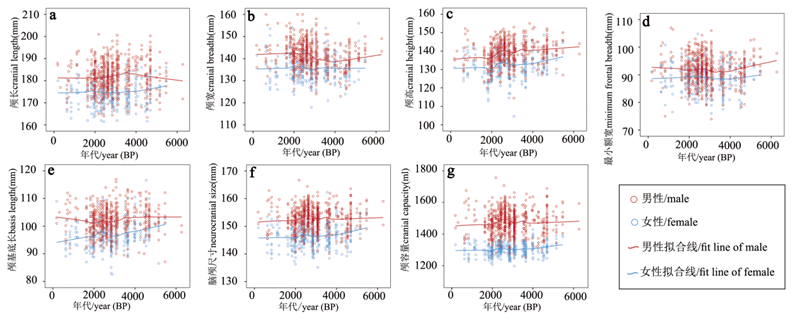
In this paper, 1159 craniums (731 males and 428 females) unearthed from 84 archaeological sites or cemeteries in Northern China were analyzed to study the sequential changes of 31 cranial traits in the middle-to-late Holocene populations. Additionally, linear correlation analysis was employed to analyze the correlation between cranial traits and temperature. The results showed that directional long-term trends and local fluctuations occurred in the sequential changes. In the long-term trends, the neurocranial dimensions slightly decreased, while the viscerocranial dimensions showed a pattern of first decreasing and then increasing. The cranial length-height index changed from hypsicrany to orthocrany; the cranial breadth - height index changed from acrocrany to metriocrany; the orbital index increased from mesoconchy to hypsiconchy; the palatal index increased from mesostaphyliny to brachystaphyliny and then returned to mesostaphyliny.
Furthermore, many cranial traits (cranial height, neurocranial size, cranial capacity, cranial length-height index, and orbital index I) exhibited local fluctuations between 3000 and 2000 years ago. The cranial width and cranial index showed significant linear negative correlations with environmental temperature, while the cranial width - height index showed a significant linear positive correlation with environmental temperature. This phenomenon is intrinsically related to the role of the cranial pattern in regulating heat metabolism equilibrium. The maxillo-alveolar length, maxillo-alveolar breadth, and palatal length showed a significant linear positive correlation with environmental temperature. This relationship is related to the nutritional and masticatory functional impacts on the growth of the nasomaxillary complex, which are influenced by dietary shifts due to environmental temperature variations.
The imbalance between the long-term trends of neurocranial and viscerocranial dimensions is likely closely related to the differences in the mechanisms of cranial growth and development. The local fluctuating changes might be caused by the frequent communication and integration of various ethnic groups during the Xia, Shang, and Zhou Dynasties. Temperature is an important driving factor in the temporal changes of physical characteristics in the Northern Chinese populations during the Holocene. This study provides further insights into the evolution of physical traits in Chinese populations during the middle-to-late Holocene and sheds light on its intrinsic mechanism.
| [1] | Stynder DD, Ackermann RR, Sealy JC. Craniofacial variation and population continuity during the South African Holocene[J]. American Journal of Physical Anthropology, 2007, 134(4): 489-500 |
| [2] | 中国社会科学院考古研究所. 中国考古学·新石器时代卷[M]. 北京: 中国社会科学出版社, 2010, 764-767 |
| [3] | 杜若甫. 中国人群体遗传学[M]. 北京: 科学出版社, 2004, 794-795 |
| [4] | Wang CC, Yeh HY, Popov AN, et al. Genomic insights into the formation of human populations in East Asia[J]. Nature, 2021, 591(7850): 413-419 |
| [5] | 王令红. 中国新石器时代和现代居民的时代变化和地理变异——颅骨测量性状的统计分析研究[J]. 人类学学报, 1986, 5(3): 243-258 |
| [6] | 张振标. 现代中国人起源的实证──颅骨特征的时空变化[J]. 第四纪研究, 1999, 19(2): 113-124 |
| [7] | Brown P, Maeda T. Post-Pleistocene diachronic change in East Asian facial skeletons: the size, shape and volume of the orbits[J]. Anthropological Science, 2004, 112(1): 29-40 |
| [8] | 韩康信.中国夏、商、周时期人骨种族特征之研究[A].见:中国社会科学院考古研究所(主编).新世纪的中国考古学:王仲殊先生八十华诞纪念论文集[C]. 北京: 科学出版社, 2005, 925-951 |
| [9] | 吴秀杰, 刘武, 张全超, 等. 中国北方全新世人群头面部形态特征的微观演化[J]. 科学通报, 2007, 52(2): 192-198 |
| [10] | 李海军, 张全超, 朱泓. 近7000年来中国北方人群下颌骨尺寸变化及意义[J]. 科学通报, 2012, 57(4): 258-266 |
| [11] | Brace CL, Shao XQ, Zhang ZB. Prehistoric and modern tooth size in China[A]. In: Smith FH, Spencer F (Eds). The originof modern humans[M]. New York: Alan R Liss Inc, 1984, 485-516 |
| [12] | 周亚威, 李海军, 朱泓. 全新世中国北方人群第一臼齿齿冠面积和齿尖相对面积的测量分析[J]. 人类学学报, 2013, 32(3): 319-329 |
| [13] | 杜抱朴, 杜靖. 中国全新世人群两性身高差异演变初析[J]. 第四纪研究, 2023, 43(1): 187-199 |
| [14] | Stock JT, Pomeroy E, Ruff CB, et al. Long-term trends in human body size track regional variation in subsistence transitions and growth acceleration linked to dairying[J]. Proceedings of the National Academy of Sciences, 2023, 120(4): e2209482119 |
| [15] | 吕锦燕. 现代中国人眼眶的形态变异[J]. 人类学学报, 2007, 26(2): 128-137 |
| [16] | 贺乐天, 刘武. 甘青地区新石器-青铜时代居民颅面部形态变异及其在人群形成上的意义[J]. 第四纪研究, 2017, 37(4): 721-734 |
| [17] | 李海军. 新石器时代至近代成年男性下颌骨颏孔、下颌孔大小的变化[J]. 解剖学报, 2011, 42(3): 403-405 |
| [18] | 李海军, 陈峰, 戴成萍. 全新世中国北方人群下颌第一臼齿磨耗的比较研究[J]. 第四纪研究, 2017, 37(4): 686-695 |
| [19] | 李海军, 黄玉清, 郭北姮, 等. 中国全新世人群枕外隆突与枕区突隆的时代变异[J]. 解剖学报, 2021, 52(4): 652-656 |
| [20] | Liu C, Tang Y, Ge H, et al. Increasing breadth of the frontal lobe but decreasing height of the human brain between two Chinese samples from a Neolithic site and from living humans[J]. American Journal of Physical Anthropology, 2014, 154(1): 94-103 |
| [21] | Ruff CB, Trinkaus E, Holliday TW. Body mass and encephalization in Pleistocene Homo[J]. Nature, 1997, 387(6629): 173-176 |
| [22] | 杜抱朴, 杜靖. 从头面部测量性状分析中国现代人群体质类型及其成因[J]. 解剖学报, 2019, 50(6): 805-815 |
| [23] | Jantz RL, Meadows Jantz L. Secular change in craniofacial morphology[J]. American Journal of Human Biology, 2000, 12(3): 327-338 |
| [24] | Lee A, Pearson K. Data for the problem of evolution in man: VI, a first study of the correlation of the human skull[J]. Philosophical Transactions of Royal Society of London Series A, 1901, 196: 225-264 |
| [25] | Wu J, Shen C, Yang H, et al. Holocene temperature variability in China[J]. Quaternary Science Reviews, 2023, 312: 108184 |
| [26] | 李福明, 徐瑾如, 李天元, 等. 中国全新世人群头骨尺寸性别差异的时代比较[J]. 解剖学杂志, 2019, 42(3): 287-291 |
| [27] | Enlow DH, Hans MG. 颅面生长发育学[M]. 译者:林久祥. 北京: 北京大学医学出版社, 2012 |
| [28] | Holló G, Szathmáry L, Marcsik A, et al. Linear measurements of the neurocranium are better indicators of population differences than those of the facial skeleton: comparative study of 1,961 skulls[J]. Human Biology, 2010, 82(1): 29-46 |
| [29] | Carson EA. Maximum likelihood estimation of human craniometric heritabilities[J]. American Journal of Physical Anthropology, 2006, 131(2): 169-180 |
| [30] | Hubbe M, Hanihara T, Harvati K. Climate signatures in the morphological differentiation of worldwide modern human populations[J]. The Anatomical Record: Advances in Integrative Anatomy and Evolutionary Biology, 2009, 292(11): 1720-1733 |
| [31] | Beals KL, Smith CL, Dodd SM. Climate and the evolution of brachycephalization[J]. American Journal of Physical Anthropology, 1983, 62(4): 425-437 |
| [32] | von Cramon-Taubadel N. Revisiting the homoiology hypothesis: The impact of phenotypic plasticity on the reconstruction of human population history from craniometric data[J]. Journal of Human Evolution, 2009, 57(2): 179-190 |
| [33] | Paula Menendez L. Moderate climate signature in cranial anatomy of late Holocene human populations from Southern South America[J]. American Journal of Physical Anthropology, 2018, 165(2): 309-326 |
| [34] | 潘其风(主编). 潘其风考古人类学文选[C]. 北京: 科学出版社, 2015, 97-106 |
| [35] | 谭婧泽, 徐智, 金建中, 等.中国青铜至秦汉时期古代居民体质研究[A].见:董为(主编).第十届中国古脊椎动物学学术年会论文集[C]. 北京: 海洋出版社, 2006, 131-141 |
| [36] | 河南省文物局. 荥阳薛村遗址人骨研究报告[M]. 北京: 科学出版社, 2015, 171-172 |
| [37] | Bureti?-Tomljanovi? A, Giacometti J, Ostoji? S, et al. Sex-specific differences of craniofacial traits in Croatia: the impact of environment in a small geographic area[J]. Annals of Human Biology, 2007, 34(3): 296-314 |
| [38] | Katz DC, Grote MN, Weaver TD. A mixed model for the relationship between climate and human cranial form[J]. American Journal of Physical Anthropology, 2016, 160(4): 593-603 |
| [39] | Cho EO, Cowgill LW, Middleton KM, et al. The influence of climate and population structure on East Asian skeletal morphology[J]. Journal of Human Evolution, 2022, 173: 103268 |
| [40] | 李咏兰, 于会新, 张兴华, 等. 中国不同地理分区人群的头面部特征[J]. 人类学学报, 2023, 42(6): 793-806 |
| [41] | 侯光良, 方修琦. 中国全新世气温变化特征[J]. 地理科学进展, 2011, 30(9): 1075-1080 |
| [42] | 章典, 詹志勇, 林初升, 等. 气候变化与中国的战争、社会动乱和朝代变迁[J]. 科学通报, 2004, 49(23): 2468-2474 |
| [43] | 方修琦, 苏筠, 郑景云, 等. 历史气候变化对中国社会经济的影响[M]. 北京: 科学出版社, 2019, 1-275 |
| [44] | 张银运, 刘武. 再论南京直立人的高耸鼻梁和气候适应[J]. 人类学学报, 2010, 29(2): 150-158 |
| [45] | 黎海明, 崔一付, Nathaniel J, 等. 中国中北部地区黄土高原东部新石器晚期-青铜时代不同地貌单元农业发展模式的时空变化[J]. 中国科学:地球科学, 2022, 52(6): 1038-1053 |
| [46] | Wilson KM, McCool WC, Brewer SC, et al. Climate and demography drive 7000 years of dietary change in the Central Andes[J]. Scientific Reports, 2022, 12(1): 2026 |
/
| 〈 |
|
〉 |
 京ICP证05002819号-3