


河北泥河湾盆地东缘石器原料的开发与利用
收稿日期: 2023-10-17
录用日期: 2024-09-23
网络出版日期: 2026-02-13
基金资助
国家重点研发计划项目“以泥河湾盆地为重点的华北早期人类演化与适应研究”(2020YFC1521500)
Lithic raw material resources and early human utilization in the eastern margin of Nihewan Basin, Hebei Province
Received date: 2023-10-17
Accepted date: 2024-09-23
Online published: 2026-02-13
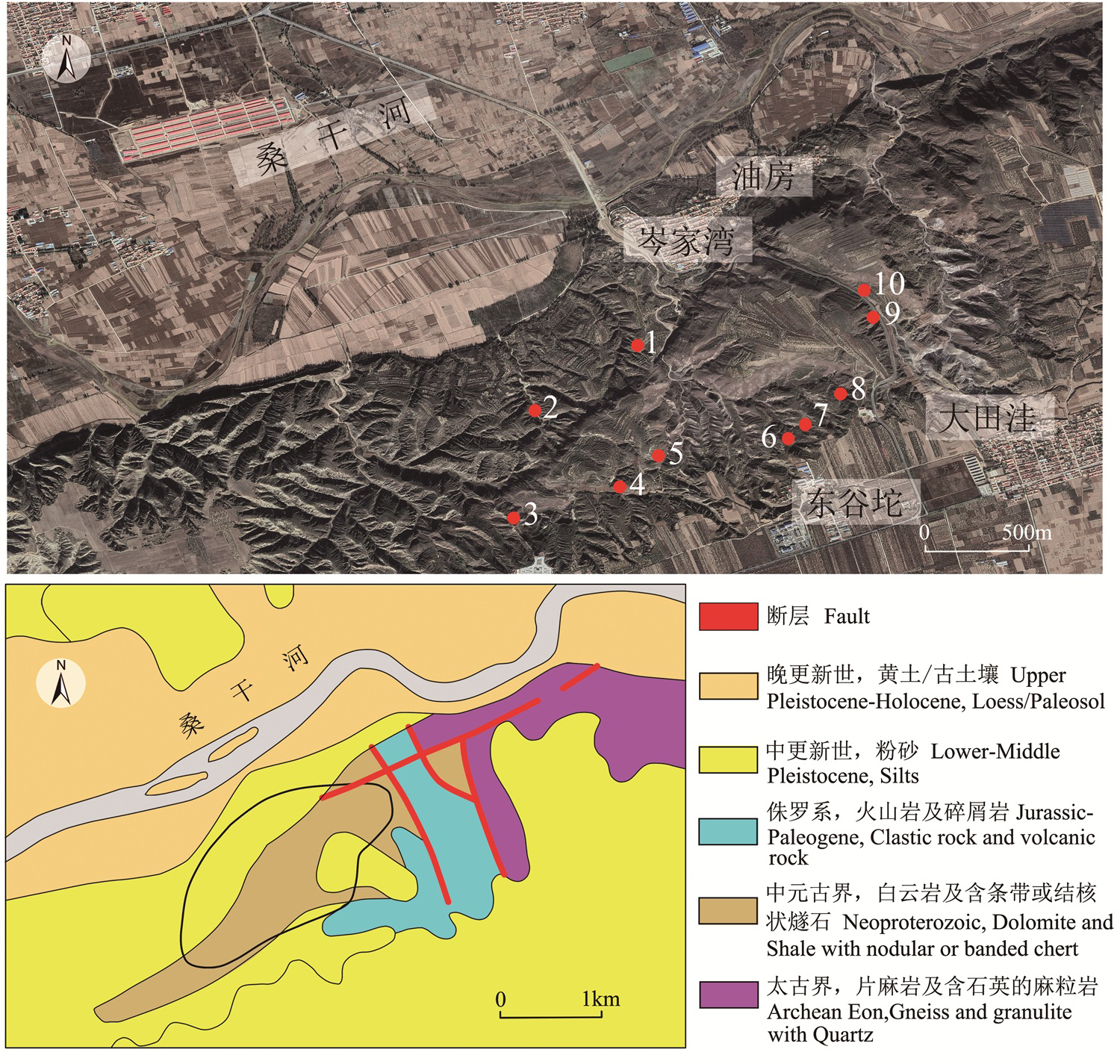
泥河湾盆地岑家湾台地是华北地区史前人类活动的密集区之一,旧石器时代遗址数量丰富,时代延续时间长,石制品原料种类多样,优劣不一。为了解遗址石制品原料产源和周边石料的大致分布情况,作者对该地区开展专门调查,根据纵向地质剖面和横向基岩露头情况分为8个区域,对区域内主要的原料岩性进行镜下切片鉴定后说明石料分布情况。根据以往研究,并以三个遗址为例,将调查区域石料资源与遗址中出土的石制品原料进行对比和来源分析,用以推断可能的原料源地。分析结果显示,该区域内古人类活动主要采用就近取材的方式开发和利用石料资源,以最小的距离成本获取原料来满足打制石制品需要。本文结合岩相学和宏观观察的方法,初步建立了泥河湾盆地东缘古人类活动遗址与石料产源地之间的联系,研究中定性化的推测相对较多,有待利用更多科技手段进一步量化分析和完善。
赵海龙 , 周天路 , 马冲 , 杨博灿 , 贾倩 . 河北泥河湾盆地东缘石器原料的开发与利用[J]. 人类学学报, 2026 , 45(01) : 34 -45 . DOI: 10.16359/j.1000-3193/AAS.2025.0028
The Cenjiawan Platform of the Nihewan Basin is one of the regions with intensive prehistoric human activities in North China. It boasts a large number of Paleolithic sites, a long chronological span, diverse raw material types, and varying qualities. Stone materials, as crucial means for prehistoric people to produce tools, significantly influenced early humans’ manufacturing techniques, population migrations, and social organizational structures. The selection of raw materials also mirrored ancient people’s understanding and utilization of resources, ultimately reflecting the evolution of their cognitive abilities. Abundant stone resources are among the indispensable factors contributing to the rich remains of prehistoric human activities in this area.
To ascertain the provenance of stone artifact raw materials at the sites and the approximate distribution of surrounding stone resources, we conducted a specialized investigation. The area was divided into eight regions based on the longitudinal geological sections and bedrock exposures. After identifying the main raw material lithologies through thin-section petrographic analysis, we described the distribution of stone materials in each region. Among the sites in the Cenjiawan platform area, flint predominantly originates from the Youfang fault and Zhoujiashan bedrock; dolomite and siliceous limestone mainly come from slope deposits; and esitic porphyrite, basalt, tuff, and other igneous rocks primarily come from the Huoshigou and Hougou areas. The above-mentioned raw materials, along with others that account for a relatively small proportion at the sites, are found in the gravel layer at the bottom of the Nihewan Formation. Subsequently, based on previous studies, we compared and analyzed the stone material resources in the investigation area with the lithic raw material sources of the archaeological sites discovered there, inferring the possible raw material sources of the sites. The results basically indicate that prehistoric inhabitants in this area mainly adopted the strategy of sourcing stone materials locally to meet the needs of stone artifact production with the minimum transportation cost. The scarcity of high-quality raw materials and the utilization of abundant nearby stone materials provide insights into the “expediency” of prehistoric human stone tool production at that time. It also reflects the limited scope of human activities, the low demand for high-quality stone materials, and the extent of their environmental awareness. This paper combines petrographic and macroscopic observation methods to preliminarily establish the relationship between archaeological sites and stone material sources. However, the current research is more abundant in qualitative inferences, which need to be further quantified using more advanced technological means.
| [1] | Andrefsky W. Raw-material availability and the organization of technology[J]. American Antiquity, 1994, 59(1): 21-34 |
| [2] | Kaufman D. Redating the social revolution: the case for the Middle Paleolithic[J]. Journal of Anthropological Research, 2002, 58: 477-492 |
| [3] | Browne CL, Wilson L. Evaluating inputs to models of hominin raw material selection: map resolution and path choices[J]. Journal of Archaeological Science, 2013, 40(11): 3955-3962 |
| [4] | Marta Sánchez de la Torre. El sílex en su contexto geológico: Un corpus de datos para el Pirineo centro-oriental [Chert in its geological context: A data corpus for the central-eastern Pyrenees][J]. Journal of Lithic Studies, 2015, 2(2): 167-187 |
| [5] | Crandell O. Knappable materials in the Cris Valley, Romania[J]. Journal of Lithic Studies, 2014, 1(2): 47-62 |
| [6] | Montegú J, Franco Salvi V, Salazar J. First technological and provenance analysis on obsidian artifacts from Tafí Valley (Tucumán Province, Argentine Republic)[J]. Journal of Lithic Studies, 2018, 5(2) |
| [7] | Vera Bogosavljevi P, Markovi J. Raw material studies of West Central Serbia[J]. Journal of Lithic Studies, 2014, 1(1): 55-71 |
| [8] | Sánchez M, Rey M, Rodríguez N, et al. The Lithic UB project: A virtual lithotheque of siliceous rocks at the University of Barcelona[J]. Journal of Lithic Studies, 2014, 1(1): 281-292 |
| [9] | 杨石霞, 岳健平. 史前人类对资源的认知和开发能力——石器原料研究的方法与意义[J]. 人类学学报, 2020, 39(1): 12-20 |
| [10] | 裴树文. 石制品原料的分类命名及相关问题讨论[J]. 文物春秋, 2001, 2: 17-23+76 |
| [11] | 刘扬. 谈旧石器时代石制品原料质量的评估标准[N]. 中国文物报,2014-04-25(006) |
| [12] | 高星. 周口店第15地点石器原料开发方略与经济形态研究[J]. 人类学学报, 2001, 20(3): 186-200 |
| [13] | 陈淳. 旧石器研究:原料、技术及其他[J]. 人类学学报, 1996, 3: 268-275 |
| [14] | 谢光茂. 原料对旧石器加工业的影响[J]. 广西民族研究, 2001, 2: 99-102 |
| [15] | 李锋, 王春雪, 刘德成, 等. 周口店第一地点第4-5层脉石英原料产地分析[J]. 第四纪研究, 2011, 31(5): 900-908 |
| [16] | 裴树文, 侯亚梅. 东谷坨遗址石制品原料利用浅析[J]. 人类学学报, 2001, 4: 271-281 |
| [17] | 杜水生. 泥河湾盆地东部早期旧石器文化的石料与文化性质探讨[J]. 文物春秋, 2002, 2: 8-15 |
| [18] | 杨晓冬. 泥河湾盆地南山根地点的发现与研究[D]. 硕士学位毕业论文, 石家庄: 河北师范大学, 2019 |
| [19] | Yang SX, Hou YM, Yue JP, et al. The lithic assemblages of Xiaochangliang, Nihewan Basin: Implications for Early Pleistocene hominin behaviour in North China[J]. PLOS ONE, 2016, 11(5): e0155793 |
| [20] | Pei SW, Xie F, Deng CL, et al. Early Pleistocene archaeological occurrences at the Feiliang site, and the archaeology of human origins in the Nihewan Basin, North China[J]. Plos One, 2017, 12(11): e0187251 |
| [21] | 贾真秀. 泥河湾盆地早更新世古人类遗址成因与石器技术比较研究——以东谷坨、麻地沟和飞梁遗址为例[D].博士研究生毕业论文, 北京: 中国科学院大学, 2018 |
| [22] | 袁宝印, 夏正楷, 牛平山. 泥河湾裂谷与古人类[M]. 北京: 地质出版社, 2011 |
| [23] | 河北省革命委员会基本建设局地质勘测总队测绘大队. 1:20万《天镇幅》地质图说明书[R]. 河北省革命委员会基本建设局, 1970, 1-57 |
| [24] | 谢飞. 泥河湾[M]. 北京: 文物出版社, 2006 |
| [25] | 陈淳, 沈辰, 陈万勇, 等. 河北阳原小长梁遗址1998年发掘报告[J]. 人类学学报, 1999, 3: 225-239 |
| [26] | 裴树文, 贾真秀, 马东东, 等. 泥河湾盆地麻地沟E5旧石器地点的遗址成因与石器技术[J]. 人类学学报, 2016, 35(4): 493-508 |
| [27] | Guan Y, Wang FG, Xie F, et al. Flint knapping strategies at Cenjiawan, an Early Paleolithic site in the Nihewan Basin, North China[J]. Quaternary International, 2016, 400(2): 86-92 |
| [28] | Yang SX, Petraglia Michael D, Hou YM, et al. Correction: The lithic assemblages of Donggutuo, Nihewan basin: Knapping skills of Early Pleistocene hominins in North China[J]. PloS ONE, 2017, 12(12) |
| [29] | 刘连强, 王法岗, 杨石霞, 等. 泥河湾盆地马梁遗址第10地点2016年出土石制品研究[J]. 人类学学报, 2018, 37(3): 419-427 |
| [30] | 曹明明. 泥河湾盆地后沟遗址初步研究[D]. 硕士学位毕业论文, 北京: 中国科学院古脊椎动物与古人类研究所, 2007 |
| [31] | 侯亚梅, 刘扬, 李英华, 等. 泥河湾盆地三棵树旧石器遗址2008年试掘报告[J]. 人类学学报, 2010, 29(3): 227-241 |
| [32] | 赵海龙, 谭培阳, 孙雪峰, 等. 河北泥河湾盆地油房北旧石器地点的发现与研究[J]. 第四纪研究, 2021, 41(1): 164-177 |
| [33] | 谢飞, 成胜泉. 河北阳原油房细石器发掘报告[J]. 人类学学报, 1989, 8(1): 59-68+104 |
| [34] | Bustillo MA, Casta?eda N, Capote M, et al. Is the macroscopic classification of flint useful? a petroarchaeological analysis and characterization of flint raw materials from the iberian neolithic mine of casa montero[J]. Archaeometry, 2009, 51(2): 175-196 |
| [35] | 陈曦, 赵海龙, 张贝, 等. 泥河湾盆地石沟遗址B区发掘报告[J]. 第四纪研究, 2017, 37(4): 895-907 |
| [36] | 河北省地质矿产局. 河北省、北京市、天津市区域地质志[R]. 见:中华人民共和国地质矿产部地质专报·区域地质(第15号)[C]. 北京: 地质出版社, 1989, 1-741 |
| [37] | Telmo P, Anne F, Eduardo P. Presenting LusoLit: A lithotheque of knappable raw materials from central and southern Portugal[J]. Journal of Lithic Studies, 2016, 3(2): 743-757 |
/
| 〈 |
|
〉 |
 京ICP证05002819号-3