


广西西部新发现的猩猩牙齿化石及其分类演化意义
收稿日期: 2025-11-06
修回日期: 2026-01-29
网络出版日期: 2026-04-17
基金资助
国家社科基金重大招标项目(20&ZD246);国家自然科学基金(42472007);国家自然科学基金(42502016)
Newly discovered orangutan fossils from western Guangxi and their taxonomic and evolutionary significance
Received date: 2025-11-06
Revised date: 2026-01-29
Online published: 2026-04-17
牙齿化石的形态特征分析对于构建猩猩的系统分类与演化框架具有重要意义。但是,中国南方地区的猩猩化石在此方面还未开展过相关研究工作。本文报道了发现于广西壮族自治区百色市田东县独山上洞遗址新发现的64颗猩猩牙齿化石。通过对其上颌前臼齿与臼齿的形态性状进行编码,并采用对应分析和层次聚类分析的方法,我们将该标本与越南北部谅山猿属(Langsonia)、猩猩属(Pongo)化石以及现生猩猩(P. pygmaeus)进行了比较,结果表明,独山上洞标本的形态变异范围不仅超过了越南北部的相关类群,也与现生猩猩存在显著区别。结合牙齿化石尺寸与地质年代,我们将独山上洞猩猩标本归入魏氏猩猩(P. weidenreichi)。未来更多的牙齿化石形态性状评分和分析工作将进一步完善中国南方猩猩化石的分类体系和系统演化关系。
王思元 , 李金燕 , 梁华 , 谢耀樟 , 廖卫 , 王伟 . 广西西部新发现的猩猩牙齿化石及其分类演化意义[J]. 人类学学报, 2026 , 45(02) : 224 -235 . DOI: 10.16359/j.1000-3193/AAS.2026.0013
Analysis of the morphological characteristics of dental fossils is crucial for reconstructing the phylogenetic classification and evolutionary framework of orangutans. However, the fossil orangutan specimens from southern China have not been subjected to such research in this regard. This paper reports newly discovered orangutan teeth from the Dushanshang Cave site. Using morphological analysis methods for dental fossils, it attempts to construct a systematic classification and evolutionary framework for orangutans.
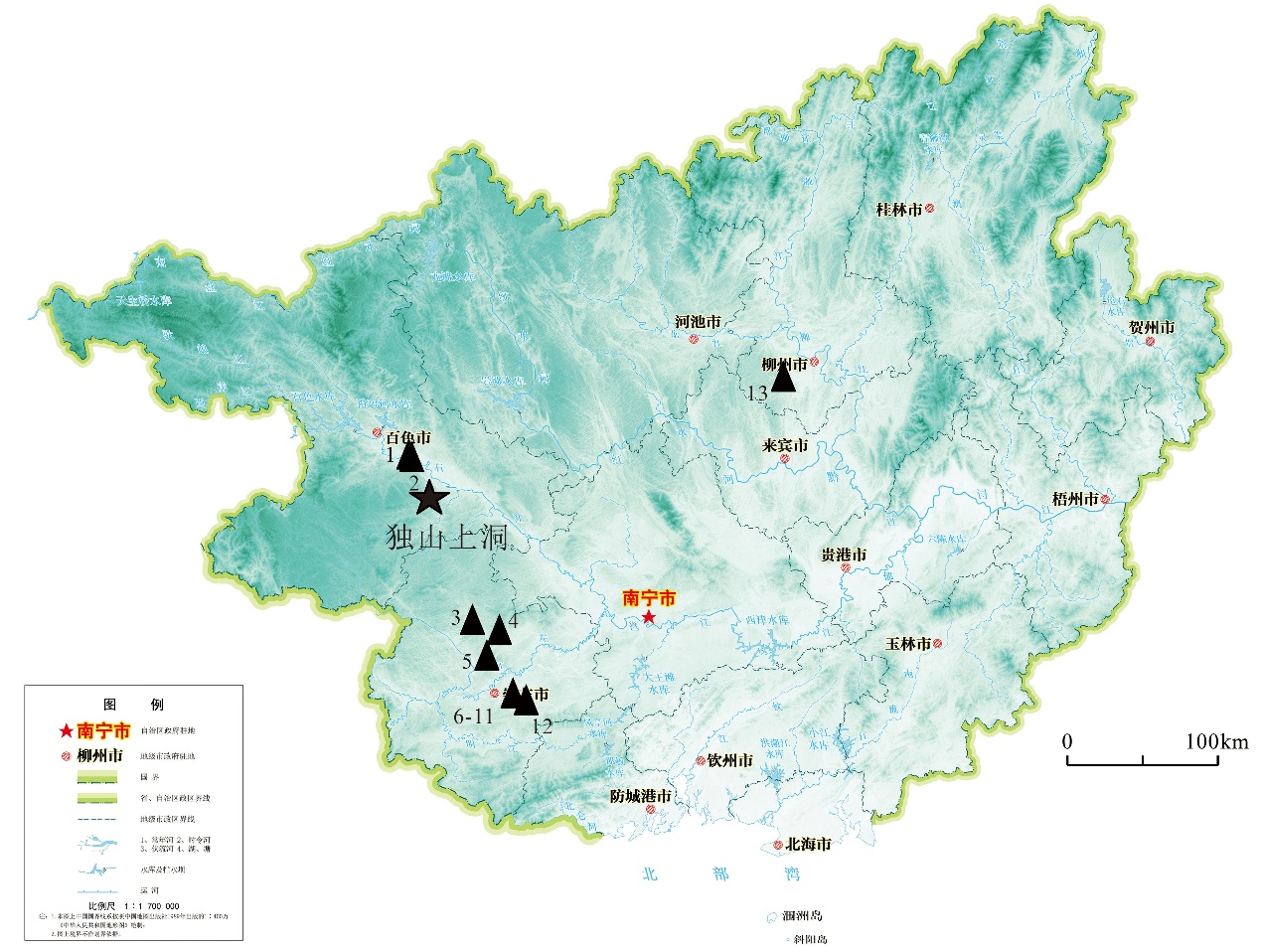
The Dushanshang Cave site is located in Yonglong Village, Linfeng Town, Tiandong County, Baise City, in the western part of Guangxi Zhuang Autonomous Region. The cave entrance faces northwest. Inside, the cave is 1~5 m wide and approximately 55 m long. The cave runs east-west overall. The entrance sits at an elevation of 236 meters above sea level, with the ground level outside the entrance approximately 16 m below. In 2012, the Guangxi Natural History Museum collaborated with the Tiandong County Museum to excavate this cave site. Prior to systematic excavation, researchers established Test Pit T1 approximately 50 meters from the cave entrance based on the preservation and distribution of deposits at Dushanshang Cave. After clearing disturbed surface deposits, excavation proceeded in 10-centimeter horizontal layers from top to bottom. Sediments from each layer were systematically collected and dry-sieved outside the cave using a 4 mm mesh to recover smaller fossils. The final excavation depth of T1 approximately 130 cm.
In addition to orangutan fossils, over 500 mammal tooth fossils were discovered at Dushanshang Cave. Representative mammal species include the Ailuropoda milanoleuea daconi, Stegodon orientalis, Elephas maximus and Megatapirus augustus. Based on comparisons with mammal faunas from different periods of the Quaternary in southern China, the Dushanshang Cave mammal assemblage has been tentatively dated to the Late Middle Pleistocene.
By encoding the morphological traits of the upper premolars and molars and employing correspondence analysis combined with classical hierarchical cluster analysis, we compared orangutan specimens from the Dushanshang Cave with fossils of the genus Langsonia and Pongo from northern Vietnam, as well as with extant P. pygmaeus. The results indicate that the morphological variation range of the Dushanshang Cave specimens not only exceeds that of the relevant groups from northern Vietnam but also shows significant distinctions from extant orangutans. Considering their dental dimensions and geological age, we assign them to P. weidenreichi. Further scoring and analysis of morphological traits from additional dental fossils will help refine the classification system and clarify the evolutionary relationships of orangutan fossils in southern China.
| [1] | Groves CP. Primate Taxonomy[M]. Washington: Smithsonian Institution Press, 2001, 1-350 |
| [2] | Nater A, Mattle-Greminger MP, Nurcahyo A, et al. Morphometric, Behavioral, and Genomic Evidence for a New Orangutan Species[J]. Current Biology, 2017, 27: 3487-3498 |
| [3] | Liang H, Harrison T, Shao Q, et al. Evidence for the smallest fossil Pongo in southern China[J]. Journal of human evolution, 2024, 189: 103507 |
| [4] | Liang H, Harrison T, Shao Q, et al. Middle Pleistocene Pongo from Ganxian Cave in southern China with implications for understanding dental size evolution in orangutans[J]. Journal of human evolution, 2023, 178: 103348 |
| [5] | Liao W, Harrison T, Yao Y, et al. Evidence for the latest fossil Pongo in southern China[J]. Journal of human evolution, 2022, 170: 103233 |
| [6] | Harrison T, Zhang Y, Yang L, et al. Evolutionary trend in dental size in fossil orangutans from the Pleistocene of Chongzuo, Guangxi, southern China[J]. Journal of Human Evolution, 2021, 161: 103090 |
| [7] | Harrison T, Jin CZ, Zhang YQ, et al. Fossil Pongo from the Early Pleistocene Gigantopithecus fauna of Chongzuo, Guangxi, southern China[J]. Quaternary International, 2014, 354: 59-67 |
| [8] | Wang CB, Zhao LX, Jin CZ, et al. New discovery of Early Pleistocene orangutan fossils from Sanhe Cave in Chongzuo, Guangxi, southern China[J]. Quaternary International, 2014, 354: 68-74 |
| [9] | Wang W, Potts R, Baoyin Y, et al. Sequence of mammalian fossils, including hominoid teeth, from the Bubing Basin caves, South China[J]. Journal of Human Evolution, 2007, 52: 370-379 |
| [10] | 顾玉眠, 黄万波, 宋方义, 等. 两广部分地区猩猩化石的研究[J]. 人类学学报, 1987, 6: 272-283 |
| [11] | 赵凌霞, 王翠斌, 金昌柱, 等. 广西崇左木榄山洞古人类遗址中发现的猩猩类牙齿化石及其分类演化意义[J]. 科学通报, 2009, 54: 2920-2926 |
| [12] | 赵凌霞, 张忠文, 戴犁. 贵州毕节团结乡麻窝口洞发现晚更新世猩猩化石[J]. 人类学学报, 2009, 28: 191-200 |
| [13] | Ciochon RL. Lang Trang Caves: a new Middle Pleistocene hominid site from northern Vietnam[J]. American Journal of Physical Anthropology, 1990, 81: 205 |
| [14] | Drawhorn GM. The systematics and paleodemography of fossil orangutans (genus Pongo)[D]. PhD thesis, California: University of California Davis, 1995, 1-198 |
| [15] | Olsen JW, Ciochon RL. A review of evidence for postulated Middle Pleistocene occupations in Vietnam[J]. Journal of Human Evolution, 1990, 19: 761-788 |
| [16] | Schwartz JH, Long VT, Cuong NL, et al. A diverse hominoid fauna from the Late Middle Pleistocene breccia cave of Tham Khuyen, Socialist Republic of Vietnam[J]. Anthropological papers of the Ameirican Museum of Natural History, 1994, 73: 1-11 |
| [17] | Schwartz JH, Long VT, Cuong NL, et al. A review of the Pleistocene hominoid fauna of the Socialist Republic of Vietnam (excluding Hylobatidae)[J]. Anthropological papers of the Ameirican Museum of Natural History, 1995, 76: 1-233 |
| [18] | Bacon AM, Demeter F, Tougard C, et al. The discovery of a Pleistocene fauna in karstic fills at Tam Hang in Laos: preliminary results[J]. Comptes Rendus Palevol, 2008, 7: 277-288 |
| [19] | Bacon AM, Duringer P, Antoine PO, et al. The Middle Pleistocene mammalian fauna from Tam Hang karstic deposit, northern Laos: New data and evolutionary hypothesis[J]. Quaternary International, 2011, 245: 315-332 |
| [20] | Bacon AM, Duringer P, Westaway K, et al. Testing the savannah corridor hypothesis during MIS2: The Boh Dambang hyena site in southern Cambodia[J]. Quaternary International, 2018, 464: 417-439 |
| [21] | Filoux A, Wattanapituksakul A. The Late Pleistocene Orangutan from Tham Prakai Phet: New discoveries[J]. Annales De Paleontologie, 2019, 105: 287-293 |
| [22] | Filoux A, Wattanapituksakul A, Lespes C, et al. A Pleistocene mammal assemblage containing Ailuropoda and Pongo from Tham Prakai Phet cave, Chaiyaphum Province, Thailand[J]. Geobios, 2015, 48: 341-349 |
| [23] | Zeitoun V, Lenoble A, Laudet F, et al. The Cave of the Monk (Ban Fa Suai, Chiang Dao wildlife sanctuary, northern Thailand)[J]. Quaternary International, 2010, 220: 160-173 |
| [24] | Ibrahim YK, Lim TT, Westaway KE, et al. First discovery of Pleistocene orangutan (Pongo sp.) fossils in Peninsular Malaysia: Biogeographic and paleoenvironmental implications[J]. Journal of Human Evolution, 2013, 65: 770-797 |
| [25] | Harrison T, Krigbaum J, Manser J. Primate biogeography and ecology on the Sunda Shelf Islands: a paleontological and zooarchaeological perspective[A]. In: Lehman SM, Fleagle JG (Eds.). Primate biogeography[C]. New York: Springer, 2006, 331-372 |
| [26] | Harrison T. The palaeoecological context at Niah Cave, Sarawak: evidence from the primate fauna[J]. Bulletin of the Indo-Pacific Prehistory Association, 1996, 14: 90-100 |
| [27] | Harrison T. Archaeological and ecological implications of the primate fauna from prehistoric sites in Borneo[J]. Bulletin of the Indo-Pacific Prehistory Association, 2000, 20: 134-146 |
| [28] | Hooijer DA. The orang-utan in Niah Cave prehistory[J]. Sarawak Museum Journal, 1960, 9: 408-421 |
| [29] | Hooijer DA. Prehistoric teeth of man and of the orang-utan from central Sumatra, with notes on the fossil orang-utan from Java and southern China[M]. Leiden: Zoologische Mededeelingen, 1948, 175-301 |
| [30] | Cameron WD, Ciochon LR, Vu L, et al. Morphology of the Upper Post Canine Complex of Pleistocene Ponginae From Vietnam—Anatomical Variability and Systematics[J]. American Journal of Biological Anthropology, 2025, 186(4): e70049 |
| [31] | Szalay FS, Delsen E. Evolutionary History of the Primates[M]. New York: Academic Press, 1979 |
| [32] | Cameron DW. The Single Species Hypothesis and Hispanopithecus Fossils from the Valles Penedes Basin, Spain[J]. Zeitschrift für Morphologie und Anthropologie, 1999, 82: 159-186 |
| [33] | Hammer Ø, Harper DAT, Ryan PD. PAST P’Aleontological STatistics Version 4.17[CP]. ,https://www.nhm.uio.no/english/research/resources/past/index.html2024 |
/
| 〈 |
|
〉 |
 京ICP证05002819号-3