


广西柳城步氏巨猿牙结石中的植物微体遗存
收稿日期: 2025-11-03
修回日期: 2026-01-05
网络出版日期: 2026-04-17
基金资助
中国科学院稳定支持基础研究领域青年团队计划(YSBR-019)
Plant micro-remains from dental calculus of Gigantopithecus blacki in Liucheng, Guangxi
Received date: 2025-11-03
Revised date: 2026-01-05
Online published: 2026-04-17
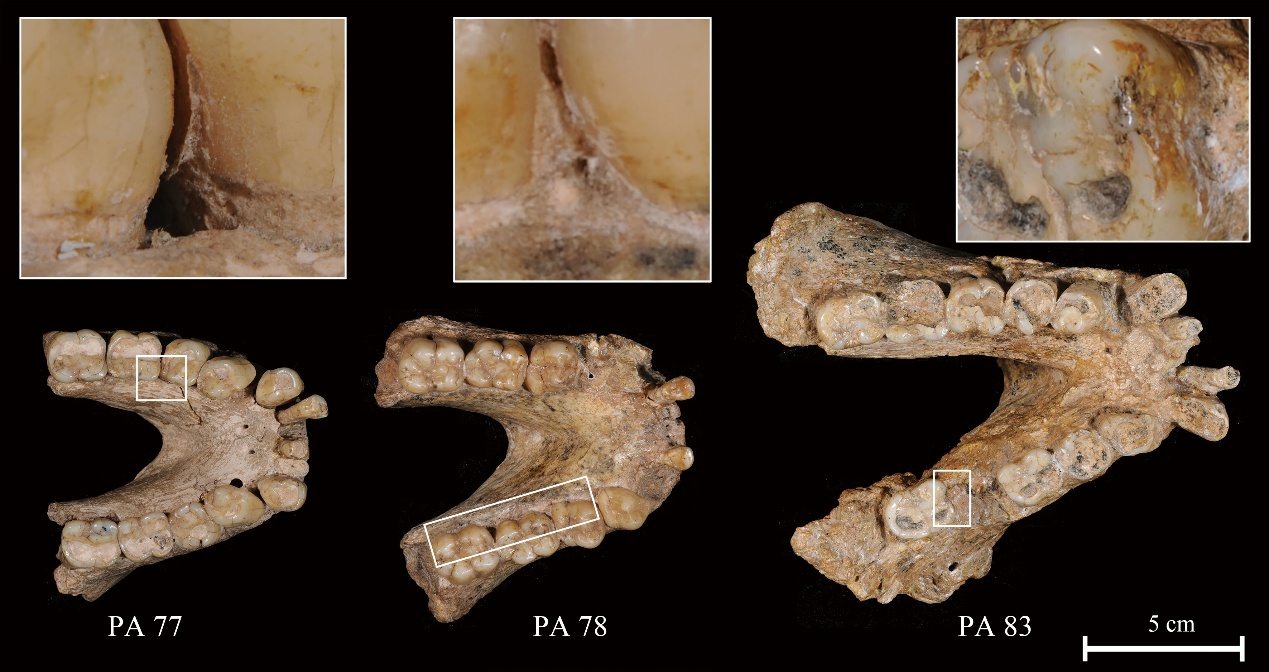
步氏巨猿(Gigantopithecus blacki)的食性特征是揭示其演化适应与绝灭机制的关键证据。本文通过分析广西柳城巨猿洞发现的3件巨猿下颌牙结石中的植物残留物,探索步氏巨猿的食性,在尽量保持牙结石完整、避免植物微体损伤的前提下,提取并分析其中的植物微体遗存。本研究共提取8份样本,研究结果表明:5份为牙结石样本,3份为其他沉积物样本;5份牙结石样本共提取出5颗淀粉粒(禾本科草籽、木本植物果实、植物的块根块茎)、4颗植硅体和较多破损植物纤维和管胞遗骸。综上,步氏巨猿食谱兼具禾本科草籽、树冠果实、叶片(裸子植物、蕨类)、茎秆和植物枝条等,丰富的植物纤维和管胞等遗存表明步氏巨猿食性结构中植物粗纤维的高占比,为复原步氏巨猿的食性信息提供了新的生物考古学证据。
杜瑞妍 , 张茂林 , 关莹 . 广西柳城步氏巨猿牙结石中的植物微体遗存[J]. 人类学学报, 2026 , 45(02) : 268 -279 . DOI: 10.16359/j.1000-3193/AAS.2026.0012
Gigantopithecus blacki, the largest extinct species within the family Hominidae, provides significant insights into the survival adaptations and extinction of primates. This study focuses on the plant-based dietary evidence of G. blacki from the Gigantopithecus Cave site in Liucheng, Guangxi. Using micro-nano spectral CT analysis, we systematically tested the composition of dental calculus samples attached to the teeth of the only three currently discovered G. blacki mandibles, extracting and analyzing the plant residues within these samples. The results show that the plant microfossils identified in the dental calculus include: starch granules from Poaceae grass seeds, fruits of woody plants, and plant roots and stems; Elongate echinate phytoliths; and tracheary elements from Water Hemlock or fern plants. Additionally, the samples contained ladder-like perforation plates from woody plant stems and reticulate vessels from the phloem of Lardizabalaceae plants. These findings indicate that the diet of G. blacki was highly diverse, covering multiple ecological niches of C3 plants and providing new evidence for its bamboo consumption behavior. This also suggests its selection of ancient relict plant groups, offering new perspectives on the ecological relationship between large primates and ancient plant communities.
In summary, although the G. blacki specimens from the Liucheng Gigantopithecus Cave site date back approximately 1.2 to 0.9 million years, dental calculus on some of the teeth retained sufficient plant residue information to support further dietary reconstruction. This study combines micro-nano spectral CT and plant residue extraction techniques, enabling rapid compositional assessment of calculus samples, thus providing a novel approach for future research on fossilized dental calculus samples that are difficult to distinguish visually. Future research should expand along both temporal and spatial dimensions: temporally, by analyzing G. blacki dental fossil samples from different geological periods, comparing the differences in plant community composition across these periods, and exploring whether its diet adapted to changes in paleoclimate and paleovegetation, thereby providing dietary evidence for understanding the evolutionary dynamics of G. blacki; spatially, considering the current distribution of G. blacki fossils across Guangxi, Hubei, Chongqing, Guizhou, and Hainan, future comparative studies of regional samples could analyze whether geographical isolation led to regional dietary differentiation, investigate the impact of different regional paleoenvironments on its diet, and refine the study of G. blacki’s ecological distribution and adaptation patterns. This would provide a more comprehensive ecological perspective for exploring the diet and extinction of Gigantopithecus blacki.
Key words: Gigantopithecus blacki; starch granules; phytoliths; plant tracheary elements; diet
| [1] | Zhang Y, Westaway KE, Haberle S, et al. The demise of the giant ape Gigantopithecus blacki[J]. Nature, 2024, 625(7995): 535-539 |
| [2] | 张颖奇. 步氏巨猿研究九十年的回顾与展望[J]. 人类学学报, 2024, 43(6): 1006-1026 |
| [3] | 裴文中. 广西柳城“巨猿”下颚骨的发现[J]. 科学通报, 1957, 6: 174-176 |
| [4] | Wang W. New discoveries of Gigantopithecus blacki teeth from Chuifeng Cave in the Bubing Basin, Guangxi, south China[J]. Journal of Human Evolution, 2009, 57(3): 229-240 |
| [5] | Takai M, Zhang Y, Kono RT, et al. Changes in the composition of the Pleistocene primate fauna in southern China[J]. Quaternary International, 2014, 354: 75-85 |
| [6] | Jin C, Wang Y, Deng C, et al. Chronological sequence of the early Pleistocene Gigantopithecus faunas from cave sites in the Chongzuo, Zuojiang River area, South China[J]. Quaternary International, 2014, 354: 4-14 |
| [7] | 董为, 王元, 白炜鹏, 等. 广西崇左缺缺洞早更新世晚期堆积中与巨猿伴生的偶蹄类[J]. 人类学学报, 2020, 39(2): 306-318 |
| [8] | Miller SF, White JL, Ciochon RL. Assessing mandibular shape variation within Gigantopithecus using a geometric morphometric approach[J]. Am J Phys Anthropol, 2008, 137(2): 201-212 |
| [9] | Ciochon R, Olsen J, James J. Other origins: the search for the giant ape in human prehistory[M]. New York: Random House Publishing Group, 1990, 1-262 |
| [10] | 张银运. 步氏巨猿牙齿大小上的变异性和南方古猿类食性假说[J]. 人类学学报, 1983, 3: 205-217 |
| [11] | Yinyun Z. Variability and evolutionary trends in tooth size of Gigantopithecus blacki[J]. American Journal of Physical Anthropology, 1982, 59(1): 21-32 |
| [12] | Zhao L, Zhang L, Zhang F, et al. Enamel carbon isotope evidence of diet and habitat of Gigantopithecus blacki and associated mammalian megafauna in the Early Pleistocene of South China[J]. Chinese Science Bulletin, 2011, 56(33): 3590-3595 |
| [13] | Qu Y, Jin C, Zhang Y, et al. Preservation assessments and carbon and oxygen isotopes analysis of tooth enamel of Gigantopithecus blacki and contemporary animals from Sanhe Cave, Chongzuo, South China during the Early Pleistocene[J]. Quaternary International, 2014, 354: 52-58 |
| [14] | 赵凌霞, 张立召, 张福松, 等. 根据步氏巨猿与伴生动物牙釉质稳定碳同位素分析探讨其食性及栖息环境[J]. 科学通报, 2011, 56(35): 2981-2987 |
| [15] | Hylander WL, Ravosa MJ, Ross CF, et al. Mandibular corpus strain in primates: further evidence for a functional link between symphyseal fusion and jaw-adductor muscle force[J]. Am J Phys Anthropol, 1998, 107(3): 257-271 |
| [16] | Ross CF, Iriarte-Diaz J, Nunn CL. Innovative approaches to the relationship between diet and mandibular morphology in primates[J]. International Journal of Primatology, 2012, 33(3): 632-660 |
| [17] | Zhixing Y, Clément Z, Wei L, et al. Estimates of absolute crown strength and bite force in the lower postcanine dentition of Gigantopithecus blacki[J]. Journal of Human Evolution, 2023, 175: 103313 |
| [18] | 张立召, 赵凌霞. 巨猿牙齿釉质厚度及对食性适应与系统演化的意义[J]. 人类学学报, 2013, 32(3): 365-76 |
| [19] | 赵资奎, 张文定. 巨猿(Gigantopithecus blacki)牙齿釉质的超微结构[J]. 古脊椎动物学报, 1994, 2: 87-93 |
| [20] | Zhao LX, Zhang LZ. New fossil evidence and diet analysis of Gigantopithecus blacki and its distribution and extinction in South China[J]. Quaternary International, 2013, 286: 69-74 |
| [21] | Kupczik K, Dean MC. Comparative observations on the tooth root morphology of Gigantopithecus blacki[J]. Journal of Human Evolution, 2008, 54(2): 196-204 |
| [22] | Ciochon RL, Piperno DR, Thompson RG. Opal phytoliths found on the teeth of the extinct ape Gigantopithecus blacki: implications for paleodietary studies[J]. Proceedings of the National Academy of Sciences of the United States of America, 1990, 87(20): 8120-8124 |
| [23] | 屈亚婷. 步氏巨猿的摄食行为及其对巨猿演化的潜在影响[D]. 博士研究生毕业论文, 北京: 中国科学院大学, 2014 |
| [24] | 金昌柱, 秦大公, 潘文石, 等. 广西崇左三合巨猿大洞早更新世小哺乳动物群[J]. 第四纪研究, 2008, 6: 1129-1137 |
| [25] | Power RC, Salazar-García DC, Wittig RM, et al. Dental calculus evidence of Taï Forest Chimpanzee plant consumption and life history transitions[J]. Sci Rep, 2015, 5: 15161 |
| [26] | Wu Y. Advances and perspectives of dental calculus in archaeological and paleontological research[J]. The Innovation Geoscience, 2025, 3(3): 100146 |
| [27] | Delaney S, Alexander M, Radini A. More than what we eat: Investigating an alternative pathway for intact starch granules in dental calculus using Experimental Archaeology[J]. Quaternary International, 2023, (653-654): 19-32 |
| [28] | Warinner C, Speller C, Collins MJ. A new era in palaeomicrobiology: prospects for ancient dental calculus as a long-term record of the human oral microbiome[J]. Philos Trans R Soc Lond B Biol Sci, 2015, 370(1660): 20130376 |
| [29] | Rink WJ, Wei W, Bekken D, et al. Geochronology of Ailuropoda-Stegodon fauna and Gigantopithecus in Guangxi Province, southern China[J]. Quaternary Research, 2008, 69(3): 377-387 |
| [30] | 吴汝康. 巨猿下颌骨和牙齿化石[M]. 北京: 科学出版社, 1962 |
| [31] | Pei WC. Discovery of Gigantopithecus mandibles and other material in Liu-cheng district of central Kwangsi in South China[J]. Vertebrata PalAsiatica, 1957, 1(2): 65-72 |
| [32] | 裴文中, 吴汝康. 华南新发现的巨猿牙齿化石[J]. 古生物学报, 1956, 4: 477-490 |
| [33] | 葛威, 刘莉, 金正耀. 几种禾本科植物淀粉粒形态比较及其考古学意义[J]. 第四纪研究, 2010, 30(2): 377-384 |
| [34] | 王维维, 马永超, 李昭, 等. 中国现代块根块茎类植物淀粉粒形态分析[J]. 第四纪研究, 2018, 38(6): 1409-1423 |
| [35] | 杨晓燕, 孔昭宸, 刘长江, 等. 中国北方主要坚果类淀粉粒形态对比[J]. 第四纪研究, 2009, 29(1): 153-158 |
| [36] | 汪兰, 邓乾春, 张芸, 等. 银杏淀粉颗粒结构及物化特性的研究[J]. 中国粮油学报, 2007, 4: 66-70 |
| [37] | Gu Y, Yan H, Zheng M, et al. Phytolith records from 15 continuouslygrowing Bambusa emeiensis leaves and its climatic significance[J]. Review of Palaeobotany and Palynology, 2022, 300: 104620 |
| [38] | 杨翊, 顾延生, 蒋明娟, 等. 太行山普通小麦植硅体记录及其生态意义[J]. 微体古生物学报, 2024, 41(2): 185-192 |
| [39] | Ge Y, Lu H, Zhang J, et al. Phytoliths in Inflorescence Bracts: Preliminary Results of an Investigation on Common Panicoideae Plants in China[J]. Frontiers in Plant Science, 2020, 10: 1736 |
| [40] | Gu Y, Liu H, Wang H, et al. Phytoliths as a method of identification for three genera of woody bamboos (Bambusoideae) in tropical southwest China[J]. Journal of Archaeological Science, 2016, 68: 46-53 |
| [41] | 胡木兰, 左丽, 介冬梅, 等. 东北地区草本植物和木本植物植硅体的形态特征鉴别分析[J]. 微体古生物学报, 2018, 35(2): 122-139 |
| [42] | 詹卉. 10种丛生竹植硅体形态特征及外源硅对竹苗耐寒性影响[D]. 博士研究生毕业论文, 云南: 西南林业大学, 2017 |
| [43] | 李岩. 百合科部分植物表观结构植纹鉴定与系统演化结构研究[D]. 博士研究生毕业论文, 长春: 东北师范大学, 2018 |
| [44] | 邵晓薇, 朱星, 周云龙, 等. 5种蕨类植物木质部管状分子的研究[J]. 北京师范大学学报(自然科学版), 2008, 44(6): 615-619 |
| [45] | 倪福太, 王淑范, 李长友, 等. 四种裸子植物木质部的比较研究[J]. 吉林师范大学学报(自然科学版), 2010, 31(1): 64-66 |
| [46] | 李茜然, 李婷, 潘彪, 等. 水青树特殊管胞的分布位置及其形态特征的研究[J]. 植物研究, 2022, 42(6): 939-45 |
| [47] | 胡蓉, 左红梅. 4种木犀科植物次生木质部导管比较研究—小叶女贞、女贞、迎春、桂花[J]. 内江师范学院学报, 2015, 12: 28-32 |
| [48] | 张小卉. 木通科4属植物导管穿孔板的比较研究[J]. 植物研究, 2011, 31(3): 277-283 |
| [49] | 温迪, 孙庆文, 陈敬忠, 等. 清风藤属药用植物石细胞特征及其鉴定学意义[J]. 中药材, 2016, 39(9): 1989-1992 |
| [50] | Li SP, Li JF, Ferguson DK, et al. Palynological analysis of the late Early Pleistocene sediments from Queque Cave in Guangxi, South China[J]. Quaternary International, 2014, 354: 24-34 |
| [51] | 龚春梅, 宁蓬勃, 王根轩, 等. C3和C4植物光合途径的适应性变化和进化[J]. 植物生态学报, 2009, 33(1): 206-221 |
| [52] | 任书杰, 于贵瑞. 中国区域478种C3植物叶片碳稳定性同位素组成与水分利用效率[J]. 植物生态学报, 2011, 35(2): 119-124 |
| [53] | Kono RT, Zhang Y, Jin C, et al. A 3-dimensional assessment of molar enamel thickness and distribution pattemm in Gigantopihecus blacki[J]. Quaternary International, 2014, 354: 46-51 |
| [54] | Perlman RF, Beehner JC, Koenig A, et al. Consumption of underground storage organs is associated with improved energetic status in a graminivorous primate[J]. Journal of Human Evolution, 2024, 192: 103545 |
/
| 〈 |
|
〉 |
 京ICP证05002819号-3