


中国台湾地区人群头面部性状的性别差异
收稿日期: 2024-06-25
修回日期: 2024-11-27
网络出版日期: 2026-04-17
基金资助
教育部人文社会科学研究项目(22YJCZH027);北京市教育委员会科技项目(KM202210025029)
Sexual dimorphism of cephalofacial dimensions of the population in Taiwan, China
Received date: 2024-06-25
Revised date: 2024-11-27
Online published: 2026-04-17
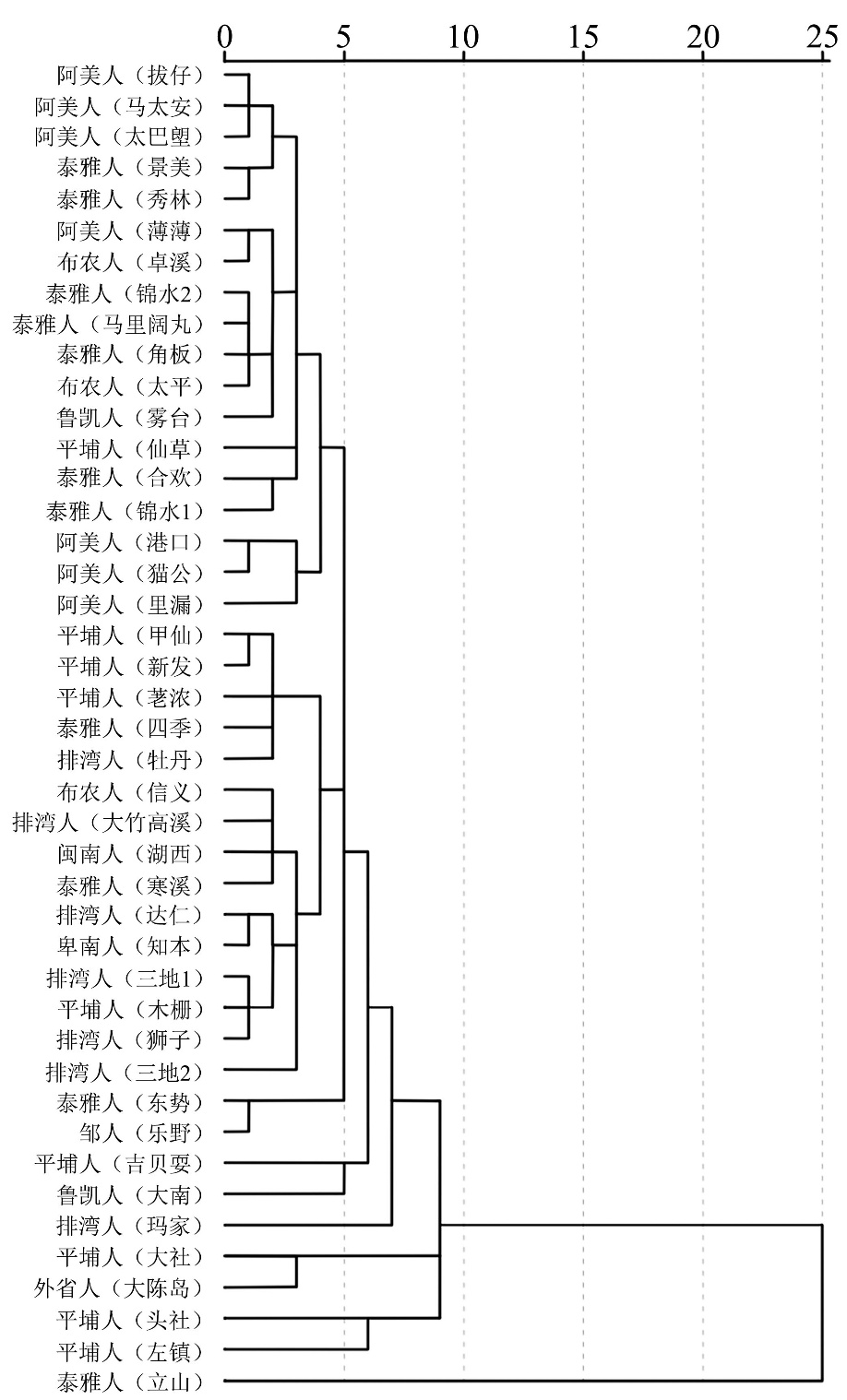
本文选取43组我国台湾地区人群作为研究对象,计算13项头面部测量指标的两性差异指数,并与131组大陆人群展开对比。在此基础上,综合分析中国人群头面部性状的两性差异指数与两性身高差异指数和地理气候因素的相关性,探讨台湾地区人群头面部性状两性差异的具体分布情况及其影响因素。结果表明:台湾地区人群头面部性状的两性差异指数变异范围较大,其中高山族鼻宽、鼻高、形态面高、下颌角间宽和容貌耳宽的两性差异程度较高,而额最小宽和眼内角间宽较低。台湾地区人群的聚类分析结果显示阿美人、泰雅人、布农人、排湾人和高雄地区的平埔人优先聚类在一起。与其他民族相比,高山族整体头面部性状的两性差异指数与北方汉族和北方少数民族相接近,而明显区别于南方汉族和南方其他少数民族。此外,部分头面部性状的两性差异指数与两性身高差异指数和地理气候因素呈低度线性相关。台湾地区人群头面部性状的两性差异分布应与性选择和地理气候环境的作用密切相关。
杜抱朴 , 杜靖 . 中国台湾地区人群头面部性状的性别差异[J]. 人类学学报, 2026 , 45(02) : 333 -344 . DOI: 10.16359/j.1000-3193/AAS.2025.0026
The distribution of sexual dimorphism in cephalofacial traits among the population in Taiwan, China, has not been comprehensively understood yet. In this study, we selected 13 cephalometric dimensions to calculate the sexual dimorphism index (Isd) for 43 populations in Taiwan, China, and subsequently compared them with 131 Chinese mainland populations. Among these 43 populations, the Gaoshan ethnic group included 7 Ami populations, 11 Atayal populations, 3 Bunun populations, 7 Paiwan populations, 1 Panapanayan population, 2 Rukai populations, 1 Tsou population, and 9 Pingpu populations, while the Han ethnic group comprised 1 Minnan population and 1 Waisheng population. This study further investigated the correlations between the Isd and sexual stature dimorphism index, as well as geographical and climatic factors. The results revealed a substantial range of variability in the Isd for cephalofacial traits among residents in Taiwan, China. Among the Gaoshan populations, nasal width, nasal height, morphological facial height, bigonial breadth, and physiognomic ear breadth exhibited higher sexual dimorphism (6%≤Isd<9%), physiognomic ear length, physiognomic facial height, mouth breadth, face breadth, head length, and auricular height exhibited moderate sexual dimorphism (3%≤Isd<6%), and minimum frontal breadth and interocular breadth displayed lower sexual dimorphism (0<Isd< 3%). In addition, the Isd of all cephalofacial traits among residents in Taiwan, China, ranged from 4% to 6%. Notably, the Ami, Atayal, Bunun, and Tsou populations demonstrated higher sexual dimorphism in all cephalofacial traits compared to the Panapanayan and Waisheng populations. Cluster analysis showed that the Ami, Atayal, Bunun, Paiwan, and Pingpu populations from the Kaohsiung area clustered together preferentially. Compared with other ethnic groups, the Isd of all cephalofacial traits of the Gaoshan populations was closely similar to those of the Northern Han and ethnic groups but differed significantly from those of the Southern Han and ethnic groups. Additionally, the Isd for certain cephalofacial traits showed significant linear correlations with the sexual stature dimorphism index and geographical-climatic factors. The Isd for head length, auricular height, face breadth, bigonial breadth, and mouth breadth showed weak positive linear correlations with the sexual stature dimorphism index. Canonical correlation analysis revealed that physiognomic ear breadth had stronger associations with the annual mean relative humidity and annual sunshine time, while bigonial breadth and mouth breadth had more robust relationships with broader environmental conditions. The distribution of sexual dimorphism in cephalofacial traits among residents in Taiwan, China, is related to the combined effects of sexual selection and geo-climatic environments. This study is of great significance for understanding the sexual dimorphism of physical traits among Chinese populations and their related influencing factors.
| [1] | 陈键兴, 刘畅. 2023年台湾地区人口增长转正但新生儿数量再创新低[EB/OL]. 新华网, URL: http://www.news.cn/tw/20240110/74a51979f23443be8dbd7f73f59ad325/c.html, 2024-01-10 |
| [2] | 陈尧峰, 张海国. 海峡两岸汉民族与南岛民族肤纹之比较[J]. 人类学学报, 2015, 34(2): 245-252 |
| [3] | 国家民委《民族问题五种丛书》编辑委员会, 《中国民族问题资料·档案集成》编辑委员会. 中国民族问题资料•档案集成.第1辑,中国少数民族.第1卷:《民族问题五种丛书》及其档案汇编[M]. 北京: 中央民族大学出版社, 2005, 504-512 |
| [4] | 李德洙, 张山(主编). 中国民族百科全书·苗族、瑶族、土家族、畲族、高山族卷[M]. 西安: 世界图书出版公司, 2015, 601-609 |
| [5] | 平埔族群[EB/OL]. URL: https://www.cip.gov.tw/zh-tw/news/data-list/520BA645FF77838B/0C3331F0EBD318C2FC44DB3AD380D63D-info.html,2017-12-29 发布,2024-06-26 引用 |
| [6] | 陈叔倬. 百年体质人类学与台湾社会的交会[A].见:林淑蓉,陈中民,陈玛玲(主编).重读台湾:人类学的视野[M]. 新竹: 台湾清华大学出版社, 2014, 91-128 |
| [7] | 蔡锡圭, 卢国贤. 台湾体质人类学研究的回顾与成果[J]. 台湾医学, 2003, 7(1): 85-89 |
| [8] | 叶惠媛. 台湾体质人类学研究的发展与回顾[J]. 人类与文化, 2010, 41: 97-102 |
| [9] | Roosenboom J, Karlijne I, Myoung KL, et al. SNPs associated with testosterone levels influence human facial morphology[J]. Frontiers in Genetics, 2018, 9: 497 |
| [10] | Lidborg LH. Facial Masculinity[A]. In: Shackelford TK(Eds). Encyclopedia of sexual psychology and behavior[M]. Cham: Springer International Publishing, 2023, 1-13 |
| [11] | Weston EM, Friday AE, Lio P. Biometric evidence that sexual selection has shaped the hominin face[J]. PLoS ONE, 2007, 2(8): e710 |
| [12] | Kramer RSS. Sexual dimorphism of facial width-to-height ratio in human skulls and faces: a meta-analytical approach[J]. Evolution and Human Behavior, 2017, 38(3): 414-420 |
| [13] | Matthews HS, Mahdi S, Penington AJ, et al. Using data-driven phenoty to investigate the impact of sex on 3D human facial surface morphology[J]. Journal of Anatomy, 2023, 243(2): 274-283 |
| [14] | Kleisner K, Tureček P, Roberts SC, et al. How and why patterns of sexual dimorphism in human faces vary across the world[J]. Scientific Reports, 2021, 11(1): 5978 |
| [15] | Tanikawa C, Akcam MO, Gokalp H, et al. Population affinity and variation of sexual dimorphism in three-dimensional facial forms: comparisons between Turkish and Japanese populations[J]. Scientific Reports, 2021, 11(1): 16634 |
| [16] | Rostovtseva VV, Mezentseva AA, Windhager S, et al. Sexual dimorphism in facial shape of modern Buryats of Southern Siberia[J]. American Journal of Human Biology, 2021, 33(2): e23458 |
| [17] | 陈柔森(主编). 重塑台湾平埔族图像:日本时代平埔族资料汇编(Ⅰ)[M]. 台北: 原民文化, 1999, 182-191 |
| [18] | Hoglund J. Size and plumage dimorphism in lek-breeding birds: a comparative analysis[J]. American Naturalist, 1989, 134(1): 72-87 |
| [19] | 朱钦, 刘文忠, 李志军, 等. 蒙古族的体格,体型和半个多世纪来的变化[J]. 人类学学报, 1993, 12(4): 347-356 |
| [20] | 朱钦, 富杰, 刘文忠, 等. 达斡尔族成人的体格、体型及半个多世纪来的变化[J]. 人类学学报, 1996, 15(2): 119-126 |
| [21] | 包金萍, 郑连斌, 宇克莉, 等. 基诺族体质特征及35年来体质的变化[J]. 人类学学报, 2021, 40(2): 261-271 |
| [22] | 杜抱朴, 李大鹏, 刘丽, 等. 中国汉族学生两性体格差异的时空变化[J]. 解剖学报, 2024, 55(6): 783-789 |
| [23] | 郑连斌, 李咏兰, 席焕久, 等. 中国汉族体质人类学研究[M]. 北京: 科学出版社, 2017 |
| [24] | Palmer A, Strobeck C. Strobeck C. Fluctuating asymmetry analyses revisited[A]. In: Polak M (Eds). Development instability: causes and consequences[M]. New York: Oxford University Press, 2003, 279-319 |
| [25] | 杜抱朴, 杜靖. 中国全新世人群两性身高差异演变初析[J]. 第四纪研究, 2023, 43(1): 187-199 |
| [26] | Mitteroecker P, Windhager S, Müller GB, et al. The morphometrics of “masculinity” in human faces[J]. PLOS ONE, 2015, 10(2): e0118374 |
| [27] | Lidborg LH. Facial Masculinity[A]. In: Shackelford TK (Eds). Encyclopedia of sexual psychology and behavior[M]. Cham: Springer International Publishing, 2023, 1-13 |
| [28] | [英]达尔文. 不可抹灭的印记之人类的由来及性选择[M].原译:潘光旦,胡寿文.校订:李绍明. 长沙: 湖南科学技术出版社, 2015, 285-809 |
| [29] | Carré JM, McCormick CM, Mondloch CJ. Facial structure is a reliable cue of aggressive behavior[J]. Psychological Science, 2009, 20(10): 1194-1198 |
| [30] | Zheng L, Zheng Y. Correlated preferences for male facial masculinity and partner traits in gay and bisexual men in China[J]. Archives of Sexual Behavior, 2015, 44: 1423-1430 |
| [31] | Zaidi AA, White JD, Mattern BC, et al. Facial masculinity does not appear to be a condition-dependent male ornament and does not reflect MHC heterozygosity in humans[J]. Proceedings of the National Academy of Science, 2019, 116(5): 1633-1638 |
| [32] | 国家民委《民族问题五种丛书》编辑委员会,《中国民族问题资料•档案集成》编辑委员会. 中国民族问题资料•档案集成.第2辑,中国少数民族简史丛书.第2卷:《民族问题五种丛书》及其档案汇编[M]. 北京: 中央民族大学出版社, 2005, 693-709 |
| [33] | 董建辉, 何茂旭. 台湾高山族“出草”习俗及其成因探析[J]. 广西民族大学学报(哲学社会科学版), 2018, 40(6): 152-159 |
| [34] | Buretić-Tomljanović A, Giacometti J, Ostojić S, et al. Sex-specific differences of craniofacial traits in Croatia: the impact of environment in a small geographic area[J]. Annals of Human Biology, 2007, 34(3): 296-314 |
| [35] | 杜抱朴, 杜靖. 从头面部测量性状分析中国现代人群体质类型及其成因[J]. 解剖学报, 2019, 50(6): 805-815 |
| [36] | 李咏兰, 于会新, 张兴华, 等. 中国不同地理分区人群的头面部特征[J]. 人类学学报, 2023, 42(6): 793-806 |
| [37] | Hiernaux J, Froment A. The correlations between anthropobiological and climatic variables in sub-Saharan Africa: revised estimates[J]. Human Biology, 1976, 48(4): 757-767 |
| [38] | Crognier E. Climate and anthropometric variations in Europe and the Mediterranean area[J]. Annals of Human Biology, 1981, 8(2): 99-107 |
| [39] | Zaidi AA, Mattern BC, Claes P, et al. Investigating the case of human nose shape and climate adaptation[J]. PLOS Genetics, 2018, 14(1): e1007207 |
| [40] | 杜若甫. 中国人群体遗传学[M]. 北京: 科学出版社, 2004, 761-799 |
| [41] | 金关丈夫. 形质人类学[M]. 东京: 法政大学出版局, 1987 |
| [42] | Chai CK. Taiwan aborigines[M]. Cambridge: Harvard University Press, 1968 |
| [43] | [日]安部国雄. 主成分分析による台湾の住民の分类[J]. 人类学杂志, 1982, 90(4): 421-434 |
| [44] | 张振标. 现代中国人体质特征及其类型的分析[J]. 人类学学报, 1988, 7(4): 314-323 |
| [45] | 刘武, 铃木基治. 亚洲地区人类群体亲缘关系:活体测量数据统计分析[J]. 人类学学报, 1994, 13(3): 265-279 |
/
| 〈 |
|
〉 |
 京ICP证05002819号-3