


泥河湾盆地蔚县中更新世古人类活动遗址的发现与科学价值
收稿日期: 2026-01-09
录用日期: 2026-02-15
网络出版日期: 2026-06-12
基金资助
国家自然科学基金项目(42371165)
Discovery and scientific value of the Middle Pleistocene archaeological sites in the Nihewan Basin (Yuxian)
Received date: 2026-01-09
Accepted date: 2026-02-15
Online published: 2026-06-12
泥河湾盆地作为构建我国更新世环境变化与人类适应的重要区域,其考古发现一直为学术界关注。作为盆地的重要组成部分,蔚县境内保留了丰富的河湖相地层,发现了大量古人类活动遗址,获取了丰富的石制品和动物化石等遗存。蔚县中更新世地层记录了泥河湾古湖发育中后期至消亡的过程,古人类活动于湖滨地貌环境,测年手段指示古人类活动于70万~20万年前。石制品组合表明古人类在远距离获取原料、系统剥片和石器多样化及精致加工方面存在进步特点。动物考古初步分析显示人类行为在多个区域参与了遗址的形成过程,且具备成熟高效的动物资源开发能力。古环境重建指示中更新世超长间冰期(MIS 15~13)与中布容事件(MIS 11)的气候波动与古人类适应方面具有较大研究潜力。蔚县中更新世的考古发现,为完善泥河湾盆地古人类活动年代框、构建百万年人类技术演化史、揭示人类对动物资源的认知与获取能力、探明环境变化与人类对湖滨景观的利用策略等,具有重要的科学意义。
裴树文 , 牛东伟 , 马东东 . 泥河湾盆地蔚县中更新世古人类活动遗址的发现与科学价值[J]. 人类学学报, 2026 , 45(03) : 403 -418 . DOI: 10.16359/j.1000-3193/AAS.2026.0027
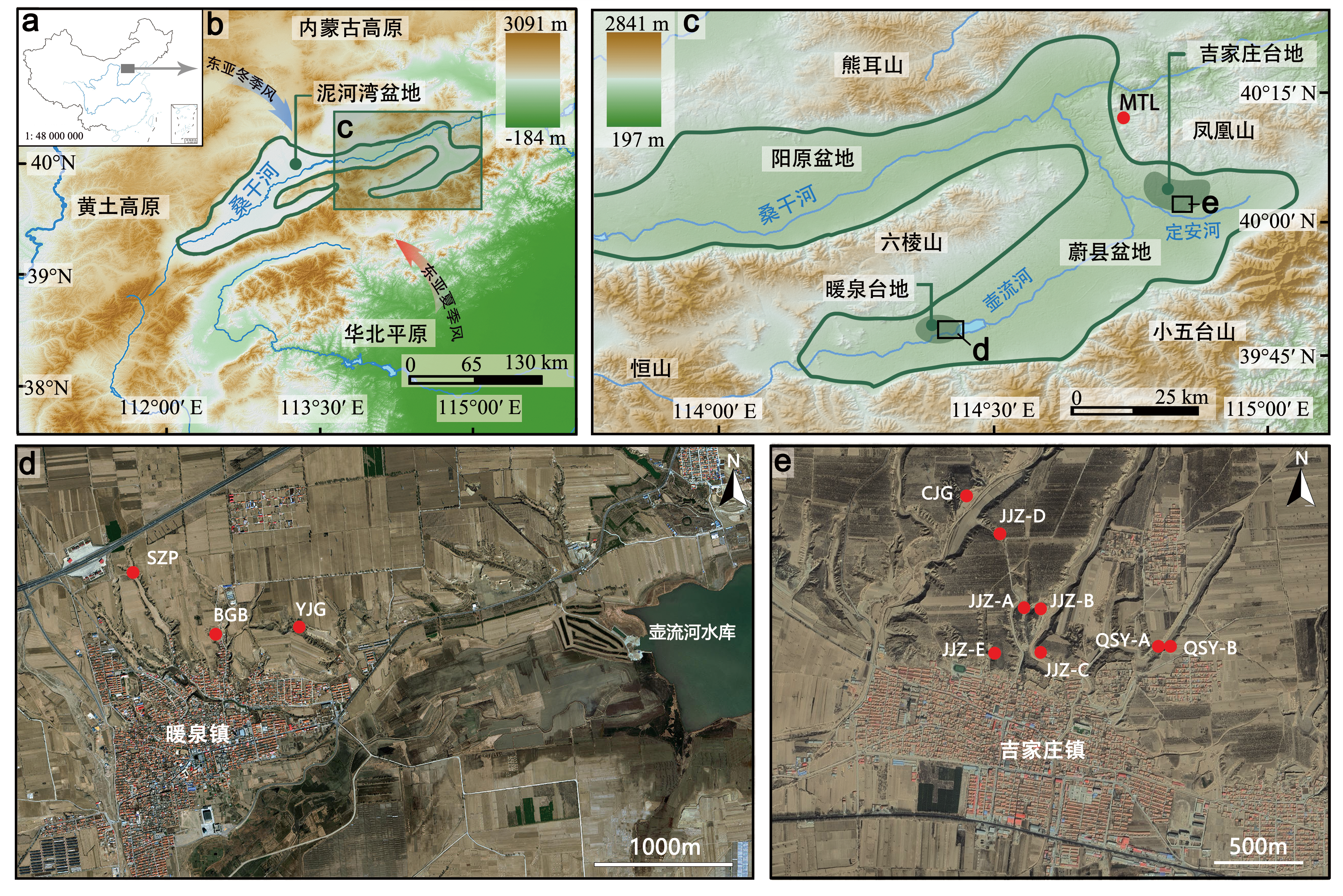
Nihewan Basin is considered as a key region for exploring the environmental fluctuation and human adaptations during Pleistocene in China. The discoveries of archaeological sites from the basin are always draw great attention to the public in the research field. Comparing to the investigations and research development from Early and Late Pleistocene in the area, the archaeological sites from Middle Pleistocene still need to be improved. As the main part of the Nihewan Basin (senso lato), the Yuxian subbasin also preserved fluvial and lacustrine Quaternary deposits which can be assigned to the Nihewan Beds during the formation of Nihewan Paleolake. Since the 21st century, many archaeological sites including Qianshangying (QSY), Jijiazhuang (JJZ), Caijiagou (CJG), Yinjiangou (YJG), and Beiguanbu (BGB) from Middle Pleistocene in the Jijiazhuang and Nuanquaan area were achieved, offering a unique opportunity to investigate Middle Pleistocene human adaptations in the Nihewan Basin.
The stratigraphic sequence of Middle Pleistocene from Yuxian subbasin documented the middle to late stages and vanish of the Nihewan paleolake, while early humans occupied in the lake shore environment of the paleolake. 26Al/10Be burial dating, Electron Spin Resoance (ESR), and Optically Stimulated Luminescence (OSL) techniques were carried out to constrain the time interval of 0.7~0.2 Ma of early human occupation. Stone tool assemblages show evidence of relatively long-distance resource procurement, systematic flaking strategy, and the increased number of retouched tools indicate standardized, extensive and refined modification. Preliminary zooarchaeological analysis indicate that early humans seemed to have primary access to animal carcasses and performed as the main agency of the formation of many sites, which demonstrate the early humans possessed the abilities of the systematic and effective exploitation of animal resources. Paleoenvironmental reconstructions imply that the relationship between climatic fluctuations of extra-long duration of interglacial or mild stadial climate events (MISs 15~13) and Mid-Brunhes Event (MBE) may be great potential research topics in the future.
It can be inferred that the archaeological discoveries from Middle Pleistocene in Yuxian subbasin will help to build the chronological framework and million years of technological evolutionary history of early humans in the Nihewan Basin. In addition, these archaeological investigations will also bear great significance for exploring the cognitive and acquisition capabilities of animal resources, how environmental change affect the behavioral strategies adapted to the lake shore landscape of hominins in the Nihewan Basin.
| [1] | Clark PU, Archer D, Pollard D, et al. The Middle Pleistocene transition: Characteristics, mechanisms, and implications for long-term changes in atmospheric pCO2[J]. Quaternary Science Reviews, 2006, 25(23-24): 3150-3184 |
| [2] | Ao H, Eelco J, Rohling EJ, et al. Two-stage mid-Brunhes climate transition and mid-Pleistocene human diversification[J]. Earth Science Review, 2020, 210: 103354 |
| [3] | Hao QZ, Wang L, Oldfield F, et al. Extra-long interglacial in Northern Hemisphere during MISs15-13 arising from limited extent of Arctic ice sheets in glacial MIS 14[J]. Scientific Reports, 2015, 5: 12103 |
| [4] | Abbate E, Sagri M. Early to Middle Pleistocene Homo dispersals from Africa to Eurasia: Geological, climatic and environmental constraints[J]. Quaternary International, 2012, 267: 3-19 |
| [5] | Rightmire GP. Homo erectus and Middle Pleistocene hominins: brain size, skull form, and species recognition[J]. Journal of Human Evolution, 2013, 65: 223-252 |
| [6] | Anton SC, Potts R, Aiello LC. Evolution of Homo: An integrated biological perspective[J]. Science, 2014, 345(6192): 1236828 |
| [7] | Galway-Witham J, Cole J, Stringer C. Aspects of human physical and behavioural evolution during the last 1 million years[J]. Journal of Quaternary Science, 2019, 34: 355-378 |
| [8] | Isaac GL. Sorting out the muddle in the middle: An anthropologist’s post-conference appraisal[A]. In: Butzer KW, Isaac GL (Eds.). After the australopithecines—Stratigraphy, ecology and culture change in the middle Pleistocene[C]. The Hague: Mouton Publishers, 1975, 875-888 |
| [9] | Bae CJ, Aiello LC, Hawks J, et al. Moving away from “the muddle in the middle” toward solving the Chibanian puzzle[J]. Evolutionary Anthropology: Issues, News, and Reviews, 2024, 33(1): e22011 |
| [10] | Malinsky-Buller A. The muddle in the middle Pleistocene: The lower-middle paleolithic transition from the Levantine perspective[J]. Journal of World Prehistory, 2016, 29(1): 1-78 |
| [11] | Roksandic M, Radovi? P, Wu XJ, et al. Resolving the “muddle in the middle”: The case for Homo bodoensis sp. nov.[J]. Evolutionary Anthropology: Issues, News, and Reviews, 2022, 31(1): 20-29 |
| [12] | Chen FH, Welker F, Shen CC, et al. A late Middle Pleistocene Denisovan mandible from the Tibetan Plateau[J]. Nature, 2019, 569: 409-412 |
| [13] | Liu W, Athreya S, Xing S, et al. Hominin evolution and diversity: a comparison of earlier-Middle and later-Middle Pleistocene hominin fossil variation in China[J]. Philosophical Transactions of the Royal Society B, 2022, 377: 20210040 |
| [14] | Li H, Lotter M. Lithic production strategies during the late Middle Pleistocene at Dali, Shaanxi Province, China: implications for understanding late archaic humans[J]. Archeological and Anthropological Sciences, 2019, 11: 1701-1712 |
| [15] | 杨石霞, 裴树文, 邓成龙. 早-中更新世中国古人类演化及其与气候环境的关系[J]. 人类学学报, 2021, 40(3): 436-453 |
| [16] | Hou YM, Potts R, Yuan BY, et al. Mid-Pleistocene Acheulean-like stone technology of Bose basin, south China[J]. Science, 2000, 287(5458): 1622-1626 |
| [17] | Kuman K, Li CR, Li H. Large cutting tools in the Danjiangkou Reservoir Region, central China. Journal of Human Evolution, 2014, 76: 129-153 |
| [18] | Li H, Wang SJ, Lotter MG, et al. The temporal-spatial evolution of handaxe technology in China: Recent progress and future directions[J]. Science Bulletin, 2024, 69: 6121-6129 |
| [19] | Hu Y, Marwick B, Zhang JF. Late Middle Pleistocene Levallois stone-tool technology in southwest China[J]. Nature, 2019, 565 (7737): 82-85 |
| [20] | Bae CJ, Li F, Cheng LL, et al. Hominin distribution and density patterns in Pleistocene China: Climatic influences[J]. Palaeogeography Palaeoclimatology Palaeoecology, 2018, 512: 118-131 |
| [21] | Zan J, Louys J, Dennell R, et al. Mid-Pleistocene aridity and landscape shifts promoted Palearctic hominin dispersals[J]. Nature Communications, 2024, 15(1): 10279 |
| [22] | 周廷儒, 李华章, 刘清泗, 等. 泥河湾盆地新生代古地理研究[M]. 北京: 科学出版社, 1991, 1-162 |
| [23] | 袁宝印, 夏正楷, 牛平山. 泥河湾裂谷与古人类[M]. 北京: 地质出版社, 2011, 1-257 |
| [24] | 卫奇. 泥河湾盆地考证[J]. 文物春秋, 2016, 2: 3-11 |
| [25] | 谢飞, 李珺, 刘连强. 泥河湾旧石器文化[M]. 石家庄: 花山文艺出版社, 2006, 113-119 |
| [26] | Barbour GB. The deposits of the Sangkanho Valley[J]. Bulletin of Geological Society of China, 1925, 4: 53-55 |
| [27] | Barbour GB, Licent E, Teilhard de Chardin P. Geological study of the deposits of the Sangkanho basin[J]. Bulletin of Geological Society of China, 1927, 5: 263-278 |
| [28] | 朱日祥, 邓成龙, 潘永信. 泥河湾盆地磁性地层定年与早期人类演化[J]. 第四纪研究, 2007, 27(6): 922-944. |
| [29] | 裴树文, 王法岗, 牛东伟. 二十一世纪以来泥河湾盆地古人类活动的发现与研究进展[J]. 人类学学报, 2024, 43(6): 913-933 |
| [30] | 王法岗, 孙永春. 泥河湾考古图典[M]. 石家庄: 河北美术出版社, 2023, 1-516 |
| [31] | 夏正楷, 刘锡清. 泥河湾层古地理环境的初步认识[J]. 海洋地质与第四纪地质, 1984, 14(3): 101-140 |
| [32] | Guo YJ, Li B, Zhang JF, et al. Luminescence ages for three ‘middle palaeolithic’ sites in the Nihewan Basin, northern China, and their archaeological and palaeoenvironmental implications[J]. Quaternary Research, 2016, 85(3): 456-470 |
| [33] | 马东东, 牛东伟, 裴树文, 等. 蔚县盆地2017-2018年旧石器考古调查简报[J]. 人类学学报, 2021, 40(1): 128-136 |
| [34] | 牛东伟, 闫晓蒙, 马东东, 等. 蔚县盆地2019-2020年旧石器考古调查[J]. 人类学学报, 2022, 41(5): 936-944 |
| [35] | 裴树文. 泥河湾盆地南部(蔚县盆地)发现一处重要古人类活动遗址群[J]. 人类学学报, 2017, 36(1): 26 |
| [36] | 叶芷, 裴树文, 马东东, 等. 泥河湾盆地蔚县前上营遗址B地点发掘报告[J]. 人类学学报, 2026, 45(3): 515-531 |
| [37] | 裴树文, 马东东, 贾真秀, 等. 蔚县盆地吉家庄旧石器遗址发掘报告[J]. 人类学学报, 2018, 37(4): 510-528 |
| [38] | 叶芷, 杜雨薇, 裴树文, 等. 蔚县盆地吉家庄旧石器遗址的形成过程[J]. 人类学学报, 2023, 42(1): 46-60 |
| [39] | Ye Z, Pei SW, Tu H, et al. 26Al/10Be burial dating and technological strategies of hominins at the Jijiazhuang Paleolithic site, Nihewan Basin, China: Implications for understanding Middle Pleistocene human adaptations in east Asia[J]. Quaternary Science Reviews, 2024, 339: 108837 |
| [40] | 耿帅杰, 裴树文, 杜雨薇, 等. 泥河湾盆地蔚县蔡家沟遗址A地点发掘简报[J]. 人类学学报, 2026, 45(3): 500-514 |
| [41] | 杜雨薇, 张乐, 叶芷, 等. 蔚县盆地吉家庄旧石器遗址动物骨骼的埋藏学分析[J]. 人类学学报, 2023, 42(3): 359-372 |
| [42] | 杜雨薇. 泥河湾盆地中更新世古人类生存策略—基于蔚县蔡家沟遗址的动物考古学研究[D]. 博士学位论文, 北京: 中国科学院大学, 2025 |
| [43] | 杜雨薇, 耿帅杰, 徐静玥, 等. 泥河湾盆地蔡家沟遗址A和B地点动物骨骼的埋藏学观察[J]. 人类学学报, 2026, 45(3): 570-585 |
| [44] | Pei SW, Xu JY, Du YW, et al. Paleoenvironmental reconstruction of human adaptation in the Nihewan Basin of North China during Middle Pleistocene: A case study of Jijiazhuang archaeological site[J]. Journal of Geographical Sciences, 2025, 35(8): 1601-1618 |
| [45] | 裴树文. 旧石器时代旷野遗址形成过程研究综述[J]. 人类学学报, 2019, 38(1): 1-16 |
| [46] | Deng CL, Zhu RX, Zhang R, et al. Timing of the Nihewan formation and faunas[J]. Quaternary Research, 2008, 69: 77-90 |
| [47] | Ao H, Dekkers MJ, An ZS, et al. Magnetostratigraphic evidence of a mid-Pliocene onset of the Nihewan Formation implications for early fauna and hominid occupation in the Nihewan Basin, North China[J]. Quaternary Science Reviews, 2013, 59: 30-42 |
| [48] | 唐锐枰, 葛俊逸, 庞海娇, 等. 泥河湾黑土沟剖面磁组构特征及古湖水文环境变化[J]. 科学通报, 2020, 65(11): 1027-1045 |
| [49] | 吴文祥. 试论早期人类占据泥河湾盆地的时代[J]. 地球学报, 2002, 23(3): 249-254 |
| [50] | Yang SX, Deng CL, Zhu RX, et al. The Paleolithic in the Nihewan Basin, China: Evolutionary history of an Early to Late Pleistocene record in Eastern Asia[J]. Evolutionary Anthropology, 2020, 29(3): 125-142 |
| [51] | 白振平. 对蔚县盆地发育过程的初步认识[A].见:卫奇,谢飞(编).泥河湾研究论文选编[C].北京: 文物出版社, 1989, 466-474 |
| [52] | 夏正楷. 大同-阳原盆地的新生代沉积和环境演变[A]. 见: 王乃樑,杨景春,夏正楷,等(著).山西地堑系新生代沉积与构造地貌[M].北京: 科学出版社, 1996, 1-72 |
| [53] | 夏正楷. 大同-阳原盆地古泥河湾湖的岸线变化[J]. 地理研究, 1992, 11(2): 52-59 |
| [54] | Dennell RW. Life without the Movius line: The structure of the east and Southeast Asian Early Palaeolithic[J]. Quaternary International, 2016, 400: 14-22 |
| [55] | Harmand S. Variability in raw material selectivity at the Late Pliocene sites of Lokalalei, West Turkana, Kenya[J]. Interdisciplinary approaches to the Oldowan, 2009, 85-97 |
| [56] | Roche H, de La Torre I, Arroyo A, et al. Naiyena Engol 2 (West Turkana, Kenya): A case study on variability in the Oldowan[J]. African Archaeological Review, 2018, 35: 57-85 |
| [57] | Gallotti R, Mussi M. The unknown Oldowan: - 1.7-million-year-old standardized obsidian small tools from Garba IV, Melka Kunture, Ethiopia[J]. PLoS One, 2015, 10(12): e0145101 |
| [58] | Pei SW, Xie F, Deng CL, et al. Early Pleistocene archaeological occurrences at the Feiliang site, and the archaeology of human origins in the Nihewan Basin, North China[J]. PLoS One, 2017, 12(11): e0187251 |
| [59] | Pei SW, Deng CL, de la Torre I, et al. Magnetostratigraphic and archaeological records at the Early Pleistocene site complex of Madigou (Nihewan Basin): implications for human adaptations in North China[J]. Palaeogeography, Palaeoclimatology, Palaeoecology, 2019, 530: 176-189 |
| [60] | Schick KD, Toth N, Wei Q, et al. Archaeological perspectives in the Nihewan Basin, China[J]. Journal of Huma Evolution, 1991, 21(1): 13-26 |
| [61] | Movius HL. The Lower Paleolithic cultures of southern and eastern Asia[J]. Transactions of the American Philosophical Society, 1948, 38: 329-420 |
| [62] | Lycett ST. Why is there a lack of Mode 3 Levallois technologies in East Asia? A phylogenetic test of the Movius-Schick hypothesis[J]. Journal of Anthropological Archaeology, 2007, 26(4): 541-575 |
| [63] | Yang SX, Yue JP, Zhou XY, et al. Hominin site distributions and behaviours across the Mid-Pleistocene climate transition in China[J]. Quaternary Science Reviews, 2020, 248: 106614 |
| [64] | Yang SX, Wang FG, Xie F, et al. Technological innovations at the onset of the mid-pleistocene climate transition in high-latitude East Asia[J]. National Science Review, 2021, 8: nwaa053 |
| [65] | Ma DD, Pei SW, Xie F, et al. Earliest Prepared core technology in Eurasia from Nihewan (China): Implications for early human abilities and dispersals in East Asia[J]. Proceedings of the National Academy of Sciences of USA, 2024, 121(11): e2313123121 |
| [66] | Hofreiter M, Stewart J. Ecological change, range fluctuations and population dynamics during the Pleistocene[J]. Current Biology, 2009, 19(14): R584-R594 |
| [67] | Magri D, Palombo MR. Early to Middle Pleistocene dynamics of plant and mammal communities in South West Europe[J]. Quaternary International, 2013, 288: 63-72 |
| [68] | Strani F. Impact of Early and Middle Pleistocene major climatic events on the palaeoecology of Southern European ungulates[J]. Historical Biology, 2020, 33(10): 2260-2275 |
| [69] | Isler K, van Schaik CP. How humans evolved large brains: comparative evidence[J]. Evolution of Anthropology, 2014, 23: 65-75 |
| [70] | Daujeard C, Prat S. What Are the “Costs and Benefits” of meat-eating in human evolution? The challenging contribution of behavioral ecology to archeology[J]. Frontiers in Ecology and Evolution, 2022, 10: 834638 |
| [71] | Paige J, Perreault C. 3.3 million years of stone tool complexity suggests that cumulative culture began during the Middle Pleistocene[J]. Proceedings of the National Academy of Sciences, 2024, 121(26): e2319175121 |
| [72] | Voormolen B. Ancient hunters, ancient butchers: Sch?ningen 13II -4, a kill-butchery site dating from the northwest European Lower Palaeolithic[D]. MA/PhD. thesis, Leiden: Leiden University, 2008 |
| [73] | Stiner MC, Barkai R, Gopher A. Cooperative hunting and meat sharing 400-200 kya at Qesem Cave, Israel[J]. Proceedings of the National Academy of Sciences of USA, 2009, 106(32): 13207-13212 |
| [74] | Starkovich BM, Conard NJ. Bone taphonomy of the Sch?ningen “Spear Horizon South” and its implications for site formation and hominin meat provisioning[J]. Journal of Human Evolution, 2015, 89: 154-171 |
| [75] | Van Kolfschoten T, Buhrs E, Verheijen I. The larger mammal fauna from the Lower Paleolithic Sch?ningen Spear site and its contribution to hominin subsistence[J]. Journal of Human Evolution, 2015, 89: 138-153 |
| [76] | Van Kolfschoten T, Parfitt SA, Serangeli J, et al. Lower Paleolithic bone tools from the :Spear Horizon” at Sch?ningen (Germany)[J]. Journal of Human Evolution, 2015, 89: 226-263 |
| [77] | Rodríguez-Hidalgo A, Saladié P, Ollé A, et al. Human predatory behavior and the social implications of communal hunting based on evidence from the TD10.2 bison bone bed at Gran Dolina (Atapuerca, Spain)[J]. Journal of Human Evolution, 2017, 105: 89-122 |
| [78] | Zhou X, Yang J, Wang S, et al. Vegetation change and evolutionary response of large mammal fauna during the Mid-Pleistocene Transition in temperate northern East Asia[J]. Palaeogeography, Palaeoclimatology, Palaeoecology, 2018, 505: 287-294 |
| [79] | 王晓敏, 刘连强, 陈国鹏, 等. 泥河湾盆地马圈沟遗址哺乳动物破碎长骨反映的古人类行为[J]. 人类学学报, 2024, 43(1): 91-105 |
| [80] | Peterson CE, Shen C, Chen C, et al. Taphonomy of an Early Pleistocene archaeofauna from Xiaochangliang, Nihewan Basin, North China[A]. In: Shen C, Keates S(Eds.). Current Research in the Chinese Pleistocene Archaeology[C]. Oxford: BAR International Series 1179, 2003, 83-98 |
| [81] | Norton CJ, Gao X. Hominin-carnivore interactions during the Chinese Early Paleolithic: Taphonomic perspectives from Xujiayao[J]. Journal of Human Evolution, 2008, 55(1): 164-178 |
| [82] | 王晓敏, 王法岗, 陈福友, 等. 泥河湾盆地板井子晚更新世遗址古人类对动物资源的消费策略[J]. 人类学学报, 2022, 41(6): 1005-1016 |
| [83] | 王晓敏, 梅惠杰. 于家沟遗址的动物考古学研究[M]. 北京: 文物出版社, 2019, 1-228 |
| [84] | Potts R. Evolution and climate variability[J]. Science, 1996, 273(5277): 922-923 |
| [85] | Timmermann A, Friedrich T. Late Pleistocene climate drivers of early human migration[J]. Nature, 2016, 538(7623): 92-95 |
| [86] | Timmermann A, Yun KS, Raia P, et al. Climate effects on archaic human habitats and species successions[J]. Nature, 2022, 604(7906): 495-501 |
| [87] | Riechers K, Mitsui T, Boers N, et al. Orbital insolation variations, intrinsic climate variability, and Quaternary glaciations[J]. Climate of the Past, 2022, 18(4): 863-893 |
| [88] | 丁仲礼. 米兰科维奇冰期旋回理论:挑战与机遇[J]. 第四纪研究, 2006, 26(5): 694-701 |
| [89] | Ruddiman WF, Raymo ME, McIntyre A. Matuyama 41,000-year cycles: North Atlantic Ocean and northern hemisphere ice sheets[J]. Earth and Planetary Science Letters, 1986, 80(1-2): 117-129 |
| [90] | Elderfield H, Ferretti P, Greaves M, et al. Evolution of ocean temperature and ice volume through the Mid-Pleistocene climate transition[J]. Science, 2012, 337(6095): 704-709 |
| [91] | Herbert TD. The Mid-Pleistocene Climate Transition[J]. Annual Review of Earth and Planetary Sciences, 2023, 51: 389-418 |
| [92] | Hodell DA, Channell JET. Mode transitions in northern hemisphere glaciation: Co-evolution of millennial and orbital variability in Quaternary climate[J]. Climate of the Past, 2016, 12(9): 1805-1828 |
| [93] | Jouzel J, Masson-Delmotte V, Cattani O, et al. Orbital and millennial Antarctic climate variability over the past 800,000 years[J]. Science, 2007, 317(5839): 793-796 |
| [94] | Ruddiman WF. Orbital changes and climate[J]. Quaternary Science Reviews, 2006, 25(23-24): 3092-3112 |
| [95] | Koutsodendris A, Kousis I, Peyron O, et al. The marine isotope stage 12 pollen record from lake ohrid (SE europe): Investigating short-term climate change under extreme glacial conditions[J]. Quaternary Science Reviews, 2019, 221: 105873 |
| [96] | Shi PJ, Yang TB, Tian QJ, et al. A warmer but drier Marine Isotope Stage 11 during the past 650 ka as revealed by the thickest loess on the western Chinese Loess Plateau[J]. Journal of Arid Land, 2016, 8(3): 315-330 |
| [97] | Jansen JHF, Kuijpers A, Troelstra SR. A mid-brunhes climatic event: Long-term changes in global atmosphere and ocean circulation[J]. Science, 1986, 232(4750): 619-622 |
| [98] | 朱云, 乔鲜果, 姚轶锋, 等. 华北泥河湾盆地植被、气候与早期人类生存环境研究进展[J]. 植物学报, 2022, 57(6): 801-814 |
| [99] | Xu Z, Pei SW, Hu Y, et al. Ecological shifts and hominin adaptations during the Mid-Pleistocene Climate Transition in Northeast Asia as evidenced by isotopic analysis (δ13C, δ18O) of mammalian enamel from Early Paleolithic sites in the Nihewan Basin, China[J]. Quaternary Science Reviews, 2023, 308: 108072 |
| [100] | Mu HS, Xu QH, Zhang SR, et al. Pollen-based quantitative reconstruction of the paleoclimate during the formation process of Houjiayao Relic Site in Nihewan Basin of China[J]. Quaternary International, 2015, 374: 76-84 |
| [101] | 张攀攀. 泥河湾虎头梁剖面孢粉、磁化率、粒度分析及其环境意义[D]. 硕士学位论文, 石家庄: 河北师范大学, 2017 |
| [102] | Da SQ, Zhang Z, Li YC, et al. Pollen-based quantitative paleoclimatic record spanning the Mid-Brunhes Event in the Nihewan Basin, north China[J]. Palaeogeography Palaeoclimatology Palaeoecology, 2023, 612: 111377 |
/
| 〈 |
|
〉 |
 京ICP证05002819号-3