


河北怀来盆地古人类文化遗存的考古发现与研究
收稿日期: 2026-02-24
录用日期: 2026-04-30
网络出版日期: 2026-06-12
基金资助
国家社科基金一般项目(23BKG001)
Archaeological findings and research on hominin remains in the Huailai Basin, North China
Received date: 2026-02-24
Accepted date: 2026-04-30
Online published: 2026-06-12
作为我国北方乃至东亚地区旧石器时代遗址分布最密集、文化序列最完整的地区,泥河湾盆地现已成为世界范围内探索人类起源和演化的经典区域。怀来盆地作为广义泥河湾盆地的重要组成部分,是更新世期间古人类迁徙扩散与文化交流的重要通道。通过对怀来盆地2014年以来旧石器考古发现与多学科研究成果的系统梳理,本文从考古调查、遗址发掘、年代学研究、石制品研究、动物考古学研究、古环境重建等多个维度,初步勾勒出该区域中更新世晚期至晚更新世末期古人类文化遗存的基本面貌与生存演化图景。怀来盆地旧石器考古工作的持续开展,是从“狭义泥河湾”扩展到“广义泥河湾”考古的重要实践,相关研究可为探讨中国北方以及东亚地区古人类技术演化、生存适应、行为多样性和区域人群互动等科学问题提供重要材料和视角。未来需进一步强化多学科交叉与区域比较研究,推动该区域旧石器考古不断走向深入。
牛东伟 , 刘尔凡 , 薛峰 , 谢飞 . 河北怀来盆地古人类文化遗存的考古发现与研究[J]. 人类学学报, 2026 , 45(03) : 419 -435 . DOI: 10.16359/j.1000-3193/AAS.2026.0039
As a key area to explore the origin and evolution of human beings in the world, Nihewan Basin is globally renowned for the continuity of Quaternary sediments and the richness of ancient human occupations. Huailai basin, which preserves fluvio-lacustrine deposits and Paleolithic cultural remains, is located in the eastern part of the Nihewan Basin (senso lato), serving as a crucial corridor for hominin migration and cultural exchange along the Sanggan River-Yongding River drainage system during the Pleistocene. Since 2014, a joint archaeological team organized by Hebei Normal University and other institutions has conducted systematic and continuous Paleolithic surveys, excavations, and multidisciplinary research in the Huailai Basin, yielding a series of important achievements that have preliminarily filled the Paleolithic archaeological gaps in this region.
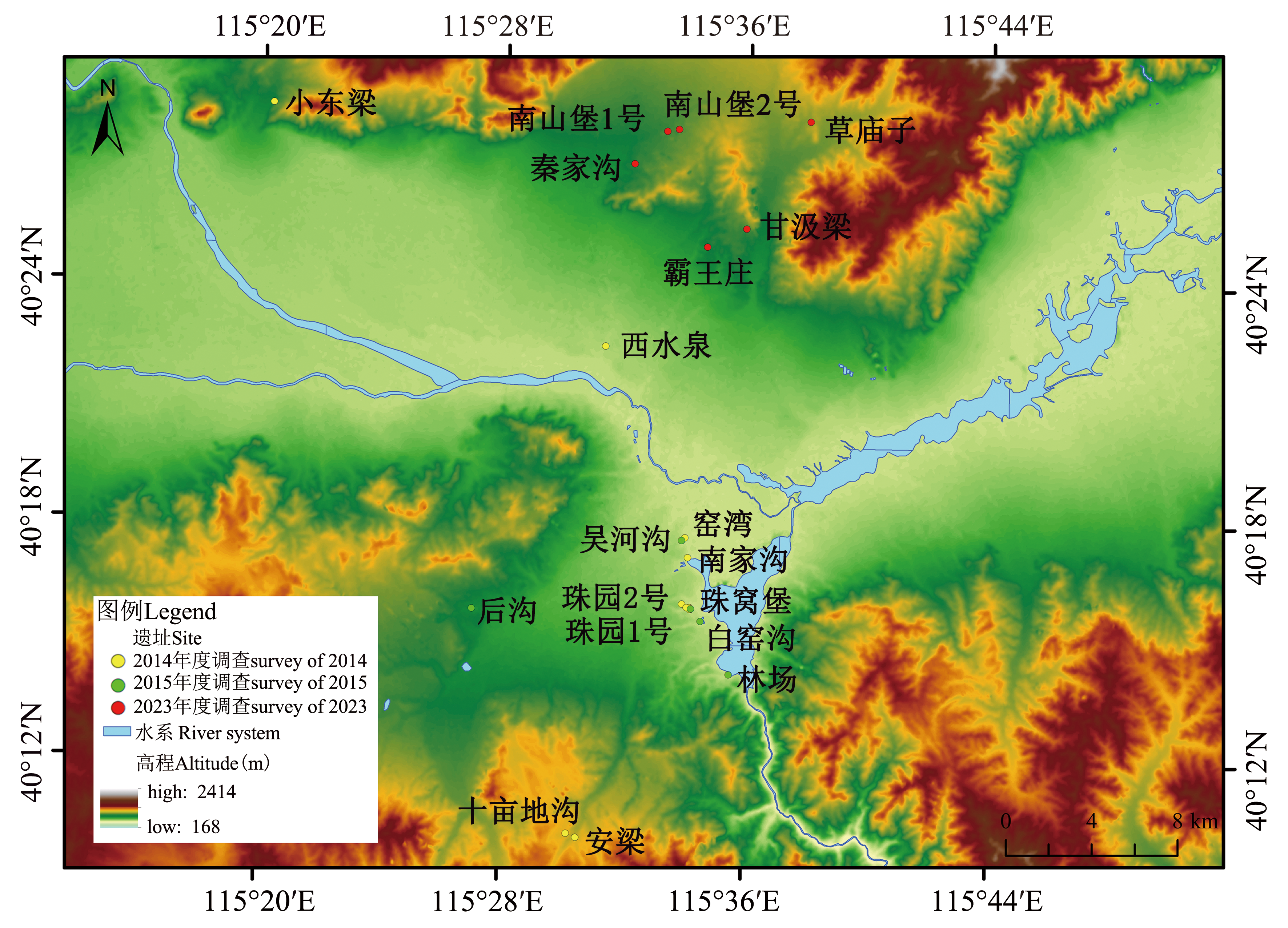
In terms of archaeological survey, a total of 21 Paleolithic localities were discovered between 2014 and 2023, mainly distributed along the southwestern shore of the Guanting Reservoir and the northern piedmont of the basin. Systematic excavations were conducted at three key sites: Zhuwobu site, Xigouwan Locality 1, and Nanjiagou site, yielding a great number of lithic artifacts, animal fossils and other archaeological remains. Chronological studies using OSL and AMS¹⁴C dating placed Zhuwobu site at 280±13 ka BP (late Middle Pleistocene), Xigouwan Locality 1 at 47~41 ka BP (early Upper Paleolithic), and Nanjiagou site at 17~16 ka (terminal Late Pleistocene).
Raw materials were predominantly locally procured, with evidence of potential long-distance transport and heat treatment of volcanic breccia at Nanjiagou site. Systematic analysis on Lithic assemblages reveals a technological transition from simple core-and-flake technology at Zhuwobu site and Xigouwan Locality 1 to the coexistence of flake tool technology and microblade technology at Nanjiagou site. Zooarchaeological analysis indicates that hominins played a dominant role in Animal resource accumulation and exploitation. At Nanjiagou site, the findings of bone needles, ostrich eggshell beads with red ochre residues, and composite tools technology reflect intensified resource exploitation and behavior diversity during the Late Paleolithic. Paleoenvironmental reconstructions based on pollen, grain size, and magnetic susceptibility, integrated with chronological frameworks, show that cultural layer at Zhuwobu site corresponded to a warm and humid environment with sediments of shallow lacustrine phase, while human occupations at Xigouwan Locality 1 occurred during a relatively cool, humid interval between H5 and H4 (Heinrich events).
In summary, over a decade of systematic Paleolithic research in the Huailai Basin has established a preliminary chronological framework and lithic technological sequence spanning the past 300 ka, outlining the basic characteristics of hominin occupations and their subsistence and evolutionary trajectory from the late Middle Pleistocene to the terminal Late Pleistocene. These findings and studies provide essential data and perspectives for addressing key scientific issues in North China and East Asia, including hominin technological evolution, subsistence adaptation, behavioral diversity, and regional population interaction. Future work should strengthen multidisciplinary integration and regional comparative research to promote the continuous development of Paleolithic Archaeology in this area.
Key words: Nihewan Basin; Huailai Basin; Paleolithic; lithic technology; behavioral diversity
| [1] | Hublin JJ, Ben-Ncer A, Bailey S, et al. New fossils from Jebel Irhoud, Morocco and the pan-African origin of Homo sapiens[J]. Nature, 2017, 546: 289-292 |
| [2] | Ni XJ, Ji Q, Wu WS, et al. Massive cranium from Harbin in northeastern China establishes a new Middle Pleistocene human lineage[J]. Innovation, 2021, 2: 100130 |
| [3] | Harvati K, Reyes-Centeno H. Evolution of Homo in the Middle and Late Pleistocene[J]. Journal of Human Evolution, 2022, 173: 103279 |
| [4] | Fu QM, Cao P, Dai QY, et al. Denisovan mitochondrial DNA from dental calculus of the >146,000-year-old Harbin cranium[J]. Cell, 2025, 188: 3919-3926 |
| [5] | Fu QM, Bai F, Rao HY, et al. The proteome of the late Middle Pleistocene Harbin individual[J]. Science, 2025, 389: 704-707 |
| [6] | Bae CJ, Wu XJ. Making sense of eastern Asian Late Quaternary hominin variability[J]. Nature Communications, 2024, 15: 9479 |
| [7] | Gibbons A. When modern humans met Neanderthals[J]. Science, 2021, 372: 115-116 |
| [8] | Wu XJ, Martínon-Torres M, Xing S, et al. The hominin teeth from the late Middle Pleistocene Hualongdong site, China[J]. Journal of Human Evolution, 2025, 206: 103727 |
| [9] | Prüfer K, de Filippo C, Grote S, et al. A high-coverage Neandertal genome from Vindija Cave in Croatia[J]. Science, 2017, 358(6363): 655-658 |
| [10] | Hoffmann DL, Angelucci DE, Villaverde V, et al. Symbolic use of marine shells and mineral pigments by Iberian Neandertals 115,000 years ago[J]. Science Advances, 2018, 4: eaar5255 |
| [11] | Iasi LNM, Chintalapati M, Skov L, et al. Neanderthal ancestry through time: Insights from genomes of ancient and present-day humans[J]. Science, 2024, 386: eadq3010 |
| [12] | Pigott EM, Cheshmedzhieva K, Zeller E, et al. A new late Neanderthal from Crimea reveals long-distance connections across Eurasia[J]. PNAS, 2025, 122(45): e2518974122 |
| [13] | Reich D, Patterson N, Kircher M, et al. Genetic history of an archaic hominin group from Denisova Cave in Siberia[J]. Nature, 2010, 468(7327): 1053-1060 |
| [14] | Chen FH, Welker F, Shen CC, et al. A late Middle Pleistocene Denisovan mandible from the Tibetan Plateau[J]. Nature, 2019, 569(7756): 409-412 |
| [15] | Zhang DJ, Xia H, Chen FH, et al. Denisovan DNA in Late Pleistocene sediments from Baishiya Karst Cave on the Tibetan Plateau[J]. Science, 2020, 370: 584-587 |
| [16] | Tsutaya T, Sawafuji R, Taurozzi AJ, et al. A male Denisovan mandible from Pleistocene Taiwan[J]. Science, 2025, 388(6743): 176-180 |
| [17] | Feng XB, Yin QY, Gao F, et al. The phylogenetic position of the Yunxian cranium elucidates the origin of Homo longi and the Denisovans[J]. Science, 2025, 389: 1320-1324 |
| [18] | Gill JP, Ashton N, Wilkinson KN, et al. The shape of technology to come: An examination of evolutionary relationships between bifacial and core technologies at the Lower-Middle Palaeolithic boundary across regions in Eurasia[J]. Journal of Human Evolution, 2025, 205: 103702 |
| [19] | Oron M, Hovers E, Porat N, et al. Nubian Levallois Technology During MIS 5: Refitted Lithic Sequences and OSL Ages of Dimona South, Israel, and Their Broader Implications[J]. Journal of Paleoarchaeology, 2024, 7: 4 |
| [20] | Rose J I, Usyk V I, Bebber M, et al. Lithic Miniaturization and Technological Innovation on the Southern Dispersal Route Out of Africa[J]. Journal of Paleoarchaeology, 2025, 8: 40 |
| [21] | Bar-Yosef O, Kuhn SL. The Big Deal about Blades: Laminar Technologies and Human Evolution[J]. American Anthropologist, 1999, 101(2): 322-338 |
| [22] | Vermeersch P, Otte M, Gilot E, et al. Blade Technology in the Egyptian-Nile Valley: Some New Evidence[J]. Science, 1982, 216: 626-628 |
| [23] | Pérez-Balarezo A, A?anca C, Guadalupe E, et al. Evidence of Blade Technology in the Peruvian Highlands: The “Knife” of Huancarucma[J]. Lithic Technology, 2025, 1-12 |
| [24] | d’Errico F, Backwell LR, Wadley L, et al. Technological and functional analysis of 80-60 ka bone wedges from Sibudu (KwaZulu-Natal, South Africa)[J]. Scientific Reports, 2022, 12: 16270 |
| [25] | Henshilwood CS, d’Errico F, Vanhaeren M, et al. Middle Stone Age shell beads from South Africa[J]. Science, 2004, 304(5669): 404 |
| [26] | d’Errico F, Vanhaeren M, Barton N, et al. Additional evidence on the use of personal ornaments in the Middle Paleolithic of North Africa[J]. PNAS, 2009, 106(38): 16051-16056 |
| [27] | Vanhaeren M, d’Errico F, Henshilwood CS, et al. Early evidence of symbolic behaviour among African Homo sapiens 75,000 years ago at Blombos Cave, South Africa: new insights from the analysis of shell beads[J]. Journal of Human Evolution, 2013, 65(4): 404-420 |
| [28] | Peresani M, Vanhaeren M, Quaggiotto E, et al. An ochered fossil marine shell from the Mousterian of Fumane Cave, Italy[J]. PLOS ONE, 2013, 8(7): e68572 |
| [29] | Henshilwood CS, d’Errico F, van Niekerk KL, et al. An abstract drawing from the 73,000-year-old levels at Blombos Cave, South Africa[J]. Nature, 2018, 562: 115-118 |
| [30] | Henshilwood CS, d’Errico F, Watts I. Engraved ochres from the Middle Stone Age levels at Blombos Cave, South Africa[J]. Journal of Human Evolution, 2009, 57(1): 27-47 |
| [31] | Yang SX, Zhang JF, Yue JP, et al. Initial Upper Palaeolithic material culture by 45,000 years ago at Shiyu in northern China[J]. Nature Ecology & Evolution, 2024, 8: 552-563 |
| [32] | Gao X. Paleolithic cultures in China: uniqueness and divergence[J]. Current Anthropology, 2013, 54: 358-370 |
| [33] | Li F. Fact or fiction: the Middle Palaeolithic in China[J]. Antiquity, 2014, 88: 1303-1309 |
| [34] | Liu JH, Ruan QJ, Ge JY, et al. 300,000-year-old wooden tools from Gantangqing, southwest China[J]. Science 2025, 389, 78-83 |
| [35] | Hu Y, Marwick B, Zhang JF, et al. Late Middle Pleistocene Levallois stone-tool technology in southwest China[J]. Nature, 2019, 565: 82-85 |
| [36] | Ruan QJ, Li H, Xiao PY, et al. Quina lithic technology indicates diverse Late Pleistocene human dynamics in East Asia[J]. Proc. Natl. Acad. Sci. USA, 2025, 122(14): e2418029122 |
| [37] | Doyon L, Li ZY, Wang H, et al. A 115,000-year-old expedient bone technology at Lingjing, Henan, China[J]. PLOS ONE, 2021, 16(5): e0250156 |
| [38] | van Kolfschoten T, Li ZY, Wang H, et al. The Middle Palaeolithic site Lingjing (Xuchang, Henan, China): preliminary new results[A]. In: Klinkenberg V, van Oosten R, van Driel-Murray C. A human environment: Studies in honour of 20 years Analecta editorship by prof. dr. Corrie Bakels[C]. Sidestone Press, 2020, 21-28 |
| [39] | Yue JP, Song GD, Yang SX, et al. Technological innovations and hafted technology in central China -160,000-72,000 years ago[J]. Nature Communications, 2026, 17: 615 |
| [40] | 郭晓明, 王法岗. 泥河湾百年科学探索述略[J]. 文物春秋, 2021, 4: 3-13 |
| [41] | 谢飞, 李珺, 刘连强. 泥河湾旧石器文化[M]. 石家庄: 花山文艺出版社, 2006, 1-27 |
| [42] | 杨景春. 怀来盆地的形成、发展、古河道演变与新构造运动的关系[J]. 中国第四纪研究, 1965, 4(2): 93-104 |
| [43] | 袁宝印, 孙建中, 刘坛森. 延怀盆地第四纪地层及地文期[A].见:河北省文物研究所.泥河湾研究论文选编[C].北京: 文物出版社, 1989, 475-488 |
| [44] | 谢飞. 河北旧石器时代晚期细石器遗存的分布及在华北马蹄形分布带中的位置[J]. 文物春秋, 2000, 2: 15-25 |
| [45] | 牛东伟, 薛峰, 李鼎元, 等. 怀来盆地2014年度旧石器考古调查简报[J]. 人类学学报, 2018, 37(1): 79-87 |
| [46] | 李鼎元, 牛东伟, 李延豪. 怀来盆地2015年度旧石器考古调查发现的石制品[J]. 文物春秋, 2018, 2: 16-20 |
| [47] | 周士航, 韩昕宸, 刘尔凡, 等. 河北怀来盆地旧石器考古调查新收获[N]. 中国文物报,2024-03-01(08) |
| [48] | 牛东伟, 王晓敏, 李鼎元, 等. 河北怀来县珠窝堡旧石器时代遗址试掘简报[J]. 考古, 2022, 3: 3-12 |
| [49] | 薛峰, 肖雨妮, 冷雨亭, 等. 怀来盆地西沟湾1号旧石器地点试掘简报[J]. 人类学学报, 2019, 38(2): 212-222 |
| [50] | 薛峰, 牛东伟, 李鼎元. 怀来盆地南家沟旧石器时代遗址2015年度发掘报告[J]. 人类学学报, 2026, 45(2): 372-386 |
| [51] | 李文朋, 刘春茹, 牛东伟, 等. 怀来盆地珠窝堡遗址ESR年代学初步研究[J]. 第四纪研究, 2018, 38(3): 680-687 |
| [52] | Guo YJ, Xian Q, Lu C, et al. Redating the Zhuwobu Paleolithic site in the Huailai basin, North China, using the MET-pIRIR procedure on K-feldspars[J]. Frontiers in Earth Science, 2022, 10: 1-15 |
| [53] | 薛峰. 怀来盆地西沟湾1号旧石器地点初步研究[D]. 硕士研究生毕业论文, 石家庄: 河北师范大学, 2019 |
| [54] | 任书德. 怀来盆地西沟湾1号地点古人类生存时期的气候环境背景[D]. 硕士研究生毕业论文, 石家庄: 河北师范大学, 2025 |
| [55] | 刘尔凡, 高佳璇, 牛东伟. 河北怀来盆地珠窝堡遗址出土的石制品[J]. 人类学学报, 2026, 45(3): 600-608 |
| [56] | 薛峰, 周士航, 牛东伟. 怀来盆地西沟湾1号地点原料和剥片技术分析[J]. 文物季刊, 2023, 3: 68-74 |
| [57] | 薛峰, 闫晓蒙, 牛东伟. 怀来盆地西沟湾1号地点石制品的拼合研究[J]. 人类学学报, 2021, 40(4): 575-586 |
| [58] | 朱之勇, 高星. 虎头梁遗址楔型细石核研究[J]. 人类学学报, 2006, 25(2): 129-142 |
| [59] | 卢纯. 怀来盆地珠窝堡遗址古环境初步研究[D]. 硕士研究生毕业论文, 石家庄: 河北师范大学, 2023 |
| [60] | Bar-Yosef O. The Upper Paleolithic Revolution[J]. Annual Review of Anthropology, 2002, 31: 363-393 |
| [61] | Bar-Yosef O. The Archaeological Framework of the Upper Paleolithic Revolution[J]. Diogenes, 2007, 54(2): 3-18 |
| [62] | McBrearty S, Brooks AS. The revolution that wasn’t: a new interpretation of the origin of modern human behavior[J]. Journal of Human Evolution, 2000, 39(5): 453-563 |
| [63] | Scerri EML, Will M. The revolution that still isn’t:the origins of behavioral complexity in Homo sapiens[J]. Journal of Human Evolution, 2023, 179: 103358 |
| [64] | d’Errico F, Henshilwood C S, Vanhaeren M, et al. Nassarius kraussianus shell beads from Blombos Cave: evidence for symbolic behaviour in the Middle Stone Age[J]. Journal of Human Evolution, 2005, 48(1): 3-24 |
| [65] | 王法岗. 新庙庄遗址:跨越十万年的华北地区古人类“演化史”[N]. 光明日报,2025-08-03 (011) |
| [66] | Wang FG, Yang SX, Ge JY, et al. Innovative ochre processing and tool use in China 40,000 years ago[J]. Nature, 2022, 603: 284-289 |
/
| 〈 |
|
〉 |
 京ICP证05002819号-3