


河北怀来南家沟遗址2016年发掘报告
收稿日期: 2025-11-05
录用日期: 2026-01-14
网络出版日期: 2026-06-12
基金资助
国家社科基金一般项目(23BKG001)
2016 excavation report of the Nanjiagou site in Huailai, Hebei
Received date: 2025-11-05
Accepted date: 2026-01-14
Online published: 2026-06-12
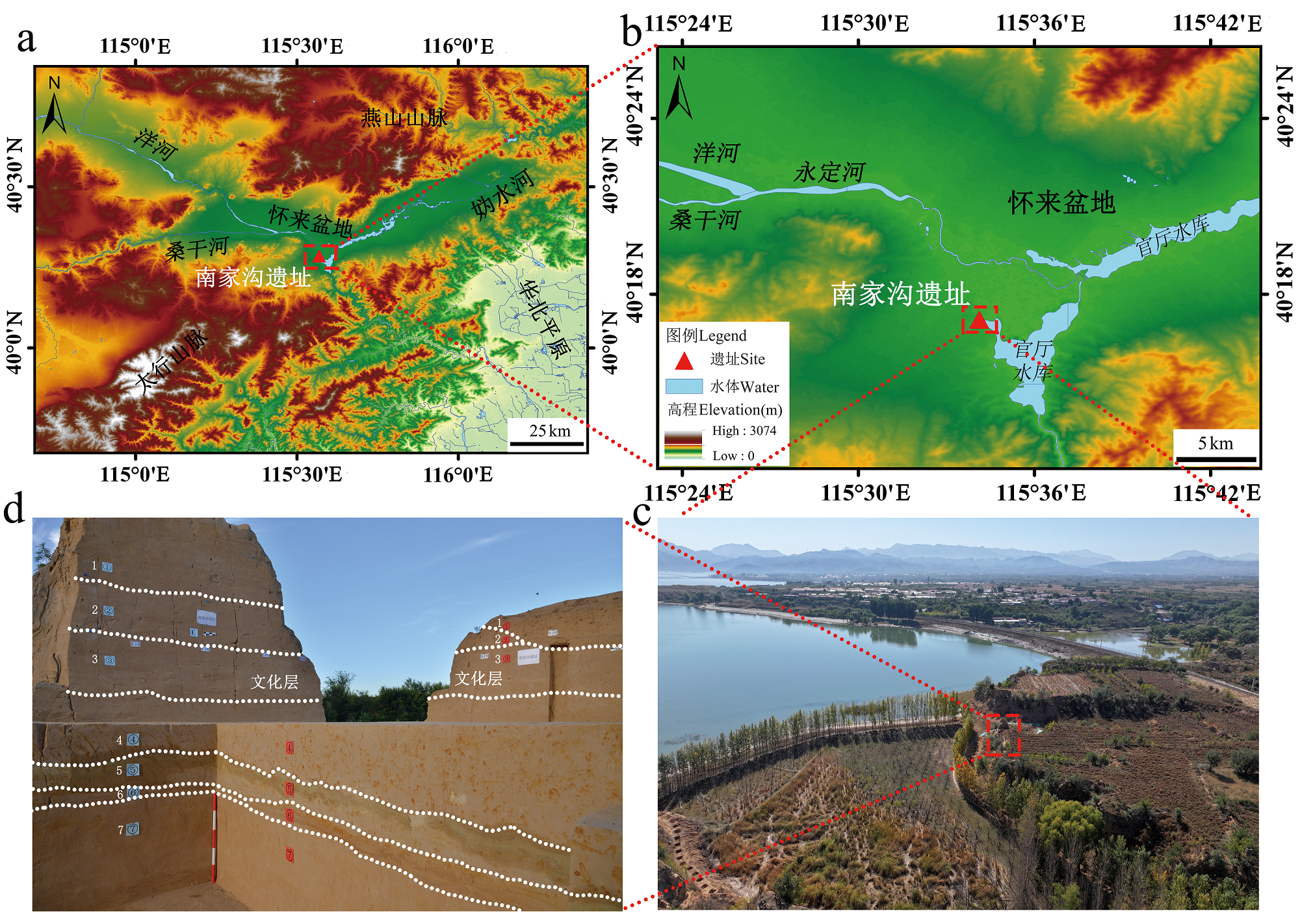
南家沟遗址首次发掘于2015年,发现的石制品以细石叶工艺为主要技术特征。2016年再次发掘,面积约25 m2,发现用火灰堆3处,石制品、动物化石、磨制骨针、鸵鸟蛋皮及制品共2378件。遗址经AMS14C测年并校正后的年代大致为17~16 kaBP,属旧石器时代晚期晚段。细石核全部为楔形石核,部分拼合组的特征显示古人类具备熟练的细石叶剥制技术。动物化石初步鉴定的动物种类包括牛科、马科、鹿科、鸟类和食肉类等。南家沟遗址的发现为完善怀来盆地乃至华北地区晚更新世晚期石器技术演化序列,以及所蕴含的古人类生计模式与文化互动等学术问题提供了重要线索。
薛峰 , 杨诗雨 , 梅惠杰 , 梁立雪 , 魏屹 , 牛东伟 , 李鼎元 . 河北怀来南家沟遗址2016年发掘报告[J]. 人类学学报, 2026 , 45(03) : 609 -622 . DOI: 10.16359/j.1000-3193/AAS.2026.0020
The Nanjiagou Paleolithic site, which was first excavated in 2015, has the lithic assemblages predominantly characterized by microblade technology. The site was re-excavated in 2016, uncovering an area of approximately 25 m2. Three ash-heaps and a total of 2407 labeled specimens incorporated stone specimens, animal fossils, bone needles, ostrich eggshells and ornaments. The AMS14C dating indicated that the age of this site was 17~16 cal kaBP, which also put the site to the late stage of Upper Paleolithic in northern China. The general features of lithic assemblage include: 1) The bipolar knapping technique was exclusively applied to volcanic breccia and chert, while end scrapers were predominantly made of chert, followed by volcanic breccia and high-quality dolostone. Field survey showed that raw materials were mainly quarried from the gravel layers around the site, whereas the volcanic breccia was not unearthed in the basin, which might be transported from a distance. It could be concluded that the inhabitants exploited materials on a wide scale, and use high-quality stone effectively. 2) The categories of 1629 lithic assemblages include free-hand cores (n=11; 0.7%), microblade cores (n=99; 6%), bipolar cores (n=3; 0.1%), free-hand flakes (n=977; 60%), microblades (n=53; 3.3%), microblade by-products (n=71; 4.4%), bipolar flakes (n=5; 0.3%), retouched tools (n=79; 4.8%), chunks (n=331; 20.3%), with small in size. 3) The free-hand cores were made by direct hammer percussion and most flakes were produced from non-cortical platforms (91%), which indicated that they were mostly secondary flake products. All the microblade cores were wedge-shaped cores, with small size, and their refitted groups discovered at Nanjiagou site could reflect the technological procedure of knapping strategy. 4) The retouched tools made of chert could be classified into side scrapers, burins, notch, end scrapers, points, spearheads, adze-shaped tools, and choppers. Most of animal fossils were in poor condition and the fauna assemblage included Cervus sp., Equus sp., Aves, Antelopinae, Rodentia, Carnivora and Bovidae, etc. The discovery of microblade technology, ostrich eggshell ornaments, and fire relices at Nanjiagou was the first excavated and reported Paleolithic cultural remains in the Huailai Basin. And the bone needles provided the earliest evidence for its occurrence across the Nihewan Basin. The discovery of this site has provided important clues for the Late Pleistocene lithic technology sequence in the Huailai Basin and even across North China, as well as for the academic issues related to ancient human subsistence strategies and cultural interactions.
| [1] | 郑荣章, 计凤桔, 李建平. 延怀盆地晚更新世中晚期湖泊发育与气候变化[J]. 地震地质, 2001, 1: 55-62 |
| [2] | 杨景春. 怀来盆地的形成、发展、古河道演变与新构造运动的关系[J]. 中国第四纪研究, 1965, 4(2): 93-104 |
| [3] | 朱志义, 郭媛, 张小帅, 等. 河北怀来地区ZK02孔第四系地层结构特征[J]. 地质学刊, 2020, 44(3): 250-257 |
| [4] | 谢飞, 李珺, 刘连强. 泥河湾旧石器文化[M]. 石家庄: 花山文艺出版社, 2006 |
| [5] | 李维明, 郗志群, 宋卫忠, 等. 河北怀来县大古城遗址1999年调查简报[J]. 考古, 2001, 11: 19-28+100-101 |
| [6] | 刘建忠, 贺勇. 河北怀来官厅水库沿岸考古调查简报[J]. 考古, 1988, 8: 673-681 |
| [7] | 安志敏. 河北懷來大古城村古城址調查記[J]. 考古通讯, 1955, 3: 44-48 |
| [8] | 袁宝印, 孙建中, 刘坛森. 延怀盆地第四纪地层及地文期[A]. 见:卫奇,谢飞(编). 泥河湾研究论文选[C]. 文物出版社, 1989, 475-488 |
| [9] | 谢飞. 河北旧石器时代晚期细石器遗存的分布及在华北马蹄形分布带中的位置[J]. 文物春秋, 2000, 2: 15-25+29 |
| [10] | 牛东伟, 薛峰, 李鼎元, 等. 怀来盆地2014年度旧石器考古调查简报[J]. 人类学学报, 2018, 37(1): 79-87 |
| [11] | 薛峰, 牛东伟, 李鼎元. 怀来盆地南家沟旧石器时代遗址2015年度发掘报告[J]. 人类学学报, 2026, 45(2): 372-386 |
| [12] | 卫奇. 《西侯度》石制品之浅见[J]. 人类学学报, 2000, 2: 85-96 |
| [13] | 梅惠杰. 泥河湾盆地旧、新石器时代的过渡:阳原于家沟遗址的发现与研究[D]. 博士研究生毕业论文, 北京: 北京大学, 2007 |
| [14] | Sullivan AP, Rozen KC. Debitage analysis and archaeological interpretation[J]. American Antiquity, 1985, 50(4): 755-779 |
| [15] | Toth N. The oldowan reassessed: A close look at early stone artifacts[J]. Journal of Archaeological Science, 1985, 12(2): 101-120 |
| [16] | 陈胜前. 细石叶工艺产品废弃的文化过程研究[J]. 人类学学报, 2008, 3: 210-222 |
| [17] | 冯玥, 梅惠杰, 谢飞, 等. 华北北部涌别技法的技术与生产特征:以阳原马鞍山遗址拼合组为例[J]. 中国国家博物馆馆刊, 2024, 6: 33-47 |
| [18] | 谢飞, 凯西·石克, 屠尼克, 等. 岑家湾遗址 1986 年出土石制品的拼合研究[J]. 文物季刊, 1994, 3: 86-102 |
| [19] | 韩昕宸. 怀来盆地南家沟遗址成因及石制品拼合研究[D]. 硕士研究生毕业论文, 石家庄: 河北师范大学, 2024 |
| [20] | Reimer PJ, Bard E, Bayliss A, et al. IntCal13 and Marine13 radiocarbon age calibration curves 0-50,000 years cal BP[J]. Radiocarbon, 2013, 55(4): 1869-1887 |
| [21] | Reimer PJ, Austin WEN, Bard E, et al. The IntCal20 Northern Hemisphere Radiocarbon Age Calibration Curve (0-55 cal kBP)[J]. Radiocarbon, 2020, 62(4): 725-757 |
| [22] | 曲彤丽, 陈宥成. 试论早期骨角器的起源与发展[J]. 考古, 2018, 3: 68-77 |
| [23] | 曲彤丽, 陈宥成. 再论中国的早期骨器[J]. 南方文物, 2023, 1: 18-27+12 |
| [24] | 温睿, 朱玉, 水维喜, 等. 识骨辨微——骨针的起源、发展、制作工艺与使用功能研究述评[J]. 文博, 2023, 1: 43-51 |
| [25] | Gilligan I. The prehistoric development of clothing: Archaeological implications of a thermal model[J]. Journal of Archaeological Method and Theory, 2010, 17(1): 15-80 |
| [26] | 黄蕴平. 小孤山骨针的制作和使用研究[J]. 考古, 1993, 3: 260-268+294-296 |
| [27] | 中国社会科学院考古研究所, 广西壮族自治区文物工作队, 桂林甑皮岩遗址博物馆, 等. 桂林甑皮岩[M]. 文物出版社, 2003 |
/
| 〈 |
|
〉 |
 京ICP证05002819号-3