


西藏阿里地区巴乌古日遗址初步研究
收稿日期: 2025-03-30
修回日期: 2025-04-21
网络出版日期: 2026-08-12
基金资助
国家自然科学基金面上项目(42472041);全国考古人才振兴计划资助(2024-266)
A preliminary study of the Bawuguri site in Ngari Prefecture of Xizang
Received date: 2025-03-30
Revised date: 2025-04-21
Online published: 2026-08-12
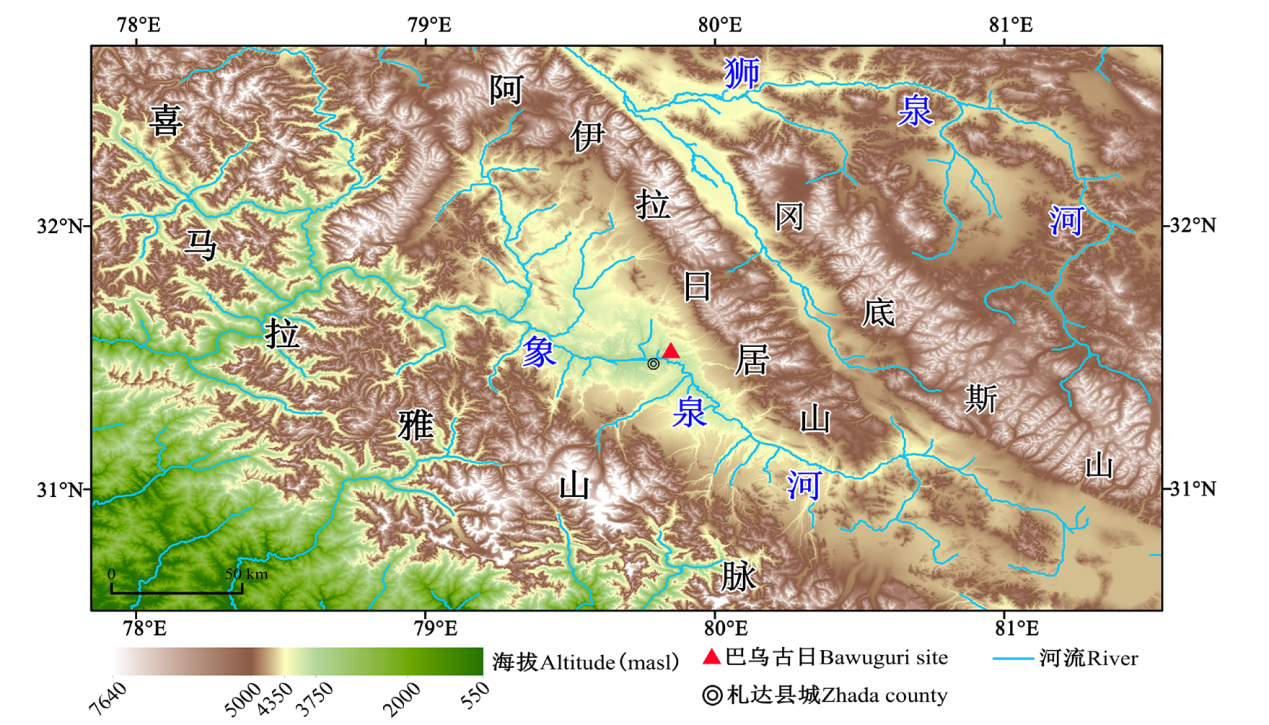
巴乌古日遗址位于青藏高原西部的札达盆地,是象泉河(朗钦藏布)上游右岸阶地的一处旷野遗址。联合考古队于2019年8月对该遗址开展了石制品与年代样品采集工作。336件石制品的分析结果表明,遗址中存在石核-石片与石叶两种石器技术。石制品原料以灰色硅质岩为主,类型包括石核、石片、石叶、小石叶、石器与断块等;石核包括简单锤击石片石核、棱柱状石叶石核与窄面石叶石核;石器仅有边刮器与凹缺器,毛坯以石片为主,修理简单。光释光测年结果表明,巴乌古日遗址石制品最晚埋藏在距今9800年,但由于石制品埋藏环境特殊,该年代并不能代表古人活动的时间,巴乌古日狩猎-采集人群在象泉河流域活动的时间应不晚于此。巴乌古日遗址的发现为了解高原西部象泉河流域古人类的流动与技术变迁提供了新材料,其石叶技术产品的发现对探讨相关人群在高原上的演化与扩散具有重要的指示意义。
谭韵瑶 , 何伟 , 葛俊逸 , 靳英帅 , 杨紫衣 , 任颖烨 , 王社江 , 张晓凌 . 西藏阿里地区巴乌古日遗址初步研究[J]. 人类学学报, 2026 , 45(04) : 661 -669 . DOI: 10.16359/j.1000-3193/AAS.2025.0038
Bawuguri site, located in the Zanda Basin on the western Tibetan Plateau, is an open-air site on the right bank terrace of the upper reaches of the Xiangquan River (Glang chen gtsang po). It was first discovered in August 2019 while lithic artifacts and dating samples collection were conducted at the same time. A total of 336 stone artifacts were collected from the surface and unearthed from the upper layer of the test pit. Results of Optically Stimulated Luminescence (OSL) show that the latest burial age of the lithics is dated to 9.8 ka BP. However, given that the unique depositional context of the lithics may lead to an underestimation of these dating results, it is suggested that the Bawuguri hunter-gatherer group was active in the upper reaches of the Xiangquan River earlier than 9.8 ka BP.
The lithic assemblage includes flake cores, blade cores, flakes, blades, bladelets, retouched tools and chunks, most of which were small in size. Low-quality grey siliceous rock collected from the nearby riverbeds was the main raw material. Utilized pebbles and flakes as blanks, flake cores were mainly produced by hard hammer and simply knapping from one single platform. In contrast, blade cores include prismatic cores and narrow-faced cores, including systematic preparation of platforms and flaking surfaces to guide sequential blade detachment. Along with blade cores were found crested blades, the typical by-products in prismatic blade flaking system. The only types of tools are scraper and notch, slightly retouched by direct hard hammer percussion from flake blanks. Bawuguri site exhibits typical blade technology products, whereas blade sites are exceptionally rare across the Tibetan Plateau.
Bawuguri site is the only early Holocene site ever found along the Xiangquan River, an important cultural exchange junction on the western Tibetan Plateau. The discovery of the Bawuguri site not only provides valuable materials for understanding early human adaptation and lithic technology communication, but is also important for exploring the migration of the blade technology populations as well as the dispersal routes of the blade technology across the Tibetan Plateau.
Key words: Bawuguri site; Early Holocene; Zanda Basin; lithic technology; Tibetan Plateau
| [1] | 张镱锂, 李炳元, 刘林山, 等. 再论青藏高原范围[J]. 地理研究, 2021, 40(6): 1543-1553 |
| [2] | 陈奋宁, 陈锐明, 李娜, 等. 藏南札达盆地上中新统—上新统托林组介形类群落[J]. 地质学报, 2023, 97(10): 3180-3197 |
| [3] | 霍巍. 试论西藏发现的早期金属器和早期金属时代[J]. 考古学报, 2014, 3: 327-350 |
| [4] | Tsukamoto S, Rades EF. Performance of pulsed OSL stimulation for minimising the feldspar signal contamination in quartz samples[J]. Radiation Measurements, 2016, 84: 26-33 |
| [5] | 卫奇. 《西侯度》石制品之浅见[J]. 人类学学报, 2000, 2: 85-96 |
| [6] | 张晓凌, 王呈祥, 谭韵瑶, 等. 青藏高原旧石器时代考古发现与研究[J]. 人类学学报, 2024, 43(6): 967-978 |
| [7] | Zhang XL, Ha BB, Wang SJ, et al. The earliest human occupation of the high-altitude Tibetan Plateau 40 thousand to 30 thousand years ago[J]. Science, 2018, 362(6418): 1049-1051 |
| [8] | 张晓凌, 李林辉, 何伟, 等. 西藏申扎县尼阿底旧石器时代遗址2016年发掘简报[J]. 考古, 2024, 3: 3-13 |
| [9] | 冯玥, 李文成, 艾涛, 等. 新疆塔什库尔干县库孜滚遗址发掘简报[J]. 考古, 2022, 9: 3-13 |
| [10] | Ge JY, Zhang XL, Wang SJ, et al. New dating indicates intermittent human occupation of the Nwya Devu Paleolithic site on the high-altitude central Tibetan Plateau during the past 45,000 years[J]. Science China Earth Sciences. 2024, 67: 531-551 |
| [11] | 西藏文物考古研究所(编著). 西藏文物考古研究(第4辑)[C]. 北京: 科学出版社, 2022, 4: 1-27 |
/
| 〈 |
|
〉 |
 京ICP证05002819号-3