


20世纪90年代安徽皖江考古发现的旧石器
收稿日期: 2024-10-05
修回日期: 2025-01-08
网络出版日期: 2026-08-12
基金资助
全国考古人才振兴计划项目(2024-278);国家社会科学基金青年项目(20CKG001);安徽省第八批“特支计划”A类创新领军人才专项
Paleolithics discovered in the Wanjiang of Anhui during the 1990s’ surveys
Received date: 2024-10-05
Revised date: 2025-01-08
Online published: 2026-08-12
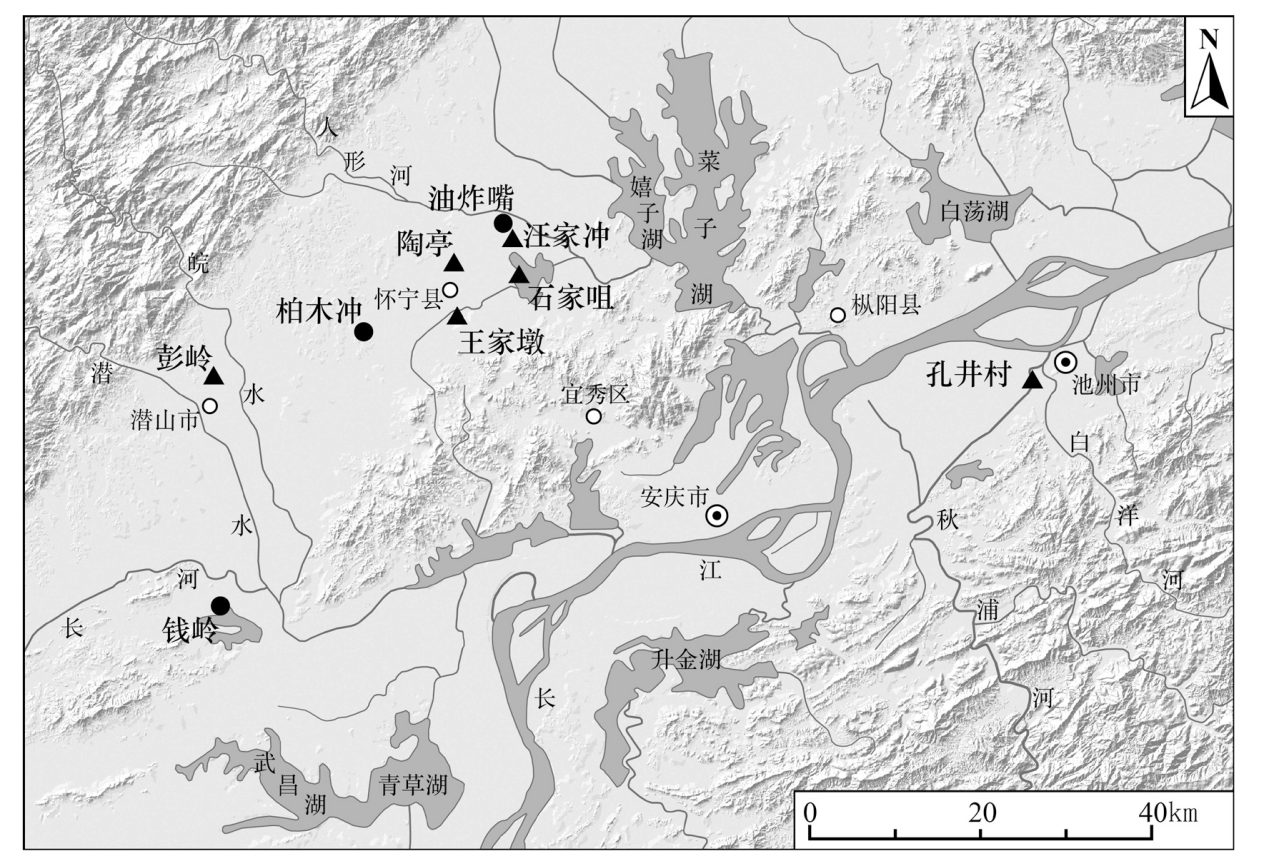
20世纪90年代,安徽省文物考古研究所在皖江地区发现10余处旧石器遗址,其中以怀宁腊树钱岭和潜山彭岭等遗址为代表的考古发现虽未系统公布,却常被学术界引用。安徽省文物考古研究所对这批石制品进行了系统的技术类型学研究。孔井村和柏木冲遗址的石制品埋藏于网纹红土中,多面体石核、大石片和大型石器在石制品组合中占比较高;其他以钱岭、油炸嘴和彭岭遗址为代表,石制品埋藏于灰白色和红色粉砂质黏土中,脉石英为主要原料,以中、小型为主,石器多以石片为毛坯加工成刮削器和锯齿刃器等,石器工业呈现石片石器特征。这些遗址普遍缺少测年数据,根据石制品埋藏层位,初步推测腊树钱岭遗址时代由中更新世晚期延续至晚更新世,孔井村和柏木冲遗址时代为中更新世晚期,其他遗址时代为晚更新世。
董哲 , 战世佳 . 20世纪90年代安徽皖江考古发现的旧石器[J]. 人类学学报, 2026 , 45(04) : 742 -752 . DOI: 10.16359/j.1000-3193/AAS.2025.0032
In the 1990s, the Institute of Archaeology and Cultural Relics of Anhui Province discovered more than ten Paleolithic sites in the Wanjiang Region, represented by Lashu Qianling in Huaining County and Pengling in Qianshan County. Although the archaeological materials have not been deeply analyzed or published, they are widely cited by many scholars. Recently, the Institute of Archaeology and Cultural Relics of Anhui Province systematically conducted a technical typological analysis.
Stone artifacts found in Kongjingcun and Baimuchong were buried in vermiculated red soil, and most of them were manufactured from quartzite and quartz cobbles. Polyhedrons, large flakes, and heavy-duty tools dominated the entire assemblage of stone artifacts. Handaxes, picks, cleavers, and knives were typical heavy-duty tools. Early hominins detached large flakes from large cores, and both of these indicate that early humans had the ability to produce Mode II artifacts. Most of the stone artifacts were manufactured using freehand hammer percussion, followed by the bipolar technique.
Lithics from the remaining sites were discovered in grey-white and red silty clay. Raw materials were procured from local riverbeds, with quartz as the dominant type of rock. The lithics were almost all small to medium in size. Scrapers and denticulates retouched from flakes were the majority types of stone tools. It is noticeable that lithics discovered in these sites showed some characteristics different from those found in the sites mentioned above, such as lithic miniaturization, utilization of high-quality raw materials, and domination of flaked tools. The lithic assemblage could be assigned to the Flake Tool Industry or a regional variant of the Pebble Tool Industry in South China.
Dating work has not been conducted for any of these sites. Judging from the layers where the lithics were buried, Qianling, Youzhazui, and Pengling can be deduced to date to the Late Pleistocene, while the Kongjingcun and Baimuchong sites can be deduced to date to the late Middle Pleistocene. This research is of great significance for studying the transition of lithic technology and the diffusion and variation of Acheulean technology in South China from the Middle to the Late Pleistocene.
| [1] | 安徽省区域地质调查队. 安徽省地层志(第四系分册)[M]. 合肥: 安徽科学技术出版社, 1988, 1-115 |
| [2] | Wu XJ, Pei SW, Cai YJ, et al. Archaic human remains from Hualongdong, China, and Middle Pleistocene human continuity and variation[J]. PNAS, 2019, 116: 9820-9824 |
| [3] | 董哲, 裴树文, 盛锦朝, 等. 安徽东至华龙洞古人类遗址2014-2016年出土的石制品[J]. 第四纪研究, 2017, 37(4): 778-788 |
| [4] | 裴树文, 蔡演军, 董哲, 等. 安徽东至华龙洞遗址洞穴演化与古人类活动[J]. 人类学学报, 2022, 41(4): 593-607 |
| [5] | 韩立刚. 安徽远古文化发现与研究[A].见:文集编委会. “元谋人”发现三十周年纪念暨古人类国际学术研讨会文集[C]. 昆明: 云南科技出版社, 1998, 143-158 |
| [6] | 赵建明. 贵池发现旧石器地点[N]. 中国文物报, 1992-03-22(001) |
| [7] | 韩立刚. 潜山县彭岭旧石器地点[M].中国考古学年鉴(1993年). 北京: 文物出版社, 1995, 148 |
| [8] | 怀宁县文物管理所,安徽省第三次全国文物普查办公室(编). 怀宁考古记:基于“三普”调查的发现与研究[M]. 北京: 文物出版社, 2011, 50-54 |
| [9] | 韩立刚. 安徽旧石器时代考古发现研究与展望[J]. 文物研究, 1993, 8: 4-16 |
| [10] | de la Torre I, Mora R, Domínguez-Rodrigo M, et al. The Oldowan industry of Peninj and its bearing on the reconstruction of the technological skills of Lower Pleistocene hominids[J]. Journal of Human Evolution, 2003, 44: 203-224 |
| [11] | de la Torre I, Mora R. Technological strategies in the Lower Pleistocene at Olduvai Beds I&II[M]. études et Recherches Archéologiques de l’Université de Liège, 2005, 1-249 |
| [12] | de la Torre I, Mora R, Martínez-Moreno J. The early Acheulean in Peninj (Lake Natron, Tanzania)[J]. Journal of Anthropological Archaeology, 2008, 27: 244-264 |
| [13] | de la Torre I. The Early Stone Age lithic assemblages od Gadeb (Ethiopia) and the Developed Oldowan/early Acheulean in East Africa[J]. Journal of Human Evolution, 2011, 60: 768-812 |
| [14] | de la Torre I, Mora R. Oldowan technological behavior at HWK EE (Olduvai Gorge, Tanzania)[J]. Journal of Human Evolution, 2018, 120: 236-273 |
| [15] | 张森水. 管窥中国旧石器考古学的重大发现[J]. 人类学学报, 1999, 18(3): 35-56 |
| [16] | Bar-Yosef O, Wang YP. Paleolithic archaeology in China[J]. Annual Review of Anthropology, 2012, 41: 319-335 |
| [17] | Gao X. Paleolithic cultures in China: Uniqueness and divergence[J]. Current Anthropology, 2013, 54(S8): 358-370 |
| [18] | Guan Y, Xu XM, Kuman K, et al. The absence of Acheulean: Qiliting Mode 1 site and the Mode 1 occupations in southeast China[J]. Quaternary International, 2018, 480: 152-165 |
| [19] | 李超荣, 侯远志, 王强. 江西新余发现的旧石器[J]. 人类学学报, 1994, 13(4): 309-313 |
| [20] | 房迎三, 李徐生, 杨达源. 江西新余旧石器地点的埋藏环境与时代[J]. 人类学学报, 2003, 22(2): 139-144 |
| [21] | 刘德银, 王幼平. 鸡公山遗址发掘初步报告[J]. 人类学学报, 2001, 20(2): 102-114 |
| [22] | 浙江省文物考古研究所,长兴县文物保护管理所. 七里亭与银锭岗[M]. 北京: 科学出版社, 2009, 1-266 |
| [23] | Li H, Li YY, Yu LP, et al. Continuous technological and behavioral development of late Pleistocene hominins in central South China: Multidisciplinary analysis at Sandinggai[J]. Quaternary Science Reviews, 2022, 298 |
| [24] | 湖南省文物考古研究所,临澧县文物局. 湖南临澧县条头岗旧石器时代遗址发掘简报[J]. 考古, 2019, 3: 3-14 |
| [25] | 湖南省文物考古研究所,澧县文化旅游广电体育局. 湖南澧县十里岗旧石器时代遗址发掘简报[J]. 考古与文物, 2020, 1: 3-13 |
| [26] | 湖南省文物考古研究所. 湖南澧县乌鸦山旧石器遗址2011年发掘简报[J]. 江汉考古, 2019, 6: 16+20-31 |
| [27] | 李三灵, 赵文杰, 高玉, 等. 江西高安盆地旧石器遗址调查简报[J]. 人类学学报, 2023, 42(6): 807-814 |
| [28] | 赵文杰, 贾真秀, 李三灵, 等. 2020年江西高安上湖旧石器遗址发掘报告[J]. 人类学学报, 2023, 42(3): 373-380 |
| [29] | 李浩. 探究早期现代人的南方扩散路线[J]. 人类学学报, 2022, 41(4): 630-648 |
| [30] | 韩立刚. 淮北平原五河西尤遗址石制品初步观察[J]. 文物研究, 1999, 12: 57-62. |
| [31] | 董哲, 战世佳. 安徽沿江地区旧石器考古调查新发现的石制品[J]. 东南文化, 2023, 3: 100-107 |
| [32] | 房迎三. 安徽庐江、枞阳发现的旧石器[J]. 文物季刊, 1996, 4: 11-16 |
| [33] | 房迎三. 安徽铜陵地区发现的旧石器[J]. 文物研究, 1993, 8: 93-100 |
| [34] | 董哲, 裴树文, 袁四方. 安徽水阳江流域2017年旧石器考古调查简报[J]. 人类学学报, 2019, 38(2): 223-231 |
| [35] | 董哲, 战世佳. 安徽省宣城麻村旧石器遗址调查及发掘简报[J]. 人类学学报, 2020, 39(1): 74-85 |
| [36] | 董哲, 战世佳. 安徽省宁国市安友庄旧石器遗址调查及发掘简报[J]. 人类学学报, 2022, 41(2): 334-341 |
| [37] | 董哲. 安徽水阳江流域陈山遗址古人类石器技术研究[J]. 东南文化, 2025, 3: 80-89 |
| [38] | 房迎三, 宫希成. 新安江中上游流域的史前遗存调查[J]. 东南文化, 2000, 1: 56-64 |
| [39] | Qiao YS, Guo ZT, Hao QZ, et al. Loess-soil sequences in southern Anhui Province: Magnetostratigraphy and paleoclimatic significance[J]. Chinese Science Bulletin, 2003, 48(19): 6 |
| [40] | 袁宝印, 夏正楷, 李保生, 等. 中国南方红土年代地层学与地层划分问题[J]. 第四纪研究, 2008, 28(1): 1-13 |
/
| 〈 |
|
〉 |
 京ICP证05002819号-3