


安徽水阳江流域官山遗址古人类的石器技术
收稿日期: 2025-03-12
修回日期: 2025-06-24
网络出版日期: 2026-10-16
基金资助
国家社会科学基金青年项目(20CKG001);全国考古人才振兴计划项目(2024-278);安徽省第八批“特支计划”A类创新领军人才专项
Lithic technology of ancient hominins of the Guanshan site in Shuiyangjiang River Basin, Anhui Province
Received date: 2025-03-12
Revised date: 2025-06-24
Online published: 2026-10-16
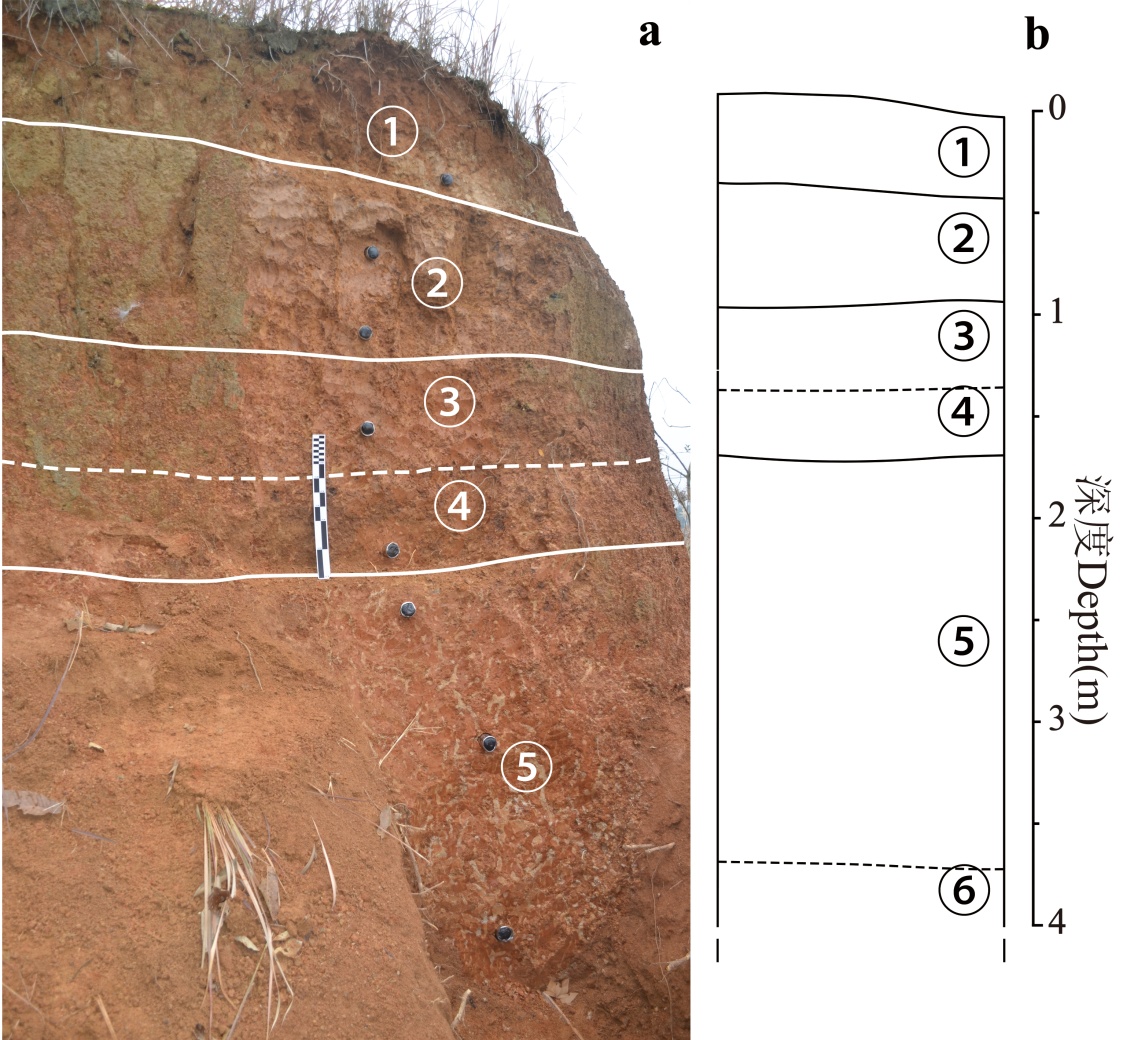
官山旧石器遗址于1987年首次调查发现。1993年和1996年,安徽省文物考古研究所先后两次对官山遗址开展考古发掘,发掘面积200 m2,共获得石制品222件,原料以中津河(水阳江一级支流)二级阶地底部砾石层中产出的石英砂岩砾石为主,少量为脉石英。石制品尺寸普遍较大,类型包括石核、石片、断块、直接使用标本和工具;石器除砍砸器和重型刮削器外,还包括一定数量的大型切割工具。使用硬锤直接剥片或修理是主要的石核剥片与加工方式,此外还存在极少量砸击品,石制品出自中国南方地区常见的网纹红土和均质红土中。根据长江中下游地区第四纪红土风化壳年代的相关研究结果,初步推断官山遗址古人类生存活动的时代为中更新世。官山旧石器遗址存在一定数量的大石核与大石片,以及以手镐等为代表的大型切割工具,对研究阿舍利技术在中国的扩散与变异具有重要的科学意义。
董哲 , 战世佳 . 安徽水阳江流域官山遗址古人类的石器技术[J]. 人类学学报, 2026 , 45(05) : 851 -860 . DOI: 10.16359/j.1000-3193/AAS.2025.0086
The Guanshan site is located in the Shuiyangjiang River Basin, Ningguo City, and was confirmed in 1987. Guanshan site is near another famous site, Maozhushan, where a pebble semicircle was recovered and believed by researchers to be an artificial structure. Two further excavations were conducted in 1993 and 1996 by the Institute of Archaeology and Cultural Relics of Anhui Province. A total of two hundred and twenty-two lithics were discovered on the surface and in the red clay deposit from a two-hundred-square-meter digging area. The raw materials of these lithics were mainly nearby quartzite river cobbles and quartz was less common. Most of the stone artifacts were medium to large in size. The assemblages of stone artifacts included cores, flakes, chunks, utilized materials, and stone tools. The majority of core platforms had cortex, and chopper cores were predominant. The situation is similar to the whole flakes, whose natural platforms were also predominant. All of the tools were large size and heavy-duty scrapers, choppers and picks were more common. There were also a few knives manufactured from large flakes. Most of the lithics were produced by stone hammer free-hand percussion, although bipolar products also existed. According to the stone artifacts buried in the homogeneous red clay and vermiculated red clay, it is reasonable to anticipate that early humans occupied the site during the Middle Pleistocene. Although the OSL dating work was also conducted at this site, unfortunately there was still no result because of lacking proper testing specimens. Several large flakes detached from large cores and some Acheulean large cutting tools especially picks were recognized at the site. The situation is somewhat similar to other Middle Pleistocene sites that are also buried in the Shuiyangjiang River Basin. All of these sites exhibited characteristics resembling Acheulean-like technology. The research also bears great significance for studying the diffusion and variation of Acheulean technology in China.
| [1] | 郑喆轩, 冯玥, 谭培阳, 等. 四川稻城县皮洛旧石器时代遗址[J]. 考古, 2022, 7: 3-14 |
| [2] | Li H, Li CR, Kuman K, et al. The Middle Pleistocene handaxe site of Shuangshu in the Danjiangkou Reservoir Region, central China[J]. Journal of Archaeological Science, 2014, 52: 391-409 |
| [3] | Pei SW, Niu DW, Guan Y, et al. Middle Pleistocene hominin occupation in the Danjiangkou Reservoir Region, Central China: studies of formation processes and stone technology of Maling 2A site[J]. Journal of Archaeological Science, 2015, 53: 391-407 |
| [4] | Li H, Li YY, Yu LP, et al. Continuous technological and behavioral development of late Pleistocene hominins in central South China: Multidisciplinary analysis at Sandinggai[J]. Quaternary Science Reviews, 2022, 298: 107850 |
| [5] | 李超荣, 徐长青. 江西安义潦河发现的旧石器及其意义[J]. 人类学学报, 1991, 10(1): 34-41 |
| [6] | 张森水. 管窥新中国旧石器考古学的重大发展[J]. 人类学学报, 1999, 18(3): 193-214 |
| [7] | Guan Y, Xu XM, Kuman K, et al. The absence of Acheulean: Qiliting Mode 1 site and the Mode 1 occupations in southeast China[J]. Quaternary International, 2018, 480: 152-165 |
| [8] | Li H, Wang SJ, Lotter MG, et al. The temporal-spatial evolution of handaxe technology in China: Recent progress and future directions[J]. Science Bulletin, 2024, 69(14): 2161-2165 |
| [9] | 赵其国, 杨浩. 中国南方红土与第四纪环境变迁的初步研究[J]. 第四纪研究, 1995, 2: 107-116 |
| [10] | 杨浩, 赵其国, 李小平, 等. 安徽宣城风成沉积—红土系列剖面ESR年代学研究[J]. 土壤学报, 1996, 33(3): 293-300 |
| [11] | 乔彦松, 郭正堂, 郝青振, 等. 皖南风尘堆积-土壤序列的磁性地层学研究及其古环境意义[J]. 科学通报, 2003, 48(13): 1465-1469 |
| [12] | 李徐生, 杨达源, 鹿化煜. 皖南风尘堆积序列氧化物地球化学特征与古气候记录[J]. 海洋地质与第四纪地质, 1999, 19(4): 75-82 |
| [13] | 房迎三. 水阳江旧石器地点群的考古发掘与研究[J]. 文物研究, 1998, 11: 2-9 |
| [14] | Leakey MD. Olduvai Gorge, Volume 3: Excavations in Beds I and II, 1960-1963[M]. Cambridge: Cambridge University Press, 1971, 5-7 |
| [15] | Toth N. The Stone Technologies of Early Hominids at Koobi Fora: An Experimental Approach[D]. PhD thesis, Berkeley: University of California, 1982, 48-101 |
| [16] | Toth N. The Oldowan reassessed: A close look at early stone artifacts[J]. Journal of Archaeological Science, 1985, 12(2): 101-120 |
| [17] | Kuman K, Li H, Li CR. Large Cutting Tools from the Danjiangkou Reservoir Region, central China: Comparisons and contrasts with western and south Asian Acheulean[J]. Quaternary International, 2016, 400: 58-64 |
| [18] | Leakey MD. A review of the Oldowan culture from Olduvai Gorge, Tanzania[J]. Nature, 1966, 210(5035): 462-466 |
| [19] | 陕西省考古研究院, 商洛地区文管会, 洛南县博物馆. 花石浪(I):洛南盆地旷野类型旧石器地点群研究[M]. 北京: 科学出版社, 2007, 48-49 |
| [20] | 房迎三. 皖南水阳江旧石器地点群调查简报[J]. 文物研究, 1988, 3: 74-83 |
| [21] | 房迎三. 安徽省宣州市陈山旧石器地点1988年发掘报告[J]. 人类学学报, 1997, 16(2): 96-106 |
| [22] | 董哲, 战世佳. 安徽省宣城麻村旧石器遗址调查及发掘简报[J]. 人类学学报, 2020, 39(1): 74-85 |
| [23] | 房迎三, 黄蕴平, 梁任又, 等. 安徽宁国毛竹山发现的旧石器早期遗存[J]. 人类学学报, 2001, 20(2): 115-124 |
| [24] | 董哲, 战世佳. 安徽省宁国市安友庄旧石器遗址调查及发掘简报[J]. 人类学学报, 2022, 41(2): 334-341 |
| [25] | Bar-Yosef O, Wang YP. Paleolithic archaeology in China[J]. Annual Review of Anthropology, 2012, 41: 319-335 |
| [26] | Gao X. Paleolithic cultures in China: Uniqueness and divergence[J]. Current Anthropology, 2013, 54(S8): S358-S370 |
| [27] | 董哲, 裴树文, 袁四方. 安徽水阳江流域2017年旧石器考古调查简报[J]. 人类学学报, 2019, 38(2): 223-231 |
| [28] | 董哲. 安徽水阳江流域陈山遗址古人类石器技术研究[J]. 东南文化, 2025, 3: 80-89 |
| [29] | 谢光茂. 百色手斧与手镐比较研究[J]. 考古学研究, 2008, 7: 86-92 |
| [30] | 高星. 中国旧石器时代手斧的特点与意义[J]. 人类学学报, 2012, 31(2): 97-112 |
| [31] | Asfaw B, Beyene Y, Suwa G, et al. The earliest Acheulean from Konso-Gardula[J]. Nature, 1992, 360: 732-735 |
| [32] | Lepre CJ, Roche H, Kent DV, et al. An earlier origin for the Acheulian[J]. Nature, 2011, 477(7362): 82-85 |
| [33] | de la Torre I, Mora R. Technological Strategies in the Lower Pleistocene at Olduvai Beds Ⅰ&Ⅱ[M]. Liège: études et Recherches Archéologiques de l’ Université de Liège, 2005 |
| [34] | de la Torre I. The Early Stone Age lithic assemblages of Gadeb (Ethiopia) and the Developed Oldowan / early Acheulean in East Africa[J]. Journal of Human Evolution, 2011, 60(6): 768-812 |
| [35] | Semaw S, Rogers M, Stout D. The Oldowan-Acheulian transition: is there a “Developed Oldowan” artifact tradition?[A]. In: Camps M, Chauhan P(eds.). Sourcebook of Paleolithic Transitions[M]. Springer Science+Business Media, LLC, 2009, 173-193 |
| [36] | Beyene Y, Katoh S, WoldeGabriel G, et al. The characteristics and chronology of the earliest Acheulean at Konso, Ethiopia[J]. Proceedings of the National Academy of Sciences, 2013, 110(5): 1584-1591 |
| [37] | Wang W, Lycett SJ, von Cramon-Taubadel N, et al. Comparison of Handaxes from Bose Basin (China) and the western Acheulean indicates convergence of form, not cognitive differences[J]. PloS One, 2012, 7(4): e35804 |
| [38] | Kuman K. Acheulean Industrial Complex[A]. In: Smith C(ed.). Encyclopedia of global archaeology[M]. New York: pringer, 2014, 7-18 |
/
| 〈 |
|
〉 |
 京ICP证05002819号-3